

You’re planning a clean, immersive audio setup, but your home’s standard 2×4 stud walls present a unique challenge. Finding speakers that fit the cavity without compromising on sound quality can feel like a puzzle. This guide is crafted for homeowners and DIY enthusiasts who want professional-grade audio that disappears into their walls.
We have evaluated the leading in-wall models specifically with standard construction in mind. Our goal is to help you achieve a flawless installation and exceptional sound. For those dealing with unconventional wall spaces, our guide on the best In-Ceiling speakers for thin walls offers complementary solutions.
Pros
- Exceptional sound clarity and power output that rivals larger traditional speakers
- Professional-grade construction with premium materials ensures long-term reliability
- Flexible mounting and tuning options accommodate various room configurations and layouts
- Highly rated by verified buyers who praise realistic, immersive surround effects
- Seamless integration into existing Klipsch systems or mixed-brand setups
Cons
- Premium pricing reflects quality but may exceed budgets for casual home theater setups
- Requires professional installation for optimal performance in wall cavities
- Not waterproof, limiting outdoor use despite outdoor speaker classification
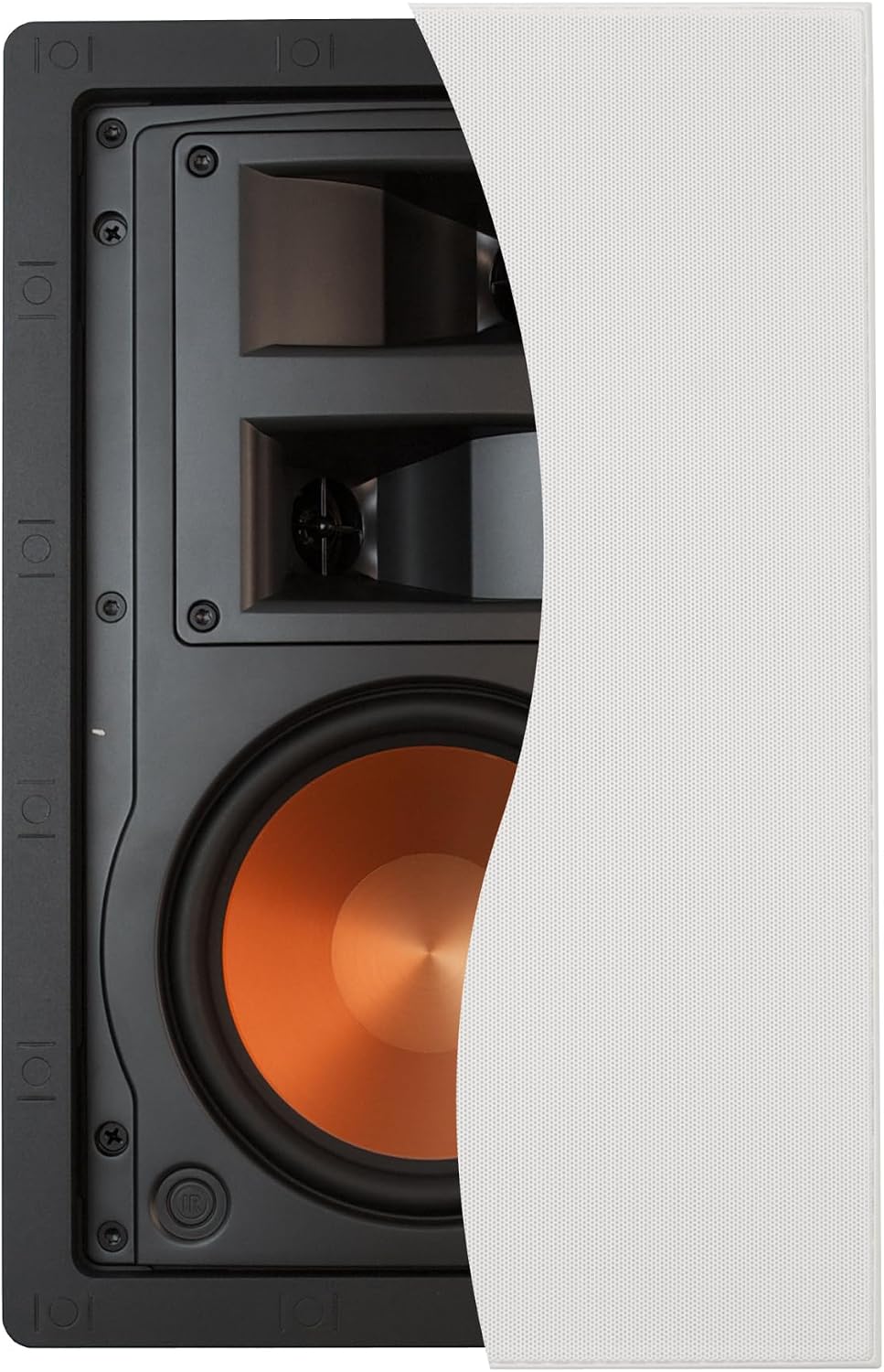
The Klipsch R-5650-S II is a premium in-wall surround speaker engineered for home theater enthusiasts who refuse to compromise on audio quality or room aesthetics. This speaker targets dedicated audio professionals and serious home theater builders seeking surround channels that deliver theater-grade performance without visible hardware disrupting interior design.
What sets this speaker apart is its patented Tractrix Horn technology, which combines a 1-inch titanium dome compression driver with a precision-engineered 90-degree by 60-degree horn array. The 6.5-inch cerametallic woofer handles midrange and bass frequencies with authority, while horn-loading significantly reduces distortion and increases acoustic output. The pivoting tweeter allows you to direct sound precisely, making it adaptable to various room layouts and seating configurations.
Build quality is exceptional throughout. The ABS enclosure is robust and designed for in-wall mounting, while the premium driver materials reflect Klipsch's commitment to durability. Treble and midbass attenuation switches provide room-specific tuning, allowing you to dial in the perfect tonal balance for your space. The 200-watt power handling ensures these speakers can keep pace with demanding action sequences and complex soundtrack mixes.
The primary consideration is installation complexity. These are not plug-and-play speakers; proper in-wall mounting and acoustic treatment behind the speaker significantly impact performance. Additionally, while classified as outdoor speakers, the non-waterproof design limits true outdoor applications. The premium price point also positions these as an investment rather than a budget option.
Verdict: The R-5650-S II delivers professional-grade surround performance in a discreet package. If you're building a serious home theater system and value both sonic excellence and clean aesthetics, these speakers justify their investment. Highly recommended for dedicated audio enthusiasts and professional installers.
Driver Configuration: 1-inch titanium dome compression driver with 4-inch square 90x60-degree Tractrix Horn, 6.5-inch cerametallic woofer
Power Handling: 200 watts maximum output
Frequency Response: 60 Hz and above
Impedance: 8 ohm
Audio Channels: 5.1 compatible
Connectivity: Infrared remote control with app compatibility
Dimensions: 14.3 inches H x 9.3 inches W x 3.75 inches D
Mounting: Wall-mount in-wall installation
Enclosure Material: Acrylonitrile Butadiene Styrene (ABS)
Warranty: 5-year limited warranty
Who Should Buy: Home theater enthusiasts with existing Klipsch systems, professional installers, and audio-focused homeowners seeking high-performance surround speakers that maintain clean interior aesthetics.
Installation Considerations: Successful performance requires proper in-wall installation with adequate cavity space and acoustic treatment behind the speaker. Professional installation is strongly recommended to maximize sound quality and reliability. Ensure your amplifier or receiver can handle 8-ohm impedance loads.
Optimization Tips: Use the treble and midbass attenuation switches to tune the speaker to your specific room acoustics. Position the pivoting tweeter to direct sound toward primary listening areas. Add acoustic foam or insulation behind the speaker to improve bass response and reduce wall resonance.
Compatibility: Works with any amplifier or AV receiver supporting 5.1 channel surround configurations. Integrates seamlessly with Klipsch home theater systems but functions excellently in mixed-brand setups. Requires IR remote control or compatible app for operation.
Buying Guide for 2×4 Stud Speakers
Driver Size and Cavity Fit
The space between your wall studs is precisely 14.5 inches. Speaker baskets and mounting mechanisms must fit within this width. An 8-inch woofer, like in the Polk Audio RC85i 2-way Premium In-Wall 8″, often represents the practical upper limit for robust bass in this space.
Dual smaller woofers, such as the 5.25-inch drivers in other models, can provide excellent midrange and bass while ensuring an easier fit. Always confirm the manufacturer’s required cutout dimensions against your actual wall cavity before making a final decision.
Sound Direction and Room Calibration
Once installed, you cannot physically aim a flush-mounted speaker. This makes adjustable tweeters critical for proper sound staging. A pivoting tweeter allows you to direct high frequencies toward your primary listening area after installation.
Look for models with treble and midbass attenuation switches. These controls, found on many Klipsch models, let you fine-tune the sound to compensate for room acoustics. This ensures balanced audio whether the speaker is in a reflective kitchen or a absorptive living room.
Build Quality and Moisture Resistance
In-wall speakers are a semi-permanent installation. You need components built to last for years without degradation. Look for materials like Cerametallic cones or moisture-resistant composites that withstand humidity changes inside your walls.
This durability extends the speaker’s placement options. A robust build means you can safely install in a bathroom or kitchen without worry. For other discreet audio options, explore our review of best low profile in-wall speakers.
Ease of Installation and Mounting
A secure, rattle-free installation is non-negotiable. Premium speakers feature robust mounting systems with multiple contact points or rotating clamps that grip the drywall securely. This prevents vibration and ensures the speaker becomes a solid part of your wall.
Also, consider the wiring process. Models with clearly marked, easy-to-access terminals and generous wire cup depth make the electrician’s or DIYer’s job much simpler. A paintable grille is the final touch for a truly invisible install.
Final Thoughts
Selecting the right in-wall speaker for standard construction elevates your home audio seamlessly. For a premium home theater experience with exceptional clarity, the Klipsch R-5502-W II in-Wall Left is an outstanding choice. If you seek reliable, versatile performance for whole-home audio on a sensible budget, the 5252W Silver Ticket in-Wall Speaker with Pivoting delivers remarkable value. Whichever model you choose, proper planning ensures your sound is as impressive as your invisible setup. For more audio solutions, visit our main In-Ceiling / In-Wall Speakers category.
Frequently Asked Questions
Can I install in-wall speakers in any wall with 2×4 studs?
Most interior walls with standard 2×4 studs are suitable, but you must check for obstructions. Always use a stud finder to confirm stud location and probe the cavity for electrical wires, plumbing, or horizontal fire blocking before cutting. The installation process is similar for many discreet audio products, which you can read about in our guide to best wireless in-ceiling speakers.
Do I need special tools to install these speakers?
You will need common tools: a stud finder, a drywall saw or rotary tool for cutting the opening, a screwdriver, and wire strippers. Some installers also use a template for precise cutouts. The speakers themselves typically include mounting hardware, and the process is designed for confident DIYers.
How do in-wall speakers compare to bookshelf or floorstanding models?
In-wall speakers save significant floor space and offer a clean, built-in look. While high-end bookshelf or floorstanding speakers can offer slightly more acoustic refinement due to their dedicated enclosures, modern in-wall models provide stunningly accurate sound. The difference is often negligible in a well-integrated home theater.
Can these speakers be used as front left, center, and right channels?
Absolutely. Many models, especially those designated as LCR (Left, Center, Right), are specifically engineered for this purpose. Using identical speakers across your front soundstage ensures perfect tonal matching, creating a cohesive and immersive sound field for movies and music in 2026.


Write Your Review
No reviews yet. Be the first to share your experience!