

You love your stereo system’s rich sound, but you’re tired of the clutter of cables and the limitations of physical media. You want to stream your favorite playlists, podcasts, and high-resolution albums directly to your cherished speakers, enjoying seamless control from your phone. Modernizing your setup shouldn’t mean compromising on audio quality or breaking the bank. This guide is crafted for the audiophile who values both convenience and fidelity, presenting two exceptional devices that bridge the gap between your classic components and today’s wireless world.
We’ve assessed the latest streamers designed to integrate with your existing amplifier and speakers. Our focus is on performance, connectivity, and user experience, ensuring you can make an informed choice. For more options at different budget points, explore our guide to the best Wi-Fi audio streamers under $200.

Pros
- Exceptional streaming versatility with support for nearly every major platform including Spotify, TIDAL, Qobuz, and Amazon Music
- True high-resolution audio output up to 24-bit/192kHz delivers audiophile-grade sound through existing equipment
- Flexible connectivity options including optical, coaxial, RCA, and Ethernet suit a wide range of stereo systems
- Multiroom audio support across AirPlay 2, Google Cast, and Alexa ecosystems in a single compact device
- Strong 4.3-star rating from a large number of verified buyers reflects reliable real-world performance
Cons
- AirPlay receiver only, meaning it cannot transmit audio to other AirPlay-enabled speakers or devices downstream
- Full 24-bit/192kHz streaming is limited to a handful of services like Amazon Music Ultra HD and Qobuz, so users of other platforms may not hear the full benefit
The WiiM Pro Plus is a network music streamer designed to breathe new life into traditional hi-fi and stereo systems. Rather than replacing your amplifier or speakers, it slots neatly into your existing setup and adds modern wireless streaming capabilities, making it ideal for audiophiles who love their current gear but want the convenience of today's streaming services.
The standout feature is its support for high-resolution audio up to 24-bit/192kHz, delivered via both digital optical or coaxial outputs and analog RCA. Combined with gapless playback and bit-perfect output, the listening experience is genuinely impressive. The built-in MQA core decoder is a welcome bonus for TIDAL subscribers seeking Master-quality tracks, and Roon Ready certification appeals to serious home audio enthusiasts.
Connectivity is a real strength here. The WiiM Pro Plus supports AirPlay 2, Google Cast, Spotify Connect, TIDAL Connect, Qobuz Connect, and Amazon Music, covering virtually every major streaming ecosystem. Multiroom grouping works seamlessly across AirPlay 2, Google Home, and Alexa devices, letting you sync audio throughout your home without investing in a separate smart speaker system. Voice control via Alexa, Google Assistant, and Siri adds everyday convenience.
In terms of design, the unit is compact at 5.5 inches square and just 1.6 inches tall, fitting discreetly into any rack or shelf. Build quality feels solid for the price point, and the variety of physical connectors including USB-C, RCA, optical, coaxial, and Ethernet ensures broad compatibility. One important limitation to note is that the device is an AirPlay receiver only and cannot send audio to other AirPlay speakers downstream.
Overall, the WiiM Pro Plus delivers exceptional value for anyone looking to modernize a stereo system with minimal fuss. Its broad platform support, true hi-res audio output, and multiroom capabilities make it one of the most versatile streamers in its class. If you already own quality speakers or an amplifier and want to add streaming without compromise, this is a highly recommended choice.
Brand: WiiM (WiiMHome) | ASIN: B0CC2HWC7N | Color: Black | Dimensions: 5.5 x 5.5 x 1.6 inches
Connectivity: Wi-Fi, Ethernet (wired), Bluetooth | Audio Resolution: Up to 24-bit/192kHz on digital and analog outputs | Digital Outputs: Optical (TOSLINK) and Coaxial SPDIF | Analog Output: RCA stereo | Other Ports: USB Type-C, Ethernet
Streaming Protocols: AirPlay 2 (receive only), Google Cast, Spotify Connect, TIDAL Connect (with MQA core decoding up to 24-bit/96kHz), Qobuz Connect, Amazon Music, Roon Ready, DLNA, NAS, UPnP | Voice Assistants: Amazon Alexa (built-in), Google Assistant, Siri
Multiroom Support: AirPlay 2, Google Home, Amazon Alexa, WiiM proprietary multiroom | Compatible Devices: Amplifiers, DACs, speakers, HomePod, Apple TV, Echo, Google Home, mobile phones, tablets | Audio Output Mode: Stereo (2-channel)
The WiiM Pro Plus is best suited for users who already own a quality amplifier, integrated stereo system, or DAC and want to add modern streaming without replacing their existing equipment. If you are starting from scratch with no amplifier or speakers, you may want to consider a complete wireless speaker system instead.
When choosing between the WiiM Pro Plus and its sibling the standard WiiM Pro, the key difference is audio quality. The Pro Plus offers a superior built-in DAC and supports the full 24-bit/192kHz resolution, making it the better choice if you value high-fidelity playback. If you primarily stream compressed audio from Spotify at standard quality, the price difference may be less relevant to you.
For multiroom setups, this device works best when you already have other AirPlay 2, Google Home, or Alexa-compatible speakers in your home. Pairing multiple WiiM devices together using the proprietary WiiM multiroom function is also a cost-effective way to expand synchronized audio across rooms without buying into a single brand ecosystem.
Keep in mind that the AirPlay receiver-only limitation means you cannot use the WiiM Pro Plus as a hub to send audio to other AirPlay speakers. If you need that capability, you will need a separate AirPlay transmitter device. For most users who want to receive and play music locally, this restriction will not be an issue in everyday use.
Pros
- Exceptional audio quality with 117dB SINAD and 120dB SNR delivers clean, detailed sound across all input types
- Versatile connectivity with support for multiple streaming services, NAS playback, and various speaker configurations
- Compact footprint and elegant design make it easy to integrate into existing audio or home theater systems
- Intuitive Fosi Audio app provides convenient control and 10-band EQ for sound customization
- Solid build quality with premium components including Japan ELNA capacitors and low-noise power supply
Cons
- Software features lag behind hardware capabilities, lacking native Amazon Music and bass management for subwoofers
- Some users report occasional firmware stability issues that require updates and troubleshooting
- Limited native integration with certain voice assistants and smart home ecosystems
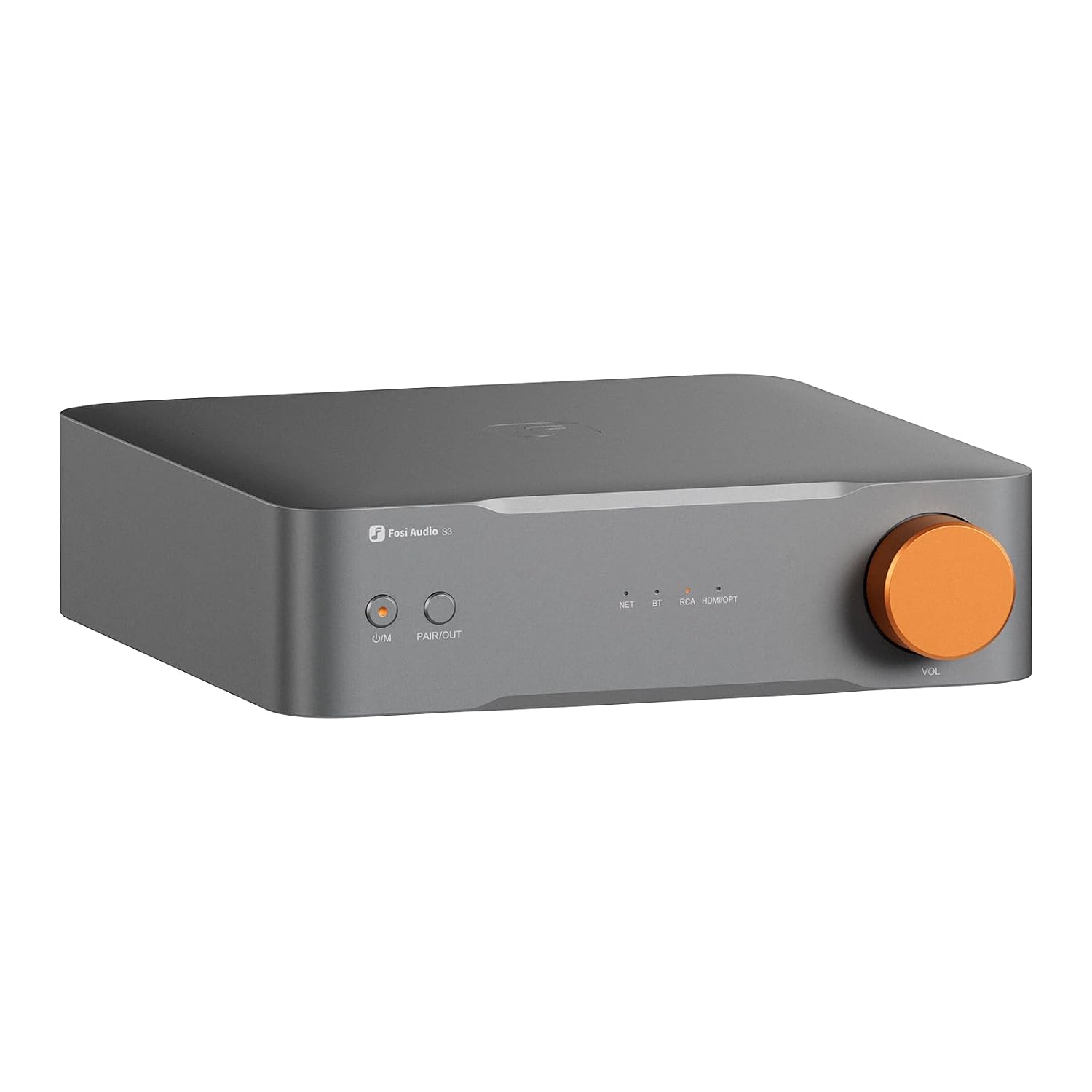
The Fosi Audio S3 is an all-in-one HiFi streamer, DAC, and preamp designed for audiophiles and home theater enthusiasts who want professional-grade sound quality from their digital music sources. Whether you're streaming from Spotify, Tidal, or high-resolution files via NAS, this compact device handles it all with impressive clarity and minimal distortion. It's perfect for those looking to upgrade their existing audio setup or build a complete streaming system from scratch.
The standout feature is the AK4493SEQ DAC, which supports PCM up to 32bit/768kHz and delivers reference-grade performance with THD+N under 0.00018% and 120dB SNR. Real-world testing confirms the audio quality is exceptional across all input types, optical, RCA, XLR, and Bluetooth connections all produce clean, detailed sound with a wide soundstage. The 10-band EQ provides flexibility for fine-tuning to your preferences, and the app control is intuitive and responsive.
Build quality is impressive for the price point, featuring isolated analog/digital architecture, Japan ELNA capacitors, and a low-noise power supply. The compact 6.81-inch design fits easily into most entertainment centers, and the silver-gray metallic finish looks professional and understated. Connectivity is extensive with XLR balanced outputs, HDMI eARC for TV integration, and a dedicated subwoofer output for home theater applications.
The main limitation is software maturity, as the device lacks native Amazon Music support, AlexaCast compatibility, and advanced bass management features like crossover controls for subwoofers. Some users have encountered occasional firmware stability issues, though these typically resolve with updates. Despite these shortcomings, the hardware quality and audio performance make it an excellent value for serious listeners.
The Fosi Audio S3 is a compelling choice for anyone seeking a versatile, high-quality streaming solution that doesn't compromise on sound. With its extensive connectivity, premium DAC, and compact design, it delivers professional audio performance at an accessible price point.
Audio Performance: 117dB SINAD at 2V, 120dB SNR, THD+N under 0.00018%, supports PCM up to 32bit/768kHz via LAN
Connectivity: Wi-Fi 6 dual-band (2.4/5GHz), Bluetooth 5.3 (SBC/AAC), Gigabit LAN, HDMI eARC, Optical input/output, RCA input/output, XLR balanced output, subwoofer output
Streaming Services: AirPlay 2, Spotify Connect, Tidal Connect, Qobuz Connect, Google Cast, DLNA, Roon Ready
Control: Fosi Audio App (iOS/Android), included remote control, 10-band EQ
Dimensions: 6.81 inches D x W x 1.85 inches H, Weight 0.87 kg
Warranty: 24-month manufacturer warranty
Who Should Buy: The S3 is ideal for audiophiles upgrading their streaming setup, home theater enthusiasts building a 2.1 system, and anyone seeking high-quality digital audio without expensive separates. It works well with existing power amplifiers, active speakers, and subwoofers.
Setup Tips: Use the XLR balanced outputs for the cleanest sound if your amplifier supports them. Connect via Gigabit LAN for the best streaming stability and highest resolution support. The 10-band EQ is best used subtly to match your room acoustics rather than aggressive corrections.
Compatibility: Works with turntables, CD players, and AVRs as inputs. Outputs to amplifiers, active speakers, and subwoofers. Compatible with smartphones, tablets, and PCs for wireless streaming. Note that some advanced features require firmware updates.
Alternatives to Consider: If Amazon Music or voice assistant integration is essential, look at other streaming solutions first. If you need built-in bass management for subwoofers, you may need to add an external crossover.
Buying Guide: What to Look for in a Wi-Fi Streamer
Streaming Protocol and Service Support
Your music habits dictate the necessary protocols. Look for native support for services like Spotify Connect, TIDAL Connect, and AirPlay 2. Native integration offers superior audio quality and frees your phone for other tasks. Ensure the streamer works with your primary music subscription for a seamless experience.
Multi-protocol support is a significant advantage. A device that handles AirPlay, Google Cast, and proprietary multiroom functions offers maximum flexibility. This allows you to stream from any device in your household, whether it’s an iPhone, Android phone, or laptop, directly to your hi-fi system.
Audio Resolution and DAC Quality
The internal Digital-to-Analog Converter is the heart of a streamer. It determines how accurately your digital music is converted into an analog signal for your amplifier. High-performance DAC chips, like the AK4493SEQ, support higher bitrates and sample rates, promising cleaner, more detailed sound.
Consider the maximum resolution supported via both network and digital outputs. If you have a library of high-resolution files or subscribe to a service like Qobuz, ensure the streamer can handle bit-perfect playback. For those using an external DAC, a high-quality digital output is more critical than the internal converter. Discover more about integrating these components into your home audio setup.
Connectivity and System Integration
Examine the physical connections on the device. Standard outputs include analog RCA and digital optical or coaxial. Advanced models may offer balanced XLR outputs for noise rejection in longer cable runs. Check for useful extras like a dedicated subwoofer output or an HDMI eARC input for easy TV audio integration.
Think about your future setup. If you plan to create a multiroom system, verify the streamer’s compatibility with other speakers and platforms. Some devices work within a single brand’s ecosystem, while others can group with AirPlay 2 or Google Cast devices from various manufacturers. For related wireless audio solutions, see our review of the best Bluetooth audio receivers under $200.
Control and User Experience
A well-designed companion app is essential. It should allow you to manage music sources, create presets, and adjust settings like EQ without frustration. Voice control via Alexa, Google Assistant, or Siri adds a layer of convenience for hands-free operation, especially in a multiroom context.
Advanced features like parametric EQ, room correction, or trigger outputs for syncing components can elevate your system. However, simplicity often wins. The best streamer is one you’ll use effortlessly every day, making your music instantly accessible. Explore the broader category of wireless and streaming audio for more insights.
Final Thoughts
Upgrading your stereo with a dedicated Wi-Fi streamer is a transformative step for any music lover. After evaluating the leading options, we find the WiiM Pro Plus Music Streamer for Stereo Systems excels for its intuitive multiroom capabilities and broad service integration, making it ideal for households deep in the Apple or Google ecosystems. Conversely, the Fosi Audio S3 HiFi Music Streamer DAC Preamp stands out for audiophiles seeking ultimate flexibility, thanks to its reference-grade DAC, balanced outputs, and home theater-ready features like HDMI eARC. Both deliver exceptional value, ensuring your prized audio system sounds its best for years to come.
Frequently Asked Questions
What’s the difference between a Wi-Fi streamer and a Bluetooth receiver?
Wi-Fi streaming typically offers higher audio quality, greater range, and more stable connectivity than Bluetooth. It allows you to stream directly from music services without using your phone as an intermediary, which often provides bit-perfect audio. Bluetooth is convenient for quick connections from personal devices but is generally limited by lower bandwidth and compression.
Do I need a separate amplifier with these streamers?
Yes, both devices reviewed here are preamplifier sources, not power amplifiers. They need to be connected to an existing integrated amplifier, stereo receiver, or a pair of powered speakers to produce sound. They provide the source signal and often volume control, but they do not drive passive speakers directly.
Can I use a Wi-Fi streamer to play music from my computer or network storage?
Absolutely. Most modern streamers support DLNA/UPnP protocols, allowing you to play music files stored on a Network-Attached Storage device or a computer shared on your home network. Some are also certified as Roon Ready, offering deep integration with the Roon music management platform for the ultimate library browsing experience.
Is there a noticeable sound quality improvement over using my phone’s headphone jack?
A dedicated streamer typically provides a far superior audio signal. It isolates the digital audio circuitry from the electrical noise of a smartphone, uses a higher-quality DAC, and receives data directly via a stable network connection. The result is a cleaner, more dynamic, and detailed sound that fully reveals the potential of your stereo system and high-quality recordings. For other audio upgrades, consider the best earbuds for home office in 2026 for personal listening.


Write Your Review
No reviews yet. Be the first to share your experience!