

You want immersive sound that fills your room without cluttering your space with bulky speaker boxes. The challenge is finding speakers that deliver the punch and clarity of freestanding models while being discreetly mounted within your walls. For audiophiles and home theater enthusiasts, the woofer material is a critical factor, and Kevlar stands out for its rigidity and low distortion.
This guide is crafted for anyone building a custom audio installation, from a dedicated home cinema to a whole-house music system. We have assessed the leading in-wall speakers that utilize Kevlar or its close cousin, aramid fiber, in their woofer construction. These materials are celebrated for their ability to produce tight, accurate bass, making them a top choice for hidden audio excellence. For more options with different driver technologies, explore our guide on the best In-Wall speakers with titanium tweeters.
Pros
- Carbon fiber construction delivers quick response times and improved frequency accuracy
- Removable magnetic grille blends seamlessly into room decor and prevents bass rattle
- High-frequency attenuator provides tuning flexibility for different acoustic environments
- Affordable entry point into in-wall speaker technology with quality materials
Cons
- Customer reports indicate durability issues with ribbon tweeter components failing within weeks
- Performance falls short of marketing claims, requiring subwoofer and EQ adjustment for adequate sound
- Installation challenges noted with fragile tabs and bolts that break easily during setup
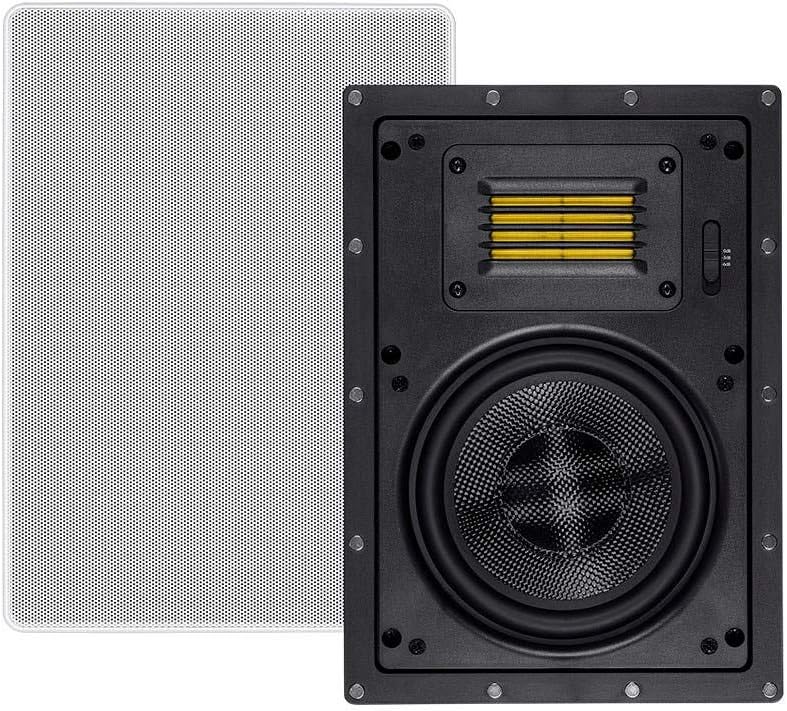
The Monoprice Amber 6.5-inch in-wall speakers target budget-conscious homeowners seeking decent audio quality without premium pricing. These speakers work best as part of a comprehensive home theater system or multi-room audio setup rather than as standalone solutions. They appeal to DIY installers and those building out new construction with integrated audio systems.
The standout features include carbon fiber drivers that promise lightweight responsiveness and rigid accuracy, plus ribbon tweeters designed to reduce distortion and expand the listening sweet spot. The adjustable high-frequency attenuator allows fine-tuning to match your room's acoustics. However, real-world performance tells a different story, with users reporting that the sound lacks richness and detail, requiring a subwoofer and careful EQ adjustments to sound acceptable.
Build quality appears solid at first glance, with the magnetic grille system working as intended to prevent rattle from bass response. The slim bezel and paintable grille do blend well into room decor. Installation presents challenges though, as users report fragile tabs and bolts that break easily during mounting, and the ribbon tweeter components appear prone to early failure.
The most significant drawback is durability. Multiple customer reports indicate the ribbon tweeter failing within weeks, and warranty support appears limited with backorder issues preventing replacement. Combined with performance that underdelivers on marketing promises, these speakers represent a risky investment despite their attractive price.
Verdict: The Monoprice Amber speakers offer decent value for casual listening in multi-room setups, but reliability concerns and performance limitations make them less suitable for primary home theater use. Consider investing in a quality soundbar or higher-end in-wall speakers if audio quality is your priority.
Physical Specs: 6.5-inch woofer and ribbon tweeter configuration, wall-mount installation, carbon fiber enclosure, black finish with removable magnetic grille.
Audio Performance: 2-channel stereo output, 2 watts maximum power, wired connectivity, high-frequency attenuator with 0, -3, or -6 dB adjustment options.
Compatibility: Works with desktops, gaming consoles, laptops, televisions, and automotive systems via corded electric connection. Includes pair of speakers (2 units total).
Warranty: Limited warranty coverage. Model number 24432, UPC 00889028055700.
Who Should Buy: These speakers suit homeowners building new construction with pre-wired audio systems, those seeking affordable in-wall speaker solutions for secondary rooms, and budget-conscious buyers willing to pair them with a subwoofer and quality receiver with EQ controls.
Who Should Avoid: Skip these if you want primary home theater speakers, need reliable long-term durability, or prefer hassle-free installation without construction challenges. Also avoid if you're unwilling to invest in a subwoofer to compensate for weak bass response.
Setup Tips: Plan for careful installation to avoid breaking fragile mounting tabs. Budget for a quality subwoofer to fill in missing low frequencies. Use your receiver's EQ to adjust midrange response. Test the ribbon tweeter immediately after installation to catch defects early within warranty period.
Alternatives to Consider: Explore other Monoprice speaker models with better reviews, consider established brands like Klipsch or Polk Audio in-wall speakers, or invest in a high-quality soundbar system if traditional in-wall installation isn't critical.
Buying Guide for In-Wall Speakers with Kevlar Woofers
Woofer Size and Bass Response
Larger woofers, typically 8 inches, move more air and generally produce deeper bass frequencies, which is ideal for home theater setups where you want to feel movie explosions. Smaller 6.5-inch woofers can offer faster, more precise bass that suits music listening. The YAMAHA NS-IW660 3-Way In-Wall Speaker System uses a 6.5-inch Kevlar cone, while the Rockville WA858 White 8″ in-Wall Home Speakers provide a larger 8-inch driver for more impactful low-end. Your choice should align with your primary use case and the natural acoustics of your room.
Tweeter Technology and Sound Clarity
The tweeter handles the high frequencies, and its design greatly influences overall sound brightness and detail. Horn-loaded tweeters, like those in Klipsch models, are highly efficient and direct sound powerfully, reducing distortion. Silk dome tweeters, found in the Rockville and Monoprice models, often deliver a smoother, more relaxed high end. If you prefer a different sound signature, our review of the best In-Wall speakers with silk dome tweeters offers excellent alternatives.
Installation Flexibility and Adjustability
Look for features that make installation easier and allow you to fine-tune the sound post-installation. Pivoting tweeters, like the one on the Klipsch R-5800-W II, let you aim the high frequencies toward your listening position for optimal clarity. Attenuation switches or controls, present on many models we reviewed, enable you to reduce treble or midbass output to compensate for overly bright or boomy room acoustics. These adjustments are invaluable for achieving balanced sound without moving the speaker.
Power Handling and System Matching
Ensure the speakers you choose can handle the power output of your amplifier or receiver. Power handling is listed as RMS (continuous) and peak (maximum) watts. Speakers with higher power handling, like the Rockville WA858, can play louder with less risk of damage. Also, check the impedance, most commonly 8 ohms, to ensure compatibility with your audio equipment. For systems requiring different loads, you can find specialized options in our list of the best 4-ohm in-wall speakers.
Final Thoughts
Upgrading to in-wall speakers with Kevlar woofers is a definitive step toward achieving professional-grade audio that remains out of sight. Our evaluation confirms that this technology provides a tangible improvement in bass precision and overall durability. For a premium, versatile three-way design that excels in both music and movies, the YAMAHA NS-IW660 3-Way In-Wall Speaker System is a superb choice. If your priority is value-focused performance with easy installation and a paintable grille, the Rockville WA858 White 8″ in-Wall Home Speakers deliver impressive sound without a hefty investment. You can explore more architectural audio solutions on our main In-Ceiling / In-Wall Speakers category page.
Frequently Asked Questions
Are Kevlar woofers better than other materials for in-wall speakers?
Kevlar is highly regarded for its exceptional stiffness-to-weight ratio. This means the woofer cone can move air efficiently without flexing or distorting, resulting in cleaner, more accurate bass reproduction compared to many standard paper or plastic cones. It is a material often associated with higher-end audio performance and longevity.
Can I install in-wall speakers with Kevlar woofers myself?
Yes, most DIY enthusiasts can handle the installation with proper tools and planning. Key steps include locating studs, using the provided template to cut a precise opening, running speaker wire, and securing the speaker into the wall. Many models, like those from Rockville and Monoprice, feature spring-loaded clips or dog-leg clamps that simplify mounting in drywall.
Do I still need a subwoofer if I use speakers with large Kevlar woofers?
While an 8-inch Kevlar woofer will provide much more substantial bass than a smaller driver, it may not reach the deepest sub-bass frequencies (below 40Hz) that a dedicated subwoofer delivers. For a full home theater experience, especially for action movies, adding a subwoofer is recommended. For music-focused systems, larger in-wall speakers may provide sufficient bass on their own.
How do I choose between a 2-way and a 3-way in-wall speaker design?
A 2-way speaker uses a woofer and a tweeter. A 3-way design adds a dedicated midrange driver, which can improve vocal clarity and instrument separation by reducing the workload on the woofer. The YAMAHA NS-IW660 is a prime example. A 3-way speaker often provides a more refined, detailed soundstage but typically comes at a higher cost. For more comparisons on driver materials, see our guide on best In-Ceiling speakers with polypropylene woofers.


Write Your Review
No reviews yet. Be the first to share your experience!