

You crave that deep, chest-thumping bass that brings music and movies to life. Yet, you also demand clarity and precision, where every low note is distinct, not a muddy rumble. This pursuit often leads audio enthusiasts to a specific component: the subwoofer cone. The material it’s made from is paramount. For those seeking a perfect balance of rigidity and internal damping, subwoofers with Kevlar cones present a compelling solution. This guide is crafted for anyone evaluating their low-frequency options, whether you are building a home theater or upgrading your car audio system. We will delve into the advantages of this technology and what makes it stand out in a crowded market of modern subwoofers.
Kevlar, known for its incredible strength-to-weight ratio, brings unique acoustic benefits to speaker design. A cone must be both stiff to prevent unwanted flex and well-damped to stop residual vibrations. Kevlar often achieves this balance better than many traditional materials. This results in bass reproduction that is both powerful and remarkably clean. If you are tired of bass that sounds bloated or distorted, understanding the role of cone composition is your first step. Let’s explore what you should prioritize when searching for a subwoofer that utilizes this advanced material.

Pros
- Exceptional value for under $240 with powerful dual 12-inch drivers and integrated amplifier
- Space-saving slim profile fits vehicles where traditional subwoofer boxes won't work
- Versatile connectivity supports both factory radio systems and aftermarket head units without additional equipment
- Built-in Class D amp with aluminum heatsink maintains cool operation during extended listening sessions
- Real-world users report noticeable bass improvement in compact vehicles like Jeeps and Equinoxes
Cons
- Some users report sound quality diminishes over time, suggesting durability concerns with extended heavy use
- Factory radio integration may require additional line output converter for optimal performance
- A few reports of loose fittings causing squeaking noises at road bumps after several months of use
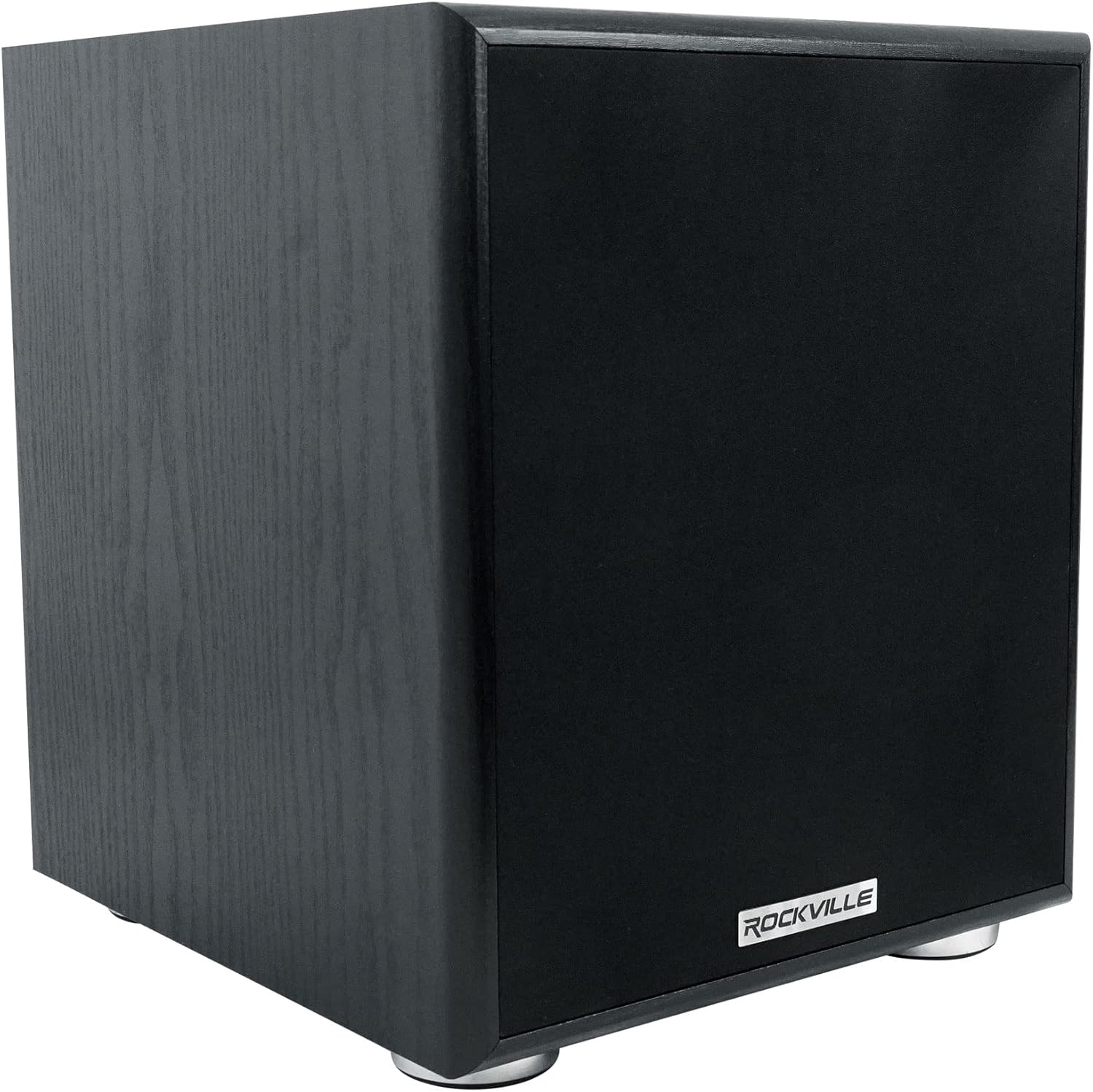
The Rockville RG212CA v2 is a powered subwoofer enclosure designed for car owners who want serious bass without the installation complexity of separate amplifiers and wiring. It combines dual 12-inch drivers with a 500W RMS integrated amp in a remarkably compact footprint, making it perfect for sedans, compact SUVs, and other vehicles where trunk space is limited.
The standout feature is the slim 4.37-inch depth that actually fits in tight vehicle spaces while delivering genuine bass impact. Real-world reviewers report that when properly connected to an aftermarket head unit, the subwoofer keeps up with demanding music and produces the attention-grabbing low frequencies that make bass enthusiasts happy. The adjustable crossover and remote control give you flexibility to dial in the bass character that matches your vehicle's acoustics and your listening preferences.
Build quality centers on 3/4-inch MDF construction with a vinyl finish and ribbed design that maximizes structural rigidity. The dual Kevlar-reinforced woofers with aluminum voice coils are engineered for durability, and the Class D amp includes an aluminum heatsink for reliable long-term operation. The overall package feels solidly constructed for the price point.
Some users have reported that sound quality can degrade over extended use, and a few mentioned loose fittings causing squeaks after several months. Additionally, factory radio systems may require a line output converter for optimal performance rather than working directly with the high-level inputs. These aren't dealbreakers but worth considering during installation planning.
The Rockville RG212CA v2 represents smart value for budget-conscious car audio enthusiasts. It delivers noticeable bass improvement, installs without major vehicle modifications, and works with most car stereo setups. For under $240, it's a solid entry point into powered subwoofer ownership that genuinely improves the listening experience in compact vehicles.
Audio Performance: 2000W peak power, 500W RMS output, 30Hz frequency response, mono audio mode
Drivers: Dual 12-inch subwoofers with Kevlar-reinforced composite pulp cones and 2-inch high-temperature aluminum voice coils
Amplifier: Class D mono-block amp, 2-ohm stable, 5V input voltage, aluminum heatsink cooling
Crossover: Low-pass filter adjustable from 50Hz to 200Hz with auto-start music sense
Dimensions: 29.52 inches long, 15 inches tall, 4.37 inches deep, weighs 40.1 pounds
Construction: 3/4-inch MDF with vinyl finish, side vents tuned to 40Hz, ribbed reinforced design
Connectivity: Low-level RCA inputs, high-level speaker inputs, RJ11 jack for dash-mounted remote control
Warranty: 1-year limited warranty, compatible with car audio systems
Placement: The slim 4.37-inch depth allows installation in trunk corners, under rear seats, or against interior panels. Secure the enclosure to prevent movement during acceleration and braking.
Power Connection: Run a power cable from your vehicle battery through a fuse holder to the subwoofer amp. Use proper gauge wiring based on your vehicle's electrical system for safe operation.
Audio Input: Connect RCA cables from your head unit to the subwoofer's RCA inputs for optimal signal quality. Alternatively, use high-level speaker inputs if your factory stereo doesn't have RCA outputs. A line output converter may be needed for factory radios.
Remote Installation: Mount the included bass remote control on your dashboard or steering wheel for convenient crossover adjustment while driving. The RJ11 connection allows wireless control of volume and frequency settings.
Break-in Period: Run the subwoofer at moderate volume for the first few hours to allow the drivers to settle. Check all connections after the initial break-in period and tighten any loose fittings to prevent squeaking noises later.
Key Considerations for Your Purchase
Cone Material and Construction
The primary reason you are looking at Kevlar is its performance. A Kevlar-reinforced cone, like those found in the Rockville RG212CA v2 Dual 12″ Slim Vented Powered, is designed for accuracy. The material’s innate stiffness resists deformation at high power levels. This directly translates to lower distortion and more controlled bass response. You hear the sound the producer intended, not coloration from the speaker itself. For those prioritizing sonic purity, this is a non-negotiable feature. It is a hallmark of many high-performance drivers aimed at both car and home audio applications.
Power Handling and Amplification
Matching your subwoofer’s power capabilities with an appropriate amplifier is critical. Look closely at both RMS and peak power ratings. A robust amplifier ensures the driver operates within its ideal range, unlocking its full potential without risk of damage. Many premium options come with integrated amplification for a seamless, optimized setup. This built-in approach guarantees component synergy. It simplifies your installation process significantly. Always verify that your electrical system can support the power demands of your chosen setup for reliable, long-term performance.
Enclosure Design and Physical Fit
The cabinet or enclosure is just as important as the driver itself. A well-designed vented (ported) enclosure can enhance low-frequency extension and output efficiency. However, it requires more space than a sealed design. Consider the exact dimensions of your available space before making a decision. A slim-profile design can be a lifesaver in tight trunks or compact living rooms. The goal is to achieve the acoustic performance you desire without impractical compromises on installation. Your subwoofer should complement your space, not dominate it.
Integration and System Compatibility
Your new subwoofer must work harmoniously with your existing audio gear. Check for the necessary input types, such as low-level RCA or high-level speaker inputs. Features like an adjustable low-pass crossover and a phase control switch are invaluable for fine-tuning. They help you blend the subwoofer’s output seamlessly with your main speakers. Some models offer remote controls for convenient adjustment from your listening position. Proper integration is the final step in achieving a cohesive, immersive soundstage where the bass feels like a natural extension of your system. Exploring different categories like floorstanding speakers can provide context for how a subwoofer completes a full-range system.
Final Thoughts
Selecting a subwoofer with a Kevlar cone is an investment in audio fidelity, prioritizing clarity and impact over mere volume. For enthusiasts seeking a powerful, all-in-one solution that excels in constrained spaces, the Rockville RG212CA v2 Dual 12″ Slim Vented Powered stands out with its integrated amplifier and space-saving design. Its use of Kevlar-reinforced cones ensures the bass remains tight and articulate even at high output levels. For those building a system piece by piece, focusing on heavy duty subwoofers with similar cone technology for raw driver performance would be a logical next step. Ultimately, choosing a model that aligns with your specific power requirements, spatial constraints, and listening goals will deliver the rich, immersive low-end experience you deserve.
Frequently Asked Questions
What are the main benefits of a Kevlar cone in a subwoofer?
Kevlar cones offer an exceptional balance of stiffness and internal damping. This combination minimizes cone breakup and distortion at high volumes. The result is bass reproduction that is both powerful and precise, allowing you to hear subtle details in the low-frequency range. This makes them a preferred choice for listeners who value accuracy alongside impact.
Are subwoofers with Kevlar cones only for car audio systems?
No, Kevlar cone technology is used across both car audio and home audio subwoofers. The material benefits are universal: reduced distortion and improved transient response. Whether you are upgrading your vehicle’s sound system or your home theater, a Kevlar cone can be a mark of a high-performance driver. The core principles of clean bass reproduction apply equally in all environments.
How does a Kevlar cone compare to other materials like polypropylene or aluminum?
Polypropylene cones are common and offer good damping but can lack ultimate stiffness. Aluminum cones are very rigid but can sometimes exhibit ringing or coloration if not properly treated. Kevlar aims to sit between these extremes, providing high rigidity like metal but with better natural damping. This often results in a more neutral and controlled sound character, which is why it is frequently associated with low distortion performance.
Do I need a special amplifier for a subwoofer with a Kevlar cone?
Not specifically for the cone material itself. Your amplifier choice should be based on the subwoofer’s power handling specifications (RMS power) and impedance. A quality amplifier that delivers clean, stable power within those parameters will allow any well-designed driver, including one with a Kevlar cone, to perform at its best. Many powered models, like the one reviewed here, solve this by including a perfectly matched amplifier built right in.



Write Your Review
No reviews yet. Be the first to share your experience!