

You’ve invested in a great sound system, but something is still missing. The movie explosions lack punch, and your favorite music tracks don’t have that visceral, room-filling depth. The culprit is often a subwoofer that can’t handle the low frequencies without adding unwanted coloration or distortion.
The cabinet material plays a crucial role in this performance. Medium-Density Fiberboard, or MDF, is prized for its acoustic properties. It’s dense, non-resonant, and provides a rigid enclosure that prevents the cabinet itself from vibrating and muddying the sound. This guide is for anyone seeking that perfect blend of powerful, clean bass anchored by solid engineering. We’ve evaluated top models to help you find the ideal subwoofer with an MDF cabinet for your setup.

Pros
- Powerful 100W dynamic output in a compact, space-saving enclosure ideal for smaller rooms
- Versatile hookup options including RCA and speaker-level connections suit a wide range of receivers and amplifiers
- Adjustable crossover and volume controls make tuning simple and precise for any listening environment
- Durable resonance-free driver materials ensure consistent performance during extended high-volume use
- Comprehensive 5-year limited warranty with dedicated amplifier coverage adds strong long-term value
Cons
- At 11.8 kg the unit is relatively heavy for its size, which may complicate placement or repositioning in tight spaces
- The 40-160 Hz frequency response means it is optimized for bass duties only and will not extend into higher mid-range frequencies
- No wireless connectivity option means cable management is required for clean installation in modern setups
The Polk Audio PSW10 is a 10-inch powered subwoofer designed for home theater and stereo enthusiasts who want impactful bass without dedicating a large footprint to their audio setup. It targets small to mid-sized rooms and works as a straightforward upgrade to any existing speaker system, requiring no separate amplifier thanks to its fully self-contained design.
At the heart of the PSW10 is a Dynamic Balance woofer paired with a high-current 50W RMS amplifier capable of delivering up to 100 watts of dynamic power. The configured directed port enhances bass depth and extension, producing a frequency response of 40-160 Hz that covers the full range of cinematic low-end effects and musical bass lines with impressive accuracy and minimal distortion.
The cabinet is engineered from non-resonant materials, which prevents unwanted vibrations from coloring the sound at high volumes. A detachable front grille, clean black finish, and compact 17 x 14.25 x 14.5 inch dimensions give the PSW10 a tidy, unobtrusive appearance that fits neatly alongside most furniture. Connectivity is straightforward, with RCA line-level and speaker-level inputs and outputs on the rear panel alongside a Phase Toggle Switch for users running dual subwoofer configurations.
One honest drawback is the lack of wireless connectivity, which is increasingly common at this price point and would simplify placement in modern living rooms. The unit is also on the heavier side at nearly 12 kg, so moving it around during setup can be a bit cumbersome. Additionally, the crossover filter tops out at 160 Hz, so users pairing it with small satellite speakers should verify their main speakers can cover the upper bass and midrange adequately.
Overall, the Polk Audio PSW10 is a well-engineered, reliable subwoofer that delivers genuine low-frequency performance in a compact package. Its flexible inputs, adjustable crossover, and robust warranty make it a smart and accessible choice for anyone looking to add serious bass to a home theater or music system without complexity or compromise.
Driver Size: 10 inches | Amplifier Power: 50W RMS, 100W Dynamic | Frequency Response: 40-160 Hz (-3dB) | Impedance: 8 ohm | Channels: 5.1 compatible
Crossover: Continuously variable 80-160 Hz low-pass filter | Connectivity: RCA line-level input/output, Speaker-level input/output | Power Source: AC corded | Mounting: Floor mount
Dimensions: 17 inches D x 14.25 inches W x 14.5 inches H | Weight: 11.8 kg | Color: Black | Model Number: AM1055-C (PSW10)
Warranty: 5-year limited warranty, 3 years on amplifier parts and labor | In the Box: Powered subwoofer, grille, online registration card, owner's manual | Manufacturer: DEI Holdings (Polk Audio)
If you are shopping for your first subwoofer, the PSW10 is an excellent starting point. Its self-contained amplifier means you do not need to budget for a separate sub amp, and its dual input options make it compatible with virtually any AV receiver, stereo amplifier, or even a soundbar with a subwoofer output.
Room size is an important consideration. The PSW10 performs best in rooms up to roughly 2,000 square feet. For larger spaces or dedicated home theater rooms, you may want to consider a larger driver or a higher-wattage model, but for typical living rooms and apartments this unit delivers more than enough output.
When positioning the subwoofer, start by placing it near the front of the room close to your main speakers, then use the rotary volume and crossover controls to dial in a balanced blend. The Phase Toggle Switch is particularly useful if you ever expand to a dual-subwoofer setup, helping eliminate bass cancellation between units.
Buyers who prioritize wireless convenience or who are building a fully cable-free setup should note that the PSW10 uses only wired connections. In that case, pairing it with an aftermarket wireless subwoofer adapter is a straightforward workaround. For everyone else, the PSW10 represents a dependable, high-value choice backed by a strong warranty and Polk Audio's decades of acoustic engineering expertise.
What to Look for in a Subwoofer with an MDF Cabinet
Cabinet Construction and Design
An MDF cabinet is the starting point, but its construction matters. Look for terms like “critically braced” or “rigid” in the description, as seen with the Polk Audio Monitor XT12. This internal bracing further reduces panel resonance. The finish, such as a high-grade vinyl or a sleek detachable grille, also contributes to durability and aesthetics. A well-built MDF enclosure is a hallmark of a heavy-duty subwoofer designed for long-term use.
Driver Size and Amplifier Power
Driver size, from compact 6.5-inch woofers to massive 18-inch pro drivers, directly influences bass output and extension. Match the size to your room. A 10-inch model like the Polk Audio PSW10 is excellent for small to mid-sized spaces. Amplifier power, measured in Watts RMS, determines how loud and controlled the bass can be. Ensure the amp is adequately matched to the driver, as seen in the Rockville Rock Shaker’s Class-D design, for clean sound at all volumes.
Connectivity and Controls
Versatile connectivity ensures easy integration. Most home theater subwoofers offer line-level RCA inputs and an LFE input for AV receivers. Models like the Rockville PBG18 pro subwoofer feature SpeakON and 1/4″ jacks for professional audio setups. User-adjustable controls are essential for fine-tuning. Look for variable crossover frequency, phase switches, and independent volume knobs to blend the subwoofer seamlessly with your main bookshelf speakers.
Intended Use and Placement
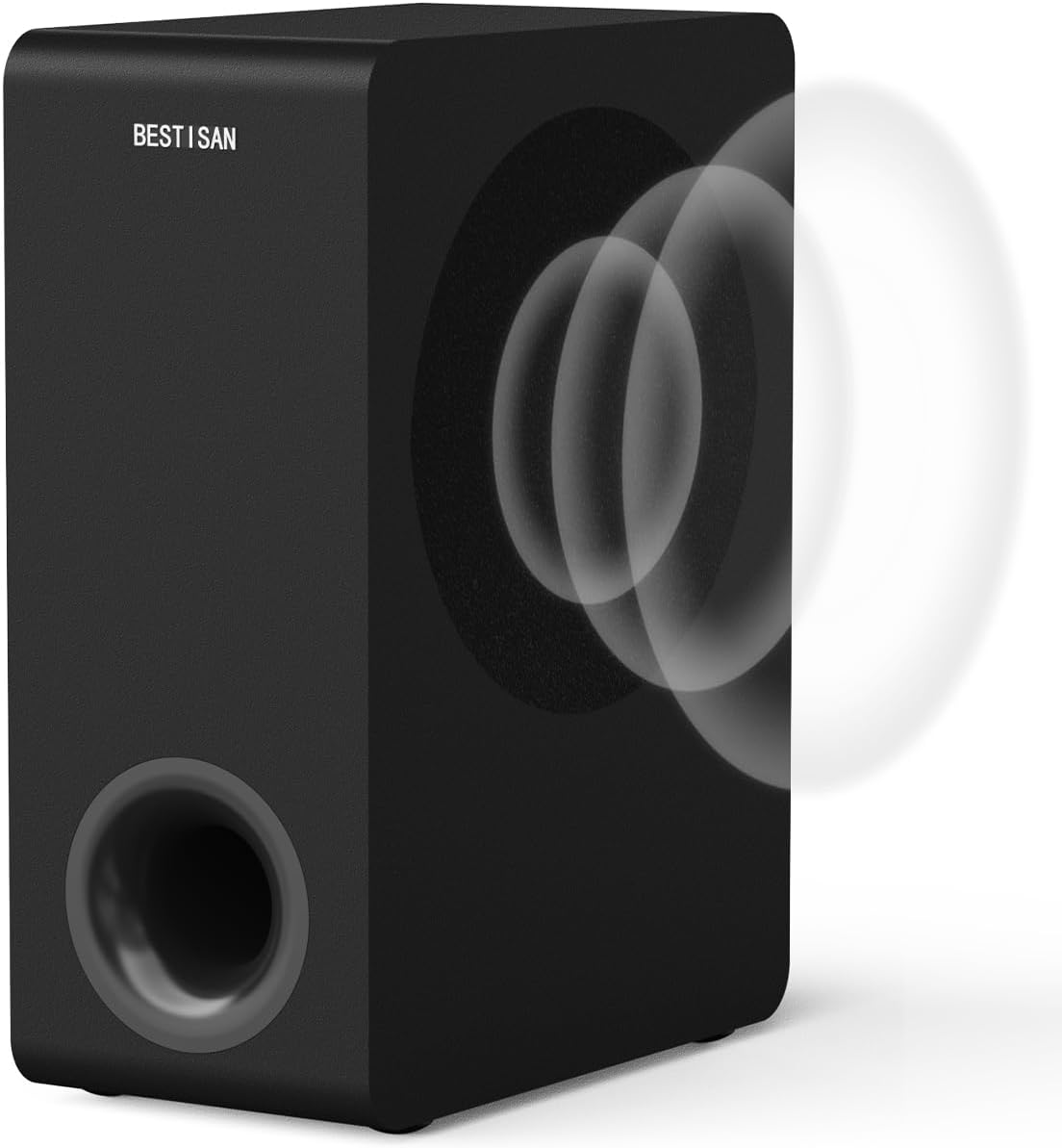
Your primary use case dictates the best choice. For dedicated home theater immersion, a powered subwoofer with deep low-frequency extension is key. For music listening, accuracy and speed might be prioritized. Consider physical placement; a down-firing design like the BESTISAN subwoofer can maximize floor coupling, while a front-firing driver might offer more placement flexibility. Compact designs are ideal for discreet integration into living spaces.
Final Thoughts
Selecting a subwoofer with a quality MDF cabinet is a significant step toward achieving audio fidelity, as it provides the solid foundation necessary for accurate bass reproduction. For those seeking a powerful, feature-rich option for a dedicated home theater, the Polk Audio Monitor XT12 12″ Powered Subwoofer stands out with its robust build and deep bass extension. If you need a compact, budget-friendly solution to augment a smaller system, the Rockville Rock Shaker 10″ Black Powered Subwoofer offers impressive performance and easy integration, proving that great bass doesn’t require a massive footprint.
Frequently Asked Questions
Why is an MDF cabinet important for a subwoofer?
MDF is dense and non-resonant, meaning it vibrates far less than thinner or less rigid materials like basic plastic or particle board. This stability prevents the cabinet itself from adding unwanted colorations or distortions to the sound. The result is tighter, cleaner, and more accurate bass reproduction, which is why it’s a preferred material in quality audio equipment, including many modern subwoofers.
Can I use a pro audio subwoofer like the Rockville PBG18 in a home theater?
Technically yes, but it may not be ideal. Pro audio subwoofers are designed for high output in large, often treated spaces like venues. They are typically passive, requiring a separate external amplifier, and their sound profile is geared for impact over nuanced home theater detail. For most living rooms, a powered home theater subwoofer will offer easier setup and sound better optimized for movie and music content.
What’s the difference between a powered and a passive subwoofer?
A powered subwoofer, like the Edifier T5, has a built-in amplifier. You simply connect it to your receiver’s subwoofer output or speaker terminals. A passive subwoofer, like the Rockville PBG18, does not have an internal amp and must be powered by an external amplifier or receiver. Powered models are the standard for home audio due to their convenience and optimized amp-driver matching, which helps minimize low distortion.
How do I set the crossover frequency on my new subwoofer?
The crossover frequency determines which low-frequency sounds are sent to the subwoofer and which go to your main speakers. A common starting point is 80Hz. You can set it on the subwoofer itself using the variable crossover knob, and often also in your AV receiver’s settings. The goal is a seamless blend where the bass transitions smoothly from the subwoofer to the speakers without a noticeable gap or overlap. Fine-tuning by ear while listening to familiar content is recommended.




Write Your Review
No reviews yet. Be the first to share your experience!