

You are mixing a track, and everything sounds tight and balanced on your studio monitors. Yet, when you play the final version on another system, the bass feels thin or, worse, overwhelmingly boomy. This common frustration underscores a critical gap in many home studios: the missing low-frequency foundation. A dedicated studio monitor subwoofer is not just about adding volume. It is about revealing the full sonic spectrum, ensuring your decisions translate perfectly to every listening environment.
This guide is for music producers, audio engineers, and content creators who demand accuracy. We have evaluated the top contenders in the market to identify the best studio monitor subwoofers. Our focus is on performance, integration flexibility, and value. Whether you are crafting deep electronic music or mixing a podcast with cinematic sound design, the right subwoofer is a game-changer. You can explore more options in our main subwoofers category.

Pros
- Exceptional accuracy and clarity, letting you hear room characteristics and mix details clearly
- Tight, controlled bass with no bloat or rumble, perfect for critical listening
- Comprehensive controls including low-cut, high-cut, and phase adjustment for any room
- Solid construction and engineering from a trusted brand with 15+ years of professional endorsement
- Excellent value for pro-level quality and performance
Cons
- Premium price point requires significant investment for home studio enthusiasts
- 8-inch driver may require careful placement and tuning in larger rooms
- Limited wireless connectivity, primarily wired XLR connection for best performance
The Yamaha HS8S is a professional-grade powered subwoofer designed for recording studios, live music monitoring, and serious home studio setups. If you're mixing music, producing podcasts, or working with any audio that requires accurate low-end reproduction, this subwoofer fills the critical gap that small studio monitors cannot reach.
What sets the HS8S apart is its commitment to accuracy over flashiness. The 150W amplifier drives an 8-inch bass-reflex driver with a frequency response of 22Hz to 150Hz, delivering tight, controlled bass that reveals room acoustics and mix imperfections rather than masking them. The low-cut and high-cut controls allow you to dial in the perfect blend with your main monitors, while the phase switch ensures coherent integration with your monitoring system. Users consistently report that this subwoofer transforms their ability to hear and mix accurate low-end content.
Build quality is exceptional, with Yamaha's engineering expertise evident in every detail. The shockproof stainless steel enclosure feels durable and professional. The touch controls and comprehensive connectivity options, including XLR inputs and routing outputs, make this subwoofer a seamless addition to any studio setup. This is equipment designed by engineers for engineers, not marketing departments.
The main consideration is price. This is a professional investment, not an impulse purchase. Additionally, the 8-inch driver performs best in rooms where proper placement and tuning are possible. If you have a very large room or prefer wireless convenience, you may want to evaluate alternatives.
For serious home studio owners, music producers, and professional engineers, the Yamaha HS8S represents exceptional value in the studio subwoofer category. It delivers the accuracy and reliability needed for professional mixes at a reasonable price point for this quality tier.
Driver and Output: 8-inch bass-reflex powered subwoofer with 150W amplifier. Frequency response 22Hz to 150Hz. Dynamic driver design for accurate reproduction.
Controls and Connectivity: Low-cut switch and control (80-120Hz), high-cut control (80-120Hz), and phase switch for room integration. XLR connectivity with audio routing outputs. Touch control interface.
Physical: Floor-standing design with stainless steel enclosure. Compact footprint suitable for studio environments. Not water-resistant.
Warranty: 1-year manufacturer limited warranty from Yamaha Corporation of America. Valid only when purchased from authorized Yamaha retailers.
Who Should Buy: Music producers, audio engineers, podcast creators, and serious home studio owners who need accurate low-end monitoring. This subwoofer is ideal for mixing and mastering applications where precision matters.
Room Considerations: The HS8S performs best in treated studio environments or rooms where you can place and tune the subwoofer properly. Smaller rooms benefit most from the compact 8-inch design. Larger rooms may require additional subwoofers or larger drivers.
Integration Tips: Use the low-cut control to keep bass out of your main monitors, allowing them to focus on midrange clarity. Experiment with the phase switch to achieve seamless blending. Proper placement away from room corners typically yields best results.
Comparison: The HS8S is the compact option in Yamaha's HS line. It competes with other professional 8-inch studio subwoofers but stands out for accuracy and control rather than maximum output or size.
Pros
- Exceptional bass clarity and control with intuitive gain, crossover, and filter adjustments for precise tuning
- Powerful 170W amplifier with low distortion delivers punchy, articulate bass that doesn't muddy the mix
- Included footswitch for instant bypass comparison makes mixing decisions faster and more confident
- High-pass filter protects full-range monitors and improves their performance in the midrange
- Solid build quality with vinyl-laminated MDF enclosure and professional connectivity options
Cons
- At 10 inches, this subwoofer requires dedicated floor space and may not suit extremely compact studio setups
- The learning curve for optimal crossover and filter settings takes time to master for best results
- Premium pricing positions it above entry-level options, though justified by professional-grade features and build quality
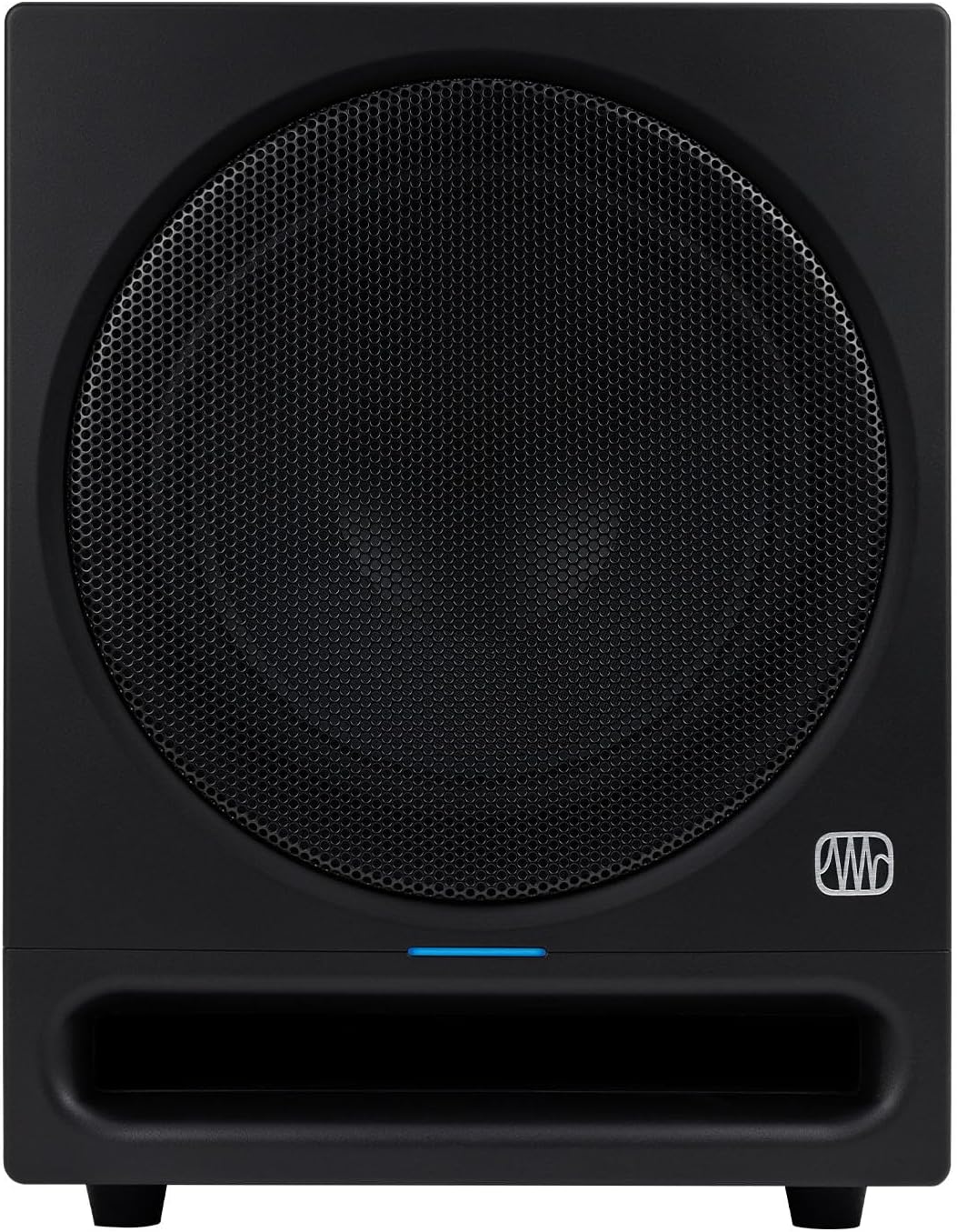
The PreSonus Eris Pro Sub 10 is a professional-grade active subwoofer engineered for serious home studios and commercial production environments. It's designed to complement full-range studio monitors by extending their low-frequency response with natural, musical bass rather than overwhelming boom. This makes it ideal for mixing and mastering engineers who need accurate bass representation below what their main monitors can reliably reproduce.
What sets this subwoofer apart is its control and flexibility. The 170W Class AB amplifier delivers up to 113 dB SPL with a 20-200 Hz frequency response, while the continuously variable lowpass filter (50-130 Hz) lets you precisely dial in where the subwoofer takes over from your main monitors. The switchable highpass filter is particularly clever, removing sub-bass content from the full-range monitor outputs to keep them focused on their sweet spot. Real-world users report that pairing it with 8-inch monitors transforms bass perception, making previously thin mixes suddenly feel balanced and representative.
Build quality is professional throughout. The 10-inch front-firing glass-composite woofer sits in a vinyl-laminated MDF enclosure with a bass-reflex port, delivering tight, articulate bass without bloat. The included momentary footswitch enables instant bypass for quick A/B comparisons, a feature that accelerates mixing decisions. Connectivity is comprehensive with balanced XLR and 1/4-inch TRS inputs, plus pass-through outputs and subwoofer output for daisy-chaining a second unit in larger rooms.
The main consideration is that optimal setup requires patience. Dialing in the crossover frequency, gain, and filter settings to match your specific monitors and room takes experimentation. Additionally, the 10-inch form factor needs dedicated floor space and represents a significant investment compared to smaller alternatives. However, users consistently report the results justify both the space and cost.
Verdict: The Eris Pro Sub 10 is an excellent choice for mixing and mastering professionals who demand accurate bass response without coloration. Its flexible controls, solid amplification, and professional connectivity make it a reliable foundation for serious studio work. Highly recommended for anyone serious about mixing bass-heavy music or requiring critical low-frequency monitoring.
Amplification: 170W RMS Class AB amplifier, maximum SPL 113 dB
Driver: 10-inch front-firing glass-composite woofer with bass-reflex port
Frequency Response: 20-200 Hz
Crossover Controls: Continuously variable lowpass filter (50-130 Hz), switchable highpass filter (80 Hz)
Gain Control: -30 dB to +6 dB continuously variable
Inputs: Balanced XLR and 1/4-inch TRS, unbalanced RCA
Outputs: Balanced XLR and 1/4-inch TRS pass-through, XLR subwoofer output for daisy-chaining
Additional Controls: Polarity invert switch, ground-lift switch, momentary footswitch (included)
Enclosure: Vinyl-laminated medium-density fiberboard
Warranty: 2-year manufacturer limited warranty
Who Should Buy: This subwoofer is ideal for mixing and mastering engineers, music producers, and serious home studio owners who need accurate low-frequency monitoring. It's particularly valuable if your main monitors are 5-8 inches and lack bass definition below 70 Hz. The professional connectivity and flexible controls also make it suitable for small commercial studios.
Room Considerations: The Eris Pro Sub 10 works best in rooms where you can place it on the floor with some breathing room around the bass-reflex port. Avoid corners initially, as corner placement can cause excessive bass buildup. Experiment with placement to find the sweetest spot for your specific room acoustics.
Integration Tips: Start with the highpass filter enabled to protect your main monitors. Set the lowpass filter to match your monitors' low-end rolloff point (typically 60-80 Hz for most studio monitors). Use the included footswitch to compare your mix with and without the subwoofer, ensuring it enhances rather than dominates your mix balance.
Budget Alternative: If space or budget is limited, consider PreSonus's smaller 8-inch Eris Pro Sub, though users report the 10-inch model provides noticeably more impactful bass and headroom for professional work.

Pros
- Surprisingly powerful bass response for an 8-inch subwoofer, reaching deep lows without muddiness
- Multiple connectivity options including Bluetooth 5.0, balanced TRS, RCA, and auxiliary inputs
- Adjustable crossover and room-tuning controls allow precise calibration to any space
- Excellent value for music production, gaming, and critical listening applications
- Clean pass-through outputs enable easy integration with existing monitor systems
Cons
- Requires proper EQ adjustment and crossover tuning to avoid boomy bass in smaller rooms
- When using Bluetooth with multiple PreSonus BT devices, both units must be connected to a PC for optimal audio routing
- Limited to 10-meter Bluetooth range, which may be restrictive for larger spaces or multi-room setups
The PreSonus Eris Sub 8BT is a powered subwoofer engineered for music producers, content creators, and serious listeners who need accurate low-frequency reproduction. This 100W compact sub is designed to extend the frequency response of full-range studio monitors, delivering clear bass down to 30 Hz. Whether you're mixing EDM, hip-hop, or simply want to experience the full sonic spectrum in your home, this subwoofer fills that critical gap.
Performance is where this subwoofer truly impresses. The 8-inch woven-composite woofer produces tight, punchy bass that feels powerful without sounding muddy or bloated. Users consistently report that the sub hits hard and clean, filling rooms with authority despite its modest size. The adjustable low-pass and high-pass filters allow you to dial in the perfect crossover point, ensuring seamless integration with your main monitors. For bedroom studios and small spaces, this level of control is invaluable for achieving professional-sounding mixes.
Connectivity is remarkably flexible. Bluetooth 5.0 wireless input makes it easy to stream from phones, tablets, or laptops, while the balanced 1/4-inch TRS inputs, unbalanced RCA inputs, and front-panel auxiliary input ensure compatibility with virtually any audio source. The added convenience of a front-panel headphone output with built-in amplifier lets you quickly switch to headphone monitoring without unplugging cables. Build quality feels solid with metal and plastic construction, and the compact footprint fits easily into tight studio spaces.
There are a few considerations worth noting. In smaller rooms, the subwoofer can sound boomy at moderate volumes unless you properly adjust the crossover and EQ settings. Additionally, if you're using multiple Bluetooth-equipped PreSonus devices, both units must connect to a computer for optimal audio routing, which may complicate some wireless setups. The 10-meter Bluetooth range is also somewhat limited for larger spaces or multi-room applications.
The PreSonus Eris Sub 8BT is an excellent choice for anyone looking to add professional-grade bass to their monitoring system. Its combination of accurate sound, intuitive controls, multiple connectivity options, and competitive pricing makes it a standout value in the powered subwoofer category. Highly recommended for music producers, gamers, and audiophiles seeking better low-end clarity and impact.
Audio Output: 100W RMS power output
Driver Size: 8-inch woven-composite woofer
Frequency Response: 30 Hz to 200 Hz
Connectivity: Bluetooth 5.0 (10m range), 1/4-inch TRS balanced inputs, RCA inputs, 1/8-inch TRS auxiliary input, RCA pass-through outputs
Controls: Adjustable input gain, variable low-pass filter, high-frequency and low-frequency tuning controls
Additional Features: Front-panel headphone output with amplifier, power-saving mode (auto-engage after 40 minutes idle)
Dimensions: 12.7 inches wide x 11.7 inches tall x 9.8 inches deep
Weight: 8 lbs (3.6 kg)
Warranty: 2-year manufacturer limited warranty
Compatible Devices: Laptops, smartphones, tablets, gaming consoles, televisions, projectors, MP3 players
Who Should Buy This? The Eris Sub 8BT is ideal for bedroom studio producers, content creators, gamers, and music enthusiasts who want to expand their monitoring system. It's particularly well-suited for EDM, hip-hop, and bass-heavy music genres where accurate low-end reproduction is essential. The Bluetooth connectivity also makes it appealing for casual listeners who want better bass for streaming music and movies.
Room Considerations: This subwoofer performs best in rooms ranging from 100 to 300 square feet. In smaller spaces, start with lower crossover settings and reduced gain to avoid overwhelming bass. Larger rooms may require higher crossover settings and increased gain. The adjustable tuning controls make it adaptable to most acoustic environments.
Integration with Existing Monitors: While designed to complement PreSonus Eris monitors, this subwoofer works with most full-range studio monitors. Use the RCA pass-through outputs to maintain your existing monitor connections, or connect via balanced TRS inputs for professional setups. Proper crossover tuning is essential for seamless integration.
Setup Tips: Position the subwoofer where it sounds most balanced in your room, typically in a corner or against a wall. Use the adjustable low-pass filter to set the crossover frequency just below where your main monitors begin to roll off, typically around 80-100 Hz. Fine-tune using the high and low-frequency controls based on your listening preferences and room acoustics.

Pros
- Delivers punch and clarity with minimal rattling or distortion, as confirmed by experienced audiophiles
- Selectable crossover and sleep mode toggle provide professional control over bass integration and power management
- Excellent value for the price with XLR connectivity and comprehensive back-panel controls
- Pairs seamlessly with KRK studio monitors and other professional audio equipment
- Solid construction with no hum or noise, offering reliable performance for daily production work
Cons
- Compact 8-inch design limits the deepest bass extension compared to 10-inch models, better suited for instruments than ultra-low frequencies
- Weighs 26.5 pounds and requires significant floor or shelf space, making it challenging to relocate or fit in tight studio setups
- No wireless or Bluetooth connectivity, requiring XLR cable connection to audio interface or mixing console
The KRK S8.4 is a powered studio subwoofer engineered for music producers, recording engineers, and serious audiophiles who need accurate bass monitoring without excessive footprint. This compact 8-inch subwoofer builds on KRK's reputation for sonic accuracy, making it an excellent choice for home studios, project studios, and small control rooms where space is a consideration.
The standout feature is the combination of the glass-aramid composite woofer and 109-watt Class-D amplifier, which delivers tight, punchy bass with excellent transient response. Bass extends down to 30Hz with 112 dB max SPL, providing sufficient low-end coverage for music production work. The four-position selectable crossover allows you to fine-tune integration with your existing monitors, while the exclusive bypass-control feature lets you route full-range audio to your monitors independently, a professional-level feature rarely found at this price point.
Build quality is solid and robust. The curved enclosure design with front-firing bass port provides placement flexibility, and users consistently report zero rattling, humming, or unwanted resonances. The back-panel controls are intuitive and comprehensive, including the valuable sleep mode toggle that prevents the annoying on-off cycling that plagues many consumer subwoofers. Weighing 26.5 pounds with dimensions of 16.12 inches deep, 11.5 inches wide, and 11 inches high, the S8.4 requires dedicated floor or shelf space and is moderately difficult to relocate once positioned.
The primary limitation is the 8-inch woofer diameter. While this delivers excellent punch and clarity for instrument-based music and typical mixing scenarios, it does not extend as deep as 10-inch alternatives and is better suited for frequencies above 35Hz. Additionally, connectivity is XLR only, with no wireless or Bluetooth options available.
The KRK S8.4 represents excellent value for producers and engineers seeking professional-grade bass monitoring in a compact package. Its accurate response, thoughtful feature set, and reliable construction make it a smart investment for anyone upgrading their studio monitoring system.
Driver and Enclosure: 8-inch glass-aramid composite woofer, curved enclosure with front-firing bass port
Amplification: 109-watt Class-D amplifier with improved transient response and control
Frequency Response: Bass extension to 30Hz, maximum SPL of 112 dB, signal-to-noise ratio of 92 dB
Crossover: Four-position selectable crossover for flexible integration with studio monitors
Connectivity: XLR input, corded electric power source
Controls: Touch control interface, footswitch input (footswitch not included), bypass control feature, sleep mode toggle
Dimensions and Weight: 16.12 inches deep, 11.5 inches wide, 11 inches high, 26.5 pounds
Warranty: 1-year limited warranty with 5-year EU spare parts availability
Ideal For: Music producers, recording engineers, mixing and mastering professionals, home studio owners, and audiophiles seeking compact, accurate bass monitoring. Perfect for pairing with KRK studio monitors or other professional audio equipment in small to medium-sized control rooms.
Best Use Cases: Music production and mixing, recording studio applications, personal listening rooms, project studios with space constraints, upgrading existing 2-speaker monitor setups, and situations where bass extension to 30Hz is sufficient for the intended content.
May Not Be Ideal For: Users requiring ultra-deep bass below 35Hz, those with severe space limitations or portability needs, studios requiring wireless connectivity, or mixing environments where 10-inch or larger subwoofers are already standard practice.

Pros
- Delivers accurate, punchy bass with zero rumble or muddy coloration, ideal for critical mixing and mastering
- Extends down to 27Hz for complete frequency monitoring that reveals true bass content in your tracks
- XLF mode provides inspirational club-inspired tuning for dance and electronic music production
- Flexible connectivity supports both professional XLR and standard TRS balanced inputs for any setup
- Compact 10-inch ported design fits medium to large studios without dominating the room
Cons
- Requires separate XLR cables to connect to matching JBL monitors, adding to total setup cost
- Downward-facing driver is delicate and requires careful placement to avoid accidental damage
- Limited to wired connections only with no wireless connectivity options for flexible studio layouts
The JBL Professional LSR310S is a powered studio subwoofer designed for music producers, audio engineers, and mastering professionals who need accurate low-frequency monitoring. This 10-inch sub is engineered specifically for modern music production where bass plays a critical role in the final mix, from hip-hop and electronic music to pop and film scoring.
What sets the LSR310S apart is its combination of accuracy and power. The 200-watt amplifier drives a custom-engineered 10-inch driver that reaches down to 27Hz while maintaining crisp, clean bass with zero rumble. The patented double-flared port design is precisely calculated to optimize low-frequency extension, ensuring you hear exactly what's in your mix. The XLF mode is a unique feature that activates club-inspired bass tuning, perfect for producers crafting dance tracks who want to hear how their music will sound in professional club environments.
Build quality is professional-grade throughout. The enclosure uses durable PVC construction, and the driver is built to handle continuous full-power operation without failure. Connectivity is fully professional with balanced XLR and 1/4-inch TRS inputs, plus XLR outputs for daisy-chaining to other studio monitors. The sensitivity switch accommodates both high and low-output equipment, making it compatible with virtually any studio setup. The compact floor-standing design fits seamlessly into medium to large studios alongside JBL 3-series monitors, with matching finish and LED indicators.
Two minor considerations: the downward-facing driver requires careful placement to avoid damage, and you'll need separate XLR cables to connect matching JBL monitors. Additionally, all connections are wired only with no wireless options available. Despite these minor points, user feedback consistently praises the LSR310S for delivering professional-quality bass monitoring at an accessible price point.
The JBL Professional LSR310S is an excellent investment for serious producers and engineers who refuse to compromise on mix accuracy. Its combination of extended low-frequency response, clean punchy bass, and professional connectivity makes it an essential tool for anyone monitoring modern music production in a dedicated studio environment.
Audio Output: 200 watts, 113dB peak output
Frequency Response: 27Hz to 2kHz
Driver Size: 10-inch custom-engineered woofer
Enclosure: PVC, floor-standing ported design
Connectivity: 2x XLR balanced inputs, 2x TRS balanced inputs, XLR outputs
Controls: Touch-activated, sensitivity switch for +4dBu and -10dBV compatibility
Power: Corded electric, includes power cable
Warranty: 5-year limited warranty on professional loudspeaker products
Included in Box: LSR310S subwoofer, power cable, setup guide
Who Should Buy: Music producers, audio engineers, mastering professionals, and serious home studio enthusiasts who need accurate bass monitoring. Ideal for anyone working with modern genres like electronic, hip-hop, pop, and film scoring where low-end accuracy is critical.
Studio Setup: The LSR310S pairs perfectly with JBL 3-series monitors (305P, 306P, 308P) but works with virtually any studio monitor system. It can also function as the LFE channel in 5.1 surround sound setups. Requires balanced XLR cables for connection and adequate floor space for placement.
Room Size: Best suited for medium to large studios. The 10-inch driver and 200-watt amplifier provide sufficient output for professional monitoring in rooms up to approximately 200 square feet without overwhelming smaller spaces.
Budget Consideration: Positioned as an affordable active subwoofer solution for professional monitoring. Offers professional-grade accuracy and build quality at a price point significantly lower than high-end studio subs, making it excellent value for serious producers.
XLF Mode: The club-tuning feature is particularly valuable for electronic and dance music producers who want to verify how their mixes translate to professional club sound systems during the production and mixing phase.

Pros
- Excellent value for professional-grade bass reinforcement at this price point
- Intuitive desktop remote control eliminates the need to reach behind equipment to adjust levels
- Flexible connectivity with Bluetooth, RCA, and TRS inputs adapts to any studio configuration
- Variable crossover and polarity controls provide precise calibration for seamless monitor integration
- Powerful 200-watt amplifier delivers impactful low-frequency response in medium to large rooms
Cons
- Some users report potential ground loop noise, though this is easily resolved with an inexpensive isolator
- Large footprint (16.2" W x 14" H x 12.6" D) requires dedicated floor space in smaller studios
- Rare manufacturing defects reported by a small number of users, though Mackie offers a 1-year warranty
The Mackie CR8SBT is a dedicated studio subwoofer engineered to extend the bass capabilities of Mackie's CR Series monitors and other compact studio speakers. It's designed for music producers, podcasters, content creators, and audio enthusiasts who need accurate low-frequency monitoring without investing in full-range studio monitors. The 8-inch woofer and 200-watt amplifier deliver controlled, articulate bass down to 40Hz, revealing mix details that smaller speakers simply cannot reproduce.
The standout feature is the included CRDV desktop volume controller, which gives you one-handed access to both master volume and subwoofer level adjustments. This thoughtful addition eliminates the frustration of reaching behind equipment or bending down to adjust settings. The adjustable crossover frequency and polarity switch allow precise integration with your existing monitors, ensuring the subwoofer complements rather than overwhelms your mix. Bluetooth connectivity adds modern convenience, letting you audition music from any wireless device without rewiring your setup.
Build quality is solid with a stainless steel enclosure and professional-grade amplifier. The black vinyl wrap finish looks polished in any studio environment. At 32.4 pounds, the unit feels substantial and substantial enough to handle sustained bass output without cabinet resonance or rattle. Connectivity is comprehensive with 1/4" TRS, RCA, and Bluetooth inputs, ensuring compatibility with virtually any audio interface or source device.
The primary drawback is occasional ground loop noise reported by some users, though this is easily resolved with a $10 ground loop isolator and doesn't reflect a design flaw. The subwoofer's large footprint requires dedicated floor space, which may challenge users with compact studios. Rare manufacturing defects have been reported, but Mackie's 1-year all-inclusive warranty provides peace of mind.
The Mackie CR8SBT delivers professional bass reinforcement at an accessible price point. If you're using compact studio monitors and want to hear the full frequency spectrum of your mixes, this subwoofer is an excellent investment that will immediately improve your production environment and listening experience.
Audio & Connectivity: Stereo 2.1 channel configuration with 40Hz frequency response. Connectivity includes Bluetooth, 1/4" TRS, and RCA inputs. Compatible with smartphones, tablets, laptops, desktops, and music players.
Amplification & Driver: 200-watt powered subwoofer with 8-inch dynamic driver. Adjustable crossover frequency and polarity switch for monitor integration.
Physical Specifications: Dimensions 16.2"W x 14"H x 12.6"D. Weight 32.4 pounds. Black vinyl wrap enclosure with stainless steel construction. Floor-standing mounting type.
Control & Accessories: Includes CRDV desktop volume controller with remote access to volume and bass level. Shipped with 1/8" to 1/8" cable, 1/8" to RCA cable, and remote control. 1-year all-inclusive limited warranty.
Who Should Buy This: Music producers, audio engineers, podcasters, and content creators using compact studio monitors who need extended bass response. Also ideal for home theater enthusiasts, gamers, and music lovers seeking enhanced low-frequency performance in desktop setups.
Who Should Skip It: Users with extremely limited floor space, those requiring a subwoofer for large rooms (over 400 sq ft), or anyone exclusively using full-range studio monitors that already cover the 40Hz range.
Setup Tips: Start with the crossover set around 80-120Hz depending on your monitor specifications. Use the desktop remote to dial in bass level gradually rather than maxing it out initially. If experiencing ground loop noise, insert a ground loop isolator on your audio input cable.
Best Paired With: Mackie CR Series monitors (CR3, CR4, CR5), PreSonus Eris speakers, Yamaha HS series monitors, or any compact studio monitor system lacking deep bass extension.

Pros
- Exceptional clarity and punch in bass frequencies, even at moderate volume levels
- Intuitive setup process with multiple connectivity options for different audio systems
- Excellent value for a powered studio subwoofer at this price point
- Pairs perfectly with other Samson MediaOne series speakers for cohesive sound
- Rugged wooden enclosure design looks professional in any studio or entertainment space
Cons
- Some users report reliability issues, with occasional power cycling or failure within the first month
- Limited frequency response at 300Hz minimum may not satisfy bass enthusiasts seeking ultra-low frequencies
- Setup requires basic to moderate audio knowledge for complex workstation integration
The Samson MediaOne 10S is a powered studio subwoofer designed for home studios, music production, gaming, and entertainment systems. It combines a 100-watt amplifier with a 10-inch copolymer woofer to deliver deep, responsive bass that complements powered studio monitors and home audio setups. This subwoofer is ideal for creators who need accurate low-end reproduction without breaking the bank.
Performance-wise, the MediaOne 10S excels at delivering clear, punchy bass across music, film, and gaming applications. The variable low-pass frequency control allows precise tuning to your room and speaker combination, while the down-firing tuned bass reflex port enhances bass projection. Users consistently praise its ability to add weight and impact to audio without muddiness, even when pushed to higher volumes. The plug-and-play setup means you can have it running within minutes of unboxing.
Build quality is solid, featuring a professional wooden enclosure that looks at home in any studio or living room. The back panel offers multiple connectivity options including RCA inputs and outputs, plus speaker-level connections for flexible system integration. The compact 19-inch cube design fits comfortably on stands or floors without taking up excessive space. Auto-sleep functionality adds practical energy efficiency for always-on setups.
The main drawback is occasional reliability concerns reported by a small number of users, with some experiencing power issues within the first 30 days. Additionally, the 300Hz minimum frequency response may leave some bass enthusiasts wanting deeper ultra-low frequencies. Complex audio workstation setups may require some research or technical knowledge to properly integrate.
Overall, the Samson MediaOne 10S offers excellent value for home studio and entertainment applications. Its combination of accurate bass reproduction, flexible connectivity, and affordable pricing makes it a smart choice for most users. The 2-year warranty provides reassurance, though purchasing from a retailer with easy returns is recommended for added protection.
Audio Performance: 100 watts RMS power output, 10-inch copolymer woofer with butyl surround, 300Hz minimum frequency response, down-firing tuned bass reflex port
Connectivity: RCA line-level inputs and outputs, speaker-level inputs and outputs, wired corded electric power
Controls: Variable low-pass frequency control, selectable auto-sleep mode, corded remote control
Dimensions: 19 inches wide x 18.75 inches deep x 19 inches high
Warranty: 2 years parts and labor coverage from Samson
Who Should Buy This: Home studio producers, musicians, gaming enthusiasts, and home theater users who want accurate bass without premium pricing. Works especially well with Samson MediaOne powered monitors for a complete matched system.
Who Should Look Elsewhere: Professional mastering engineers requiring ultra-low frequency extension below 300Hz, or users who prioritize extended warranty coverage and local retail support for quick replacements.
Setup Tips: Place the subwoofer on the floor for optimal bass projection. Start with the low-pass frequency set to around 80-100Hz and adjust based on your speakers and room acoustics. If connecting to a complex audio workstation, verify speaker-level vs. line-level compatibility before purchasing.
Best Practices: Let the subwoofer warm up for 15 minutes before critical listening sessions. Use the auto-sleep mode if the subwoofer will sit idle for extended periods. Keep the variable frequency control accessible for easy tweaking as you acclimate to the bass response in your space.

Pros
- Accurate, musical bass response that seamlessly integrates with T-Series monitors for cohesive mixing
- Flexible placement options with down-firing woofer design and adjustable room compensation controls
- Footswitch bypass feature enables quick A/B testing of mixes for critical bass decision-making
- Solid build quality with MDF enclosure and reliable 130W amplifier for consistent professional performance
- Excellent value for professional-grade studio monitoring at competitive price point
Cons
- Requires wired RCA connectivity, limiting placement flexibility compared to wireless alternatives
- Auto sleep mode can cause 1-2 second audio delay when powering up from standby, affecting workflow continuity
- Optimized for ADAM T-Series monitors, may require additional calibration when used with other speaker brands
The ADAM Audio T10S is a professional active subwoofer built for recording studios, mixing suites, and mastering rooms where accurate bass monitoring is essential. It's specifically engineered to extend the low-frequency capabilities of ADAM's T5V and T7V nearfield monitors, though it can work with other studio speakers when properly calibrated. This is the go-to choice for producers and engineers who struggle to hear critical bass detail on smaller monitors or need verification of their low-end mix decisions.
The standout features revolve around flexibility and precision. The adjustable two-channel crossover, phase rotation switch, and dedicated volume control allow you to dial in the perfect integration for your specific room acoustics. The down-firing 10-inch woofer delivers extension from 28 Hz to 120 Hz with a robust 130W Class-D amplifier producing 104 dB maximum SPL. The subwoofer bypass footswitch is a game-changer, letting you instantly toggle bass on and off to verify your mix translates without the low-end extension, a critical workflow feature for serious mixing professionals.
Build quality is solid with an MDF enclosure and reliable internal amplification. The compact floor-standing design fits naturally into studio setups without dominating the room. Connectivity is straightforward with wired RCA inputs, though this does limit placement flexibility compared to wireless systems. The controls on the rear panel are intuitive and well-organized, making calibration and adjustments straightforward even for users less familiar with subwoofer setup.
One minor drawback is the auto sleep mode, which can introduce a 1-2 second audio delay when the sub powers up from standby. This shouldn't impact normal mixing sessions but may catch you off guard when first powering on your system. Additionally, while the T10S excels with ADAM speakers, using it with other monitor brands may require more extensive calibration to achieve optimal results.
Overall, the ADAM Audio T10S delivers professional-grade bass monitoring in a compact, reasonably priced package. If you own T5V or T7V monitors or need reliable low-frequency extension in a treated studio environment, this subwoofer represents excellent value. The adjustable crossover, bypass footswitch, and solid amplification make it a worthwhile investment for any serious mixing or mastering setup.
Driver and Amplification: 10-inch down-firing woofer, 130W Class-D amplifier, 104 dB maximum SPL output
Frequency Response: 28 Hz to 120 Hz with adjustable crossover settings
Connectivity: Wired RCA stereo inputs, subwoofer bypass footswitch connection, phase rotation switch
Controls: Adjustable crossover, volume control, phase rotation, room compensation adjustments
Construction: MDF enclosure, floor-standing design with down-firing configuration
Power: Corded electric, auto sleep mode with audio signal detection
Warranty: 5-year manufacturer warranty
Model: ADAM Audio T10S (AMS-T10S)
Best For: This subwoofer is ideal for music producers, mixing engineers, mastering professionals, and serious home studio users who own ADAM T5V or T7V monitors. It's perfect if you've noticed missing low-frequency detail on your current monitors or need to verify bass translation across different playback systems.
Room Considerations: The T10S performs best in treated studio environments where you can position it strategically and adjust room compensation controls. Larger rooms may benefit from the full 130W output, while smaller spaces will appreciate the compact footprint and adjustable crossover settings.
Setup Tips: Start with the crossover set around 80 Hz and adjust based on your monitor size and room response. Use the phase rotation switch to find the position that provides the smoothest integration. Take advantage of the bypass footswitch during mixing to regularly check how your bass decisions translate without the subwoofer.
Alternative Considerations: If you need wireless connectivity or use non-ADAM studio monitors, research other subwoofers in this price range. If your studio space is extremely limited, smaller 8-inch subwoofers may suffice, though you'll sacrifice some low-end extension.
How to Choose Your Studio Monitor Subwoofer
Size and Driver Configuration
Driver size, typically ranging from 8 to 10 inches, influences extension and output. An 8-inch model like the Yamaha HS8 Studio Subwoofer,Black is often sufficient for nearfield setups in smaller rooms, providing tight, controlled bass. For larger spaces or genres requiring subterranean lows, a 10-inch driver offers greater headroom and depth. Consider whether a front-firing or down-firing woofer suits your placement options best.
Crossover and Integration Controls
Seamless integration with your main monitors is non-negotiable. Look for a subwoofer with variable lowpass (crossover) and highpass filter controls. This allows you to set the frequency handoff point precisely where your monitors’ bass rolls off. The PreSonus Eris Pro Sub 10 — 10-inch Active excels here with its continuously adjustable filters, preventing a muddy overlap or a gap in your frequency response.
Connectivity and Flexibility
Your subwoofer should adapt to your studio’s signal flow. Balanced XLR and TRS inputs/outputs are essential for professional setups to prevent noise. For hybrid workflows, features like the Bluetooth connectivity on the PreSonus Eris Sub 8BT — 8″ Inch Powered Subwoofer add tremendous convenience. A dedicated bypass switch, either on the unit or via a footswitch, is crucial for quickly checking your mix without the sub.
Power and Room Considerations
Amplifier power correlates with maximum output and control at high volumes, not just loudness. A powerful, clean amplifier ensures low distortion, which is vital for accurate monitoring. You can read more about the importance of this in our guide on subwoofers with low distortion. Always assess your room size. A massive subwoofer in a tiny room can create uncontrollable standing waves, while an underpowered sub in a large space will fail to deliver. A robust build quality also indicates reliability for long sessions, a trait covered in our heavy-duty subwoofers review.
Final Thoughts
Selecting the best studio monitor subwoofer is an investment in the accuracy and translatability of your work. Our evaluation confirms that the right choice balances deep extension with precise control to reveal every nuance in your low end. For producers seeking a powerful, feature-rich professional solution, the JBL Professional LSR310S stands out with its exceptional engineering and club-inspired XLF mode. Meanwhile, creators needing versatile connectivity and excellent value should strongly consider the PreSonus Eris Sub 8BT with its integrated Bluetooth and compact design. Either path leads to a more confident and complete monitoring experience.
Frequently Asked Questions
Do I really need a subwoofer for my studio monitors?
While not always mandatory, a subwoofer is highly recommended for serious audio work. Most nearfield monitors cannot accurately reproduce frequencies below 50-60Hz. A subwoofer fills this gap, allowing you to hear and correctly balance kick drums, bass guitars, and synth sub-bass. This prevents mix decisions based on guesswork, leading to tracks that sound full and controlled on all playback systems.
How do I set up a subwoofer to avoid boomy bass?
Proper setup is key to avoiding a muddy or boomy low end. Start by placing the subwoofer in your listening position (the chair) and then crawl around the room to find where the bass sounds most even. That spot is where your sub should go. Use the crossover controls to blend it with your monitors, typically around 80Hz. Finally, use the phase switch to ensure the sub and monitors are in sync, maximizing output at the crossover point.
Can I use a home theater subwoofer for studio monitoring?
It is generally not advised. Home theater subwoofers are often designed to accentuate bass for dramatic effect, not to reproduce it with flat, accurate response. Studio monitor subwoofers are engineered for neutrality and detail, providing an uncolored reference. Using a home theater sub could lead to mixes where the bass is underrepresented because you are overcompensating for an exaggerated low end.
What size subwoofer is best for a small bedroom studio?
For a small room, an 8-inch powered subwoofer is often the ideal choice. Models like the KRK S8.4 S8 Generation 4 8″ 109 Watt Powered offer sufficient low-end extension without overwhelming the acoustically challenging space of a small room. Their compact size makes placement easier, and their output is more than adequate for nearfield listening at sensible volume levels, helping you maintain accurate bass management in 2026’s compact production spaces.



Write Your Review
No reviews yet. Be the first to share your experience!