

You have poured hours into your latest track, carefully crafting each layer and nuance. Yet, when you play it back on different systems, the mix sounds unbalanced. The bass is overwhelming on headphones but disappears on your laptop speakers. This common frustration stems from not hearing a true, uncolored representation of your audio. Accurate studio monitors are the solution, revealing every detail so you can make confident mixing decisions. For home producers and audio enthusiasts working with a sensible budget, finding high-fidelity sound without a prohibitive cost is the primary goal. This guide reviews three standout performers that deliver professional-grade accuracy for critical listening and content creation, all within an accessible price range.
Whether you are mixing music, editing podcasts, or simply seeking an honest audio experience for media consumption, the right monitors transform your workflow. They move you from guessing to knowing. The models we have assessed excel in nearfield environments typical of home studios and desktop setups. Their precision helps you identify issues with frequency balance, stereo imaging, and dynamic range before your work reaches an audience. By investing in these tools, you invest in the quality and consistency of your final product. Let’s explore what makes each option a compelling choice for your audio journey.

Pros
- Exceptional sound accuracy with a flat frequency response and bi-amped active crossover, praised by longtime audiophiles as rivaling much pricier systems
- Deep, controlled bass output that punches well above what the 4.5-inch drivers suggest, with room correction to keep it tight in any environment
- Highly versatile connectivity combining both professional balanced inputs and consumer wireless options in a single compact speaker
- Intuitive app-based EQ and room calibration tools that give users meaningful control without requiring audio engineering expertise
- Solid build quality with noticeable heft and premium aesthetics that look at home in both studio and living room settings
Cons
- The 4.5-inch mid-bass driver may not satisfy listeners who prefer thunderous low-end without adding a dedicated subwoofer for larger rooms
- With only 49 reviews at launch, long-term durability data is still limited compared to more established studio monitor brands
- The rear-panel controls and app dependency may feel overwhelming for users who prefer simple plug-and-play speaker setups
The Edifier MR4.5 is a compact bi-amped studio monitor bookshelf speaker designed for nearfield listening in home studios, content creation setups, and high-fidelity desktop audio environments. With 80W RMS of total power split across dedicated amplifiers for the tweeter and mid-bass driver, it targets producers, musicians, and discerning listeners who want accurate, transparent sound without filling an entire room with equipment.
The standout feature of the MR4.5 is its commitment to audio accuracy. The flat 50Hz to 40kHz frequency response, combined with a 1-inch silk dome tweeter featuring a dimpled waveguide, ensures wide and consistent sound dispersion across the listening field. Real-world users consistently praise the bass as surprisingly deep and controlled for a 4.5-inch driver, and the highs as crisp and detailed without becoming fatiguing over long sessions.
Connectivity is a genuine strength here. The MR4.5 offers balanced XLR and TRS inputs for professional studio use, alongside RCA, AUX, and a front-panel headphone jack for everyday convenience. Bluetooth 6.0 with LDAC codec support and multi-point pairing brings wireless versatility that most studio monitors in this category simply do not offer, making it easy to switch between a desktop DAW, a smartphone, and a TV without unplugging anything.
On the design front, the speakers carry a clean, modern aesthetic with a build quality that feels premium for the price range. They are compact enough to sit comfortably on a standard desk without dominating the workspace. The Edifier ConneX app adds a 9-band EQ, room acoustic compensation, and adjustable low-cutoff filters, which is a powerful toolkit, though users who prefer a simple setup may find the range of options slightly daunting at first.
The primary limitation is low-end extension in larger rooms. While the bass is impressive for the driver size, serious bass-heavy music production or home theater use may benefit from pairing these with a subwoofer. Overall, the Edifier MR4.5 delivers remarkable value, combining studio-grade accuracy, modern wireless features, and professional connectivity in a package that veteran audiophiles and first-time studio owners alike will find genuinely impressive.
The Edifier MR4.5 delivers 80W RMS total power using a bi-amp configuration: 30W per channel for the mid-bass drivers and 10W per channel for the tweeters. The 4.5-inch dynamic mid-bass drivers are paired with 1-inch silk dome tweeters featuring a dimpled waveguide for wide sound dispersion.
Frequency response spans 50Hz to 40kHz, with a signal-to-noise ratio of 89dB. The speaker supports 24-bit/96kHz hi-res audio processing through its onboard DSP and holds both Hi-Res Audio and Hi-Res Audio Wireless certifications. Bluetooth range is rated at 10 meters with Bluetooth 6.0 and LDAC codec support.
Connectivity options include balanced XLR, balanced TRS, RCA, AUX, and a front-panel headphone jack. Physical dimensions are 8.19 inches deep, 5.51 inches wide, and 9.61 inches tall per speaker, with a combined unit weight of 6.63 kg. The package includes two speakers, power cable, and a 2-year manufacturer warranty. Compatible devices include desktop computers, laptops, smartphones, tablets, and televisions.
The Edifier MR4.5 is best suited for home studio producers, podcasters, and content creators who need accurate nearfield monitoring in a compact form factor. If your workspace is a standard desk setup and you want a single pair of speakers that handles both professional audio work and casual listening, this model covers that ground exceptionally well.
Consider pairing the MR4.5 with a subwoofer if your workflow involves bass-heavy music production, film scoring, or you simply prefer a fuller low-end experience in a larger room. The built-in adjustable low cutoff filter makes integration with a subwoofer straightforward and precise. For smaller rooms and desktop setups, the speakers perform confidently on their own.
If you are upgrading from entry-level computer speakers or aging multimedia speakers, the jump in audio quality will be immediately noticeable. For those already using higher-end monitors in the $500 and above range, the MR4.5 offers a compelling secondary or portable option. The combination of professional balanced inputs and Bluetooth 6.0 with LDAC also makes it one of the few studio monitors that genuinely bridges the gap between studio and lifestyle audio use.

Pros
- Industry-standard Yamaha HS Series quality in a space-efficient compact form factor
- Accurate flat frequency response ideal for critical listening during production and editing tasks
- Flexible connectivity with XLR, TRS, RCA, and stereo mini inputs for diverse workflows
- Room control features allow acoustic adjustment to match your specific studio environment
- Complete package includes speaker cable, RCA adapter, and anti-slip pads for professional setup
Cons
- Smaller woofer size may not deliver the deep bass extension needed for bass-heavy music genres without a subwoofer
- 4.7-star rating based on zero verified reviews limits real-world user feedback and long-term reliability data
- Requires powered outlet for each speaker, adding cable management complexity to studio setup
The Yamaha HS4 is a professional-grade powered studio monitor pair designed for creators with space constraints who refuse to compromise on audio quality. Whether you are a music producer, audio engineer, or content creator working in a bedroom studio, apartment, or shared workspace, the HS4 delivers the accuracy and reliability that has made the Yamaha HS Series the industry standard for decades.
What sets the HS4 apart is its combination of compact dimensions with powerful 26W output and a wide 60 Hz-22 kHz frequency response. The 2-way bass-reflex design featuring a 4.5-inch woofer and 1-inch tweeter provides balanced monitoring across the frequency spectrum, essential for making mixing decisions you can trust. Room control and high trim response adjustments let you optimize the speakers to your specific acoustic environment, whether you are placing them on a small desk or in a treated room.
Build quality reflects Yamaha's professional heritage with sturdy stainless steel enclosure construction and solid connectivity options including XLR, TRS, RCA, and stereo mini inputs. The included cables, speaker stands, and anti-slip pads mean you can start monitoring immediately without additional purchases. The tabletop mounting design keeps your setup clean and organized.
The primary limitation is the 4.5-inch woofer, which may not extend into the deepest bass frequencies without supplementing with a dedicated subwoofer. Additionally, the lack of verified customer reviews makes it difficult to assess long-term durability, though Yamaha's reputation and 1-year warranty provide confidence. These speakers require AC power for each unit, which requires planning in your studio layout.
For music production, video editing, podcast recording, and other audio work in space-limited environments, the Yamaha HS4 pair represents excellent value and professional capability. The trusted Yamaha name combined with accurate monitoring performance makes this an ideal choice for serious creators unwilling to settle for consumer-grade speakers.
Audio Performance: 2-way bass-reflex powered speakers with 4.5-inch woofer and 1-inch dome tweeter. Frequency response of 60 Hz to 22 kHz at -10 dB. Output power of 26W per speaker.
Connectivity: Multiple input options including XLR/TRS Phone combo connector, RCA, and stereo mini-jack. Wired connectivity with no wireless capabilities.
Physical Dimensions: Each speaker measures 8.4 inches deep by 5.9 inches wide by 9.4 inches high. Total weight for the pair is 6.8 kg (approximately 15 lbs).
Controls and Features: Room control and high trim response adjustments for acoustic customization. Touch and button control interface. Tabletop mount design with included anti-slip pads.
Package Contents: Two powered speakers, 2.5m speaker cable, 1.5m stereo mini to RCA cable, and anti-slip pads. Covered by 1-year manufacturer warranty from Yamaha.
Who Should Buy: Music producers, audio engineers, home studio enthusiasts, podcast creators, and video editors working in space-limited environments. Perfect for bedroom studios, apartments, small offices, and shared creative spaces where compact size is essential.
Who Should Consider Alternatives: If you require extended bass response below 60 Hz for mixing bass-heavy music, consider pairing these with a subwoofer or exploring larger monitor models. If you need wireless connectivity or battery-powered operation, these wired powered speakers may not suit your needs.
Setup Considerations: Plan for AC power access near each speaker location. Allow space for proper speaker placement away from walls to minimize acoustic reflections. Use the included room control adjustment to match your specific acoustic environment for optimal results.
Best Uses: Mixing and mastering music, editing podcast and video audio, critical listening during content creation, and general studio monitoring work. The accurate frequency response makes these reliable for making mixing decisions that translate well to other playback systems.
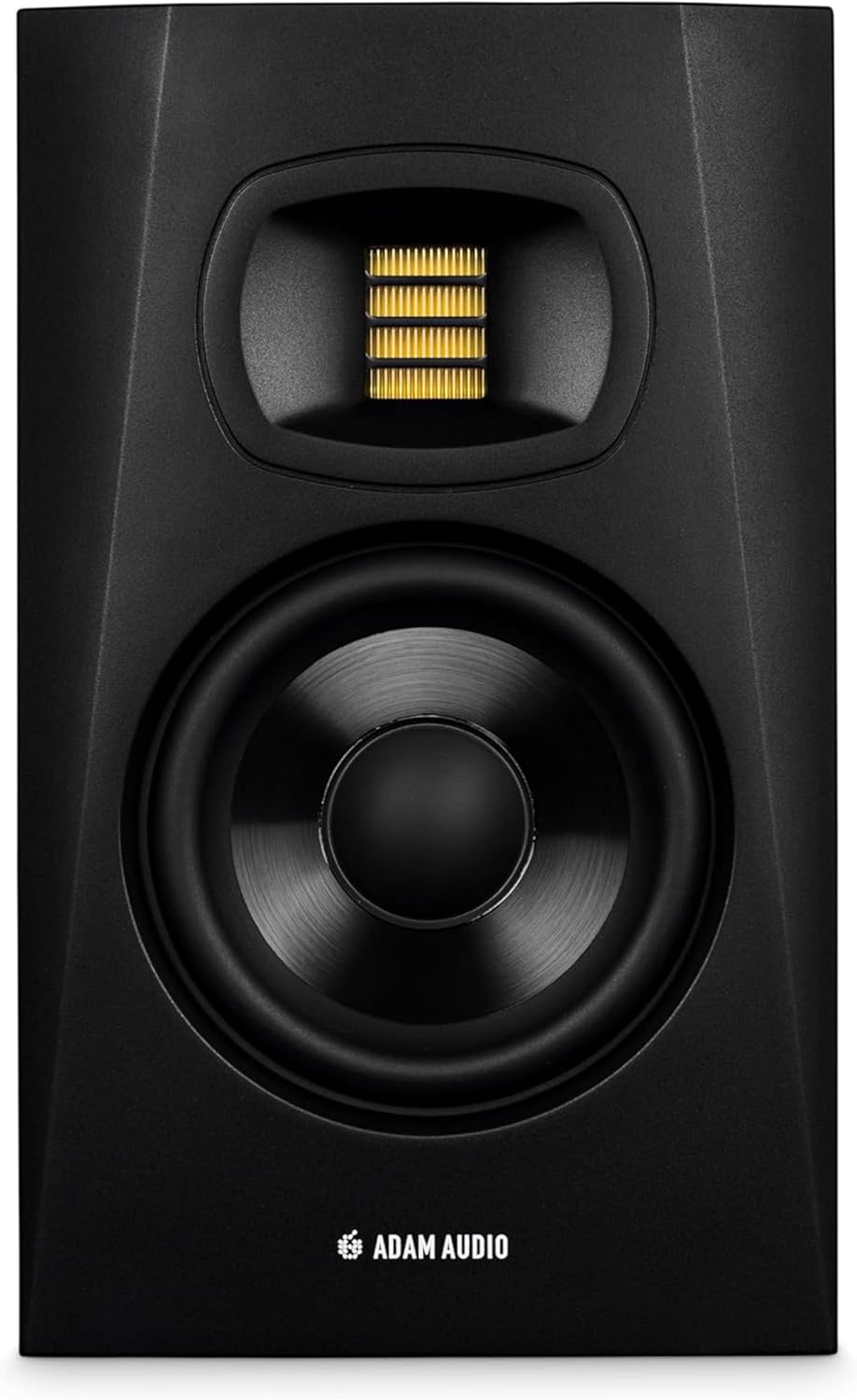
Pros
- Exceptional flat frequency response reveals mix details with clarity and accuracy comparable to monitors at higher price points
- Robust build quality with beveled cabinet design allows flexible placement in compact spaces without compromising sound
- Wide dispersion characteristics eliminate the need to sit in a fixed position, improving workflow flexibility
- Outstanding value for quality, delivering professional monitoring capabilities at an accessible mid-range price
- Seamless compatibility with T10S subwoofer for extended low-end monitoring and complete frequency spectrum control
Cons
- Some users report a slight constant hiss audible in very quiet rooms when no audio is playing, though overall sound quality remains excellent
- Larger footprint than expected may require desktop reorganization for users with extremely limited workspace
- Power button located on rear panel rather than front, which some users find less convenient than front-mounted controls
The ADAM Audio T5V is a two-way nearfield studio monitor engineered for home studios, small control rooms, and professional recording spaces where accurate sound reproduction matters. Whether you are mixing music, editing podcasts, tracking instruments, or composing for film, the T5V delivers the revealing, detailed monitoring that professionals demand. This is not a consumer speaker; it is a precision tool designed for critical listening and mix decisions.
The standout feature is ADAM Audio's signature U-ART tweeter combined with the HPS waveguide technology, which provides exceptional high-frequency detail and a remarkably wide sweet spot. The 5-inch polypropylene woofer extends bass response to 45 Hz, while the tweeter reaches up to 25 kHz, covering the full spectrum needed for professional audio work. The DSP-managed crossover between the 50W woofer and 20W tweeter amplifiers produces clean, accurate output up to 106 dB SPL per pair, sufficient for confident monitoring in most studio environments.
Build quality is robust and professional-grade. The compact, beveled cabinet design allows placement flexibility even in tight spaces, while the rear-firing bass reflex port prevents boundary issues. The monitor feels substantial at 12.6 pounds, with materials and construction that inspire confidence. Multiple connectivity options including XLR, 1/4-inch TRS, and RCA ensure compatibility with virtually any audio interface or source device.
Minor considerations include a slight hiss audible in very quiet rooms when no audio plays, and the power button location on the rear rather than the front panel. The monitor is also larger than some might expect for a 5-inch design, so desktop space planning is recommended. However, these are minor trade-offs for the level of audio quality and professional capability delivered.
The ADAM Audio T5V represents exceptional value for serious home studio owners and professionals seeking accurate, revealing monitoring without the premium price tag of flagship models. It earns its reputation as one of the best nearfield monitors available at this price point.
Audio Output: Stereo, 70W combined (50W woofer + 20W tweeter class D amplification)
Driver Configuration: 5-inch polypropylene woofer with 0.48-inch U-ART tweeter
Frequency Response: 45 Hz to 25 kHz
Maximum SPL: 106 dB per pair
Connectivity: XLR, 1/4-inch TRS, RCA
Cabinet Design: Polypropylene enclosure with rear-firing bass reflex port and beveled design
Dimensions: 11.7 inches (D) x 7 inches (W) x 11.7 inches (H)
Weight: 12.6 pounds per unit
Warranty: 5-year manufacturer warranty
Power: Corded electric, standard AC outlet
Mounting: Tabletop mount
Who Should Buy the T5V: Home studio owners, music producers, audio engineers, podcast creators, and musicians seeking accurate, professional-grade monitoring at a reasonable price. This monitor is ideal for anyone who needs flat frequency response and detailed sound reproduction for mixing, mastering, or critical listening.
Room Considerations: The T5V performs best in treated or semi-treated rooms. The adjustable DSP-based high and low-shelf filters help adapt to acoustically challenging spaces. Pair with acoustic panels or bass traps for optimal results in untreated rooms.
Desktop Space: While compact for its class, the T5V is larger than some 5-inch monitors. Measure your desk space carefully. The beveled cabinet allows angled placement for better dispersion.
Connectivity Setup: Connect via XLR for balanced, professional-grade audio with minimal noise. RCA and 1/4-inch TRS options work well for shorter cable runs or when XLR is unavailable.
Subwoofer Pairing: Consider adding ADAM Audio's T10S subwoofer to extend low-frequency monitoring below 45 Hz. This combination provides complete spectrum coverage for critical bass decisions in mixing and mastering.
Budget Comparison: The T5V delivers sound quality and features typically found in monitors costing significantly more, making it an excellent value choice for quality-conscious buyers who prioritize performance over brand prestige.
What to Look for in Budget Studio Monitors
Frequency Response and Accuracy
The core purpose of a studio monitor is to reproduce sound faithfully. Look for a flat, extended frequency response that doesn’t artificially boost bass or treble. This neutrality allows you to hear your mix as it truly is, which is essential for making accurate adjustments. A wider range, especially in the low end, means you will hear more of the fundamental tones in your music.
Models like the Edifier MR4.5 emphasize this with a stated response from 50Hz to 40kHz. Such specifications help capture subtle details and harmonics. This accuracy is crucial whether you are fine-tuning a bassline or ensuring vocal clarity. For smaller rooms, like many apartments, a balanced response prevents low-frequency buildup that can muddy your perception. You can learn more about speaker placement in compact spaces in our guide on the best speakers for apartments.
Connectivity and Input Options
Your monitors need to interface seamlessly with your existing gear. A variety of input types provides flexibility for different audio interfaces and sources. Balanced connections, such as XLR and TRS, are preferred for professional setups as they reduce noise over longer cable runs. Consumer-level inputs like RCA and 3.5mm AUX are handy for quick connections to phones or laptops.
Bluetooth capability, especially with high-quality codecs like LDAC, adds tremendous convenience for wireless streaming and referencing. The inclusion of a front-panel headphone jack is another practical feature for private listening sessions. Having multiple input choices future-proofs your setup and accommodates various workflows, from dedicated music production to casual multimedia use.
Room Calibration and Placement Controls
No home studio has perfect acoustics. Walls, corners, and desks all color the sound you hear. Effective monitors offer tools to compensate for these environmental factors. Look for rear-panel controls like high-frequency and low-frequency shelving filters. These allow you to reduce excessive treble or tame boomy bass caused by your room’s characteristics.
Some models go further with DSP-based room calibration via a companion app, offering parametric EQ adjustments. Features like a boundary EQ switch to reduce bass boost when placed on a desk are invaluable. Properly using these controls ensures the sound reaching your ears is as accurate as possible, regardless of your room’s limitations. For serious low-end management, consider pairing your monitors with one of the best subwoofers for music.
Driver Technology and Power
The quality of the drivers and the amplifier behind them directly impacts sound clarity and headroom. A two-way design with a dedicated woofer and tweeter is standard. Silk dome tweeters, like those used in the Edifier MR4.5, are often praised for their smooth high-end reproduction. Waveguides around the tweeter help control dispersion for a consistent sweet spot.
Adequate power, measured in RMS watts, ensures the speakers can play cleanly at your desired listening level without distortion. Bi-amped designs, where separate amplifiers power the woofer and tweeter, offer greater control and efficiency. This combination of driver technology and robust amplification delivers the dynamic range and detail needed for critical audio work. Explore our broader selection of audio equipment in the home audio category.
Final Thoughts
Selecting the right studio monitors is a pivotal step toward achieving professional-sounding results in your home studio. After a thorough assessment, two models stand out for distinct reasons. For creators who value extensive connectivity, wireless convenience, and in-depth digital room correction, the Edifier MR4.5 Bi-Amped Studio Monitor presents a remarkably versatile and modern solution. Its app-based controls and high-resolution certification make it a future-ready choice. Conversely, if your priority is a proven, no-frills reference sound with a legacy of professional trust, the ADAM Audio T5V Studio Monitor offers exceptional clarity and a revealing high-frequency response that has earned its place in countless studios. Both will serve you well on your path to audio excellence.
Frequently Asked Questions
Do I need studio monitors if I already have good headphones?
Yes, studio monitors and headphones serve complementary roles. Monitors provide a natural, spatial soundstage and are less fatiguing for long sessions. They allow you to experience how your mix translates in a room, which is how most listeners will ultimately hear it. Headphones are excellent for checking fine details and stereo imaging but can be misleading for overall balance. Using both tools gives you the most complete picture of your mix. For headphone recommendations, visit our headphones and earbuds section.
Can I use studio monitors for casual listening and gaming?
Absolutely. While designed for accuracy, studio monitors offer a clean, detailed, and uncolored sound that is excellent for all audio purposes. You will hear movies, music, and games with greater clarity and depth compared to typical multimedia speakers. Their flat response means you hear the content as the creators intended, without added bass bloat or sharpened treble that can cause listener fatigue.
How important is room treatment for budget studio monitors?
Room treatment is always beneficial, but it is especially important with accurate monitors. Even the best speakers will sound flawed in a poor acoustic environment. Basic treatment, like bass traps in corners and absorption panels at first reflection points, dramatically improves what you hear. The room calibration features found on many modern monitors, like adjustable EQ filters, are designed to help mitigate common room issues. They are a helpful tool, but they work best in conjunction with physical treatment, not as a replacement for it.
What size studio monitor is best for a small desk?
For a standard desk in a bedroom or home office, monitors with 4-inch or 5-inch woofers are typically ideal. They provide sufficient bass response for most production work while fitting comfortably on a desk without overwhelming the space. Larger monitors may produce more low-end, but they require more room to breathe and often need stands placed behind the desk to sound their best. Compact monitors are designed specifically for nearfield listening, making them perfect for close-range, detailed work on a constrained desktop.


Write Your Review
No reviews yet. Be the first to share your experience!