

Do you ever feel like your music’s sparkle is missing? That the shimmer of cymbals, the delicate breathiness of a vocal, or the airy resonance of a violin lacks its full, brilliant texture? The culprit is often a compressed digital source or a lackluster digital-to-analog converter. The quest for crystalline highs without harshness or distortion is a primary goal for audiophiles and casual listeners alike. This guide is crafted for anyone seeking to unveil the full, detailed upper register of their music collection, whether you’re building a desktop sanctuary or enhancing your mobile listening. We’ve assessed a curated selection of DACs renowned for their high-frequency performance to help you make an informed choice.
From ultra-portable USB-C dongles to sophisticated desktop powerhouses, the right DAC can transform your listening experience. Clear highs contribute significantly to soundstage width, instrument separation, and overall musical realism. A well-implemented DAC retrieves those subtle details that get lost in lesser conversions, bringing you closer to the original recording. Let’s explore the key players in the pursuit of perfect treble.
Top DACs for Clear Highs: At a Glance

Pros
- Exceptional sound quality with dual ES9219 DAC architecture and multiple high-quality wireless codecs
- Sufficient power to drive demanding high-impedance headphones that passive Bluetooth receivers cannot handle
- Compact, lightweight design with aluminum clip makes it ideal for travel and daily portable use
- Comprehensive app-based control with parametric EQ for personalized audio tuning
- Excellent build quality with anti-scratch UV coating and solid user reviews praising reliability
Cons
- Small button placement can be awkward and prone to misfires during operation
- Designed exclusively for wired headphones, not compatible with Bluetooth headphones or speakers
- Requires smartphone or computer connection for full functionality, cannot operate independently
The Qudelix-5K is a portable Bluetooth DAC/amplifier designed for music enthusiasts who refuse to compromise on audio quality while maintaining wireless convenience. It bridges the gap between high-end wired headphones and the freedom of Bluetooth connectivity, making it essential for audiophiles with substantial headphone collections who want to go wireless without sacrificing sound fidelity.
The standout feature is its dual ES9219 DAC architecture paired with Qualcomm's QCC5124 Bluetooth chipset, which supports premium wireless codecs including LDAC, aptX Adaptive, and aptX HD. Real-world performance is exceptional, delivering 240mW of power through the balanced 2.5mm output and 80mW through the 3.5mm unbalanced output. Users consistently report that the Qudelix-5K powers high-impedance headphones like 120-ohm models to their full potential, something many portable DAC/amps struggle to achieve. The embedded double-precision equalizer provides granular sound customization through a well-designed mobile app.
Design and build quality are impressive for the price point. At just 25 grams with a compact 52.8mm x 26.7mm footprint, the device clips easily to bags, cables, or clothing. The plastic body features anti-scratch UV coating while the aluminum clip provides durability. Battery life ranges from 6 to 20 hours depending on usage, with both Bluetooth and USB wired modes supported. The device works across Android, iOS, Windows, and macOS platforms seamlessly.
The primary drawback is that small button placement can feel awkward and lead to accidental presses, though most adjustments happen through the app anyway. Additionally, this is strictly a Bluetooth receiver, not a transmitter, so it cannot pair with Bluetooth headphones or speakers. It requires a smartphone or computer connection to function, limiting standalone operation.
The Qudelix-5K represents the gold standard for portable Bluetooth DAC/amplifiers in its price category. It delivers genuine audio improvements for wired headphone enthusiasts, handles challenging impedance loads, and offers the wireless flexibility modern listeners demand. Highly recommended for anyone serious about portable audio quality.
DAC and Amplification: Dual ES9219 HiFi DAC with 96kHz/24-bit support. Balanced 2.5mm output delivers 240mW at 4V RMS. Unbalanced 3.5mm output delivers 80mW at 2V RMS.
Bluetooth and Connectivity: Qualcomm QCC5124 chipset supporting LDAC, aptX Adaptive, aptX HD, AAC, HFP, HSP, A2DP, and AVRCP. USB interface for wired DAC mode. Compatible with Android, Windows, iPhone, and macOS.
Battery and Power: 500mA Li-Po battery providing 6 to 20 hours of streaming depending on usage patterns and output mode.
Physical Specifications: Dimensions 52.8mm height x 26.7mm width x 15.6mm depth including clip. Weight 25 grams. Plastic body with anti-scratch UV coating and dark gray aluminum clip.
Audio Processing: Embedded double-precision equalizer with app-based control for precise frequency adjustment and sound customization.
Who Should Buy: The Qudelix-5K is ideal for audiophiles with wired headphone collections who want Bluetooth convenience without sound quality loss. It's particularly valuable for those with high-impedance headphones (80+ ohms) that standard Bluetooth receivers cannot adequately power. Musicians, sound engineers, and critical listeners benefit from the advanced EQ capabilities and premium codec support.
Who Should Skip: If you exclusively use Bluetooth headphones or wireless speakers, this device won't help. It's also not necessary if you use low-impedance earphones that work fine with basic Bluetooth receivers. Users who value simplicity over customization may find the small buttons and app-dependent controls frustrating.
Key Considerations: Ensure your headphones have a 3.5mm or 2.5mm jack. Verify your device supports the Qudelix app for Android, iOS, Windows, or macOS. Consider whether you need balanced or unbalanced output based on your headphone cable. Factor in that this requires a paired smartphone or computer to function as a standalone device.
Value Assessment: At this price point, the Qudelix-5K offers exceptional value compared to dedicated portable amplifiers or higher-end DAC/amp combos. The dual DAC architecture, codec support, and proven track record among audiophile communities make it a smart investment for serious listeners.

Pros
- Exceptional musicality and detail retrieval that users consistently praise for revealing new dimensions in familiar music
- Versatile R2R architecture with NOS/OS modes provides flexibility for different listening preferences and source materials
- Comprehensive connectivity and powerful headphone amplification make it a true desktop hub for audio
- 10-band PEQ with intuitive app control enables precise sound customization without external EQ hardware
- Excellent build quality with satisfying tactile controls and premium component selection throughout
Cons
- Optical TOSLINK input limited to 96kHz maximum, restricting high-resolution streaming from some sources
- Front panel LED halo lights can become intrusive in dim lighting conditions despite brightness adjustment
- Requires proper setup and understanding of NOS/OS modes to achieve optimal sound quality, not plug-and-play for casual users
The FiiO K13 R2R is a desktop audio powerhouse designed for serious music listeners who demand both sonic quality and versatility. This DAC and headphone amplifier combination serves as a central hub for any desktop audio setup, whether you're using high-end headphones, powered speakers, or integrating into a larger home audio system. It's built for audiophiles who appreciate musicality and want the tools to shape their sound precisely.
What truly sets the K13 R2R apart is its proprietary R2R DAC architecture, which uses 192 ultra-precise 0.1% thin-film resistors to create a uniquely musical presentation. The dual NOS/OS modes give you real flexibility: Non-Oversampling mode preserves the original sampling rate for a natural, organic quality, while Oversampling mode upsamples to 384kHz for enhanced clarity and technical performance. Users consistently report that the K13 reveals details and musicality in their favorite recordings that other DACs simply miss, creating an engaging listening experience that feels less analytical and more emotionally connected.
The 2400mW headphone amplifier output is genuinely powerful, capable of driving even demanding planar magnetic and high-impedance headphones with authority and control. The 10-band parametric EQ with app and web interface control is a game-changer for customization, allowing you to fine-tune the sound to match your headphones' characteristics or your personal preferences. Connectivity is comprehensive with balanced XLR outputs, dual RCA preamp outputs, 4.4mm balanced headphone jacks, and 6.35mm single-ended outputs, making it adaptable to virtually any audio component.
Build quality is solid throughout, with satisfying tactile controls and premium component selection. The display is functional for a desktop unit, and the front panel knobs have excellent detent feel. One caveat: the LED halo lighting around the front knobs can become distracting in dim rooms despite adjustable brightness levels. Additionally, the TOSLINK optical input maxes out at 96kHz, which may limit high-resolution streaming from certain sources like some network streamers that only output via optical.
The FiiO K13 R2R delivers exceptional value for desktop audiophiles seeking musicality, power, and connectivity in one compact unit. It's not a magic bullet that will transform poor recordings, but it excels at revealing the quality and character inherent in well-mastered music. If you appreciate analog warmth, want R2R DAC technology without the premium price tag, and need flexible desktop audio control, this is a compelling choice that justifies its position as a best seller in its category.
DAC Architecture: Proprietary 4-channel fully differential complementary 24Bit R2R DAC with 192 ultra-precise 0.1% thin-film resistors, 30ppm temperature drift
Audio Modes: NOS (Non-Oversampling) and OS (Oversampling with 384kHz upsampling)
Supported Formats: PCM up to 384kHz/32bit, DSD256
Headphone Output: 2400mW power output, 4.4mm balanced and 6.35mm single-ended jacks
Connectivity: XLR balanced line out, dual RCA outputs, TOSLINK optical (up to 96kHz), USB, Bluetooth 5.4 with LDAC/AAC/SBC codecs
EQ: 10-band parametric equalizer with app and web interface control, preset library and sharing
Dimensions: Compact desktop form factor, 0.7 kg weight
Warranty: 1 year manufacturer warranty
Compatible Devices: PC, Laptop, Smartphone, Tablet, Bluetooth-enabled devices
Who Should Buy: Desktop audiophiles with high-quality headphones, music enthusiasts who value musicality over pure technical metrics, and anyone seeking a versatile audio hub that combines DAC, preamp, and headphone amplifier functions. Ideal for those who want R2R DAC character without the ultra-premium price tag.
Who Might Want to Look Elsewhere: Users whose primary source is limited to TOSLINK optical at high-resolution rates (above 96kHz) may face limitations. Those seeking purely clinical, reference-level sound might prefer delta-sigma DACs. Budget-conscious buyers should note this is mid-range pricing for serious audio gear.
Setup Tips: Experiment with both NOS and OS modes to find which suits your music and headphones best. Use the 10-band PEQ to optimize for your specific headphone model. Take advantage of the balanced XLR outputs if connecting to powered speakers or a separate amplifier for superior signal quality.
Key Considerations: This unit benefits from proper setup and understanding of its features. The LED lighting can be dimmed in preferences if it becomes bothersome. Ensure your USB source can provide adequate power, or use the included power supply for optimal performance. The R2R architecture means this is not a neutral reference tool but rather a musicality-focused component designed to enhance enjoyment of your music collection.

Pros
- Noticeable audio quality improvement, especially with high-resolution lossless audio files
- Exceptional durability with strain relief design and premium materials
- Broad compatibility with modern USB-C devices across multiple brands and generations
- Works seamlessly across operating systems including Linux without driver installation
- Compact and lightweight, ideal for travel and daily portable use
Cons
- Audio-only functionality with no charging or video transfer capabilities
- Not bidirectional, so it cannot connect 3.5mm devices to USB-C headsets like AirPods Max
- Some users report minimal difference compared to older adapter models
The UGREEN USB-C to 3.5mm Audio Adapter is a high-resolution digital audio converter designed for modern smartphone users who refuse to compromise on sound quality. This adapter bridges the gap between newer USB-C devices and traditional 3.5mm headphones, making it essential for audiophiles, music enthusiasts, and anyone seeking superior audio performance on the go.
The standout feature is its built-in DAC chip supporting up to 384KHz/32bit resolution, which significantly enhances audio clarity and separation. Real-world performance shows crisp, clear sound with improved high frequencies and pure low-end response. When paired with quality headphones and high-resolution lossless audio files, users report a tangible upgrade in listening experience compared to standard adapters.
Build quality is impressive with a durable nylon-braided cable, alloy shell housing, and proven strain relief design that survives 15,000+ bending cycles. The compact 5-gram form factor makes it portable enough for daily commutes, travel, and switching between devices. Compatibility spans iPhones 15-17, Samsung Galaxy S-series, Google Pixel phones, iPads, MacBooks, and even gaming consoles like PS5.
The main limitation is that this adapter handles audio transmission only, with no charging or video capabilities. Additionally, it's not bidirectional, meaning you cannot use it to connect older 3.5mm devices to USB-C headsets. Some users with standard audio files may notice minimal difference from budget adapters, though high-resolution audio listeners consistently report improvements.
Verdict: This is an excellent value purchase for anyone with a USB-C device who wants to use traditional headphones with noticeably better sound quality. Recommended for musicians, audiophiles, and everyday listeners seeking affordable high-fidelity audio.
Audio Performance: High-resolution DAC chip, 384KHz/32bit sampling rate, lossless audio transmission with noise filtering
Physical Specifications: Weight: 5g, Dimensions: 8.27 x 5.91 x 1.57 inches, Color: Black with metallic finish, Cable: Nylon-braided with strain relief
Connectivity: USB Type-C male to 3.5mm female connector, 0.8A current rating, 0.03W nominal power consumption, no power plug required
Compatibility: iPhone 15-17 series, Samsung Galaxy S20-S26 series, Google Pixel 8-10 series, iPad models, MacBook Pro/Air, most USB-C phones and tablets, PS5, Nintendo Switch 2
Warranty: Extended warranty coverage included with purchase
Who Should Buy This: Perfect for users with USB-C phones who want to use existing 3.5mm headphones without sacrificing audio quality. Ideal for audiophiles, musicians, podcast enthusiasts, and anyone streaming high-resolution lossless audio formats.
What to Know Before Purchasing: This adapter is audio-only with no charging capability, so you cannot charge your device while using it. It cannot connect older 3.5mm devices to USB-C headsets. Ensure your headphones have a 3.5mm jack, not a USB-C connector.
Best Use Cases: Daily commuting with quality wired headphones, portable music listening with high-res audio files, professional use with studio monitors or amplifiers, gaming with headsets on USB-C devices, and travel with legacy audio equipment.
Alternative Scenarios: If you need simultaneous charging and audio, look for powered USB-C hubs. If you use AirPods Max or other USB-C headsets, this adapter won't work. For video streaming or data transfer needs, this product is audio-only.
Pros
- Professional-grade dual DAC chipset delivers transparent, true-to-source audio reproduction
- Hi-Res certification ensures compatibility with high-fidelity audio content and streaming services
- Premium cable construction with copper-silver fusion optimizes both low and high frequency performance
- Wide device compatibility covers smartphones, tablets, laptops, and gaming platforms
- Durable aluminum build with slim, portable design suitable for travel and studio use
Cons
- No customer reviews available yet, making real-world performance validation difficult
- Premium pricing may be steep for casual users who don't require Hi-Res audio capabilities
- Requires USB-C port on device, limiting compatibility with older USB-A only devices
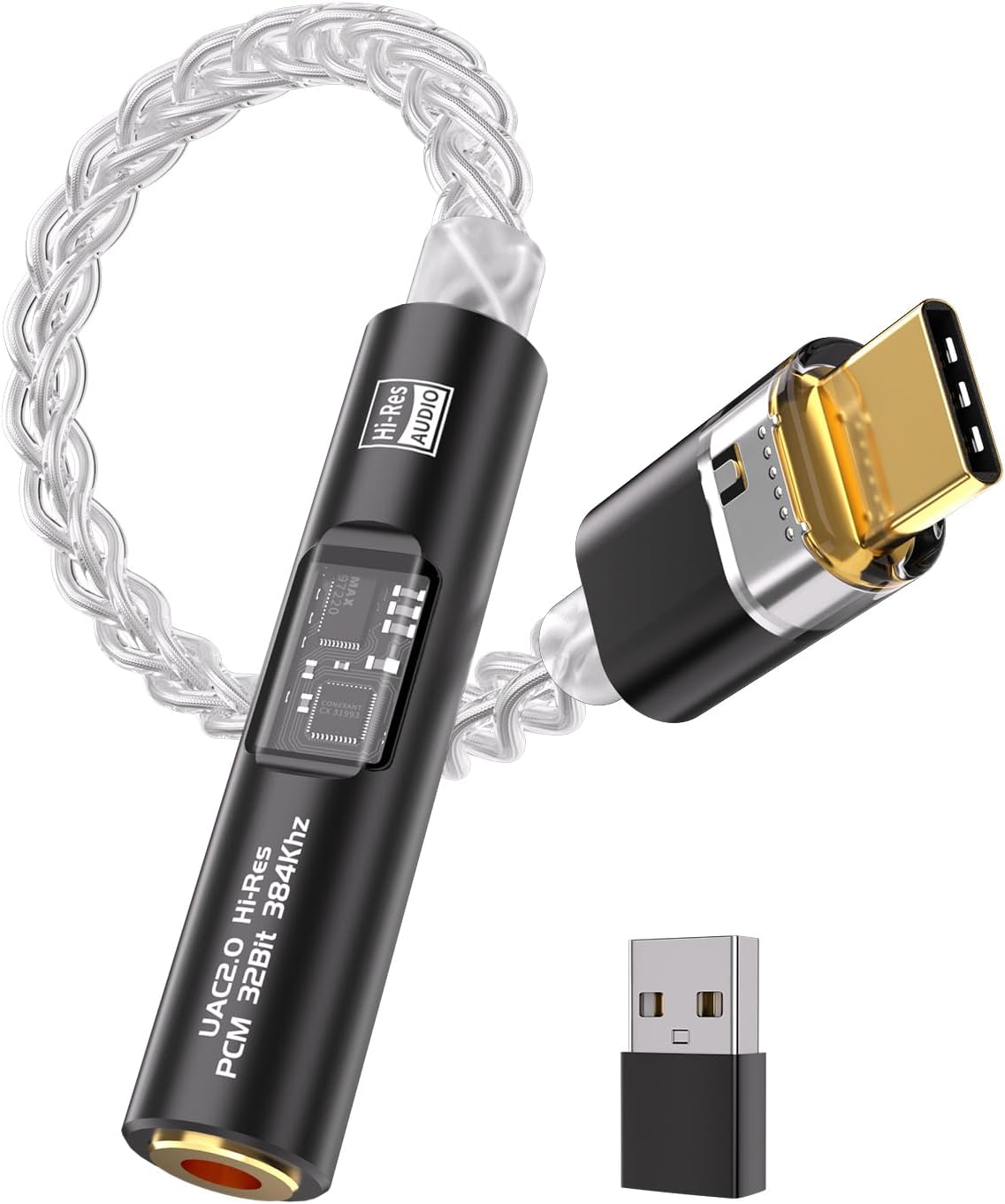
The BZINK USB-C to 3.5mm audio adapter is a premium solution designed for audiophiles, music producers, content creators, and anyone serious about audio quality. This adapter bridges the gap for users with USB-C devices who refuse to compromise on sound, offering a professional-grade alternative to compressed wireless audio.
The standout feature is its dual DAC architecture using premium U.S.-made CX31993 and MAX97220 chipsets. These work together to convert digital signals to analog with zero loss, supporting up to 32-bit/384kHz audio sampling rates. The Hi-Res Gold certification validates this capability, ensuring you experience studio-quality sound with crisp highs and powerful bass reproduction. The 8-strand 4N single-crystal copper-silver plated cable further enhances performance by leveraging copper's low-frequency strength and silver's high-frequency detail.
Build quality is impressive, featuring aviation-grade aluminum alloy casing that resists scratches and corrosion. The slim, lightweight design makes it portable for studio sessions, travel, or daily use. The included USB-A adapter adds practical versatility, allowing connection to a broader range of devices including older computers and accessories.
The main limitation is the lack of verified user reviews, making it difficult to assess long-term reliability or real-world performance consistency. Additionally, the premium price point targets serious audio enthusiasts rather than casual listeners. Compatibility is limited to USB-C devices, though the included USB-A adapter partially addresses this concern.
Overall, this adapter delivers exceptional value for audiophiles and professionals seeking distortion-free audio. The combination of Hi-Res certification, dual DAC technology, and premium construction makes it a standout choice. With 20-month warranty coverage and responsive customer support, BZINK backs this product with confidence. Highly recommended for anyone transitioning to USB-C devices without sacrificing audio quality.
Audio Technology: Dual DAC amplifier with CX31993 and MAX97220 chipsets, Hi-Res Gold certified, supports 32-bit/384kHz audio sampling rates
Cable Construction: 8-strand 4N high-purity single-crystal copper-silver plated wire cores
Compatibility: iPhone 16/15 series, iPad Pro/Air, MacBook Pro/Air, Android devices (Samsung Galaxy S25/S24/S23 series, Google Pixel 9/8/7 series, OnePlus), Dell XPS, HP Chromebook, Surface Book 3, Steam Deck, PS5, and more
Connectors: USB Type-C input, 3.5mm audio jack output, includes USB-A adapter
Physical: Aviation-grade aluminum alloy casing, black metallic finish, weight 0.05 kg, slim and portable design
Warranty: 20-month limited warranty with 24-hour email support
Who Should Buy This: Audiophiles, music producers, audio engineers, content creators, and gamers who use USB-C devices and demand high-fidelity sound. Also ideal for anyone upgrading from wired headphones and refusing to compromise on audio quality.
Who Should Skip This: Casual listeners satisfied with standard audio quality, users exclusively on older USB-A devices without the included adapter, or budget-conscious buyers seeking basic audio connectivity.
Key Considerations: Verify your device has a USB-C port (included USB-A adapter adds flexibility). Confirm your headphones or speakers connect via 3.5mm jack. Consider whether Hi-Res audio content is available through your preferred music streaming service to fully leverage this adapter's capabilities.
Warranty and Support: The 20-month warranty and responsive 24-hour email support reduce purchase risk. This extended coverage reflects manufacturer confidence in build quality and durability.
Pros
- Exceptional value for professional-grade DAC and amplifier functionality in one unit
- Transparent, neutral sound signature with excellent channel matching from DAC-controlled volume
- Versatile connectivity and multi-platform support across Windows, Mac, Linux, iOS, and Android
- Feature-rich design with customizable EQ and multiple output modes for any audio setup
- Robust 2-year manufacturer warranty provides peace of mind
Cons
- Quality control concerns reported by some users, particularly with headphone jack durability during hot-swapping
- Requires careful handling to avoid damaging connectors, as they lack protective design
- May require learning curve to fully utilize advanced PEQ and system integration features
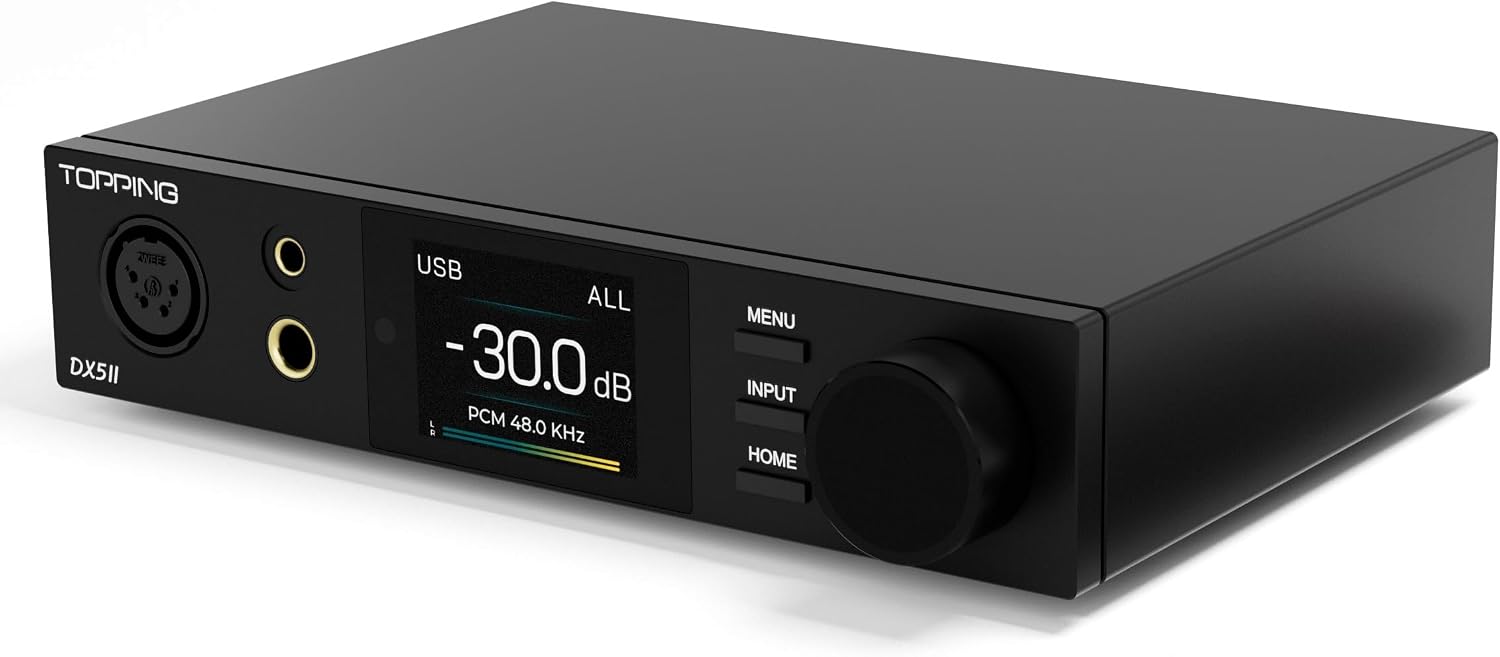
The TOPPING DX5 II is a desktop DAC and headphone amplifier combo designed for serious audiophiles, content creators, and HiFi enthusiasts who demand professional audio quality without the premium price tag. It combines dual ESS9039Q2M DAC chips with a powerful X-Hybrid balanced amplifier in a single compact unit, making it an excellent centerpiece for a high-end audio workstation.
The standout feature is its dual DAC architecture paired with 7600mW of balanced power output, delivering transparent and detailed sound reproduction. The 10-band parametric EQ is a game-changer for customization, allowing users to fine-tune their system to match their headphones, room acoustics, or personal preferences. LDAC Bluetooth 5.1 support brings wireless convenience without sacrificing audio quality, while the Aurora UI display makes navigation and mode switching intuitive and visually appealing.
Build quality is solid with metal and plastic construction, though some users have noted that the headphone jacks lack protective design and can be vulnerable to damage during hot-swapping. The internal power supply and extensive connectivity options, including USB, optical, coaxial, and Bluetooth inputs, make it compatible with virtually any audio source and operating system.
The main drawback is the reported quality control inconsistency with connector durability. Users should avoid frequent hot-swapping of headphone cables and handle connections carefully to prevent premature failure. Despite this concern, the unit delivers exceptional audio performance and versatility for the price.
The TOPPING DX5 II is a smart investment for anyone building a professional-grade desktop audio system or upgrading from consumer-level equipment. It offers the features and performance of much more expensive DAC amplifiers, making it a standout value in the audiophile market.
DAC Chipset: Dual ESS9039Q2M
Audio Format Support: PCM up to 768kHz/32bit, DSD512
Headphone Output Power: 7600mW x2 (balanced)
Audio Processing: 10-band parametric EQ with self-developed IV circuitry
Connectivity: USB, Bluetooth 5.1 (LDAC, aptX Adaptive, aptX HD, AAC, SBC), Coaxial SPDIF, Optical SPDIF
USB Controller: XMOS XU316
Bluetooth Chipset: QCC5125
Display: 2.0 inch Aurora UI with 9 customizable themes
Outputs: 4.4mm balanced headphone jack, 6.35mm single-ended headphone jack
Additional Features: 12V trigger in/out, preamp mode, volume control via DAC
Power Supply: 12V DC internal power supply
Compatibility: Windows, Mac, Linux, iOS, Android
Warranty: 2 years manufacturer
Included Accessories: USB A to USB B cable, remote control, power cable, Bluetooth cable, headphone adapter, quick start guide
Who Should Buy This? The TOPPING DX5 II is perfect for desktop audio enthusiasts, professional audio engineers, musicians, and anyone who wants studio-quality sound from their headphones or active speakers. It's ideal if you own demanding high-impedance headphones, multiple IEMs, or want wireless audio without quality loss.
What Makes It Special? The combination of dual DAC chips, powerful balanced amplification, and 10-band EQ in one unit is rare at this price point. Most competitors force you to choose between a standalone DAC and a separate headphone amp. The parametric EQ allows you to compensate for headphone frequency response issues or room acoustics without external software.
Connectivity Considerations: This unit works with almost any audio source thanks to its multiple inputs. Use USB for computers, optical for CD transports or gaming consoles, Bluetooth for mobile devices, and coaxial for digital streamers. The preamp mode lets you connect it directly to powered speakers or active subwoofers.
Important Notes: Handle the headphone connectors gently and avoid frequent hot-swapping to prevent damage. The unit runs cool and quiet, making it suitable for near-field desktop use. Allow time to explore the PEQ settings and Aurora UI themes to maximize your investment.

Pros
- Outstanding audio quality improvement even on phones with built-in headphone jacks, delivering noticeably clearer and more detailed sound
- Exceptional value for money, outperforming DAC/amps costing 3-4 times the price according to verified users
- Truly portable at just 8.5 grams with a minimalist design that slips easily into any pocket or bag
- Versatile compatibility spanning mobile devices, computers, and gaming consoles with plug-and-play functionality
- Powerful amplification reaches painfully high volume levels with zero distortion, perfect for demanding headphones
Cons
- Non-detachable USB-C cable creates a potential durability concern for frequent mobile users, with reports of internal wire degradation after weeks of portable use
- Device operates noticeably warm during extended listening sessions, which may concern some users about long-term reliability
- Requires FIIO Control app to enable UAC1.0 mode for gaming compatibility, adding an extra setup step
The FiiO KA11 is a portable USB-C to 3.5mm DAC amplifier designed for audiophiles, mobile gamers, and anyone seeking superior sound quality on their devices. This tiny powerhouse supports hi-resolution audio up to 32bit/384kHz, making it ideal for lossless music streaming, gaming, and professional audio work on smartphones, tablets, laptops, and gaming consoles.
Performance is where the KA11 truly shines. The premium CS43131 DAC chip combined with a quality op-amp delivers exceptional audio clarity with THD+N under 0.0006% and an impressive 125dB signal-to-noise ratio. Real-world users report immediate and noticeable improvements in sound quality across all devices, with clearer vocals, richer bass, and more detailed instrumentation even at high volumes. The 245mW power output at 16 ohm load ensures you can drive quality headphones without compromise, while maintaining zero distortion even at painfully loud levels.
Design and portability are standout strengths. At just 8.5 grams and measuring 44x9.7x10.5mm, the KA11 is genuinely pocket-sized and won't weigh down your gear. The matte black finish looks professional, and the multi-layer immersion gold circuit board reflects FiiO's commitment to quality construction. Universal compatibility with Android, iOS, Windows, Mac, PS5, and Nintendo Switch makes this adapter incredibly versatile for different use cases.
The main drawback is the non-detachable USB-C cable, which creates a single point of failure for portable users. Some reviewers report internal wiring issues after weeks of regular mobile use, particularly near the strain relief. Additionally, the device runs noticeably warm during extended sessions, though this appears to be normal operation rather than a critical flaw. Enabling UAC1.0 mode for gaming requires downloading the FIIO Control app, which adds a minor setup step.
Verdict: The FiiO KA11 offers exceptional audio quality and versatility at an unbeatable price point. If you own quality headphones and want to unlock their full potential on mobile or desktop, this DAC amplifier delivers studio-grade performance in a genuinely portable package. Best suited for stationary or light mobile use, it represents outstanding value for serious audio enthusiasts and casual listeners alike.
Audio Performance: 32bit/384kHz maximum sampling rate, THD+N less than 0.0006%, SNR 125dB, Noise floor below 1.7uV
DAC Chipset: CS43131 with premium op-amp, multi-layer immersion gold circuit board design
Power Output: 245mW at 16 ohm load, 200mW at 32 ohm load
Physical Dimensions: 44 x 9.7 x 10.5mm, Weight 8.5 grams
Connectivity: USB Type-C input, 3.5mm headphone jack output, Supports UAC1.0 and UAC2.0 modes
Compatibility: Android, iOS, Windows, Mac, Nintendo Switch, PlayStation 5
Warranty: 1 year limited warranty, Manufactured by FiiO
Who Should Buy: The KA11 is perfect for audiophiles with quality wired headphones, mobile gamers seeking low-latency audio, Apple Music lossless subscribers wanting to hear the difference, and anyone frustrated with their device's built-in audio quality. If you own headphones costing over $100 or use hi-res audio formats, this adapter pays for itself in audio quality improvements.
Who Should Reconsider: If you primarily use wireless earbuds, need a rugged adapter for extreme portability, or plan to use this device constantly on the move, consider the durability concerns reported by some users. The warm operating temperature during extended use may also be a consideration for sensitive users.
Setup Tips: Download the FIIO Control app to access all features including UAC1.0 mode for gaming. The device is plug-and-play on most devices but benefits from proper driver installation on Windows computers. Allow a brief warm-up period for optimal sound quality after first connection.
Best Use Cases: Stationary listening at home or office, gaming on PS5 or Switch, enjoying lossless audio on iPhones, upgrading phone audio for music production, or portable studio work where sound quality matters.

Pros
- Exceptional audio performance with industry-leading -140dB THD specification ensures transparent, detailed sound reproduction
- Versatile connectivity across USB, optical, coaxial, AES, and Bluetooth 5.1 LDAC accommodates virtually any source device
- Powerful 10-band parametric equalizer with customizable profiles lets you tailor the sound to your preferences and room acoustics
- Ultra-low jitter at -157dB preserves timing integrity and improves spatial imaging across the frequency spectrum
- Premium build quality with CNC-machined chassis and thoughtful design elements befits its flagship positioning
Cons
- Limited user reviews available, making it difficult for potential buyers to assess long-term reliability and real-world performance
- Steep learning curve for parametric EQ software may overwhelm casual users unfamiliar with advanced audio tuning
The TOPPING D900 positions itself as an ultra-flagship digital-to-analog converter designed for the most demanding audio professionals and discerning music enthusiasts. This is not an entry-level device, but rather a precision instrument built for those who prioritize sonic excellence and technical performance above all else. It serves recording studios, mastering facilities, high-end home audio systems, and professional streaming setups where accurate sound reproduction is non-negotiable.
The standout feature is TOPPING's proprietary PSRM 1-bit decoding architecture, which achieves an impressive -140dB THD specification alongside 131dB SNR performance. Paired with the proprietary I/V conversion circuit utilizing ultra-low distortion op-amps, the D900 delivers remarkably clean analog output with exceptional dynamic range and musicality. The ultra-low jitter performance at -157dB further preserves timing accuracy, resulting in superior spatial imaging and instrument separation. The 10-band parametric equalizer with customizable frequency, gain, and Q value adjustments empowers users to fine-tune their sound signature to match their preferences or compensate for room acoustics.
Build quality reflects the flagship positioning, featuring a precision CNC-machined aluminum chassis, premium components throughout, and a thoughtfully designed 2-inch full-color interactive display that shows real-time FFT spectrum analysis, VU metering, or playback information. The included wireless remote with aluminum construction adds convenience to desktop use. Connectivity options are comprehensive, supporting USB-C, USB-B, optical, coaxial, AES, IIS-LVDS, and Bluetooth 5.1 with LDAC codec support, making it compatible with virtually any audio source from computers to streaming devices to gaming consoles.
The primary drawback is the substantial investment required, making it accessible only to serious audio professionals and committed enthusiasts. Additionally, the parametric EQ software and advanced features present a steeper learning curve compared to simpler DACs. With limited customer reviews currently available, potential buyers have minimal real-world user feedback to assess long-term reliability and practical performance in various listening environments.
The TOPPING D900 represents the pinnacle of DAC technology for those seeking uncompromising audio quality and technical excellence. Its combination of industry-leading specifications, versatile connectivity, customizable sound tuning, and premium build quality justifies its flagship status for professional and high-end consumer applications.
Audio Performance: THD: -140dB, SNR: 131dB, Jitter: -157dB
Connectivity: USB-C, USB-B, Optical, Coaxial, AES, IIS-LVDS, Bluetooth 5.1 (LDAC, aptX, HD, AAC, SBC)
Controls: Precision volume control with 0.5dB steps, 10-band parametric EQ with adjustable frequency, gain, and Q value
Display: 2-inch full-color interactive screen with FFT spectrum, VU meter, and 9 background color options
Physical: Dimensions 12.99 x 8.27 x 2.24 inches, Weight 7.7 pounds, CNC-machined aluminum construction
Accessories: Premium aluminum wireless remote control included
Who Should Buy: The TOPPING D900 is ideal for recording engineers, mastering professionals, audiophile music collectors, high-end home theater enthusiasts, and anyone who demands the absolute best in digital audio conversion quality. If you have invested significantly in quality speakers, headphones, or power amplifiers, this DAC will unlock their full potential.
Who Should Skip: Casual listeners seeking basic DAC functionality should consider more affordable options. If you primarily use compressed audio formats or listen through budget equipment, the D900's capabilities would be underutilized. Those intimidated by parametric EQ software may prefer simpler plug-and-play alternatives.
Setup Considerations: The D900 works best as a centerpiece in a dedicated audio system connected to quality amplification and speakers. It functions as both a standalone DAC and preamp, offering flexibility in system configuration. Allow time to explore the parametric EQ software to maximize the sound quality tailored to your preferences and room characteristics.
Choosing Your DAC for Superior Highs
DAC Chipset and Architecture
The heart of any DAC is its conversion technology. Different chipsets and designs impart unique characteristics to the sound. For exceptionally clear and natural highs, look for renowned chips like the ESS Sabre series (e.g., ES9039Q2M, ES9219) or proprietary architectures like the R2R ladder design in the FiiO K13. These are engineered for low distortion and high resolution, ensuring that high-frequency information is reproduced accurately without digital glare or artificial brightness.
Advanced designs, such as the self-developed PSRM 1-bit architecture in the TOPPING D900, push the boundaries of measured performance, achieving astonishingly low noise floors. This results in a pitch-black background against which the finest treble details can emerge with pristine clarity. The choice between a delta-sigma chip and an R2R design often comes down to a preference for ultra-precise, neutral detail versus a more organic, musically textured presentation.
Output Power and Headphone Matching
A DAC’s ability to render clear highs isn’t solely about the chip; the amplifier stage plays a critical role. High-impedance or demanding headphones require sufficient clean power to perform at their best across the entire frequency range. A DAC-amp combo like the TOPPING DX5 II provides massive balanced output, ensuring that even the most power-hungry headphones can deliver extended, effortless highs without strain.
For in-ear monitors and efficient headphones, a lower-power but ultra-clean amp is ideal to avoid introducing any hiss or noise. Portable options like the Qudelix-5K and the FiiO KA11 are engineered for this balance, providing enough drive for clear dynamics while maintaining a silent noise floor, which is essential for appreciating subtle high-frequency details in well-mastered tracks.
Connectivity and System Integration
Consider how the DAC will fit into your existing setup. For a desktop system, a unit with multiple inputs (USB, optical, coaxial) and outputs (RCA, XLR) like the FiiO K13 offers maximum flexibility. This allows you to connect a computer, a streaming device, or a CD transport and output to active speakers or a separate amplifier, all while benefiting from its high-quality conversion.
For smartphone or laptop use, a simple USB-C DAC adapter is the most practical solution. Models like the UGREEN adapter or the BZINKAudio unit with CX31993 chip provide a significant and immediate upgrade over built-in audio jacks, restoring lost high-frequency detail. If wireless streaming is a priority, ensure the DAC supports high-resolution codecs like LDAC or aptX HD, as found on the Qudelix-5K and TOPPING DX5 II, to preserve treble information over Bluetooth.
Features for Sound Shaping
Some listeners prefer a perfectly neutral signal path, while others appreciate the ability to tailor the sound. Many modern DACs, including several in this review, offer parametric EQ (PEQ). This powerful tool, as seen in the TOPPING D900 and FiiO K13, allows you to make precise adjustments. You can gently tame a bright headphone or add a touch of air to a warmer-sounding system, giving you ultimate control over your high-frequency presentation.
Other features like NOS/OS modes on R2R DACs let you choose between a more direct, natural sound and an oversampled one that may offer superior measured clarity. Exploring these options can be part of the fun in dialing in your ideal treble response. For a deeper dive into DACs optimized for specific genres, explore our guides on vocal clarity and classical music.
Final Thoughts
Ultimately, the journey to finding the best HiFi DACs with clear highs is about matching exceptional technology with your personal listening environment. Whether you prioritize the unmatched precision and connectivity of a desktop flagship like the TOPPING D900 Ultra-Flagship DAC or the incredible versatility and pristine wireless performance of a portable powerhouse like the Qudelix-5K Bluetooth USB DAC AMP with LDAC, the options available today can genuinely elevate your music. By focusing on high-quality components, clean amplification, and features that suit your needs, you can unlock a new level of detail and enjoyment from your favorite recordings.
Frequently Asked Questions
What makes a DAC good for high frequencies?
A DAC excels at high frequencies when it has a low noise floor and low distortion, particularly in the treble range. High-resolution support (like 32-bit/384kHz or DSD) and quality components ensure delicate details are not lost. The amplifier section must also provide clean, stable power to drive headphones or feed a system without adding grain or harshness to the sound.
Do I need a balanced connection for better highs?
A balanced connection can improve high-frequency performance by providing better channel separation and often more power, which can lead to a clearer, more dynamic sound with a wider soundstage. However, a well-designed single-ended output can also sound superb. The difference is often more pronounced in larger desktop systems or with harder-to-drive headphones.
Can a cheap USB-C DAC adapter improve sound quality?
Absolutely. Even an affordable adapter like the UGREEN or FiiO KA11 replaces the typically low-quality DAC and amp built into your phone or laptop. By using a dedicated chipset and cleaner circuitry, these adapters can provide a noticeable improvement in clarity, detail retrieval, and overall dynamic range, making highs sound more extended and less compressed.
How important is Bluetooth codec support for wireless audio quality?
For preserving high-frequency detail over Bluetooth, it is crucial. Standard SBC codecs compress audio heavily, often rolling off the top end. High-resolution codecs like LDAC, aptX HD, or aptX Adaptive transmit much more audio data, allowing for fuller, more detailed treble and a more lifelike listening experience when wireless convenience is needed.


Write Your Review
No reviews yet. Be the first to share your experience!