

Are you tired of straining to hear dialogue in your favorite shows or feeling like movie soundtracks fall flat? The speakers built into most modern TVs simply can’t deliver the rich, detailed audio that today’s content deserves. You want to feel the rumble of an explosion, the clarity of a whispered conversation, and the immersion of a cinematic score without turning your living room into a complex web of wires and components.
This guide is for anyone ready to transform their home entertainment experience with a simple, powerful upgrade. We have evaluated five leading smart soundbars, focusing on performance, features, and user-friendly design. Whether your priority is thunderous bass for action movies or crystal-clear dialogue for nightly news, a smart soundbar is the most effective solution. For those considering other tiers, our resource on the best mid-range soundbars offers further options.
Pros
- Exceptional speech and dialogue clarity thanks to a dedicated center tweeter and Dialogue Mode
- Effortless setup with a single cable connection and included optical cable
- Versatile connectivity with HDMI-ARC, optical, AUX, and Bluetooth inputs
- Sleek, low-profile design blends seamlessly with any TV setup
- Expandable with optional Bose subwoofers for a fuller home theater experience
Cons
- HDMI cable is sold separately, which may add unexpected cost for users who prefer that connection method
- At 35 watts with no built-in subwoofer, bass performance may feel limited for action movies or music lovers without an upgrade
- Wall mounting brackets are sold separately, adding cost for those who want a cleaner installation
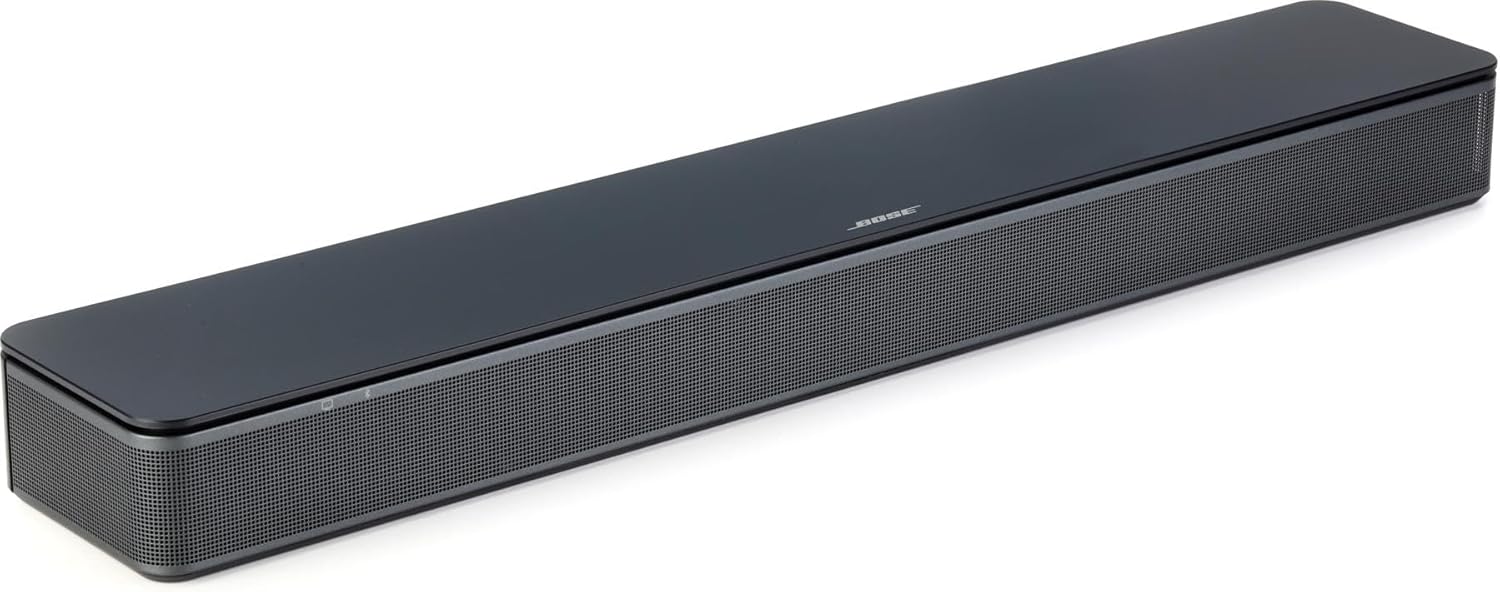
The Bose TV Speaker is a compact all-in-one soundbar built specifically to solve one of the most common frustrations with modern flat-screen TVs: poor audio quality and hard-to-understand dialogue. At just 2.21 inches tall and 23.38 inches wide, it is designed for everyday TV watchers, seniors, and anyone who wants a straightforward audio upgrade without the complexity of a full surround sound system.
The standout feature here is the Enhanced Dialogue Mode, which uses a dedicated center tweeter to sharpen vocal clarity and pronunciation. Combined with two angled full-range drivers and built-in Dolby decoding, the soundbar delivers surprisingly wide and natural-sounding audio for its compact size. Real-world performance is well-suited for news broadcasts, dramas, and talk shows where speech intelligibility is the priority.
Design-wise, Bose has kept things clean and minimal. The slim black enclosure is built from durable plastic and sits unobtrusively in front of a TV. Small LED indicators on the front provide subtle visual feedback for volume changes and feature activation. The included remote control is compact and straightforward, offering quick access to Dialogue Mode and a bass boost toggle.
There are a few honest limitations worth noting. The soundbar outputs 35 watts with no built-in subwoofer, so bass response is modest on its own. Users who enjoy action films or bass-heavy music will likely want to invest in the optional Bose Bass Module 500 or 700. Additionally, the HDMI cable is not included, and wall mounting brackets are sold separately, which can add to the overall cost.
Overall, the Bose TV Speaker earns its reputation as one of the best compact soundbars in its category. It excels at what it promises: clearer TV audio with minimal setup effort. It is a strong choice for anyone seeking a reliable, brand-trusted audio upgrade that is simple to use and easy to place in any living space.
Dimensions: 4.02 inches D x 23.38 inches W x 2.21 inches H. Weight: 8.2 pounds. The slim profile makes it easy to place on a TV stand or media console without obstructing the screen.
Audio: 35 watts maximum output power, stereo audio output mode, dynamic driver type with a 5.6 cm audio driver size and 1-inch tweeter diameter. Built-in Dolby decoding enhances audio realism.
Connectivity: HDMI-ARC with CEC support, optical audio input (cable included), AUX input (3.5mm), and Bluetooth with a 30-foot wireless range. Supports up to 3 paired Bluetooth devices simultaneously.
Compatibility: Works with all televisions. Expandable with Bose Bass Module 500 or 700 via Bose Bass Module Connection Cable or standard 3.5mm audio cable (both sold separately). Wall brackets also sold separately.
In the Box: Bose TV Speaker, remote control with pre-installed battery, optical cable, power cord (5 ft), and quick start guide. Model number: 838309-1100. Warranty: 1-year limited warranty from Bose.
If you are shopping for a soundbar primarily to improve TV dialogue clarity, the Bose TV Speaker is one of the most targeted solutions available. Its Dialogue Mode and center tweeter design make it especially well-suited for households where hearing speech on TV is the main concern, including older adults or those with mild hearing difficulties.
For buyers who want a simple plug-and-play experience, this soundbar delivers. Setup takes only minutes with the included optical cable, and HDMI-ARC connectivity means you can use your existing TV remote to control volume. There is no app required, no complex configuration, and no steep learning curve.
However, if you are a dedicated home theater enthusiast looking for booming bass and cinematic surround sound, this soundbar alone may not fully satisfy. Consider pairing it with the Bose Bass Module 500 or 700 for a more immersive experience. Budget-conscious buyers should also factor in the cost of an HDMI cable and optional wall brackets if needed.
Compared to generic budget soundbars, the Bose TV Speaker justifies its price through brand reliability, audio engineering quality, and the expandable ecosystem. It is a long-term investment for anyone who values clear, natural sound over raw volume or deep bass. It is best matched with small to medium-sized living rooms and TVs up to 55 inches.
How to Choose Your Smart Soundbar
Audio Format and Channel Configuration
The channel count is a fundamental specification. A 2.1 system, like the Samsung B-Series, provides left and right channels plus a subwoofer for solid stereo sound and bass. A 3.1 system adds a dedicated center channel, which is crucial for clear dialogue. Models like the TCL S60K S Series 3.1 Channel Sound Bar with Dolby excel here.
For true surround sound, look for systems that include physical rear speakers or advanced virtualization. The ULTIMEA 7.1ch Sound Bar with Dolby Atmos includes four surround speakers, creating a genuine multi-directional sound field. Support for formats like Dolby Atmos and DTS:X adds height and dimensionality, making soundscapes more immersive.
Connectivity and Smart Features
Modern soundbars should connect seamlessly to your existing setup. HDMI ARC or eARC is the preferred connection for single-cable simplicity and high-quality audio passthrough. Bluetooth is essential for wireless music streaming from your phone or tablet, a feature found on all models reviewed.
Smart features enhance convenience and performance. Room calibration technology, such as the AI Sonic feature in the TCL model, automatically adjusts sound to your room’s acoustics. Companion apps, like the one for the LG S60T, allow for detailed audio customization. If gaming is a priority, explore our dedicated guide to the best gaming soundbars for features tailored to that experience.
Subwoofer and Bass Performance
A subwoofer is non-negotiable for full-range audio. It handles the low-frequency effects that give movies and music their weight and impact. Most systems here include a wireless subwoofer, offering placement flexibility. Pay attention to driver size and technologies like Bass Boost or BassMX, which can enhance low-end response.
The physical design also matters. A compact soundbar like the Bose TV Speaker fits easily in front of most TVs without blocking the screen. Consider the size of your room and TV stand when making your choice. For a broader look at audio components, visit our main home audio category.
Brand Ecosystem and Expandability
Some soundbars offer better integration within a specific brand’s ecosystem. The LG S60T features WOW Orchestra and WOW Interface for seamless synergy with compatible LG TVs. This can simplify control and potentially enhance audio performance through combined speaker systems.
Consider future expansion. Models like the Samsung B-Series and Bose TV Speaker are compatible with optional wireless rear speakers or separate bass modules. This allows you to start with a solid foundation and build a more complete surround system later. Our wireless audio section has more on multi-room and expandable systems.
Final Thoughts
Upgrading your TV’s audio is one of the most impactful changes you can make to your home entertainment. After a detailed assessment, two models stand out for distinct reasons. For users seeking an immersive, theater-like experience with true surround sound, the ULTIMEA 7.1ch Sound Bar with Dolby Atmos is a compelling choice with its included rear speakers. Conversely, if your priority is legendary brand reliability, crystal-clear dialogue enhancement, and a supremely compact design, the straightforward Bose TV Speaker remains a trusted and excellent solution. Whichever path you choose, you are steps away from dramatically better sound.
Frequently Asked Questions
Do I need a soundbar if my TV has decent built-in speakers?
Even TVs with good speakers are limited by their thin design. A dedicated soundbar provides significantly more power, clearer dialogue, a wider soundstage, and impactful bass through a separate subwoofer. The difference in immersion for movies, sports, and music is immediately noticeable.
What is the difference between Dolby Atmos and standard surround sound?
Standard surround sound, like 5.1 or 7.1, channels audio to speakers around you. Dolby Atmos adds object-based audio and height channels. This creates a three-dimensional soundscape where effects can move overhead, making you feel inside the action. It represents the current pinnacle of home theater audio for 2026.
How difficult is it to set up a soundbar with a wireless subwoofer?
Setup is typically very simple. Most soundbars connect to your TV with a single HDMI cable. The wireless subwoofer usually pairs automatically when powered on, requiring no wires between it and the main bar. You just need to plug both into power outlets and place the subwoofer somewhere in the room for optimal bass.
Can a soundbar improve audio for music streaming?
Absolutely. All the soundbars featured include Bluetooth, allowing you to stream music directly from your phone, tablet, or computer. They deliver a much fuller and richer audio profile than most Bluetooth speakers, making them excellent dual-purpose devices for both TV and music. For more expert reviews and comparisons, explore our complete home audio sound bars hub.









Write Your Review
No reviews yet. Be the first to share your experience!