

You are ready to capture your voice, your music, or your next big podcast idea with crystal-clear audio. The barrier between your creativity and your audience often comes down to one crucial piece of gear, the audio interface. Navigating the options can feel overwhelming, especially when you need professional results without a professional budget. This guide cuts through the noise to highlight a standout, all-in-one solution that delivers exceptional value for content creators, musicians, and podcasters alike. For those exploring different budget tiers, you can also check out our guide on the best audio interfaces under $300.
Our focus is on interfaces that provide studio-grade preamps, versatile connectivity, and intuitive controls, all within a specific price range. We have evaluated top models based on performance, features, and real user feedback to identify a unit that simplifies your workflow. Whether you are streaming live, recording a song, or producing a podcast, the right interface transforms your raw audio into a polished, professional product. Let us dive into our top recommendation.
Our Top Audio Interface Pick
Pros
- Exceptional audio quality with clean, professional sound output straight out of the box
- Compact all-in-one solution eliminates need for multiple cables, adapters, and external equipment
- Highly customizable interface with programmable pads and presets tailored for different content types
- Works flawlessly with Mac and Windows computers for podcast and stream production
- Excellent alternative to discontinued competitors with active firmware support and 2-year warranty
Cons
- Steep learning curve for beginners, particularly when connecting to mobile devices like iPhones
- Some users report occasional firmware freezing issues at startup, requiring power cycles to resolve
- iPhone integration requires additional adapters and accessories, adding to overall setup cost
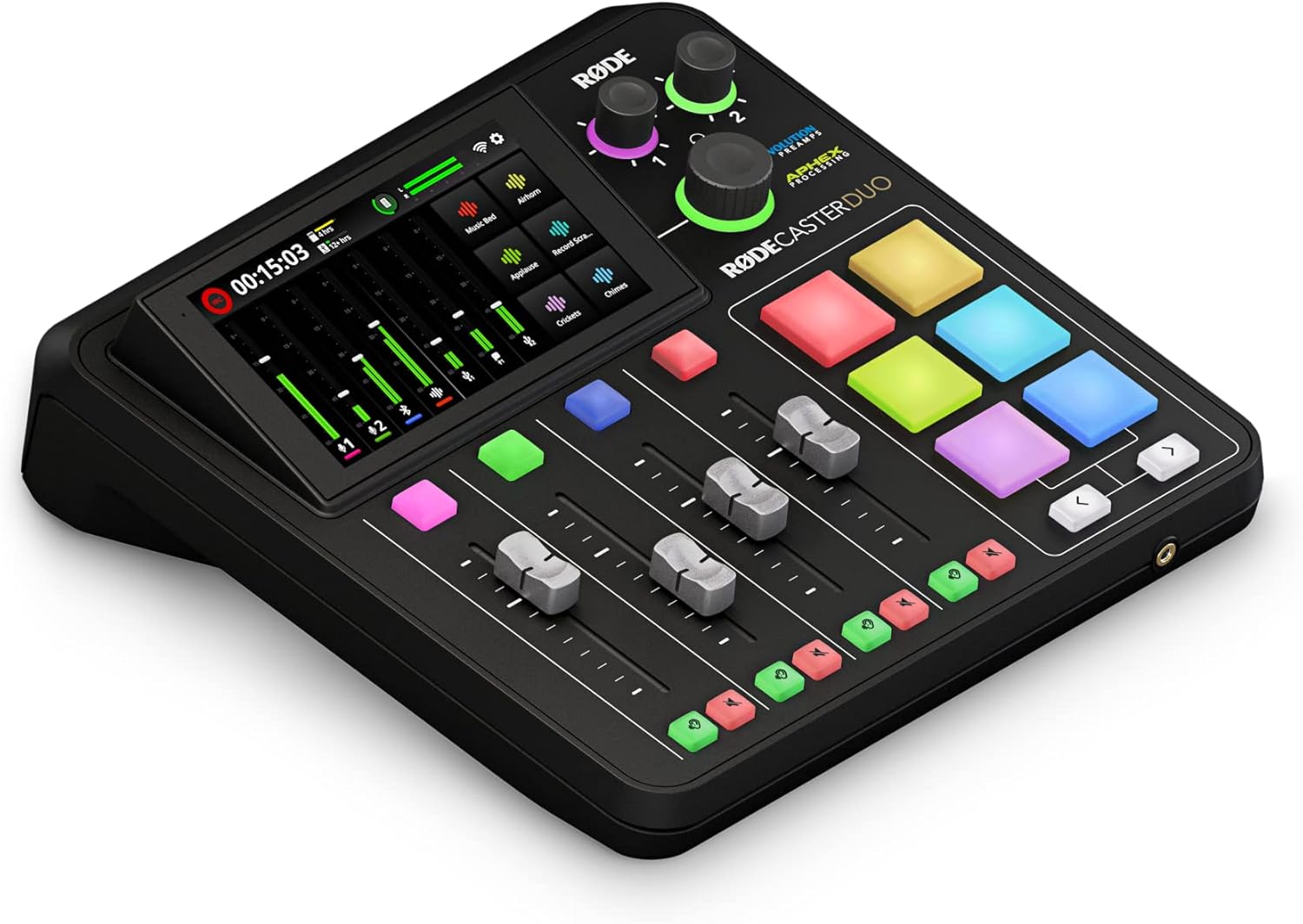
The RØDECaster Duo is a compact, all-in-one audio production solution designed for podcasters, streamers, musicians, and content creators who demand professional-quality sound without the complexity of traditional mixing consoles. It delivers everything needed to produce broadcast-ready audio in a footprint small enough for home studios, desks, and portable setups.
The standout feature is its combination of ultra-low-noise Revolution Preamps (76dB gain, -131.5dBV EIN) paired with studio-grade APHEX processing including the legendary Aural Exciter and Big Bottom effects. The integrated 2.4GHz wireless receiver eliminates the need for separate wireless systems, and multi-track recording capabilities make it ideal for complex productions. Users consistently praise the audio quality, with many noting it rivals or exceeds more expensive alternatives.
Build quality is solid with a professional touchscreen interface, four broadcast-quality faders, and six programmable SMART pads that allow personalized mixer configurations. The compact dimensions (9.25" x 8.86" x 2.99") and included USB-C cable make it portable and easy to integrate into existing setups. The 2-year warranty and active manufacturer support provide peace of mind.
The primary drawback is the setup complexity for beginners, especially when connecting mobile devices. Some users encountered firmware freezing issues requiring power cycles to resolve, though these appear to be isolated cases handled by warranty replacement. iPhone integration requires additional adapters, which can frustrate new users expecting plug-and-play functionality.
The RØDECaster Duo is an excellent choice for serious content creators ready to invest in professional audio infrastructure. It offers outstanding value for podcasters and streamers moving beyond basic USB microphones, though buyers should anticipate a learning curve during initial setup.
Audio Specifications: 2 Neutrik combo jack inputs with Revolution Preamps, 76dB gain, -131.5dBV EIN noise floor, 4 broadcast-quality faders, 3.5mm TRRS headphone monitoring input, studio-grade APHEX effects processing.
Connectivity: Dual USB-C interfaces, 2.4GHz wireless receiver, Bluetooth, Wi-Fi, Ethernet, and 3.5mm audio connections. Compatible with RØDE Wireless GO II, Wireless ME, and M2-GO systems.
Recording Options: Direct recording to microSD card, USB storage device, or computer in stereo or multitrack formats. Large high-resolution touchscreen with haptic feedback and rotary encoder for navigation.
Physical Specifications: Dimensions 9.25"D x 8.86"W x 2.99"H, Weight 2kg, Corded electric power supply. Includes USB-C to USB-C cable and power supply. 2-year extended warranty included.
Who Should Buy: This mixer is ideal for podcasters, livestreamers, musicians, and content creators who need professional audio quality in a compact form factor. It's perfect for those upgrading from basic USB microphones or replacing discontinued mixing consoles like the GoXLR.
Who Might Want to Wait: Complete beginners seeking a truly plug-and-play solution may struggle with setup, particularly on mobile devices. Those exclusively using iPhones should budget for additional adapters and account for a steeper learning curve.
Setup Considerations: Plan for 1-2 hours of initial setup time to configure channels, presets, and wireless connections. Mac and Windows computer integration is straightforward, but mobile device connectivity requires additional accessories and firmware familiarity.
Value Proposition: At its price point, the RØDECaster Duo offers exceptional value compared to traditional mixing consoles or multiple standalone devices. The integrated wireless receiver and APHEX effects eliminate the need for separate purchases, making it a cost-effective all-in-one solution.
Key Buying Considerations
Preamps and Sound Quality
The heart of any great audio interface is its microphone preamplifier. You want preamps with ultra-low noise and high gain to capture every detail of your voice or instrument without introducing hiss or distortion. Look for specifications like a low Equivalent Input Noise (EIN) figure and ample clean gain. This ensures your recordings sound rich and professional from the source, minimizing the need for heavy post-processing. Superior preamps make a tangible difference in the final clarity and presence of your audio.
Connectivity and Input Flexibility
Consider what you need to connect now and in the future. A versatile interface offers combo jacks that accept both XLR microphones and 1/4″ instrument cables. This dual functionality provides flexibility for different recording scenarios. Also, assess the need for additional inputs for multiple microphones or line-level sources. Some creators may find a two-input interface perfect, while others might need more channels. Exploring options in our broader recording and musical instruments category can help you understand the full spectrum of available connectivity.
Workflow and Built-In Features
Modern interfaces go beyond simple analog-to-digital conversion. Integrated features like physical faders, touchscreens, and programmable pads streamline your production process. Built-in DSP effects, such as compression, noise gates, and high-quality reverb, allow you to shape your sound directly on the hardware. This reduces latency and computer CPU load during recording or live streaming. An intuitive control surface and onboard processing can significantly enhance your creative workflow and final output quality.
Form Factor and Use Case
The ideal interface should fit your physical space and primary use case. A compact, all-in-one production studio is excellent for podcasters and streamers who need immediate control over multiple audio sources. Musicians recording in a home studio might prioritize pristine audio conversion and stable drivers. Consider where you will use it, a desktop for streaming or a mobile rig for location recording. Matching the form factor to your environment ensures a smooth and efficient setup. For creators integrating with wireless systems, understanding audio streaming fundamentals is also beneficial.
Final Thoughts
After careful evaluation, our top recommendation for an all-in-one production hub is the RØDE RØDECaster Duo Compact Audio Production, which excels with its revolutionary preamps and intuitive touchscreen controls for content creators. For those whose primary need is exceptional audio fidelity in a more traditional studio interface format, we also suggest considering the models highlighted in our guide to the best audio interfaces under $200, which offer fantastic value for musicians focused solely on recording quality.
Frequently Asked Questions
What is the main advantage of an audio interface over a computer’s built-in sound card?
An audio interface provides dedicated, high-quality components specifically designed for recording and playback. It offers professional-grade microphone preamps, superior analog-to-digital converters, and low-latency performance that a standard sound card cannot match. This results in cleaner, more detailed recordings and reliable monitoring, which is essential for any serious audio work.
Can I use an audio interface for live streaming and podcasting?
Absolutely. Modern interfaces are central to professional streaming and podcast setups. They provide the clean audio input for your microphone and often include features like mix-minus routing for clean guest audio over VoIP calls. Models with physical faders and onboard effects, like the RØDECaster Duo, are particularly popular for their ability to control audio levels and apply processing in real-time without software.
Do I need specific headphones to monitor with an audio interface?
While you can use many types of headphones, investing in a pair designed for studio monitoring is recommended. These headphones offer a flat, accurate frequency response, allowing you to hear your recordings without coloration or enhanced bass. This accuracy is crucial for making good mixing decisions. You can explore our dedicated headphones and earbuds category for recommendations suited to critical listening.
How many inputs do I realistically need for starting a podcast in 2026?
For a solo podcaster or a host with one guest, a two-input interface is typically sufficient. This allows you to connect two XLR microphones simultaneously. If you plan to regularly host multiple co-hosts or guests in the same room, you should consider an interface with four or more microphone preamps. Planning for a slight expansion beyond your immediate needs can be a wise investment for the future.


Write Your Review
No reviews yet. Be the first to share your experience!