

You feel that creative itch. Maybe a track needs a driving bass line with real weight, or you crave the unpredictable textures only analog circuitry can provide. The world of analog synthesizers is vast, offering everything from legendary fat tones to experimental soundscapes. Choosing the right instrument is key to unlocking your signature sound.
This guide cuts through the noise. We have assessed a curated selection of the most compelling analog synths available, from budget-friendly starters to professional studio centerpieces. Whether you are a beginner seeking an intuitive introduction or a seasoned producer looking for your next sonic weapon, you will find a detailed review to inform your decision. For a broader look at electronic instruments, explore our guide to the best synthesizers of 2026.

Pros
- Authentic MOOG analog circuitry delivers warm, characterful sound that digital synths cannot replicate
- Intuitive knob-per-function layout makes sound design accessible to beginners while satisfying advanced users
- Integrated 64-step sequencer with generative capabilities streamlines workflow for beat-making and composition
- Robust metal construction with semi-weighted keys feels premium and built to last through years of use
- Versatile connectivity options allow seamless integration into any studio setup or live rig
Cons
- Monophonic design limits polyphonic capabilities, making it better suited for lead lines and bass than chord progressions
- Relatively compact size means the 32-key keyboard may feel cramped for players accustomed to full 88-key controllers
The MOOG Messenger is a monophonic analog synthesizer designed for musicians and producers who want authentic MOOG sound in a portable package. It's ideal for anyone from bedroom producers to touring professionals who need a reliable, intuitive instrument that doesn't compromise on sonic quality or creative control.
The standout feature is the dual continuously variable-shape VCOs with wavefolding capabilities. Combined with the sub-oscillator, next-gen ladder filter with resonance bass compensation, and two ADSR envelopes, the Messenger delivers rich, complex tones ranging from warm basses to cutting leads. The 64-step sequencer with probability-based generative behavior opens up creative possibilities for evolving patterns and algorithmic composition.
Build quality is excellent with a robust metal panel and 32 semi-weighted full-size keys that feel responsive under finger. The knob-per-function layout makes navigation intuitive, whether you're tweaking parameters in real-time or programming sequences. Connectivity is comprehensive, featuring 6 analog CV patch points, MIDI over USB-C, expression and sustain pedal inputs, and external audio routing through the filter.
The main limitation is its monophonic nature, which restricts it to single-note playing. Additionally, the 32-key keyboard is compact, which some players may find limiting compared to full-size controllers. The $699 price point is also a consideration for casual users, though it's reasonable for a professional-grade instrument with this feature set.
Overall, the MOOG Messenger is an excellent choice for musicians seeking authentic analog synthesis with modern conveniences. It delivers legendary MOOG sound quality in a portable format that works equally well in the studio or on stage. Highly recommended for anyone serious about analog synthesis.
Keyboard: 32 semi-weighted full-size keys with velocity and aftertouch sensitivity
Sound Engine: Two continuously variable-shape VCOs with sync and frequency modulation, sub-oscillator, next-gen ladder filter with 4-pole/2-pole low-pass, band-pass, and high-pass responses
Sequencing: 64-step sequencer with probability-based generative behavior, parameter recording, and arpeggiator with multiple pattern modes
Modulation: Two loopable ADSR envelopes with velocity responsiveness and multi-trigger, two LFOs for extensive modulation options
Connectivity: 6 analog CV patch points, external audio input to filter, expression and sustain pedal inputs, 5-pin DIN MIDI I/O, MIDI over USB-C
Storage: 256 presets
Dimensions: 27.6 x 16.8 x 8.4 inches
Materials: Metal and plastic construction
Best For: Professional musicians, producers, sound designers, and serious hobbyists who value authentic analog sound and intuitive control. Ideal for live performance, studio work, and creative experimentation.
Consider If: You want a portable yet powerful monophonic synthesizer with modern sequencing features, extensive modulation options, and the legendary MOOG sound that digital alternatives cannot match.
May Not Be Ideal If: You need polyphonic capabilities for playing chords, prefer 88-key full-size keyboards, or are looking for a budget-friendly entry point into synthesis. Beginners might also find the price point challenging without prior synth experience.

Pros
- Authentic analog circuitry delivers fat, punchy bass tones that stand out in any mix
- Portable and battery-powered design enables creative music-making anywhere without AC power
- Intuitive interface with single VCF, VCA, LFO, and EG makes sound design accessible to beginners and experts
- Active Step function allows dynamic bass line creation by removing or inserting sequencer steps on the fly
- Self-tuning function eliminates common analog synthesizer pitch drift issues for stable performances
Cons
- Limited to bass-focused sound design with no polyphony, restricting melodic applications
- No display screen or visual feedback for parameter editing can slow down workflow compared to modern synths
- Requires batteries or external power, adding ongoing costs and potential runtime limitations during long sessions
The Korg Volca Bass is a compact analog synthesizer designed for electronic music producers, acid house enthusiasts, and performers seeking authentic bass synthesis in a portable package. This unit delivers the sonic character and hands-on control of vintage analog gear without requiring a large studio footprint or expensive investment, making it perfect for both beginners exploring synthesis and experienced producers seeking a dedicated bass tool.
The standout feature is the combination of three oscillators and an Electribe-inspired 16-step sequencer that enables users to craft fat, aggressive bass lines and grooves. The dedicated slide function captures the iconic acid house sound, while the Active Step function allows dynamic sequencer editing by adding or removing steps in real-time. The self-tuning technology ensures pitch stability across performances, addressing a common frustration with analog synthesizers. MIDI IN and SYNC connectivity enable synchronization with DAWs and other instruments for integrated studio workflows.
Build quality reflects Korg's reputation for durability in compact instruments. The 8x5 inch chassis feels solid, and the polished white finish is professional and distinctive. At 16 ounces, the unit is genuinely portable, fitting easily into bags or live rigs. Battery-powered operation combined with a built-in speaker means you can create sounds anywhere, though extended sessions may require backup batteries or external power.
The primary limitation is the bass-focused sound design without polyphony, which restricts this instrument to bass and percussion roles rather than melodic duties. The lack of a display screen means parameter editing relies on knobs and visual feedback from the interface, which may slow workflow compared to modern synthesizers with screens. These constraints are by design, prioritizing simplicity and immediacy over complexity.
The Korg Volca Bass is an excellent choice for anyone seeking authentic analog bass synthesis in a portable, affordable format. Whether you're producing acid house, techno, or electronic music in general, or simply exploring analog sound design, this synthesizer delivers genuine sonic character and creative potential that punches well above its size and price point.
Physical Specifications
Dimensions: 8 x 5 x 2 inches
Weight: 16 ounces
Material: Polished white finish with bass wood construction
Finish Type: Polished
Sound Engine
Oscillators: 3 dedicated analog oscillators
Filter: Single VCF (Voltage Controlled Filter)
Amplifier: VCA (Voltage Controlled Amplifier)
Modulation: LFO (Low Frequency Oscillator)
Envelope: EG (Envelope Generator)
Sound Profile: Bass-heavy
Sequencer and Control
Sequencer Type: 16-step Electribe-inspired sequencer
Active Step Function: Dynamic step insertion and removal
Slide Function: For acid-style bass effects
Self-Tuning: Automatic pitch stabilization
Connectivity and Power
Connectors: 3.5mm Jack, USB
MIDI IN: Yes, for DAW synchronization
SYNC Jack: Yes, for multi-unit synchronization
Built-in Speaker: Yes
Power: Battery-powered or external power
Warranty: 1 year manufacturer warranty
Who Should Buy This Synthesizer?
The Korg Volca Bass is ideal for electronic music producers, acid house enthusiasts, beat makers, and performers seeking a dedicated bass synthesis tool. It's perfect for those who value portability, authentic analog sound, and intuitive hands-on control. Both beginners exploring synthesis fundamentals and experienced producers needing a reliable bass generator will find value in this instrument.
Best Use Cases
This synthesizer excels in studio production for adding punchy, distinctive bass lines to electronic music tracks. It's equally effective for live performance, providing portable, battery-powered bass synthesis. The 16-step sequencer makes it ideal for creating grooves and bass patterns in real-time. The MIDI connectivity enables integration into larger DAW-based workflows.
What to Expect
Expect authentic analog bass sounds with character and warmth that digital synthesizers often lack. The learning curve is gentle due to the intuitive interface, but mastering the three-oscillator combinations and sequencer patterns takes creative experimentation. Sound quality is professional-grade despite the compact size and affordable price point.
Considerations Before Purchasing
This is a bass-focused instrument without polyphony, so it won't handle melodic duties. If you need a versatile synthesizer for multiple sound types, consider pairing this with other instruments. Battery life depends on usage and battery type, so budget for replacements or use external power for extended sessions. The lack of a display means learning the control layout is essential for efficient workflow.

Pros
- Exceptional value: delivers authentic analog synthesis at $249 versus thousands for original Model D
- Proven sound quality: musicians with 20+ years experience confirm it sounds exactly like the original
- Versatile oscillator control: three detunable VCOs create everything from bass to leads to experimental textures
- Active community: large user base actively shares patches and support for learning curve
- Solid build quality: metal construction and precision components ensure reliable performance
Cons
- Steep learning curve: not beginner-friendly without hardware synth experience or community patch support
- Minor build quality concerns: some users recommend careful handling for transport and touring
- Legato mode limitation: filter envelope may not trigger when notes begin exactly as previous notes end
The Behringer MODEL D is a remarkable achievement in affordable analog synthesis. This is a serious tool for sound designers, producers, and musicians who want authentic vintage analog character without spending thousands of dollars. Whether you are a seasoned synth enthusiast or someone ready to step into hardware synthesis, the MODEL D delivers legendary Moog Model D circuitry in a compact, modern package.
What sets this synthesizer apart is its authentic reproduction of original circuitry. Behringer uses matched transistors, JFETs, and ultra-precise 0.1% thin film resistors to ensure the pure analog signal path sounds and responds like the vintage classic. The triple VCO design with five variable oscillator shapes and adjustable pulse widths gives you incredible flexibility for creating everything from deep, warm bass to bright, cutting leads. Users consistently praise the sonic quality, with many confirming it sounds exactly like originals they have owned for decades.
The compact Eurorack-compatible design and metal construction make this a practical addition to any studio. At just 3.8 pounds and fitting standard Eurorack dimensions, it integrates seamlessly into modular setups or works standalone with MIDI and USB connectivity. The warm, rich, and complex sound profile is ideal for electronic music production, film scoring, and experimental sound design.
The main consideration is the learning curve. This is not a preset-based synthesizer for casual users. However, the thriving community actively shares patches and tutorials, making the learning process manageable. Some users note minor quirks with legato mode envelope triggering, though this is easily worked around. Build quality is solid for the price point, though touring musicians should handle it carefully.
The Behringer MODEL D represents exceptional value in analog synthesis. For anyone serious about authentic vintage sound and willing to invest time in learning synthesis fundamentals, this is an outstanding choice that delivers professional results at an accessible price.
The MODEL D excels at producing warm, rich, and complex tones that define analog synthesis. The three VCOs can work together for thick, detuned bass sounds or independently for precise melodic control. Users frequently highlight the ability to slightly detune oscillators for melancholy textures or use individual VCOs for simple plucks and stabs.
The Moog-style ladder filter is the sonic heart of this instrument, providing the characteristic warmth and resonance that made the original Model D legendary. Combined with the LFO and envelope generators, you can create everything from smooth pads to aggressive, filtered sweeps. The pure analog signal path ensures every sound has organic character that digital emulations struggle to match.
Physical Specifications: Dimensions are 5.35 x 14.72 x 3.54 inches with a weight of 3.8 pounds. The metal construction provides durability and a professional appearance.
Audio & Connectivity: Features MIDI and USB connectivity for integration with modern DAWs and controllers. The pure analog signal path ensures warm, uncolored sound output.
Core Components: Three voltage-controlled oscillators, Moog-style ladder filter, LFO, envelope generators, and VCA with authentic vintage circuitry design.

Pros
- Exceptional value for authentic analog synthesis compared to original Prophet 600 pricing
- Lush, nostalgic analog sound with fat detuned oscillators and classic filtering
- Intuitive unison mode stacks all 16 oscillators for massive lead and bass sounds
- Extensive patch editing via Swumpf editor makes menu diving optional
- Reliable build quality with professional connectors and compact dimensions
Cons
- Menu-based interface requires learning curve for accessing advanced parameters
- Compact size means smaller keys and controls compared to full-size keyboards
- USB connection limited to Type B, may require additional cables for modern setups
The Behringer PRO-800 is a faithful analog recreation of the legendary Prophet 600 synthesizer, packed into an affordable tabletop format. This 8-voice polyphonic synth delivers authentic analog warmth and is perfect for producers, composers, and synthesis enthusiasts who want classic sounds without the vintage price tag or maintenance headaches.
What truly sets the PRO-800 apart is its pure analog signal path featuring dual VCOs per voice, a classic voltage-controlled filter, and voltage-controlled amplifier designs. The unison mode stacks all 16 oscillators together, creating massive, thick lead and bass sounds that cut through any mix. With 6 simultaneous waveform options per oscillator and 400 program memories, you have virtually unlimited sonic potential right out of the box.
The build quality is solid and professional, with stainless steel and alloy construction that feels substantial despite its compact 22.48 x 16.65 inch footprint. The included arpeggiator and sequencer add movement and rhythmic possibilities, while the USB Type B connection enables computer-based patch editing through third-party tools like Swumpf editor, eliminating tedious menu diving.
The main consideration is that accessing advanced parameters requires navigating menus rather than dedicated knobs, though this is a reasonable trade-off for the price point. The compact size also means smaller keys and controls than full-size keyboards, but this actually makes the unit more portable and suitable for cramped studio spaces.
For anyone seeking classic analog synthesis without breaking the bank, the PRO-800 is an exceptional choice. It delivers the professional sound quality and playability of instruments costing several times more, making it an outstanding investment for both learning synthesis and creating commercially viable music.
Core Specifications:
Model: Behringer PRO-800
Voices: 8-voice polyphonic with unison mode
Oscillators: 2 VCOs per voice (16 total in unison)
Waveforms: Sawtooth, triangle, and pulse per oscillator (6 simultaneous shapes)
Memory: 400 program memories for saving custom sounds
Built-in Features: Arpeggiator, sequencer, classic VCF filter, VCA amplifier
Physical Specifications:
Dimensions: 22.48 x 16.65 x 8.43 inches
Weight: 1645 grams (3.6 lbs)
Materials: Stainless steel and alloy steel construction
Finish: Unfinished black
Connectivity: USB Type B connector
Format: Tabletop synthesizer (not Eurorack modular)
Who Should Buy the PRO-800?
This synthesizer is ideal for music producers seeking authentic analog warmth, electronic musicians wanting classic Prophet 600 sounds on a budget, synthesis students learning subtractive synthesis fundamentals, and bedroom producers needing a compact yet powerful sound design tool. It's also perfect for performers who want a reliable, portable analog synth for live performance.
Who Might Want to Look Elsewhere?
If you need extensive hands-on control without menu navigation, prefer modern digital synthesis, require full-size piano keys, or want built-in effects like reverb and delay, you may want to explore other options. However, the PRO-800 can be paired with external effects units for enhanced sound design.
Tips for Getting the Most Out of Your PRO-800:
Invest time learning the menu system or download Swumpf editor for easier patch creation. Experiment with unison mode for bold, expressive sounds. Stack two units in stereo for an enormous soundfield. Use the arpeggiator and sequencer to create evolving, dynamic patches. Join the Behringer community at musictribe.com for patches, tutorials, and support.

Pros
- Exceptional build quality with alloy steel, aluminum, and wood construction for durability
- Intuitive interface with extensive hands-on control makes sound design engaging and rewarding
- Powerful dual oscillator engine with multiple modulation options produces thick, professional-quality sounds
- Comprehensive connectivity allows integration with modular systems, DAWs, and external gear
- Included software editor extends workflow flexibility for preset management and remote control
Cons
- Premium price point makes it inaccessible for hobbyists or beginners exploring synthesis
- Learning curve is steep for users unfamiliar with analog synthesis and modulation concepts
- 2-note paraphonic limitation restricts polyphonic playing compared to fully polyphonic synthesizers
The MOOG Subsequent 37 is a professional analog synthesizer built for musicians, producers, and sound designers who prioritize tactile control and authentic analog warmth. This instrument targets serious electronic music creators who understand synthesis and want immediate access to sound-shaping tools without menu diving or software interfaces.
The standout feature is undoubtedly the control panel density: 40 knobs and 74 switches place every major parameter within arm's reach. The dual variable waveshape oscillators, sub-oscillator, and noise generator create a rich palette of raw sonic material. Dual modulation busses with LFO and programmable routing enable complex, evolving textures that define modern analog synthesis. The 2-note paraphonic engine allows stacked voices and layered melodies that add dimension to performances.
Build quality reflects MOOG's heritage with sturdy alloy steel, aluminum, and wood construction designed to withstand studio and stage use. The 37 semi-weighted keys with velocity and aftertouch provide expressive performance capability, while 256 presets offer practical starting points. Full MIDI, USB, and CV/GATE connectivity integrate seamlessly with modular systems and DAWs, making it a bridge between analog and digital workflows.
The main drawback is the steep learning curve for synthesis newcomers and the 2-note paraphonic limitation for polyphonic applications. At this price point, it demands commitment and existing synthesis knowledge to justify the investment.
The Subsequent 37 is a masterclass in analog synthesizer design that rewards deep exploration and hands-on experimentation. It's the right choice for musicians ready to invest in a workhorse instrument that will define their sonic identity for years to come.
Model: MOOG Subsequent 37 (LPS-SUB-006-06)
Dimensions: 26.77 inches wide x 14.76 inches deep x 6.69 inches tall
Materials: Alloy Steel, Aluminum, Wood
Keybed: 37 semi-weighted keys with velocity and aftertouch
Polyphony: 2-note paraphonic
Sound Sources: 2 Variable Waveshape Oscillators, 1 Square Wave Sub Oscillator, 1 Analog Noise Generator, 1 External Input with Filter Feedback
Control Elements: 40 knobs, 74 switches
Presets: 256 user-editable presets
Modulation: 2 Modulation busses with LFO and programmable routing, 2 Envelopes
Connections: MIDI In/Out/USB, 1/4 inch TS Audio In/Out, 1/4 inch TRS Headphones Out, CV/GATE Inputs (Filter CV, Pitch CV, Volume CV, KB Gate)
Software: Editor/Librarian included for Windows and Mac, works as DAW plugin or standalone
Who Should Buy: The Subsequent 37 is ideal for professional musicians, sound designers, producers, and synthesizer enthusiasts with existing synthesis knowledge. It suits performers who value hands-on control, studio engineers building analog-forward rigs, and modular synthesizer users seeking a powerful keyboard interface.
Who Should Skip: Beginners exploring synthesis for the first time should start with entry-level instruments. Those seeking fully polyphonic playback or looking for a budget-friendly option should consider alternatives. If you prefer menu-based editing and software-centric workflows, this hardware-focused design may feel restrictive.
Key Considerations: Verify your studio setup includes appropriate audio interfaces and monitoring for analog synthesis. Plan for learning time to master the extensive control panel and modulation routing. Consider whether 2-note paraphony meets your musical needs. Factor in desk space, as the 26-inch width requires dedicated real estate.
Value Assessment: The premium price reflects MOOG's legendary build quality, analog circuitry, and extensive control interface. For serious practitioners, the investment pays dividends through sonic character and creative inspiration that digital alternatives struggle to match.
Pros
- Incredible sonic versatility delivers drones, washes, dub effects, and sci-fi textures from a compact device
- Authentic analog warmth and character that professional synthesizer users appreciate and value
- Ultra-portable with built-in speaker and battery power for true go-anywhere functionality
- Ribbon controller provides expressive, theremin-like playing experience for unique performances
- Outstanding value for money with capabilities that rival much more expensive equipment
Cons
- Ribbon controller requires practice to pinpoint specific notes, making it unsuitable for precise melodic playing along with other musicians
- Inherent noise floor and hiss characteristic of analog design, especially noticeable with delay effects engaged
- Limited to sound effects and experimental textures rather than traditional keyboard-style playing
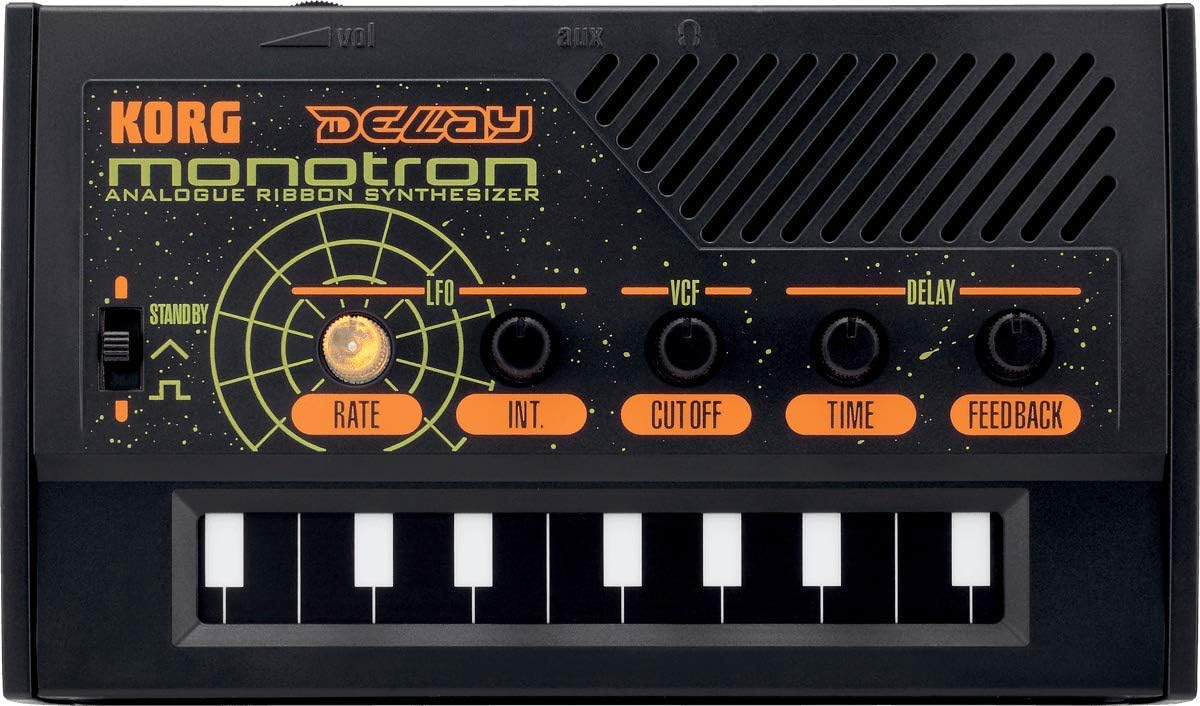
The Korg Monotron Delay is a compact analog ribbon synthesizer designed for sound designers, producers, and experimental musicians who want authentic analog character without the bulk or expense of traditional synthesizers. This pocket-sized powerhouse delivers genuine analog warmth through its vintage MS-10/MS-20 filter, making it ideal for anyone seeking to add retro, sci-fi, and textural elements to their music production or live performances.
The standout features that make this synthesizer shine are its space delay effect with rate and intensity controls, new pitch LFO with selectable waveshape, and the wide-range ribbon controller keyboard. Musicians consistently report discovering an astonishing range of sounds from drones and washes to dub effects and metallic textures. The delay effect, while characteristically lo-fi and noisy, imparts a distinctive charm that professional synthesizer users actively seek out for its organic, vintage quality.
Build quality reflects Korg's reputation for durability in a minimalist package. The device measures just 6.4 x 1.6 x 9.2 inches and weighs 6.4 ounces, featuring smooth, quality knobs and a responsive ribbon controller. Battery power and built-in speaker mean you can create sounds anywhere without additional equipment, making this genuinely portable analog synthesis accessible to anyone.
The primary limitation is the ribbon controller's learning curve. Unlike a traditional keyboard, pinpointing exact notes takes practice, and the instrument excels at sound design and effects rather than playing precise melodies in sync with other instruments. Additionally, the inherent noise floor and hiss characteristic of analog design becomes more pronounced when the delay is engaged, though experienced users embrace this as part of the authentic analog character.
The Korg Monotron Delay delivers exceptional value for musicians exploring analog synthesis, sound design, and experimental music production. Its combination of authentic analog warmth, creative delay effects, portable design, and affordable price point makes it a compelling choice for producers, artists, and enthusiasts who appreciate character-driven sounds and retro aesthetics.
Physical Specifications: Dimensions: 6.4 x 1.6 x 9.2 inches (L x W x H), Weight: 6.4 ounces, Material: Synthetic, Finish: Painted Black
Sound Engine: Original analog VCF filter from classic Korg MS-10 and MS-20 synthesizers, Pitch LFO with selectable waveshape and intensity controls, Space delay with rate and intensity controls
Interface: Wide-range ribbon controller keyboard, Quality control knobs with smooth operation, Built-in speaker for standalone monitoring, Auxiliary connector type
Power: Battery powered for portable operation, Built-in speaker for immediate sound output without external amplification
Warranty: 1-year manufacturer warranty included
Who Should Buy: Sound designers and producers seeking affordable analog character, experimental musicians exploring retro and sci-fi textures, musicians wanting a portable effect generator for live performances, synthesizer enthusiasts interested in vintage Korg sound design, anyone interested in theremin-like expressive control
Who Should Skip: Musicians needing precise keyboard playing for melodic accompaniment, users seeking clean, pristine audio without character or noise, those requiring extensive polyphony or complex sequencing capabilities
Best Use Cases: Adding distinctive sound effects to electronic music productions, creating atmospheric drones and pads, live performance texture generation, layering with other instruments and synthesizers, experimental sound design and music composition, portable creative inspiration tool for on-the-go musicians
Value Consideration: At this price point, the Monotron Delay offers exceptional value for analog synthesis capabilities. Users consistently report that its sonic character and versatility justify the investment, especially when compared to digital alternatives or expensive vintage equipment. The portable design and built-in speaker eliminate the need for additional purchases to start creating sounds immediately.

Pros
- Exceptional generative sequencer design encourages spontaneous creativity and happy accidents in composition
- Rich, complex sound character with wide frequency range suits both experimental and musical applications
- Comprehensive patch bay with 32 jacks offers professional-grade connectivity and modular integration
- Excellent build quality with metal and wood construction that feels durable and premium
- Intuitive interface balances deep capability with approachable learning curve for synthesis newcomers
Cons
- Limited to eight-step sequences, which may feel constraining for users seeking longer pattern complexity
- Steep learning curve for patch programming despite user-friendly design, requiring time investment to master
The MOOG Labyrinth is a semi-modular analog synthesizer designed for musicians and sound designers who want to explore generative synthesis without committing to a full modular setup. It combines two unique eight-step sequencers with dual oscillators, a voltage-controlled wavefolder, and a morphing state variable filter, making it capable of producing everything from subtle harmonic textures to dramatic metallic drones. This instrument works equally well as a standalone creative tool or as an expansion to an existing Eurorack system.
The standout feature is undoubtedly the dual generative sequencer engine, which uses chance operations to construct two interweaving melodic paths that twist around each other. This creates striking polymetric patterns that evolve over time, allowing you to influence their direction while maintaining an element of controlled randomness. The parallel signal paths with voltage-controlled blending mean you can process both sequencers through different effects chains simultaneously, opening creative possibilities for layering complex textures over steady drum patterns or basslines.
Build quality is impressive, with a solid metal and wood construction that feels premium and durable. The comprehensive patch bay includes 32 jacks (20 inputs and 12 outputs), providing professional-grade connectivity for syncing with external gear via MIDI or analog clock. The interface balances deep capability with relative accessibility, though mastering patch programming and the sequencer's corrupt controls does require dedicated time and study.
The main limitation is the eight-step sequence length, which some advanced users may find restrictive for longer compositional ideas. Additionally, the learning curve can be steep despite the included quickstart guide and cheat codes, making it less ideal for absolute beginners unfamiliar with synthesis concepts. At $499, it represents a significant investment, though the unique generative approach and sound quality justify the cost for serious electronic musicians.
The MOOG Labyrinth is an excellent choice for anyone seeking a powerful, self-contained synthesizer that encourages experimental exploration and sonic discovery. Its generative sequencers and parallel processing capabilities make it a lightning rod for creative inspiration, whether you're adding color to existing productions or building entirely new soundscapes from scratch.
Physical Specifications: Dimensions are 5.63 x 12.83 x 4.21 inches with a weight of 1.5 kg (3.3 lbs). The compact desktop footprint makes it suitable for studio setups with limited space. Construction materials include metal, plastic, and wood for a premium feel and durability.
Audio Architecture: Features dual low-harmonic oscillators with metallic FM and wavefolding capabilities. Includes a voltage-controlled wavefolder with smooth folding and bias controls, ring modulation, variable tone noise generator, and a state variable resonant voltage-controlled filter that morphs between lowpass and bandpass responses. The saturating mixer combines multiple signal sources for complex tonal shaping.
Sequencing and Control: Dual generative eight-step sequencers with corrupt controls for evolving patterns. Comprehensive 32 x 3.5mm jack patch bay with 20 inputs and 12 outputs. MIDI and analog clock sync capabilities for integration with external gear. Voltage-controlled blending and signal flow order switch for parallel processing control.
Connectivity and Power: Connector type is 1/4 inch TRS/TS. Includes power supply, five 12-inch patch cables, patch sheet overlays, quickstart guide, and one-year manufacturer warranty. Model number is LABYRINTH with UPC 694318026281.
Who Should Buy: The MOOG Labyrinth is ideal for electronic musicians, sound designers, and producers who want a powerful semi-modular synthesizer that encourages experimentation. It suits both beginners interested in learning synthesis through hands-on patching and experienced users seeking a unique generative engine. If you already own modular gear like the DFAM or Mother-32, the Labyrinth makes an excellent complementary addition to your setup.
When to Consider Alternatives: If you need a fully polyphonic instrument for playing chords or melodies in real time, look toward keyboard synthesizers instead. For users wanting longer sequence patterns beyond eight steps, a full modular system or software-based sequencer may be more suitable. Absolute beginners with no synthesis experience might benefit from simpler, more affordable entry-level options first.
Getting Started: The package includes comprehensive documentation with a quickstart guide and cheat codes to accelerate your learning. Start by exploring the pre-configured patches before diving into custom patching. The dual sequencers reward experimentation, so expect a rewarding learning curve as you discover how to manipulate the corrupt controls and signal flow for unique sonic results.
Value Proposition: At $499, the Labyrinth offers exceptional value for a MOOG instrument with unique generative capabilities. The sound quality, build construction, and creative potential justify the investment for serious producers and musicians. Factor in the comprehensive patch bay and standalone capability as key value drivers compared to simpler semi-modular alternatives.

Pros
- Incredibly addictive tactile experience with responsive ribbon and knobs that inspire hours of creative play
- Generates surprisingly powerful and versatile analog sounds despite its compact cassette-sized form factor
- Perfect learning tool for understanding fundamental synthesis concepts like VCOs and filters
- Affordable entry point into analog synthesis without sacrificing sound quality or build durability
- Portable enough to take anywhere, making it ideal for on-the-go music creation and inspiration
Cons
- Ribbon keyboard is small and less precise for accurate note playing compared to full-size keyboards
- Limited to standalone use without MIDI connectivity for integrating with external gear or DAWs
- Knobs can feel slightly wobbly during intensive use, though they remain responsive and functional
The Korg Monotron Duo is a pocket-sized analog synthesizer that punches well above its weight class. Designed for musicians, producers, and sound designers who value portability and hands-on control, this compact instrument delivers genuine analog warmth and character that digital alternatives struggle to replicate. Whether you're a curious beginner exploring synthesis or an experienced producer seeking a creative companion for travel and inspiration, the Monotron Duo offers remarkable versatility in a form factor that fits in your bag.
At its heart, the Monotron Duo features dual voltage-controlled oscillators and a voltage-controlled filter that form the backbone of its sound design capabilities. The responsive ribbon controller lets you play melodic lines with expressive pitch slides, while the quantized mode locks you into precise notes for playing structured riffs. The intuitive knob layout handles filter cutoff, resonance, and modulation without overwhelming complexity, making it accessible to newcomers while offering enough depth for sound designers crafting unique textures and effects.
Built with carbon fiber construction and weighing just 6.4 ounces, this synthesizer prioritizes durability and portability. The included carrying case protects your investment during transport, and the compact 6.4 x 1.6 x 9.2 inch dimensions mean it truly goes everywhere. Users consistently praise the build quality and responsive controls, though the knobs can feel slightly wobbly during vigorous tweaking, which doesn't impact functionality but worth noting for those seeking absolute rigidity.
The main limitations stem from its compact design. The ribbon keyboard, while fun and expressive, sacrifices accuracy due to its small size, making rapid note entry challenging. Additionally, the lack of MIDI connectivity means you can't control it from external keyboards or sequencers, though this forces a refreshing focus on direct sound exploration rather than complex production workflows.
The Korg Monotron Duo is a gateway drug to analog synthesis that delivers genuine inspiration and sonic possibilities. For the price, you get a professional-grade analog instrument that sounds incredible, travels anywhere, and sparks creative joy through tactile interaction. It's an essential tool for portable music makers and a brilliant introduction to synthesis fundamentals.
Physical Specifications: Dimensions: 6.4 x 1.6 x 9.2 inches, Weight: 6.4 ounces, Material: Carbon fiber construction, Finish: Standard painted finish, Included: Protective carrying case
Audio Specifications: Sound Profile: Analog, Connectivity: Auxiliary connectors, Features: Dual voltage-controlled oscillators, voltage-controlled filter, responsive ribbon controller with quantized and continuous modes
Warranty and Support: 1-year manufacturer warranty, Model: MONOTRONDUO, Manufacturer: Korg USA Inc., Unit Count: 1
Ideal For: Musicians and producers seeking portable analog synthesis, beginners learning synthesis fundamentals, sound designers creating experimental textures, travelers wanting creative tools on the go, educators introducing students to analog synthesis concepts
Not Ideal For: Those requiring MIDI connectivity for DAW integration, musicians needing precise keyboard-style note entry, users looking for extensive preset storage or menu-driven interfaces

Pros
- Compact, ultra-portable design makes it perfect for travel and on-the-go music creation
- Authentic analog sound quality delivers genuine vintage character and professional tone
- Intuitive stylus interface allows immediate playability without complex menu navigation
- Excellent value for the price with surprising volume and sound quality from such a small device
- Strong connectivity options enable integration with recording software and external gear
Cons
- Monophonic playback limits you to one note at a time, restricting harmonic complexity
- Plastic construction means durability concerns if dropped or roughly handled
- Steep learning curve to master stylus control for precise note selection and vibrato effects
The Stylophone Original is a legendary pocket synthesizer that brings authentic 1968 analog sound into a compact, portable format. This instrument is ideal for musicians seeking a tactile, retro sound source, whether you're a curious beginner exploring synthesis or an experienced producer looking for unique sonic textures in your productions.
What sets the Stylophone apart is its intuitive stylus-based interface and genuinely impressive sound quality for its size. The touch-sensitive metal surface lets you tap and slide to play different notes across three octaves, with an optional vibrato effect adding expression. The warm, vintage organ-like tone is instantly recognizable and remains musically relevant despite its 50+ year heritage.
The build is straightforward and functional. The metal playing surface and compact plastic body keep weight under 9 ounces, making it genuinely pocket-sized. Battery power (3 AA batteries) provides practical portability, while the built-in speaker delivers surprising volume. Headphone and line-out connectivity allow silent practice or integration into your recording setup via computer software.
The main limitation is monophonic playback, meaning only one note sounds at a time, which restricts harmonic possibilities compared to full keyboards. Additionally, the plastic construction requires careful handling to avoid damage from drops. Mastering stylus control takes practice, especially for precise note selection and vibrato timing.
The Stylophone Original delivers genuine vintage character at an affordable price point. It's an excellent choice for anyone wanting an authentic, playable synthesizer that combines nostalgia with real musical utility. The fun factor is undeniable, making it equally valuable as a novelty gift or a legitimate creative tool.
Dimensions and Weight: 2.05 x 3.41 x 1.86 inches, 8.8 ounces
Sound Features: 3 octaves, optional vibrato effect, warm vintage organ-like tone, monophonic playback
Power: 3 x AA batteries (battery life varies with usage)
Connectivity: 3.5mm headphone jack, 3.5mm line-out for computer connection, built-in speaker
Interface: Touch-sensitive metal playing surface with connected stylus
Materials: Metal playing surface, plastic body, polished/brushed finish
Warranty: 30 days parts coverage
Manufacturer: Dubreq Studios
Who Should Buy: Musicians exploring synthesis for the first time, producers seeking unique retro sounds, gift-givers looking for conversation-starting instruments, performers wanting ultra-portable sound sources, and nostalgia enthusiasts appreciating vintage gear.
Best Use Cases: Home music production, live performance accents, travel music-making, learning synthesis fundamentals, incorporating distinctive sounds into recordings, casual practice and experimentation.
Consider Before Buying: The monophonic limitation means you cannot play chords. The plastic body requires gentle handling. Success depends on developing stylus control through practice. This is best viewed as a specialized sound source rather than a complete musical instrument.
Value Assessment: At this price point, the Stylophone offers exceptional value for the authentic analog sound and legendary heritage. The portability and ease of use justify the investment whether you're serious about synthesis or simply exploring music creation.

Pros
- Exceptional oscillator variety with 17 different modes covering everything from sweet to aggressive timbres
- Touch-sensitive flat keybed provides lightning-fast note tracking with individual pressure sensitivity on each key
- Powerful modulation and sequencing tools including four automation recording slots and innovative randomization features
- Hybrid architecture delivers both digital precision and warm analog filtering for distinctive sonic character
- Extensive connectivity options support modular synthesis, DAW integration, and external MIDI controllers
Cons
- Steep learning curve due to advanced feature set and complex modulation matrix, requiring dedicated study time
- Flat PCB keybed lacks traditional keyboard feel and weighted keys, which may feel unusual to classical pianists
- Limited to 25 keys, restricting range compared to full-size synthesizers
The Arturia MicroFreak is a groundbreaking compact synthesizer that challenges conventional instrument design. It's engineered for experimental producers, sound designers, and musicians who prioritize sonic innovation and portability over traditional keyboard aesthetics. The MicroFreak packs professional-grade synthesis capabilities into an ultra-slim 2.2-inch profile, making it equally at home in a studio, on stage, or in a live performance setup.
The standout feature is undoubtedly the 17-mode oscillator engine, which blends Arturia's proprietary sound engines with contributions from Mutable Instruments and Noise Engineering. Combined with the analog Oberheim SEM filter, this hybrid approach delivers exceptional sonic depth and character. The flat PCB keybed with individual poly-aftertouch on all 25 keys enables expressive real-time control, while the innovative Spice and Dice sequencer functions introduce creative randomization for discovering unexpected, evolving patterns. The 5x7 modulation matrix provides virtually unlimited routing possibilities for custom sound design.
Build quality is solid with a minimalist, modern aesthetic. The flat design eliminates moving parts, reducing mechanical failure points. The included power supply, MIDI adapters, and comprehensive connectivity (CV outputs, USB, MIDI) provide seamless integration with modular systems and digital audio workstations. The compact 2.3-pound weight makes the MicroFreak genuinely portable without sacrificing functionality.
The primary drawback is the steep learning curve. The MicroFreak rewards deep exploration but demands study and experimentation. The flat keybed, while innovative, lacks the tactile feedback of traditional keys, which some players may find initially disorienting. Additionally, the 25-key range is limiting compared to full-size synthesizers.
The Arturia MicroFreak is an exceptional choice for forward-thinking musicians and producers seeking powerful hybrid synthesis in a portable package. It excels at experimental sound design and offers remarkable value for serious synthesizer enthusiasts willing to embrace its unconventional interface.
The MicroFreak's true power lies in its sound design flexibility. With 17 oscillator modes ranging from classic wavetable and superwave to unique vocoder and Karplus-Strong modes, users can explore an enormous tonal palette. The analog filter adds warmth and character that purely digital synthesizers often lack, while the 5x7 modulation matrix enables complex, evolving patches impossible on simpler instruments.
The sequencer and automation system allows recording of four simultaneous parameter automations, enabling dynamic, evolving soundscapes. The Spice and Dice randomization functions introduce creative unpredictability, perfect for discovering happy accidents and generating unique patterns. This combination of precise control and creative randomness makes the MicroFreak ideal for ambient, experimental, and electronic music production.
The MicroFreak integrates seamlessly into modern music production workflows. CV outputs allow pitch, gate, and pressure signals to be sent to any modular synthesizer or outboard gear with CV compatibility, opening possibilities for hybrid setups. USB connectivity enables deep integration with DAWs on Windows, macOS, and Linux systems, while MIDI support provides control from external keyboards and controllers.
The included 3.5mm to 5-pin DIN MIDI adapters ensure compatibility with a wide range of equipment. Combined with the 1/4 inch audio output and 3.5mm headphone jack, the MicroFreak works as a standalone instrument, a studio module, or a performance tool in virtually any setup.
How to Choose Your Analog Synthesizer
Consider Your Sound Goals
Analog synths excel in specific sonic territories. Identify the role you need it to fill. Are you after the iconic, warm bass and lead sounds of classic monosynths?
Or do you need polyphonic capabilities for chords and pads? Instruments like the Behringer PRO-800 Classic Analog 8-Voice offer true polyphony for lush textures. For experimental and generative music, semi-modular designs open vast possibilities.
Evaluate the Interface and Playability
The control layout directly impacts your creative flow. A knob-per-function design, found on many MOOG units, allows for immediate, intuitive sound shaping without menu diving.
Consider the keyboard or controller as well. Full-size, velocity-sensitive keys enhance expression, while compact ribbon controllers or unique interfaces, like the Arturia MicroFreak’s capacitive keyboard, offer a different tactile experience. Your playing style should guide this choice.
Assess Connectivity and Expansion
Think about how the synth will integrate into your setup. Standard MIDI and USB connections are essential for studio control. For modular integration, look for CV/Gate patch points.
Features like an external audio input, as seen on the MOOG Messenger, let you process other sound sources through the synth’s legendary filter. This expands its utility beyond a simple sound generator. For more on processing external signals, our review of the best delay pedals offers complementary insights.
Match Features to Your Workflow
<!–Built-in sequencers and arpeggiators are powerful creative tools. A robust sequencer can become a central idea generator, especially in generative instruments.
Preset memory is crucial for live performance and recalling complex patches. Conversely, a simple, preset-less synth like the Behringer MODEL D encourages pure, hands-on sound design. Align these features with how you create music. Find more tools for your creative space on our Recording / Musical Instruments hub.
Final Thoughts
Ultimately, the best analog synthesizer is the one that inspires you to create. For those seeking an accessible entry point with legendary character, the Stylophone The Original Pocket Electronic remains a joyfully immediate instrument. If your goal is to command a professional studio monosynth with unparalleled depth and a classic pedigree, the MOOG Subsequent 37 Paraphonic Analog Synthesizer represents a pinnacle of analog design. We hope this guide helps you find the perfect partner for your sonic explorations.
Frequently Asked Questions
What is the main advantage of an analog synthesizer over a digital one?
Analog synthesizers generate sound using continuous electrical voltages, which many musicians and producers feel results in a richer, warmer, and more organic tone, particularly for bass and lead sounds. They often provide a more immediate, hands-on tactile experience with dedicated knobs and sliders for real-time manipulation.
Are analog synthesizers good for beginners?
Yes, many are excellent for learning. Simple, affordable models with straightforward controls, like the Korg Monotron series, teach the core concepts of oscillators, filters, and modulation without overwhelming complexity. They offer a fun, direct way to understand synthesis fundamentals.
How do I maintain an analog synthesizer?
Modern analog synths are generally quite stable. The primary maintenance involves occasional calibration, which many models can perform automatically. Keeping them in a stable environment, free from extreme temperature shifts and dust, is the best practice. Always refer to the manufacturer’s manual for specific care instructions.
Can I use an analog synthesizer with my computer recording setup?
Absolutely. Most contemporary analog synths include USB or standard MIDI connections for seamless integration with digital audio workstations (DAWs). You can record their audio output into your interface and use MIDI to control them from your DAW’s piano roll or an external controller, blending analog sound with digital workflow. For enhancing vocal tracks within that same setup, consider our picks for the best vocal effect processors in 2026.


Write Your Review
No reviews yet. Be the first to share your experience!