

Your studio monitors deliver crisp highs and detailed mids, but when it comes to the crucial low-end frequencies, they might leave you guessing. You find yourself boosting the bass in a mix, only to discover it sounds overwhelming on other systems. This common pitfall stems from incomplete monitoring, where the sub-bass region remains unheard. Adding a dedicated studio subwoofer bridges this gap, revealing the full spectrum of your audio.
This guide is crafted for home studio owners, podcasters, and music producers seeking to elevate their monitoring accuracy without overspending. We have assessed several prominent models to identify which ones deliver the precise, extended low-frequency response essential for confident mixing and mastering. For a broader look at low-end monitoring tools, explore our overview of the best studio subwoofers available.

Pros
- Innovative spun-copper woofer technology produces exceptionally clean bass with minimal distortion
- Flexible front-firing configuration works well in various room layouts and placement scenarios
- Powerful 400-watt all-digital amplifier provides room-filling bass without quality compromise
- Precise phase and crossover controls allow perfect integration with existing speaker systems
- Highly rated by customers for performance, reliability, and value
Cons
- Limited to 120 Hz frequency response floor, which may not reach the absolute lowest frequencies some users desire
- Front-firing design may require more careful room placement optimization compared to downfiring alternatives
- Premium pricing reflects the advanced technology but may challenge budget-conscious buyers
The Klipsch Reference is a high-performance front-firing subwoofer designed for home theater systems and serious music listeners who demand accurate, powerful bass without compromise. Its 12-inch spun-copper woofer represents a significant advancement in subwoofer cone technology, combining exceptional lightness with the rigidity needed for clean low-frequency reproduction.
The standout feature is the innovative spun-copper thermoformed crystalline polymer woofer, which minimizes cone breakup and eliminates the distortion that plagues traditional subwoofers. Paired with the built-in all-digital amplifier delivering 400 watts of power, this subwoofer reproduces bass with remarkable clarity and impact. The front-firing driver provides flexibility in room placement while maintaining deep, articulate bass response across your listening area.
Build quality reflects Klipsch's reputation for precision engineering. The combination of advanced materials and thoughtful amplifier design ensures this subwoofer will integrate seamlessly into any AV setup. The low-pass crossover and phase control adjustments allow fine-tuning to match your room acoustics and speaker configuration perfectly, while universal line and LFE inputs work with virtually any receiver.
The primary consideration is the 120 Hz frequency response floor, which handles most home theater and music content exceptionally well but may not reach the absolute lowest organ tones or movie sound effects some enthusiasts crave. Additionally, front-firing subwoofers require slightly more thoughtful placement than downfiring models to optimize room coupling.
The Klipsch Reference is an excellent choice for anyone seeking a subwoofer that prioritizes accuracy and integration over raw output. Its combination of innovative technology, powerful amplification, and flexible design makes it ideal for upgrading existing systems or building a new home theater setup with professional-grade bass reproduction.
Driver: 12-inch spun-copper thermoformed crystalline polymer woofer
Amplifier: All-digital, 400 watts peak power
Frequency Response: 120 Hz and below
Driver Type: Front-firing high-performance driver
Controls: Low-pass crossover and phase control
Connectivity: Line and LFE inputs via speaker wire
Audio Mode: Surround compatible
Brand: Klipsch Reference Series
Who Should Buy This? Home theater enthusiasts, music lovers, and anyone upgrading their audio system who values clean, accurate bass over maximum output. This subwoofer excels in medium to large rooms where flexibility in placement matters.
Room Placement Tips: The front-firing design works well when positioned near listening areas or along front walls. Experiment with placement to find the sweet spot where bass integrates smoothly with your main speakers. Use the phase control to align the subwoofer output with your room acoustics.
Integration: The low-pass crossover lets you blend subwoofer output seamlessly with your existing speakers. Start with crossover set around 80 Hz and adjust phase control until bass feels cohesive and distortion-free. The universal inputs work with any modern AV receiver.
Comparison Consideration: This subwoofer prioritizes accuracy and integration over maximum output. If you need earth-shaking bass for large commercial spaces, consider higher-output models. For typical home theater and music listening, the Reference delivers exceptional performance.

Pros
- Exceptional accuracy and clarity, letting you hear room characteristics and mix details clearly
- Tight, controlled bass with no bloat or rumble, perfect for critical listening
- Comprehensive controls including low-cut, high-cut, and phase adjustment for any room
- Solid construction and engineering from a trusted brand with 15+ years of professional endorsement
- Excellent value for pro-level quality and performance
Cons
- Premium price point requires significant investment for home studio enthusiasts
- 8-inch driver may require careful placement and tuning in larger rooms
- Limited wireless connectivity, primarily wired XLR connection for best performance
The Yamaha HS8S is a professional-grade powered subwoofer designed for recording studios, live music monitoring, and serious home studio setups. If you're mixing music, producing podcasts, or working with any audio that requires accurate low-end reproduction, this subwoofer fills the critical gap that small studio monitors cannot reach.
What sets the HS8S apart is its commitment to accuracy over flashiness. The 150W amplifier drives an 8-inch bass-reflex driver with a frequency response of 22Hz to 150Hz, delivering tight, controlled bass that reveals room acoustics and mix imperfections rather than masking them. The low-cut and high-cut controls allow you to dial in the perfect blend with your main monitors, while the phase switch ensures coherent integration with your monitoring system. Users consistently report that this subwoofer transforms their ability to hear and mix accurate low-end content.
Build quality is exceptional, with Yamaha's engineering expertise evident in every detail. The shockproof stainless steel enclosure feels durable and professional. The touch controls and comprehensive connectivity options, including XLR inputs and routing outputs, make this subwoofer a seamless addition to any studio setup. This is equipment designed by engineers for engineers, not marketing departments.
The main consideration is price. This is a professional investment, not an impulse purchase. Additionally, the 8-inch driver performs best in rooms where proper placement and tuning are possible. If you have a very large room or prefer wireless convenience, you may want to evaluate alternatives.
For serious home studio owners, music producers, and professional engineers, the Yamaha HS8S represents exceptional value in the studio subwoofer category. It delivers the accuracy and reliability needed for professional mixes at a reasonable price point for this quality tier.
Driver and Output: 8-inch bass-reflex powered subwoofer with 150W amplifier. Frequency response 22Hz to 150Hz. Dynamic driver design for accurate reproduction.
Controls and Connectivity: Low-cut switch and control (80-120Hz), high-cut control (80-120Hz), and phase switch for room integration. XLR connectivity with audio routing outputs. Touch control interface.
Physical: Floor-standing design with stainless steel enclosure. Compact footprint suitable for studio environments. Not water-resistant.
Warranty: 1-year manufacturer limited warranty from Yamaha Corporation of America. Valid only when purchased from authorized Yamaha retailers.
Who Should Buy: Music producers, audio engineers, podcast creators, and serious home studio owners who need accurate low-end monitoring. This subwoofer is ideal for mixing and mastering applications where precision matters.
Room Considerations: The HS8S performs best in treated studio environments or rooms where you can place and tune the subwoofer properly. Smaller rooms benefit most from the compact 8-inch design. Larger rooms may require additional subwoofers or larger drivers.
Integration Tips: Use the low-cut control to keep bass out of your main monitors, allowing them to focus on midrange clarity. Experiment with the phase switch to achieve seamless blending. Proper placement away from room corners typically yields best results.
Comparison: The HS8S is the compact option in Yamaha's HS line. It competes with other professional 8-inch studio subwoofers but stands out for accuracy and control rather than maximum output or size.

Pros
- Delivers accurate, punchy bass with zero rumble or muddy coloration, ideal for critical mixing and mastering
- Extends down to 27Hz for complete frequency monitoring that reveals true bass content in your tracks
- XLF mode provides inspirational club-inspired tuning for dance and electronic music production
- Flexible connectivity supports both professional XLR and standard TRS balanced inputs for any setup
- Compact 10-inch ported design fits medium to large studios without dominating the room
Cons
- Requires separate XLR cables to connect to matching JBL monitors, adding to total setup cost
- Downward-facing driver is delicate and requires careful placement to avoid accidental damage
- Limited to wired connections only with no wireless connectivity options for flexible studio layouts
The JBL Professional LSR310S is a powered studio subwoofer designed for music producers, audio engineers, and mastering professionals who need accurate low-frequency monitoring. This 10-inch sub is engineered specifically for modern music production where bass plays a critical role in the final mix, from hip-hop and electronic music to pop and film scoring.
What sets the LSR310S apart is its combination of accuracy and power. The 200-watt amplifier drives a custom-engineered 10-inch driver that reaches down to 27Hz while maintaining crisp, clean bass with zero rumble. The patented double-flared port design is precisely calculated to optimize low-frequency extension, ensuring you hear exactly what's in your mix. The XLF mode is a unique feature that activates club-inspired bass tuning, perfect for producers crafting dance tracks who want to hear how their music will sound in professional club environments.
Build quality is professional-grade throughout. The enclosure uses durable PVC construction, and the driver is built to handle continuous full-power operation without failure. Connectivity is fully professional with balanced XLR and 1/4-inch TRS inputs, plus XLR outputs for daisy-chaining to other studio monitors. The sensitivity switch accommodates both high and low-output equipment, making it compatible with virtually any studio setup. The compact floor-standing design fits seamlessly into medium to large studios alongside JBL 3-series monitors, with matching finish and LED indicators.
Two minor considerations: the downward-facing driver requires careful placement to avoid damage, and you'll need separate XLR cables to connect matching JBL monitors. Additionally, all connections are wired only with no wireless options available. Despite these minor points, user feedback consistently praises the LSR310S for delivering professional-quality bass monitoring at an accessible price point.
The JBL Professional LSR310S is an excellent investment for serious producers and engineers who refuse to compromise on mix accuracy. Its combination of extended low-frequency response, clean punchy bass, and professional connectivity makes it an essential tool for anyone monitoring modern music production in a dedicated studio environment.
Audio Output: 200 watts, 113dB peak output
Frequency Response: 27Hz to 2kHz
Driver Size: 10-inch custom-engineered woofer
Enclosure: PVC, floor-standing ported design
Connectivity: 2x XLR balanced inputs, 2x TRS balanced inputs, XLR outputs
Controls: Touch-activated, sensitivity switch for +4dBu and -10dBV compatibility
Power: Corded electric, includes power cable
Warranty: 5-year limited warranty on professional loudspeaker products
Included in Box: LSR310S subwoofer, power cable, setup guide
Who Should Buy: Music producers, audio engineers, mastering professionals, and serious home studio enthusiasts who need accurate bass monitoring. Ideal for anyone working with modern genres like electronic, hip-hop, pop, and film scoring where low-end accuracy is critical.
Studio Setup: The LSR310S pairs perfectly with JBL 3-series monitors (305P, 306P, 308P) but works with virtually any studio monitor system. It can also function as the LFE channel in 5.1 surround sound setups. Requires balanced XLR cables for connection and adequate floor space for placement.
Room Size: Best suited for medium to large studios. The 10-inch driver and 200-watt amplifier provide sufficient output for professional monitoring in rooms up to approximately 200 square feet without overwhelming smaller spaces.
Budget Consideration: Positioned as an affordable active subwoofer solution for professional monitoring. Offers professional-grade accuracy and build quality at a price point significantly lower than high-end studio subs, making it excellent value for serious producers.
XLF Mode: The club-tuning feature is particularly valuable for electronic and dance music producers who want to verify how their mixes translate to professional club sound systems during the production and mixing phase.
Pros
- Exceptional bass quality and clarity at an affordable price point, delivering performance typically found in more expensive subwoofers
- Versatile DSP controls and multiple EQ modes allow customization for different venues and music styles
- Robust construction with resonant-free fiberboard and overload protection ensures reliability during intense use
- Compact footprint and lightweight design make it ideal for musicians with space constraints or frequent setup changes
- Multiple connectivity options (XLR and 1/4" TRS) work with powered speakers, DJ mixers, and audio interfaces
Cons
- Limited to 100/120V input voltage, not suitable for international use without a step-down transformer
- 1-year limited warranty provides basic coverage but lacks extended protection options for professional touring use
- 115Hz frequency response floor means it may not reach the absolute lowest sub-bass frequencies some electronic music producers require
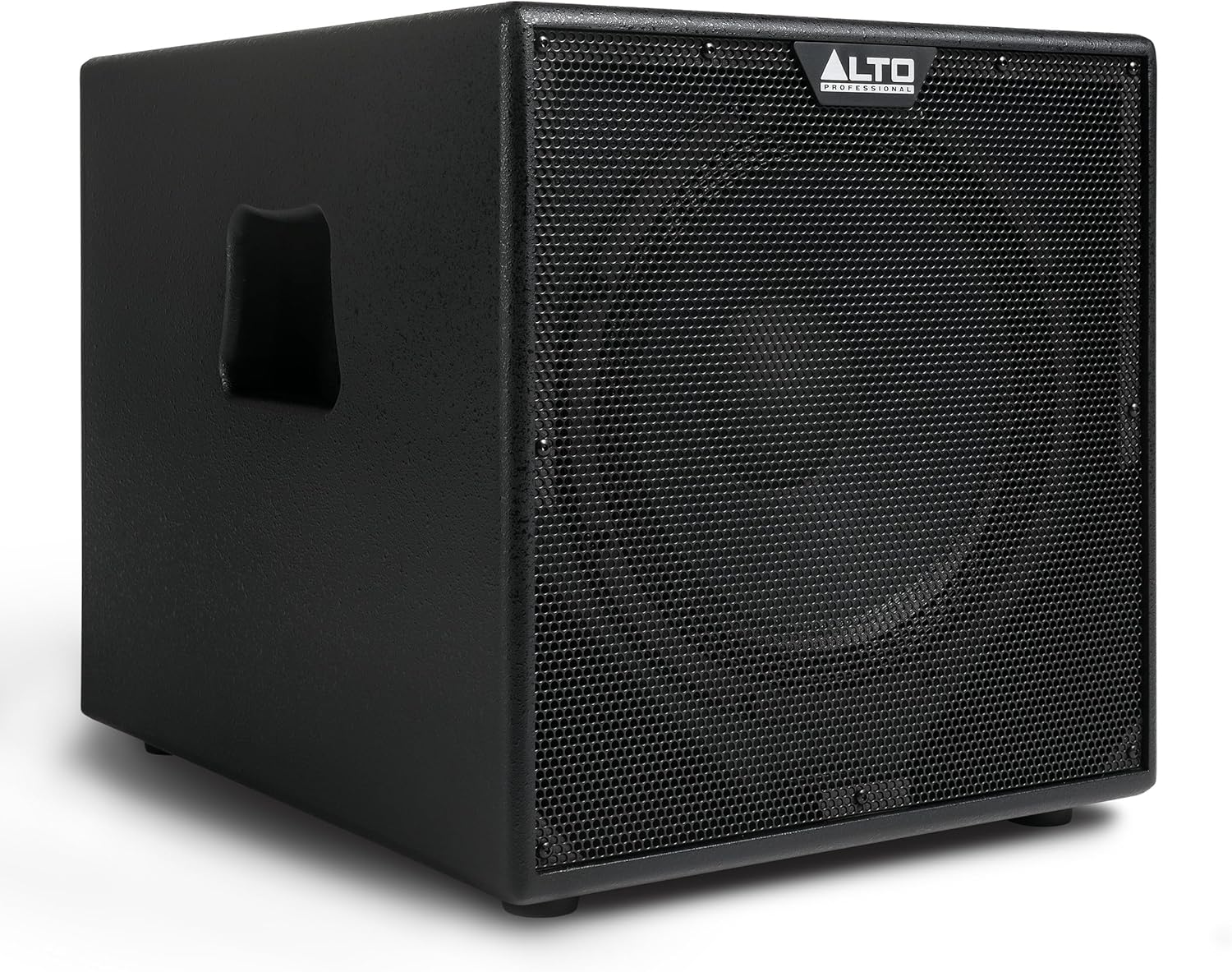
The ALTO TX12S is a powered subwoofer designed for musicians, DJs, and small business owners who need powerful low-end extension without breaking the bank. With its 900W amplifier and 12-inch woofer, it's engineered to handle small to mid-sized performance spaces, rehearsal rooms, and intimate venues where standard full-range PA speakers fall short on bass impact.
The standout feature is how effectively this subwoofer reproduces deep bass frequencies while maintaining clarity and punch. The 2-inch voice coil and Class-D amplifier work together to deliver tight, responsive bass that can be felt as much as heard. Real-world users consistently praise the "thump" and presence it adds to any audio system, with several reviewers noting it performs at a level typically associated with more expensive models. The DSP-based EQ system with Live and Music voicing modes, combined with selectable low pass filters (80Hz, 100Hz, 120Hz), gives you precise control to match your specific venue or speaker setup.
Build quality is solid throughout. The resonant-free fiberboard enclosure minimizes unwanted vibrations while enhancing acoustic performance, and the full metal grille with splatter-spray finish can withstand the rigors of touring. The 36mm pole socket allows integration into speaker stands, and at 22.4kg with convenient side handles, it's genuinely portable compared to heavier alternatives. Overload protection circuitry ensures clean bass even when pushed hard, which is crucial during extended performances.
The main limitations are the 115Hz frequency response floor, which may disappoint electronic music producers seeking extreme sub-bass, and the 100/120V power requirement that limits international use. The 1-year warranty is standard but relatively basic for professional applications. Setup is straightforward enough for non-technical users, though the quickstart guide could be more detailed.
The ALTO TX12S represents exceptional value for anyone needing serious bass extension on a budget. Whether you're upgrading a rehearsal space, building a portable DJ rig, or adding low-end weight to a small venue PA system, this subwoofer delivers performance and reliability that justifies its price point and earns strong recommendations from actual users.
Audio Output: 900W RMS, Class-D amplifier with overload protection
Driver: 12-inch high-output woofer with 2-inch voice coil
Frequency Response: 115Hz and up
Low Pass Filter: Selectable 80Hz, 100Hz, or 120Hz at 24dB per octave
Enclosure: Front-ported fiberboard, resonant-free design
Dimensions: 15.9"D x 15.9"W x 20.1"H
Weight: 22.4kg (49.3 lbs)
Connectivity: XLR and 1/4" TRS inputs
Power: 100/120V, 50/60Hz (corded electric)
Warranty: 1 year manufacturer limited warranty
Included: 6-foot power cable, quickstart guide, safety and warranty manual
Best For: This subwoofer is ideal for live musicians performing in small to mid-sized venues, DJs building portable rigs, rehearsal studios, houses of worship, nightclubs, and music producers who need reliable low-end monitoring without excessive expense. If you already own a PA speaker system and want to add impact and presence, the TX12S is a practical upgrade.
Consider Alternatives If: You require extreme sub-bass frequencies below 115Hz for electronic music production, need international power compatibility, or operate in extremely demanding touring environments where extended warranty coverage is essential. Professional sound engineers working with large-scale events may also want higher power output options.
Real-World Use Cases: Pair it with powered PA speakers as a dedicated bass reinforcement system, use it as a standalone subwoofer in music studios for accurate bass monitoring, integrate it into DJ setups for club or event work, or deploy it in small worship spaces where budget constraints are tight but quality cannot be compromised.
What to Look for in a Studio Subwoofer
Frequency Response and Extension
A subwoofer’s primary job is to reproduce the lowest notes your main monitors cannot. Look for a model that extends comfortably into the 30Hz range or lower. This ensures you can hear and control fundamental bass tones, kick drum weight, and sub-bass synth lines. A flat, accurate response is more valuable than sheer loudness for critical listening tasks.
Consider how the subwoofer’s low-end roll-off aligns with your main monitors. A smooth handoff between the sub and satellites prevents frequency gaps or muddy overlaps. This is a key factor for achieving a cohesive, full-range soundstage in your recording and musical instrument setup.
Connectivity and Integration Features
Professional studio gear typically uses balanced connections like XLR or TRS to minimize noise. Ensure your chosen subwoofer has the appropriate inputs and outputs to seamlessly integrate with your existing audio interface and monitors. Features like a variable low-pass crossover and phase control are indispensable. They allow you to precisely tune the subwoofer to blend with your specific room and speaker placement.
Some models offer additional DSP-based EQ modes or voicing options tailored for different music genres. While useful, prioritize core integration controls first. A well-integrated subwoofer should disappear, leaving you with a unified, extended frequency response rather than a localized “boom.”
Power and Driver Size
Amplifier power and driver size influence a subwoofer’s output capability and headroom. In a nearfield studio environment, controlled, accurate bass is the goal, not arena-shaking volume. A well-designed 8-inch or 10-inch driver with a capable amplifier can provide more than enough output for most project studios. It can also be a smart space-saving choice.
Larger 12-inch drivers, often found in models like the ALTO TX12S, can move more air and potentially deliver deeper extension. However, proper room integration becomes even more critical to manage room modes and standing waves. Your studio’s physical dimensions should guide this decision as much as raw specifications. For producers crafting electronic beats, pairing a capable sub with the right tools, like our picks for the best drum machines, completes the creative chain.
Form Factor and Placement
Studio real estate is precious. Consider the physical footprint of the subwoofer and whether a front-firing or down-firing design suits your space. Front-firing models can offer more placement flexibility. Many studios benefit from placing the subwoofer near the front wall, slightly off-center, to smooth out bass response. Built-in handles and a manageable weight are practical benefits, especially if you anticipate repositioning the unit for different sessions.
Remember, bass frequencies are omnidirectional. You often have more flexibility in subwoofer placement than with your main monitors. Experimentation is key to finding the spot that delivers the flattest, most even response at your listening position. This is a crucial step, similar to selecting the right hardware samplers, where the tool must fit seamlessly into your workflow.
Final Thoughts
Investing in a quality studio subwoofer is a transformative step toward professional-grade monitoring. It removes the guesswork from low-end decisions, giving you confidence that your mixes will translate reliably. For those prioritizing pristine integration with studio monitors in a critical listening environment, the Yamaha HS8 Studio Subwoofer,Black is an exemplary choice with its precise controls. Alternatively, if your needs extend to reinforcing live sound for intimate performances or rehearsals, the versatile and powerful ALTO TX12S 900W 12″ Powered PA Subwoofer offers tremendous value and robust features. Either path significantly elevates your audio production capability.
Frequently Asked Questions
Do I really need a subwoofer for a small home studio?
Yes, even in a small room. Most compact studio monitors cannot reproduce frequencies below 50-60Hz accurately. A subwoofer reveals this missing information, which is critical for mixing modern music genres rich in bass. Properly integrating a subwoofer with careful placement and calibration can actually improve bass clarity in small spaces by reducing the load on your main monitors.
How do I set the crossover frequency on my subwoofer?
Start by setting the subwoofer’s low-pass crossover frequency to match the low-frequency extension of your main monitors. A common starting point is 80Hz. Play a full-range music track you know well and adjust the crossover up or down in small increments. The goal is a seamless blend where you cannot localize the subwoofer; the bass should simply sound like it’s coming from your entire speaker system. Refer to your monitor’s manual for its specific frequency response specs.
Can a studio subwoofer be used for home theater?
While possible, it is not ideal. Studio subwoofers are engineered for accurate, flat response at moderate listening levels in the nearfield. Home theater subwoofers are often designed for higher maximum output and more dramatic impact to complement movie soundtracks. For pure audio production, a studio-focused model will provide the precision you need. If your budget is tighter, our guide to the best studio subwoofers under 300 highlights several capable options.
What’s the difference between a passive and a powered subwoofer?
All the models we reviewed are powered (active) subwoofers. This means they have a built-in amplifier specifically matched to their driver. This simplifies setup, as you only need to connect an audio signal and power cord. Passive subwoofers require an external amplifier, adding complexity and cost. For studio applications, powered subwoofers are the standard and recommended choice due to their integrated design and convenience.


Write Your Review
No reviews yet. Be the first to share your experience!