

You’re deep into a firefight, the controller rumbles, and the screen flashes with explosions. Yet, something feels flat. The audio lacks the visceral punch, the deep, chest-thumping resonance that would make the scene truly immersive. That missing layer is often the low-frequency effects handled by a dedicated subwoofer. For gamers, a quality subwoofer isn’t just about louder sound; it’s about feeling the environment, from the distant rumble of a tank column to the subtle creak of a floorboard behind you.
This guide is for players who want to upgrade their audio from simple stereo to a fully immersive, multi-dimensional experience. We’ve evaluated a range of subwoofers and complete speaker systems, from powerful standalone units to all-in-one gaming packages, to help you find the perfect bass foundation for your setup. For those building a more advanced system, understanding features like phase control can be crucial for integrating multiple components seamlessly.

Pros
- High 400-watt output provides authoritative, room-filling bass without distortion
- Copper-spun woofer cone adds rigidity and accuracy for cleaner low-frequency reproduction
- Flexible phase control and crossover settings make integration with existing speaker systems straightforward
- Dual input options (LFE and line level) ensure compatibility with a wide range of receivers and amplifiers
- Compact cabinet dimensions make placement easy without sacrificing output power
Cons
- At 12 inches, it may be too large for very small rooms or minimalist setups where a compact subwoofer would be more appropriate
- Wired-only connectivity means placement is limited by cable length, with no wireless or Bluetooth option available
- Plastic enclosure material may not feel as premium as wood-cabinet alternatives at a similar price point
The Klipsch R-12SW is a 12-inch front-firing powered subwoofer designed for home theater and stereo music systems. It targets enthusiasts who want serious bass performance without stepping into the high-end audiophile price bracket. Whether you are building a 5.1 surround sound setup or upgrading a two-channel music system, this subwoofer is engineered to deliver.
The standout feature is the 12-inch copper-spun woofer paired with a 400-watt all-digital amplifier. This combination produces a frequency response starting as low as 29 Hz, which means you will physically feel deep bass from action movies, electronic music, and orchestral recordings. The copper-spun cone adds stiffness and reduces resonance, resulting in tighter, more accurate bass compared to standard paper or polypropylene cones.
Setup and integration are made simple through the onboard low pass crossover and phase control. These tools allow you to dial in the subwoofer so it blends naturally with your main speakers, avoiding the muddy or disconnected bass that can plague poorly configured systems. Both LFE and line level inputs are included, ensuring compatibility with virtually any modern AV receiver or stereo amplifier.
On the design side, the brushed black polymer veneer cabinet with a satin painted plinth looks clean and modern. The enclosure is compact for a 12-inch driver, measuring roughly 20.5 inches on each side, which keeps placement options practical. The build quality is solid, though the plastic cabinet construction may feel less premium to buyers accustomed to MDF or real wood enclosures found on pricier competitors.
Overall, the Klipsch R-12SW delivers outstanding value for anyone seeking powerful, accurate bass for home theater or music listening. Its high power output, precise tuning controls, and flexible inputs make it a versatile performer that punches well above its price. If you need wireless connectivity or a very compact footprint, you may want to explore alternatives, but for sheer bass performance and build quality at this price, the R-12SW is a compelling choice.
The Klipsch R-12SW features a 12-inch (30.48 cm) copper-spun front-firing woofer and an all-digital amplifier rated at 400 watts of dynamic power. Its frequency response spans 29 Hz to 120 Hz, covering the full range of low-frequency audio content.
Connectivity includes both LFE (Low Frequency Effects) and line level inputs, making it compatible with 5.1, 7.1, and stereo receiver configurations. The unit supports up to 5.1 audio channels and uses wired connectivity only. Onboard controls include a low pass crossover and phase adjustment.
Cabinet dimensions measure 20.5 inches deep by 20.5 inches wide by 18 inches tall, and the enclosure is finished in brushed black vinyl. The model number is R-12SW and it is backed by a 2-year limited warranty from Klipsch. It is designed for floor-standing placement in home theater environments.
When shopping for a subwoofer, the most important factors are room size, power output, and integration flexibility. The Klipsch R-12SW is best suited for medium to large living rooms or dedicated home theater spaces where its 400-watt output can be fully appreciated. In very small rooms, a 10-inch or smaller subwoofer may actually deliver more controlled bass without overwhelming the space.
If you already own an AV receiver with a dedicated subwoofer output (LFE), the R-12SW will connect directly and easily. If you are running a stereo-only setup, the line level inputs ensure compatibility as well. Make sure your receiver supports a subwoofer channel or pre-out before purchasing any powered subwoofer.
For buyers comparing the R-12SW to competitors, consider that Klipsch is known for efficiency and dynamic performance. If you prioritize deep, impactful bass for movies and gaming, this model excels. Audiophiles focused purely on music reproduction at low volumes may want to audition alternatives with sealed enclosures, as ported designs like this one can sometimes trade ultimate accuracy for louder, more dramatic output. At its price point, the R-12SW remains one of the strongest performers available.

Pros
- Impressive 300W peak power output for a subwoofer in this price range
- Deep 32Hz frequency response brings movie soundtracks and music to life with real impact
- Flexible phase and crossover controls make integration with existing speaker setups straightforward
- Solid wood enclosure construction minimizes unwanted resonance and cabinet coloration
- Backed by Klipsch's reputation for audio quality and a strong limited warranty
Cons
- Wired-only connectivity via RCA means no wireless or Bluetooth streaming options for flexible placement
- At over 16 inches tall, the cabinet footprint may feel bulky in smaller living rooms or tight media setups
The Klipsch R-100SW is a 10-inch floor-standing subwoofer designed for home theater and stereo enthusiasts who want authoritative, room-filling bass without breaking the bank. It fits naturally into any 2.1, 5.1, or 7.1 surround sound system and is equally at home in a dedicated media room or a large living space.
At the heart of this subwoofer is a 10-inch front-firing spun-copper IMG woofer paired with an all-digital amplifier rated at 150 watts continuous and 300 watts peak. This combination delivers a frequency response reaching down to 32Hz, which is deep enough to reproduce the low-end rumble of action films, the punch of kick drums, and the resonance of pipe organs with convincing realism.
The R-100SW is built with a wood enclosure finished in a clean black brushed polymer veneer, giving it a refined appearance that blends into most home decor. The front-firing driver configuration adds placement flexibility, allowing the unit to perform well even when positioned close to a wall. Controls for volume, low-pass crossover frequency, and 0 to 180-degree phase adjustment are accessible on the rear panel, making it easy to dial in the perfect blend with your main speakers.
On the downside, the R-100SW is strictly a wired subwoofer, connecting via RCA inputs only, which limits placement flexibility compared to wireless-enabled alternatives. The cabinet is also fairly substantial in size, so buyers with compact rooms should measure carefully before purchasing.
Overall, the Klipsch R-100SW delivers exceptional bass performance and build quality at its price point. With a class-leading 5-year woofer warranty, broad receiver compatibility, and Klipsch's proven acoustic engineering, it is a compelling choice for anyone looking to add serious low-end impact to their home audio system.
The Klipsch R-100SW features a 10-inch (25.4 cm) spun-copper IMG woofer in a front-firing configuration housed in a wood enclosure. Amplifier power is rated at 150 watts continuous and 300 watts peak, delivered by an all-digital amplifier stage.
Frequency response spans 32Hz to 120Hz at plus or minus 3dB, making it suitable for both cinematic low-frequency effects and musical bass reproduction. Connectivity is handled via line-level LFE RCA inputs, ensuring compatibility with the vast majority of AV receivers and stereo amplifiers.
Rear-panel controls include a volume knob, variable low-pass crossover, and a 0 to 180-degree phase switch. The auto power-on feature activates the subwoofer when a signal is detected and powers it down during periods of silence. Cabinet dimensions are approximately 14.5 inches wide by 12.5 inches deep by 16.4 inches tall. The unit is covered by a 5-year limited warranty on the woofer and a 2-year limited warranty on the amplifier.
If you are building or upgrading a home theater system and want to add deep, impactful bass, the Klipsch R-100SW is worth serious consideration. It pairs especially well with Klipsch Reference series bookshelf or floor-standing speakers, but its flexible crossover controls make it compatible with virtually any brand of main speakers.
For rooms up to around 2,000 square feet, the R-100SW provides more than enough output. If you have a very large open-plan space or you listen at consistently high volumes, you may want to consider a larger 12-inch model for additional headroom. For typical living rooms and dedicated home theaters, this unit is more than capable.
When positioning the subwoofer, try placing it near a front corner of the room for maximum bass reinforcement, then use the phase control to align it with your main speakers. Connect it to your AV receiver using a standard RCA subwoofer cable and set your receiver's crossover to around 80Hz as a starting point, adjusting from there based on your main speakers' bass extension. The auto power-on feature means you can leave it plugged in without worrying about standby power consumption.
Pros
- Powerful 100W dynamic output in a compact, space-saving enclosure ideal for smaller rooms
- Versatile hookup options including RCA and speaker-level connections suit a wide range of receivers and amplifiers
- Adjustable crossover and volume controls make tuning simple and precise for any listening environment
- Durable resonance-free driver materials ensure consistent performance during extended high-volume use
- Comprehensive 5-year limited warranty with dedicated amplifier coverage adds strong long-term value
Cons
- At 11.8 kg the unit is relatively heavy for its size, which may complicate placement or repositioning in tight spaces
- The 40-160 Hz frequency response means it is optimized for bass duties only and will not extend into higher mid-range frequencies
- No wireless connectivity option means cable management is required for clean installation in modern setups
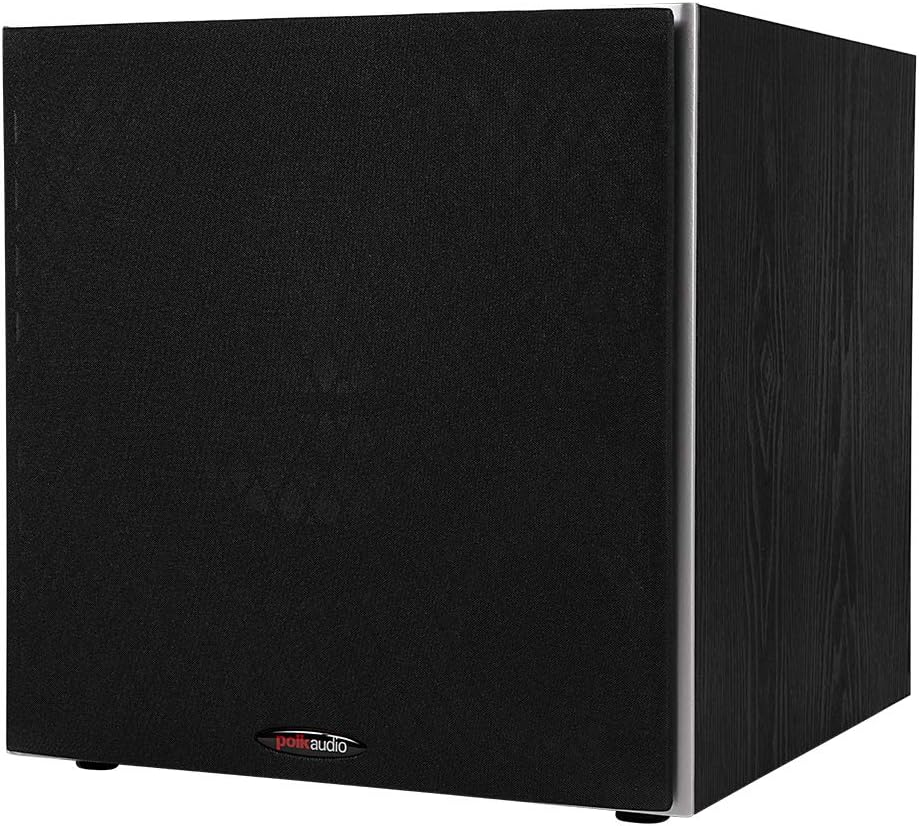
The Polk Audio PSW10 is a 10-inch powered subwoofer designed for home theater and stereo enthusiasts who want impactful bass without dedicating a large footprint to their audio setup. It targets small to mid-sized rooms and works as a straightforward upgrade to any existing speaker system, requiring no separate amplifier thanks to its fully self-contained design.
At the heart of the PSW10 is a Dynamic Balance woofer paired with a high-current 50W RMS amplifier capable of delivering up to 100 watts of dynamic power. The configured directed port enhances bass depth and extension, producing a frequency response of 40-160 Hz that covers the full range of cinematic low-end effects and musical bass lines with impressive accuracy and minimal distortion.
The cabinet is engineered from non-resonant materials, which prevents unwanted vibrations from coloring the sound at high volumes. A detachable front grille, clean black finish, and compact 17 x 14.25 x 14.5 inch dimensions give the PSW10 a tidy, unobtrusive appearance that fits neatly alongside most furniture. Connectivity is straightforward, with RCA line-level and speaker-level inputs and outputs on the rear panel alongside a Phase Toggle Switch for users running dual subwoofer configurations.
One honest drawback is the lack of wireless connectivity, which is increasingly common at this price point and would simplify placement in modern living rooms. The unit is also on the heavier side at nearly 12 kg, so moving it around during setup can be a bit cumbersome. Additionally, the crossover filter tops out at 160 Hz, so users pairing it with small satellite speakers should verify their main speakers can cover the upper bass and midrange adequately.
Overall, the Polk Audio PSW10 is a well-engineered, reliable subwoofer that delivers genuine low-frequency performance in a compact package. Its flexible inputs, adjustable crossover, and robust warranty make it a smart and accessible choice for anyone looking to add serious bass to a home theater or music system without complexity or compromise.
Driver Size: 10 inches | Amplifier Power: 50W RMS, 100W Dynamic | Frequency Response: 40-160 Hz (-3dB) | Impedance: 8 ohm | Channels: 5.1 compatible
Crossover: Continuously variable 80-160 Hz low-pass filter | Connectivity: RCA line-level input/output, Speaker-level input/output | Power Source: AC corded | Mounting: Floor mount
Dimensions: 17 inches D x 14.25 inches W x 14.5 inches H | Weight: 11.8 kg | Color: Black | Model Number: AM1055-C (PSW10)
Warranty: 5-year limited warranty, 3 years on amplifier parts and labor | In the Box: Powered subwoofer, grille, online registration card, owner's manual | Manufacturer: DEI Holdings (Polk Audio)
If you are shopping for your first subwoofer, the PSW10 is an excellent starting point. Its self-contained amplifier means you do not need to budget for a separate sub amp, and its dual input options make it compatible with virtually any AV receiver, stereo amplifier, or even a soundbar with a subwoofer output.
Room size is an important consideration. The PSW10 performs best in rooms up to roughly 2,000 square feet. For larger spaces or dedicated home theater rooms, you may want to consider a larger driver or a higher-wattage model, but for typical living rooms and apartments this unit delivers more than enough output.
When positioning the subwoofer, start by placing it near the front of the room close to your main speakers, then use the rotary volume and crossover controls to dial in a balanced blend. The Phase Toggle Switch is particularly useful if you ever expand to a dual-subwoofer setup, helping eliminate bass cancellation between units.
Buyers who prioritize wireless convenience or who are building a fully cable-free setup should note that the PSW10 uses only wired connections. In that case, pairing it with an aftermarket wireless subwoofer adapter is a straightforward workaround. For everyone else, the PSW10 represents a dependable, high-value choice backed by a strong warranty and Polk Audio's decades of acoustic engineering expertise.

Pros
- Surprisingly powerful bass response for an 8-inch subwoofer, reaching deep lows without muddiness
- Multiple connectivity options including Bluetooth 5.0, balanced TRS, RCA, and auxiliary inputs
- Adjustable crossover and room-tuning controls allow precise calibration to any space
- Excellent value for music production, gaming, and critical listening applications
- Clean pass-through outputs enable easy integration with existing monitor systems
Cons
- Requires proper EQ adjustment and crossover tuning to avoid boomy bass in smaller rooms
- When using Bluetooth with multiple PreSonus BT devices, both units must be connected to a PC for optimal audio routing
- Limited to 10-meter Bluetooth range, which may be restrictive for larger spaces or multi-room setups
The PreSonus Eris Sub 8BT is a powered subwoofer engineered for music producers, content creators, and serious listeners who need accurate low-frequency reproduction. This 100W compact sub is designed to extend the frequency response of full-range studio monitors, delivering clear bass down to 30 Hz. Whether you're mixing EDM, hip-hop, or simply want to experience the full sonic spectrum in your home, this subwoofer fills that critical gap.
Performance is where this subwoofer truly impresses. The 8-inch woven-composite woofer produces tight, punchy bass that feels powerful without sounding muddy or bloated. Users consistently report that the sub hits hard and clean, filling rooms with authority despite its modest size. The adjustable low-pass and high-pass filters allow you to dial in the perfect crossover point, ensuring seamless integration with your main monitors. For bedroom studios and small spaces, this level of control is invaluable for achieving professional-sounding mixes.
Connectivity is remarkably flexible. Bluetooth 5.0 wireless input makes it easy to stream from phones, tablets, or laptops, while the balanced 1/4-inch TRS inputs, unbalanced RCA inputs, and front-panel auxiliary input ensure compatibility with virtually any audio source. The added convenience of a front-panel headphone output with built-in amplifier lets you quickly switch to headphone monitoring without unplugging cables. Build quality feels solid with metal and plastic construction, and the compact footprint fits easily into tight studio spaces.
There are a few considerations worth noting. In smaller rooms, the subwoofer can sound boomy at moderate volumes unless you properly adjust the crossover and EQ settings. Additionally, if you're using multiple Bluetooth-equipped PreSonus devices, both units must connect to a computer for optimal audio routing, which may complicate some wireless setups. The 10-meter Bluetooth range is also somewhat limited for larger spaces or multi-room applications.
The PreSonus Eris Sub 8BT is an excellent choice for anyone looking to add professional-grade bass to their monitoring system. Its combination of accurate sound, intuitive controls, multiple connectivity options, and competitive pricing makes it a standout value in the powered subwoofer category. Highly recommended for music producers, gamers, and audiophiles seeking better low-end clarity and impact.
Audio Output: 100W RMS power output
Driver Size: 8-inch woven-composite woofer
Frequency Response: 30 Hz to 200 Hz
Connectivity: Bluetooth 5.0 (10m range), 1/4-inch TRS balanced inputs, RCA inputs, 1/8-inch TRS auxiliary input, RCA pass-through outputs
Controls: Adjustable input gain, variable low-pass filter, high-frequency and low-frequency tuning controls
Additional Features: Front-panel headphone output with amplifier, power-saving mode (auto-engage after 40 minutes idle)
Dimensions: 12.7 inches wide x 11.7 inches tall x 9.8 inches deep
Weight: 8 lbs (3.6 kg)
Warranty: 2-year manufacturer limited warranty
Compatible Devices: Laptops, smartphones, tablets, gaming consoles, televisions, projectors, MP3 players
Who Should Buy This? The Eris Sub 8BT is ideal for bedroom studio producers, content creators, gamers, and music enthusiasts who want to expand their monitoring system. It's particularly well-suited for EDM, hip-hop, and bass-heavy music genres where accurate low-end reproduction is essential. The Bluetooth connectivity also makes it appealing for casual listeners who want better bass for streaming music and movies.
Room Considerations: This subwoofer performs best in rooms ranging from 100 to 300 square feet. In smaller spaces, start with lower crossover settings and reduced gain to avoid overwhelming bass. Larger rooms may require higher crossover settings and increased gain. The adjustable tuning controls make it adaptable to most acoustic environments.
Integration with Existing Monitors: While designed to complement PreSonus Eris monitors, this subwoofer works with most full-range studio monitors. Use the RCA pass-through outputs to maintain your existing monitor connections, or connect via balanced TRS inputs for professional setups. Proper crossover tuning is essential for seamless integration.
Setup Tips: Position the subwoofer where it sounds most balanced in your room, typically in a corner or against a wall. Use the adjustable low-pass filter to set the crossover frequency just below where your main monitors begin to roll off, typically around 80-100 Hz. Fine-tune using the high and low-frequency controls based on your listening preferences and room acoustics.

Pros
- Exceptional clarity and detail thanks to Microtractrix horn technology and efficient driver design
- Powerful bass response from quality 6.5-inch subwoofer that you can physically feel
- Universal compatibility with multiple input devices and gaming platforms
- Easy setup and intuitive controls make it accessible for all users
- THX certification provides assurance of professional audio standards and quality
Cons
- Limited to wired 3.5mm connectivity, no wireless or Bluetooth options available
- Subwoofer gain control may require manual tuning to achieve optimal bass levels for different rooms
- Premium price point compared to basic computer speakers, though justified by THX certification and performance
The Klipsch ProMedia 2.1 is a THX-certified 2.1 channel speaker system designed for serious PC gamers, movie enthusiasts, and music listeners who refuse to compromise on audio quality. This system combines Klipsch's legendary sound engineering with professional THX standards, making it ideal for anyone who spends significant time at their computer and demands room-filling audio.
The standout feature is Klipsch's proprietary Microtractrix horn technology, which dramatically improves clarity and efficiency. The two satellite speakers house 3-inch midrange drivers that work in perfect harmony with a robust 6.5-inch side-firing subwoofer. Together, they deliver 200 watts of peak power and achieve 110dB output in-room, equivalent to live rock concert levels. This means you get thunderous bass and detailed mids without distortion, whether you're playing competitive shooters or watching action films.
Build quality reflects the premium positioning. The satellites are compact and thoughtfully designed to fit modern desks without visual bulk, while the subwoofer's ported design ensures efficient bass reproduction. The control pod is intuitive, offering separate volume and subwoofer gain controls so you can dial in the perfect balance for your space. Plug-and-play setup via 3.5mm input makes installation straightforward with any device.
The main limitation is the lack of wireless connectivity. This system requires wired connections, which may feel restrictive if you frequently switch between multiple devices. Additionally, the subwoofer gain control requires some manual adjustment to optimize bass for different room sizes and acoustics, so expect a brief tuning period.
Verdict: The Klipsch ProMedia 2.1 delivers professional audio performance that justifies its investment. If you value genuine sound quality, powerful bass, and THX certification for gaming and entertainment, this system will transform your desktop audio experience. Not ideal for minimalists seeking wireless simplicity, but perfect for audio enthusiasts who know the difference between speakers and a real sound system.
Audio Output: 200 watts peak power, 110dB in-room maximum output
Speaker Configuration: 2.1 channel system with two satellite speakers and one subwoofer
Drivers: Twin 3-inch midrange drivers in satellites, 6.5-inch side-firing ported subwoofer
Frequency Response: 31 Hz to 20 kHz
Connectivity: Wired via 3.5mm audio jack
Audio Mode: Stereo
Satellite Dimensions: 8.5 inches (H) x 4.2 inches (W) x 5.67 inches (D)
Subwoofer Dimensions: 9.5 inches (H) x 9.8 inches (W) x 10.2 inches (D)
Controls: Main volume control and independent subwoofer gain adjustment on control pod
Certification: THX Certified
Ideal For: PC gamers seeking competitive audio advantages, film enthusiasts wanting theater-quality sound at home, music producers and audiophiles with desktop setups, and content creators who need professional audio monitoring.
Best Use Cases: Competitive gaming where audio cues matter, watching movies and streaming content, music production and mixing, online video conferencing with high-quality audio, and general multimedia entertainment.
Not Recommended For: Users seeking wireless or Bluetooth connectivity, minimalist desk setups with severe space constraints, and those seeking budget options under $100. Also not ideal for users who frequently relocate their speakers, as the subwoofer requires dedicated space and tuning.

Pros
- Genuine Dolby Atmos 5.1 surround sound without needing rear speakers, making setup simple and clutter-free
- Powerful 300W output with a tuned wooden subwoofer delivers impressive bass depth for its size and price point
- VoiceMX dialogue enhancement keeps vocals intelligible even at low volumes or during intense audio scenes
- Feature-rich companion app with extensive EQ customization gives users precise control over their listening experience
- Rated number one in its category with consistently strong customer praise for ease of setup and noticeable sound improvement over TV speakers
Cons
- Bass levels may feel underwhelming out of the box and require manual adjustment through the app or remote EQ settings
- Best suited for small to medium-sized rooms and secondary TVs rather than large dedicated home theater spaces
- Subwoofer is wired rather than wireless, which may limit placement flexibility in some room layouts
The ULTIMEA Poseidon M60 is a 5.1-channel Dolby Atmos soundbar system designed for home theater enthusiasts who want immersive, cinema-quality audio without the complexity of a full surround speaker setup. At $595, it targets buyers who are upgrading from basic TV speakers and want meaningful audio improvement without committing to a multi-speaker installation. It is equally at home in a bedroom, living room, or dedicated media space of small to medium size.
The standout feature here is the true 5.1-channel Dolby Atmos experience delivered through a single soundbar unit. Two side-firing drivers create a wide soundstage that mimics rear surround channels convincingly, while the dedicated wired wooden subwoofer adds genuine low-end weight. The VoiceMX dialogue enhancement is a real-world differentiator, keeping speech clear and natural even during loud cinematic scenes, a common frustration with standard TV audio. Customers consistently note the night-and-day difference compared to built-in TV speakers.
Build quality is solid for the price range. The soundbar has a slim, low-profile design at just 2.76 inches tall, fitting neatly under most televisions on a console or mounted to a wall. The subwoofer enclosure is constructed from wood, which contributes to its tighter, more accurate bass response compared to plastic alternatives. At 12.6 pounds total system weight, it feels substantial without being difficult to install.
There are a few honest considerations to keep in mind. The bass output at default settings has been noted by some users as requiring adjustment before it reaches its full potential, so expect a brief EQ tuning session after setup. The wired subwoofer connection, while providing a more reliable signal, does restrict placement options compared to wireless models. This system is also better matched to smaller or secondary rooms rather than large open-plan spaces where a more powerful dedicated system would serve better.
Overall, the ULTIMEA Poseidon M60 delivers exceptional value for buyers seeking a straightforward, feature-rich Dolby Atmos upgrade. The combination of app-based EQ control, HDMI eARC connectivity, Bluetooth 5.4, and a genuinely powerful 300W driver configuration makes it one of the most capable soundbar systems in its category. For anyone stepping up from TV speakers or looking for a capable bedroom or secondary room audio solution, this is a highly recommended purchase.
Audio Channels: 5.1-channel with Dolby Atmos
Peak Output Power: 300 watts
Frequency Response: 45 Hz to 18 kHz
Maximum SPL: 99 dB
Driver Configuration: Five full-range drivers plus one 5.25-inch subwoofer driver
Connectivity: HDMI eARC, Optical, Bluetooth 5.4
Subwoofer Connection: Wired
Control Methods: App (iOS and Android), Remote Control
Soundbar Dimensions: 31.5 inches x 3.54 inches x 2.76 inches
System Weight: 12.6 pounds
Mounting Options: Tabletop or Wall Mount (brackets included)
Enclosure Material: Wood (subwoofer)
Warranty: 1-year limited warranty
Compatible Devices: Television, Gaming Console, Desktop, Home Theater
In the Box: Soundbar, Wired Subwoofer, HDMI Cable, Remote Control, Power Adaptor, Wall Brackets, Mounting Hardware
If you are considering the ULTIMEA Poseidon M60, the most important question is what you are upgrading from and what room you plan to use it in. This system is an outstanding choice for anyone moving up from built-in TV speakers, a basic two-channel soundbar, or a budget single-unit system. The jump in audio quality, particularly in dialogue clarity and bass depth, will be immediately noticeable and satisfying.
For room sizing, this system performs best in spaces up to roughly 300 to 400 square feet. Bedrooms, home offices, and mid-sized living rooms are ideal environments. If you have a very large open-plan living area or a dedicated home theater room with high ceilings, you may want to consider a more powerful system or one with physical rear speakers to fill the space adequately.
Connectivity is a key strength here. If your TV supports HDMI eARC, use it. This connection unlocks the full lossless Dolby Atmos signal and provides the best possible audio quality the system can deliver. Optical is available as a fallback, and Bluetooth 5.4 handles wireless streaming from phones and tablets with minimal latency. Gaming console users will also appreciate the low-latency DSP processing, which keeps audio synchronized with fast-paced on-screen action.
Take time to explore the companion app after setup. The default sound profile is a reasonable starting point, but spending ten minutes adjusting the 10-band EQ and experimenting with the 121 presets will help you dial in a sound signature that suits your room acoustics and personal taste. Many users who initially found the bass underwhelming resolved this quickly through the app, so do not judge the system on its out-of-box defaults alone.

Pros
- Excellent value for money with proven reliability from a trusted audio brand
- Compact subwoofer design works in tight spaces without dominating your desk setup
- Wired control pod keeps volume and power controls within easy reach
- Bass boost feature adds flexibility for different content types and listening preferences
- Universal 3.5mm input ensures compatibility with virtually any audio device
Cons
- Corded power connection limits placement flexibility compared to wireless systems
- No Bluetooth connectivity, requiring wired 3.5mm connection for audio input
- 25-watt output may not satisfy users seeking high-volume gaming or party audio
The Logitech Z313 is a 2.1 multimedia speaker system designed for desktop users who want quality audio without breaking the bank. This system pairs two satellite speakers with a compact 9-inch subwoofer to deliver balanced sound across the frequency spectrum. It's ideal for office workers, casual gamers, music enthusiasts, and anyone using a desktop setup who wants an upgrade from standard monitor speakers.
The standout feature of the Z313 is its combination of compact design and genuine bass performance. The 25-watt output provides adequate volume for most desktop scenarios, while the dedicated subwoofer handles low frequencies that built-in speakers simply cannot reproduce. The bass boost feature adds flexibility, allowing you to enhance low-end response when watching movies or playing music-heavy games. Real-world performance is solid for a system at this price point, delivering noticeably better sound than typical computer speakers.
Build quality reflects Logitech's reputation for reliability. The plastic enclosure is sturdy and professional-looking in black, while the wired control pod offers tactile buttons for power and volume adjustment. The 3.5mm input accepts audio from any device with a standard headphone jack, making setup straightforward. Dimensions of approximately 13 inches deep by 9.4 inches wide mean it fits most desktop setups without dominating your workspace.
The main limitations are the lack of wireless connectivity and corded power requirement. You'll need a 3.5mm cable running to your audio source, and the system must stay plugged into an outlet. The 25-watt output, while respectable, won't satisfy users seeking high-volume gaming or party audio. Additionally, there's no Bluetooth, so mobile device connectivity requires an adapter.
The Logitech Z313 delivers solid value for budget-conscious buyers seeking meaningful audio improvement over standard computer speakers. It's a proven bestseller backed by thousands of positive reviews, making it a reliable choice for desktop audio that won't disappoint.
Audio Performance: 25 watts RMS output, Stereo audio mode, Bass boost feature, 10-meter maximum range
Physical Dimensions: 12.9 inches D x 9.4 inches W x 6.2 inches H, 6.3 pounds total weight, 5.25-inch satellite speakers, 9-inch subwoofer diameter
Connectivity: 3.5mm audio input, Corded electric power source, Wired control pod with touch controls
Compatibility: Desktop computers, MP3 players, televisions, and any device with 3.5mm audio output
Warranty: Limited manufacturer's warranty, available upon request from customer service
Who Should Buy: The Z313 is perfect for desktop users upgrading from basic monitor speakers, students, office workers, casual gamers, and anyone seeking affordable audio improvement without complex setup.
Who Should Look Elsewhere: If you need Bluetooth connectivity, wireless operation, or high-volume party audio, consider alternatives. Users in noise-sensitive environments may find even 25 watts excessive.
Setup Considerations: Plan for desk space approximately 13 inches deep. Ensure a power outlet is nearby and position the subwoofer where it won't vibrate sensitive equipment. The 3.5mm cable should reach your audio source comfortably.
Maintenance: Keep the speaker vents dust-free and avoid exposing the system to moisture. The corded design means no battery maintenance required.

Pros
- Outstanding sound quality with crisp mids and highs complemented by punchy, deep bass from the subwoofer
- RGB lighting is genuinely impressive, reacting to audio in real-time and enhancing the gaming atmosphere
- Plug-and-play setup takes just 15 minutes, making installation effortless for all skill levels
- Logitech software integrates seamlessly with other G-series peripherals for unified customization
- Exceptional value for a premium gaming speaker system with professional-grade audio performance
Cons
- DTS:X surround sound is not supported on Mac OS, limiting compatibility for Apple users
- Software occasionally requires a learning curve, though most users master it within 20 minutes
- Some users report rare instances where RGB lighting fails to sync with specific games and reverts to default settings
The Logitech G560 LIGHTSYNC PC Gaming Speakers represent a significant leap forward in gaming audio, combining powerful sound reproduction with stunning visual effects. This 2.1 speaker system is designed for serious gamers, content creators, and music enthusiasts who demand both exceptional audio quality and immersive lighting that responds to their media in real-time.
The standout feature is undoubtedly the DTS:X Ultra surround sound engine, which renders 3D positional audio from games and music. Combined with 240 Watts of peak power, this delivers explosions that feel visceral, footsteps that pinpoint enemy locations with precision, and bass that you can feel in your chest. Users consistently praise the clarity across the frequency spectrum, with crisp dialogue and detailed sound effects that enhance competitive gaming and movie watching alike.
Build quality is excellent, with a sleek black plastic enclosure and a unique driver design that produces a huge soundscape from compact satellite speakers and a powerful down-firing subwoofer. The four customizable RGB lighting zones project both front-facing and rear ambient effects that sync with in-game action or audio visualizers, creating an immersive sensory experience that genuinely elevates gaming sessions.
The system connects via USB, 3.5mm, and Bluetooth, allowing seamless switching between up to four devices. However, it is worth noting that DTS:X surround sound is not supported on Mac OS, which may disappoint Apple users. Additionally, the RGB lighting occasionally fails to sync with certain games and reverts to default settings, though this is rare and doesn't significantly impact overall performance.
The Logitech G560 delivers exceptional value for gamers seeking premium audio with visual flair. While not designed for professional audio production, it excels at what it does: transforming your gaming and entertainment experience into something truly special.
Audio Performance: 240 Watts Peak power (120 Watts RMS), 7.1 DTS:X Ultra surround sound, 97dB maximum sound pressure level, 18kHz frequency response, dynamic drivers with wide-angle design.
Connectivity: USB, 3.5mm audio jack, and Bluetooth (10-meter range). Supports up to 4 devices with Easy-Switch technology. Windows PC and Bluetooth-enabled devices compatible. Mac OS does not support DTS:X.
Lighting: 16.8 million color options across four customizable zones (front-facing and rear ambient projection). Game-driven LIGHTSYNC with audio visualizer and screen sampler modes. Fully customizable via Logitech Family Software.
Physical Specs: Tabletop mount design, 15.9 inches speaker size, 16.6cm subwoofer diameter, plastic enclosure, 9.7-meter maximum operating range. 1-year limited hardware warranty included.
Who Should Buy: PC gamers seeking immersive audio with visual effects, content creators needing quality monitoring speakers, music enthusiasts wanting powerful bass response, and anyone building a premium gaming setup who values both performance and aesthetics.
Who Should Consider Alternatives: Mac users who need DTS:X support, audiophiles seeking studio-grade reference monitors, users with limited desk space, or those prioritizing audio quality over lighting effects and gaming features.
Setup Considerations: Requires approximately 15 minutes for unboxing and placement. The Logitech software has a learning curve but becomes intuitive within 20 minutes of exploration. Works best with Windows-based PCs for full DTS:X functionality. Pairs seamlessly with other Logitech G-series peripherals for unified RGB synchronization.
Value Proposition: At this price point, the G560 offers exceptional value, delivering professional-grade gaming audio combined with genuine immersive lighting effects that justify the investment for serious gamers and entertainment enthusiasts.

Pros
- Truly wireless subwoofer placement removes clutter and simplifies room setup
- Bluetooth 6.0 provides noticeably more stable and faster connections than older standards
- App-based 10-band EQ with 121 presets gives audiophile-level customization at an entry-level price
- Multiple connectivity options including HDMI ARC, Optical, and Bluetooth cover virtually all TV and device setups
- Mica-reinforced drivers and BassMX technology together deliver audio quality that punches above the price point
Cons
- With no verified reviews yet, real-world long-term durability and reliability remain unconfirmed
- At 5.25 inches, the subwoofer driver is on the smaller side and may not fully satisfy bass enthusiasts in large rooms
The ULTIMEA Poseidon M30 is a 2.1-channel sound bar system designed for home theater use, pairing a slim 23.6-inch soundbar with a dedicated wireless subwoofer. It targets buyers who want a meaningful audio upgrade over built-in TV speakers without spending a premium price or dealing with complicated wiring. The 240W peak output and wide 45 Hz to 18 kHz frequency range make it versatile enough for movies, music, and gaming alike.
The standout technical features here are VoiceMX and BassMX, two proprietary DSP-driven technologies that address the two most common complaints with budget sound bars: muddy dialogue and weak bass. VoiceMX dynamically boosts the 120 Hz to 6 kHz vocal range in real time, keeping speech intelligible even during loud action sequences. BassMX pairs an 18mm high-excursion driver with a tuned 6.5L cabinet to produce bass that feels controlled and deep rather than boomy or distorted.
Build quality reflects the price point, with a clean, minimalist bar design suited to tabletop placement or wall mounting using the included brackets. The mica-reinforced diaphragms are a notable engineering choice at this price, increasing driver rigidity by up to 30% and reducing distortion by up to 20% compared to standard cones. The wireless subwoofer connection works over a dedicated link rather than Bluetooth, which typically means lower latency and more consistent synchronization with the bar.
The main drawbacks to consider are the subwoofer driver size and the lack of real-world user reviews at launch. A 5.25-inch driver in a 6.5L cabinet performs well in medium-sized rooms, but buyers with large open-plan spaces may find the low-frequency output insufficient. Additionally, while the spec sheet is impressive, the absence of long-term owner feedback means durability and software reliability are still unknowns.
Overall, the Poseidon M30 makes a compelling case for anyone seeking a feature-rich 2.1 sound bar under $100. The combination of Bluetooth 6.0, a fully app-controlled 10-band EQ, wireless subwoofer, and HDMI ARC connectivity is genuinely rare at this price. If the build quality holds up in practice, this system represents outstanding value for everyday home theater use.
System Configuration: 2.1-channel sound bar with dedicated wireless subwoofer. Peak output power is 240W with a frequency response of 45 Hz to 18 kHz and a maximum SPL of 95 dB.
Drivers and Cabinet: Mica-reinforced diaphragm drivers in the soundbar for reduced distortion. Subwoofer features a 5.25-inch (18mm high-excursion) driver housed in a tuned 6.5L cabinet with a high-density magnetic circuit.
Connectivity: HDMI ARC, Optical input, and Bluetooth 6.0 for wireless streaming. The subwoofer connects to the soundbar wirelessly without audio cables.
Control and Software: Full control via the Ultimea App, featuring a 10-band parametric equalizer and 121 preset EQ matrices. OTA firmware updates are supported for ongoing improvements.
Physical Dimensions and Package: Soundbar measures 23.62 inches wide x 2.76 inches deep x 3.54 inches tall. Package includes the soundbar, wireless subwoofer, HDMI cable, two power adapters, two wall brackets, mounting screws, and wall mount kit. One-year manufacturer warranty included.
Who should buy this: The Poseidon M30 is ideal for apartment dwellers, dorm rooms, and living rooms up to roughly 300 to 400 square feet. It suits anyone upgrading from flat TV audio who wants genuine bass impact and clear dialogue without running speaker wire across the room.
Connectivity considerations: If your TV supports HDMI ARC, use it for the best audio quality and simplified remote control. Optical input is a solid fallback for older TVs. Bluetooth 6.0 is best reserved for casual music streaming from a phone or tablet rather than as a primary TV audio connection.
Getting the most from the EQ: Download the Ultimea App before your first use. Start with one of the 121 preset matrices matched to your content type, then use the 10-band EQ to fine-tune based on your room acoustics. Placing the subwoofer in a corner can naturally reinforce bass output without needing to push the driver harder.
Room size guidance: For rooms larger than 400 square feet, manage expectations around the subwoofer output. The 5.25-inch driver performs well in moderate spaces, but very large or open rooms may benefit from a larger dedicated subwoofer system. The soundbar itself handles mids and highs with confidence regardless of room size.
Alternatives to consider: If you need Dolby Atmos support or a larger subwoofer driver, look at systems in the $150 to $200 range. However, for pure value per dollar in the sub-$100 category, the Poseidon M30 is difficult to beat given its feature set and power output.
Pros
- Excellent value for the price with powerful 30W output suitable for gaming and casual listening
- Three dedicated EQ modes let you optimize sound for different content types with one button
- Multiple connectivity options including Bluetooth 5.3 and three wired inputs eliminate compatibility issues
- Vibrant RGB lighting effects add visual appeal to any gaming setup
- Includes all necessary cables and accessories ready to use out of the box
Cons
- Cable lengths are short, which limits positioning flexibility on larger desks
- RGB lighting placement is not optimal for visibility in dimly lit rooms during night gaming sessions
- Sound quality has a tinny character for some users, with limited bass presence compared to premium alternatives
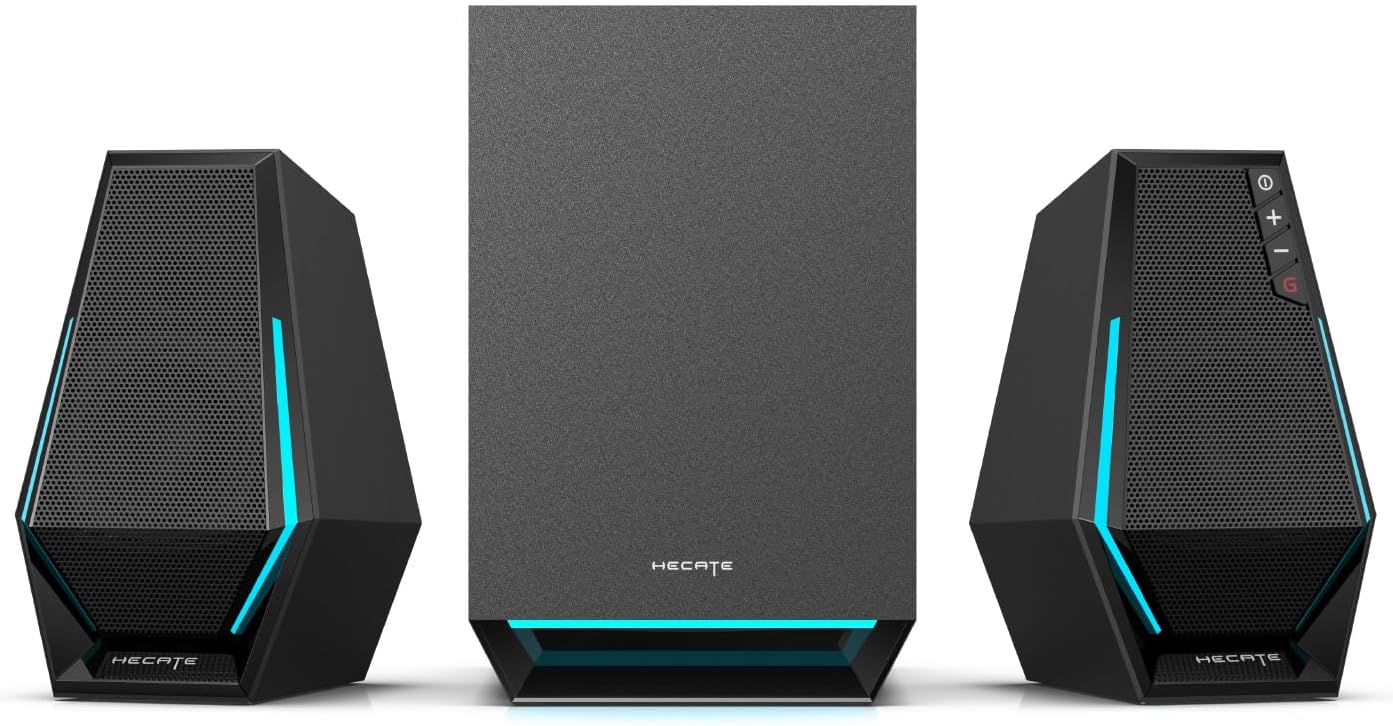
The Edifier G1500 MAX is a 2.1 gaming speaker system designed for PC gamers, console players, and content creators seeking affordable audio with visual flair. At 30W total power with a dedicated 4-inch wood subwoofer, it targets the budget-conscious gamer who wants more than basic desktop speakers but doesn't need professional-grade audio equipment.
The standout feature is the three dedicated sound modes accessible via a single button. Gaming mode enhances positional audio for competitive titles, Music mode optimizes stereo separation for streaming, and Movie mode boosts surround effects for cinematic experiences. This intelligent EQ switching delivers noticeable improvements in audio clarity and immersion across different content types. Bluetooth 5.3 connectivity pairs reliably with smartphones and tablets, while USB-A, USB-C, and 3.5mm inputs ensure compatibility with virtually any device without requiring adapters.
Design-wise, the G1500 MAX embraces a cyberpunk aesthetic with its mechanical hardline construction and sleek black finish. The 10 preset RGB light effects create an engaging gaming atmosphere that complements modern setups. However, the lighting placement prioritizes visual appeal over practical visibility, so adjusting volume or switching inputs in low-light conditions can be frustrating. The compact footprint saves desk space, though the relatively short cables may require creative positioning on larger work surfaces.
Sound performance is where opinions diverge. Users report powerful, punchy bass suitable for gaming and action movies, with clear dialogue and detailed mids. However, some listeners find the treble slightly tinny and bass response inconsistent depending on content and EQ mode selection. This system performs admirably for its price tier but shouldn't be compared to higher-end gaming speakers or studio monitors.
Final verdict: The Edifier G1500 MAX is a solid entry-level gaming speaker that excels in versatility and value. The three EQ modes and multi-connectivity options make it genuinely useful across different scenarios. If you're upgrading from basic PC speakers or need an affordable all-rounder for gaming and media consumption, this delivers. Just manage expectations on absolute sound quality and plan cable runs carefully on your desk setup.
Audio Performance: 30W total RMS power (7.5W x 2 satellite speakers + 15W subwoofer), 2.1 stereo configuration, 20 kHz frequency response, greater than 80dB signal-to-noise ratio, less than 25dB(A) noise level.
Speaker Configuration: Two 2.5-inch full-range drivers in satellite speakers, 4-inch (10.16cm) subwoofer with wooden enclosure, dynamic driver audio technology with built-in DSP.
Connectivity: Bluetooth 5.3 wireless, USB-A wired input, USB-C wired input, 3.5mm AUX jack. Compatible with desktops, laptops, smartphones, tablets, televisions, and gaming consoles including PS4 and Nintendo Switch.
Design: Tabletop mount configuration, compact dimensions 16.7 inches deep by 9.8 inches wide by 11.4 inches high, black finish, three-piece system with 2 satellite speakers and 1 subwoofer.
Warranty and Accessories: 2-year manufacturer limited warranty, includes USB-A cable, USB-C cable, 3.5mm AUX cable, power cable, quick start guide, brand card, and brand sticker.
Ideal Buyers: PC gamers seeking affordable gaming audio with RGB aesthetics, console players needing multi-device compatibility, content creators on a budget, anyone upgrading from basic monitor speakers, streamers who want visual appeal alongside decent audio.
Best Use Cases: Gaming on PC or PlayStation 5, streaming video content and movies, music listening in casual settings, content creation on a budget, colorful desk setups requiring compact speaker solutions.
Not Recommended For: Audiophiles seeking premium sound quality, professional music production or mastering, users requiring extensive cable runs on large desks, those who prefer minimal lighting in their workspace, anyone needing superior bass response compared to vintage budget speakers.
Buying Guide: Choosing Your Gaming Subwoofer
Power and Driver Size
The raw power of a subwoofer, measured in watts, determines how loud and impactful the bass can be. Driver size, typically ranging from 8 to 12 inches, influences how deep and resonant the low frequencies sound. A larger driver, like the 12-inch unit in the Klipsch R-12SW, can move more air, creating a physical sensation you can feel, which is perfect for cinematic gaming. For smaller rooms or desktop setups, a compact 10-inch model or a system like the Klipsch ProMedia 2.1 might be more appropriate.
Connectivity and System Compatibility
Consider how you’ll connect the subwoofer to your existing gear. Traditional home theater subwoofers use RCA line-level or LFE inputs, which require a compatible AV receiver. For PC gamers, systems with a direct 3.5mm input or USB connection, such as the Logitech G560, offer plug-and-play simplicity. Wireless options, like Bluetooth on the PreSonus Eris Sub 8BT or the wireless subwoofer in the ULTIMEA soundbar, provide flexible placement without cable clutter.
Special Gaming Features
Some systems are engineered specifically for interactive entertainment. Look for features like integrated DTS:X Ultra surround sound for precise positional audio, which helps you pinpoint footsteps or gunfire. RGB lighting that syncs with in-game action, as seen on the Logitech G560 and Edifier G1500 MAX, adds to the visual atmosphere. Dedicated sound modes for gaming, music, and movies allow you to optimize audio profiles instantly for different content.
Room Size and Placement Flexibility
The physical space where you game dictates your ideal subwoofer. A massive, high-power unit can overwhelm a small bedroom. Conversely, a modest subwoofer might get lost in a large living room. Look for models with adjustable crossover and phase controls, features often highlighted in guides for subwoofers with variable crossover, to fine-tune the bass to your room’s acoustics. Wireless subwoofers or front-firing designs offer more placement options than larger, rear-ported models.
Final Thoughts
Ultimately, the best subwoofer for your gaming setup depends on your space, budget, and desired level of immersion. For a premium, dedicated home theater gaming experience, a powerful unit like the Klipsch R-12SW 12″ 400W Subwoofer delivers unmatched impact. If you seek an all-in-one solution with gaming-specific features and vibrant aesthetics, the Logitech G560 PC Gaming Speaker System provides a compelling balance of audio performance and interactive flair. Whichever path you choose, adding substantial bass will redefine how you experience every game.
Frequently Asked Questions
Do I need a subwoofer for gaming?
While not strictly necessary, a subwoofer significantly enhances gaming immersion. It reproduces the low-frequency sound effects that standard speakers often miss, such as explosions, engine roars, and atmospheric rumbles. This adds a tactile, physical dimension to the audio, making the virtual world feel more real and impactful.
Can I use a home theater subwoofer for my PC?
Yes, absolutely. Many home theater subwoofers are excellent for gaming PCs if you have the correct connections. You will typically need an AV receiver that can process the audio signal from your PC and output it to the subwoofer via an LFE or line-level cable. This setup is ideal for creating a powerful, home audio system that serves both movies and games.
What’s the difference between a 2.1 system and a standalone subwoofer?
A 2.1 system, like the Klipsch ProMedia 2.1 or Logitech Z313, is a complete, matched package with two satellite speakers and a subwoofer. It’s designed to work together seamlessly and is often plug-and-play. A standalone subwoofer is a single component meant to be added to an existing speaker setup, requiring you to already own or purchase satellite speakers and potentially a receiver. Standalone subwoofers often offer more power and customization for advanced setups.
How do I reduce subwoofer vibration or rattling?
Rattling is often caused by the subwoofer interacting with loose room furnishings or being placed directly on a resonant floor. First, ensure the subwoofer itself is on a solid, level surface. Consider placing it on an isolation pad or stand designed to decouple it from the floor. Then, check the room for objects that may vibrate sympathetically. Finally, use the subwoofer’s volume and crossover controls to find a level that provides clean bass without overdriving your room.



Write Your Review
No reviews yet. Be the first to share your experience!