

You want to hear your music as the artist intended, without added warmth, exaggerated bass, or softened highs. A neutral amplifier is the cornerstone of that pursuit, acting as a transparent window to your audio source. This guide is for listeners who prioritize accuracy, from audiophiles building a reference system to musicians seeking honest playback. We have evaluated a range of amplifiers celebrated for their uncolored, faithful sound reproduction to help you make an informed choice. For those preferring a different tonal character, our guide to the best amplifiers with warm sound offers an excellent alternative.
Our selection spans integrated stereo amplifiers, modern streaming units, and specialized power amps. Each model is assessed for its ability to deliver a balanced frequency response, low distortion, and precise imaging. The goal is to identify components that get out of the way, letting the integrity of your recordings shine through. Whether you are powering bookshelf speakers or a high-end setup, neutrality ensures you hear every detail without artificial enhancement.
Pros
- Excellent sound clarity with balanced highs, mids, and bass across all input sources
- Phono input eliminates the need for a separate turntable preamp, saving money and desk space
- Bluetooth connection is quick to pair and remains stable during extended listening sessions
- Compact low-profile design fits standard AV furniture without any awkward modifications
- Highly rated by a large number of verified buyers, reflecting consistent real-world reliability
Cons
- Maximum volume output may feel limited for larger rooms or listeners who prefer concert-level loudness
- 2-channel stereo only, so it is not suitable for home theater surround sound setups
- No digital optical or coaxial inputs, which may frustrate users wanting to connect modern TVs or DACs directly
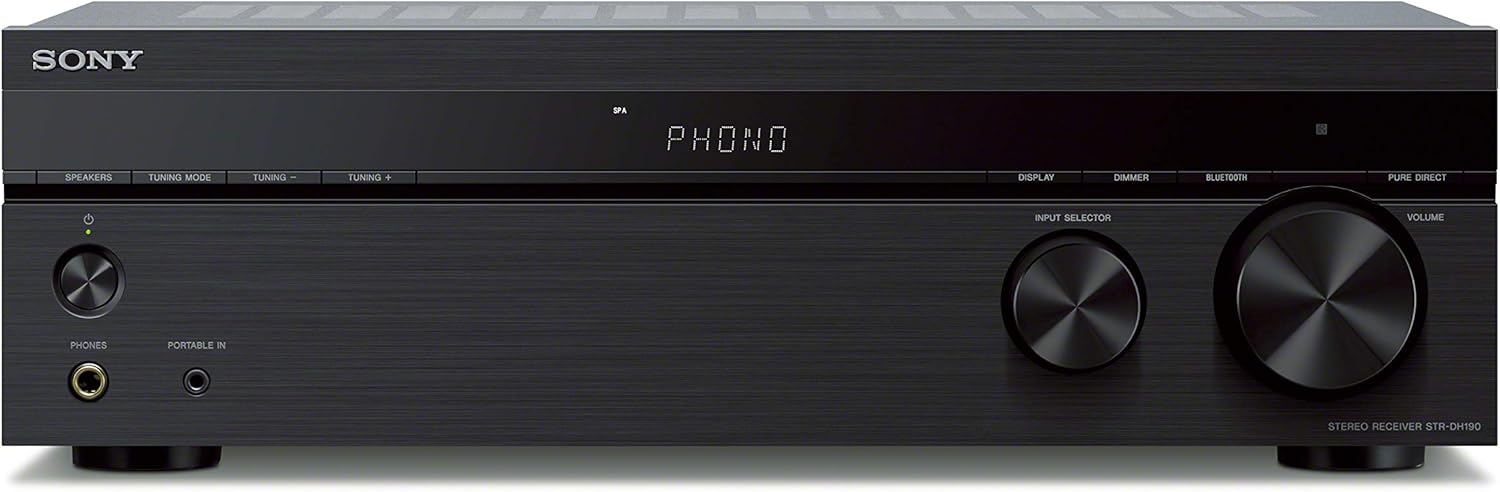
The Sony STRDH190 is a 2-channel home stereo receiver designed for music lovers who want a clean, capable hub for multiple audio sources. Whether you are spinning vinyl, streaming from a phone, or tuning into FM radio, this receiver handles it all in one compact unit. It is particularly well suited to first-time stereo system builders and returning audiophiles who value simplicity over complexity.
Sound performance is the STRDH190's strongest suit. With 100 watts per channel and Sony's large-capacity power transformer, the receiver delivers a composed, detailed soundstage with crisp highs and solid bass. Customer feedback consistently praises its clarity at moderate to high volumes, and High-Resolution Audio support means the unit can resolve fine details that compressed streaming formats often obscure.
The feature set is thoughtfully chosen for its target audience. The built-in phono preamp is a genuine convenience for turntable users, while Bluetooth pairing is described by owners as fast and reliable. The A/B speaker switching is a practical bonus, allowing two pairs of speakers to run simultaneously or independently for multi-room flexibility. A full-size headphone jack and 30-preset FM tuner round out the everyday usability.
On the design side, the STRDH190's low-profile chassis at just over 5 inches tall is a real-world advantage for anyone working with a standard AV cabinet. Build quality feels solid for the price point, and the included remote adds a layer of convenience that budget receivers often skip. The unit weighs 17 pounds, which speaks to the substantial internal components rather than hollow construction.
The main limitations are its 2-channel-only configuration, which rules it out for surround sound duties, and a lack of digital inputs for users wanting to connect a TV or external DAC. Volume headroom in very large rooms can also feel modest. That said, for a stereo-focused listener who values vinyl, Bluetooth, and clean audio in one tidy package, the STRDH190 is a genuinely impressive and well-rounded receiver.
Model: Sony STRDH190 | Color: Black | Channels: 2 (Stereo) | Output Power: 100W x 2 (8 ohms, 1 kHz) | Total Wattage: 200W
Speaker Impedance: 6 to 16 ohms | Inputs: Phono input, 4x stereo RCA, 3.5mm aux | Outputs: Stereo RCA, A/B speaker terminals, 1/4-inch headphone jack
Wireless: Bluetooth (2.4 GHz, max output 5.0 dBm) | FM Tuner: 30 station presets | Audio Format: WMA, High-Resolution Audio
Dimensions: 11"D x 17"W x 5.2"H | Weight: 17.1 lbs | Power: AC 120V, 60 Hz | Warranty: 1 year limited
In the Box: Receiver, remote control (RMT-AA400U), batteries, FM antenna | ASIN: B078WFDR8D | UPC: 027242908383
If you are shopping for your first stereo receiver, the STRDH190 is one of the most complete entry-level options available. It covers all the essential bases: Bluetooth streaming, FM radio, a phono stage for turntables, and enough inputs for a CD player, TV audio output, and more. You will not need to buy a separate phono preamp, which keeps your total system cost down.
Pairing advice: this receiver works best with bookshelf or floor-standing speakers rated between 6 and 16 ohms. Popular matches noted by owners include Yamaha bookshelf speakers and classic Bose 301s. For turntable users, Sony's own PS-LX310BT is a frequently recommended companion that integrates seamlessly with the STRDH190's phono input.
Consider your room size before purchasing. The 100-watt-per-channel rating is more than adequate for small to medium rooms, but listeners in large open-plan spaces who prefer very high volume levels may eventually want to step up to a higher-powered model. For most living rooms and dedicated listening spaces, however, the power on offer is genuinely sufficient.
This receiver is not the right choice if you need surround sound for a home theater setup, or if you want to connect a modern TV via optical or coaxial digital audio. For those use cases, a dedicated AV receiver would be a better fit. But as a pure stereo music receiver with broad source compatibility, the STRDH190 is hard to beat at its price point.
How to Choose a Neutral Amplifier
Total Harmonic Distortion and Noise
Look for a low THD+N specification, as this indicates how much unwanted signal an amplifier adds. A truly neutral amp introduces minimal distortion, preserving the purity of the original audio. Measurements like -106 dB THD+N, as seen in some high-performance models, represent exceptional transparency.
This spec is a reliable indicator of an amplifier’s engineering quality. Lower distortion correlates with cleaner, more accurate sound, allowing subtle details in recordings to emerge without being masked. It is a key metric for anyone seeking an uncolored listening experience.
Power Supply and Circuit Design
The quality of the power supply and internal layout directly impacts sound neutrality. Advanced designs like divided circuitry, which isolates digital and analog sections, prevent interference. High-current capability ensures stable performance even with demanding speaker loads.
Robust capacitors and efficient heat management, such as extruded aluminum heat sinks, contribute to consistent, uncolored output. A well-designed power stage avoids compressing dynamics or altering tonal balance, which is crucial for smooth treble and overall accuracy.
Digital-to-Analog Conversion Quality
<!–For amplifiers with digital inputs, the integrated DAC is critical. Premium DAC chips from manufacturers like ESS Sabre ensure bit-perfect conversion with high resolution. This process must be free of jitter and noise to maintain a neutral signal path from your digital source to your speakers.
Support for high-resolution formats like 24-bit/192kHz PCM and DSD allows the amplifier to handle detailed audio files without downsampling or quality loss. A superior DAC guarantees that the digital foundation of your music is translated with utmost fidelity.
Connectivity and System Integration
<!–Consider the sources you will use. A neutral amplifier should offer clean connections for all of them. Phono inputs for turntables, optical inputs for TVs, and Bluetooth with high-quality codecs are common needs. Each input must be implemented without degrading the signal.
Features like room correction software can adapt the sound to your environment, but the underlying amplification must remain neutral. Smart integration, such as multi-room audio, should not compromise the core audio performance. Explore our broader home audio category for more on system building.
Final Thoughts
Selecting an amplifier with a neutral sound profile is a commitment to audio accuracy, ensuring your speakers reveal the true character of your music collection. For listeners seeking a classic, high-performance integrated amplifier with impeccable build, the YAMAHA A-S801BL Natural Sound Integrated Stereo is a standout choice. If your priority is a modern, all-in-one streaming solution with advanced room correction and robust power, the WiiM Amp Ultra Stereo Streaming Amplifier offers exceptional value and flexibility. Both excel at delivering the transparent, uncolored performance that discerning listeners demand.
Frequently Asked Questions
What does “neutral sound” mean in an amplifier?
A neutral amplifier adds minimal coloration or alteration to the audio signal. It does not emphasize bass, treble, or midrange frequencies but aims to reproduce the source material as accurately as possible. This transparency is ideal for critical listening, studio monitoring, and those who want to hear recordings as they were originally mixed.
Is a neutral amplifier good for all music genres?
Yes, a neutral amplifier is versatile because it faithfully reproduces whatever you feed it. Whether you are listening to complex classical arrangements, detailed jazz recordings, or electronic music, the amplifier will not impose its own sonic signature. This makes it an excellent foundation for any system, particularly for acoustic music where tonal accuracy is paramount.
How important is amplifier power for neutral sound?
Adequate power is crucial for neutrality because an underpowered amp can distort or compress dynamics when driving speakers, especially at higher volumes. This distortion alters the sound. An amplifier with clean, stable power across the frequency spectrum maintains neutrality even during demanding musical passages, ensuring consistent performance.
Can I make a non-neutral amplifier sound more accurate?
You can use tone controls or equalization to adjust the frequency response, but this may not achieve true neutrality. These adjustments often work on broad frequency bands and can introduce phase issues or distortion. Starting with an amplifier designed for a neutral response from the ground up is generally more effective for achieving accurate, uncolored sound.





Write Your Review
No reviews yet. Be the first to share your experience!