

If you’re serious about audio quality, whether for a live stage, a studio session, or your living room, you’ve likely encountered the need for balanced XLR connections. These inputs are the gold standard for professional audio, designed to reject interference and deliver a clean, noise-free signal over long cable runs. But finding the right amplifier that fits your specific needs and budget can be a challenge. This guide is designed to help musicians, DJs, and home audio enthusiasts navigate the options.
We have evaluated a range of amplifiers that feature XLR inputs, from compact acoustic guitar combos to high-power rack units and sophisticated home audio components. Whether you need to plug in a microphone, connect a professional mixer, or integrate a high-end DAC, the right amplifier with the proper connectivity is crucial. Let’s explore the key players in the market to help you make an informed decision for your setup.

Pros
- Unique whizzer cone speaker provides superior acoustic guitar amplification compared to standard designs
- Compact size and light weight make it genuinely portable for musicians on the move
- XLR microphone input allows seamless integration of vocals without additional equipment
- Built-in reverb effect sounds natural and professional without cluttering the control panel
- Versatile enough for practice, small venues, rehearsals, and PA monitor applications
Cons
- 40 watts may be insufficient for larger venues or outdoor performances without additional support
- Single output channel limits flexibility compared to multi-channel amplifiers for complex setups
- Specifications show some inconsistencies in product dimensions across documentation
The Fender Acoustasonic 40 is a purpose-built amplifier for acoustic guitarists and singer-songwriters seeking portable, high-quality amplification. This 40-watt combo amp delivers the natural warmth and clarity that acoustic players demand, making it ideal for solo performers, small venues, rehearsals, and even use as an onstage monitor in larger PA systems.
What sets this amplifier apart is its exclusive whizzer cone speaker technology, a small supplementary cone attached to the main 6.5-inch speaker that enhances acoustic tone reproduction. Combined with built-in reverb that adds professional ambiance without excess processing, the Acoustasonic 40 captures the authentic character of acoustic instruments. The dual front-panel inputs, including a standard instrument jack and XLR microphone connector, make it exceptionally versatile for performers who blend guitar and vocals in their sets.
Build quality reflects Fender's reputation for durability, with a stainless steel enclosure and solid construction that withstands regular transport and use. At just 10 pounds and measuring 17.5 inches deep by 15.25 inches wide, this amp is genuinely portable compared to larger combo amplifiers. The grab-and-go design makes it practical for musicians who perform multiple venues weekly or travel frequently.
The main limitation is power output: 40 watts works well for intimate venues and rehearsals but may require PA support for larger outdoor performances or venues with high ambient noise. Additionally, the single output channel lacks the flexibility of multi-channel systems for complex live setups, though this simplicity also contributes to its ease of use and portability.
Overall, the Fender Acoustasonic 40 delivers exceptional value for acoustic guitarists prioritizing tone quality, portability, and versatility. Its thoughtful feature set and proven Fender engineering make it a smart investment for performers ranging from bedroom practitioners to working musicians.
Power and Output: 40 watts RMS, solid-state amplification, 1 output channel
Speakers: Dual 6.5-inch speakers with proprietary whizzer cone technology for acoustic tone enhancement
Inputs: One 1/4-inch instrument jack, one XLR microphone input
Effects: Built-in reverb on instrument channel
Physical Dimensions: 17.5 inches deep x 15.25 inches wide x 10 inches high
Weight: 10 pounds
Power Source: 120V AC corded electric
Enclosure: Stainless steel construction
Color: Brown and wheat finish
Warranty: 2-year limited warranty covering defects in materials and workmanship
Who Should Buy This Amp? The Acoustasonic 40 is perfect for acoustic guitarists and singer-songwriters who perform in coffeehouses, small clubs, churches, and intimate venues. Solo performers combining guitar and vocals will especially appreciate the dual inputs. It's also excellent for rehearsal studios, practice spaces, and musicians who need a portable backup amplifier.
Who Might Want to Look Elsewhere? If you regularly perform large outdoor venues or need extreme portability for air travel, consider whether 40 watts provides sufficient power. Musicians requiring multi-channel input mixing or extensive effects processing may prefer larger combo amps or PA systems.
Key Considerations: Verify that 40 watts meets your typical venue requirements before purchasing. Test the reverb effect to ensure it matches your tonal preferences. Consider the XLR microphone input as a major advantage if you perform vocals alongside guitar. The Fender brand and 2-year warranty provide confidence in long-term reliability.

Pros
- Exceptional value as an integrated solution combining DAC, headphone amp, and preamp functionality in one device
- High-quality components and balanced circuit design deliver noticeably cleaner, more detailed sound than separate budget alternatives
- Flexible connectivity and output options make it compatible with virtually any audio source, headphone, or powered speaker system
- Intuitive interface with physical controls and remote, plus customizable EQ and filter options for personalized sound tuning
- Strong output power handles both sensitive IEMs and high-impedance headphones without compromise
Cons
- EQ functionality is limited to headphone output only, not available for preamp output to powered speakers
- Some users report the amplifier section sounds slightly sterile compared to dedicated high-end amplifiers when used as a preamp
- Requires direct USB connection to computers in some setups rather than working through USB docks or hubs
The Fosi Audio ZH3 is a premium all-in-one desktop audio solution designed for audiophiles, music producers, and gamers who demand exceptional sound quality without the clutter of multiple components. It combines a high-performance DAC, powerful headphone amplifier, and balanced preamp into a single compact unit, making it an excellent choice for anyone looking to upgrade their listening experience on a budget.
The ZH3 delivers standout performance through its premium chipset architecture, featuring the respected AKM4493SEQ DAC paired with an XMOS XU316 processor and four OPA1612 amplifiers. It supports up to PCM 768kHz/32bit and DSD512, meaning it can handle virtually any audio format you throw at it. The fully balanced circuitry maintains ultra-low noise at just 1.9μV, resulting in clean, detailed sound with minimal distortion. Real-world testing confirms users hear noticeably improved clarity and soundstage compared to budget DAC/amp combos.
The ZH3 excels in versatility and power delivery. Dual output stages provide 640mW at 32Ω on the 6.35mm single-ended output and an impressive 2570mW at 32Ω on the balanced 4.4mm output, easily driving everything from sensitive IEMs to demanding full-size headphones. The three-level gain switch intelligently matches impedance ranges from 16Ω to 300Ω, eliminating the guesswork of volume matching. Four input types (USB, optical, coaxial, RCA) and four output formats (XLR, RCA, 4.4mm, 6.35mm) provide exceptional flexibility for connecting to any audio ecosystem.
Design and usability are thoughtfully executed. The compact desktop form factor integrates all functions into a clean interface with an OLED display and included remote control, allowing seamless switching between headphone and speaker modes with a double-click. Customization options including bass/treble EQ, six filter types, and swappable op-amps enable you to fine-tune the sound signature to match your preferences. However, note that EQ adjustments only apply to headphone output, not preamp output.
The main consideration is that while the ZH3 performs excellently as a DAC and headphone amp, some users report the amplifier section sounds slightly clinical compared to dedicated high-end power amps when used primarily as a preamp. Additionally, USB connectivity can be finicky with certain dock setups. Despite these minor limitations, the ZH3 represents exceptional value as an integrated solution, delivering studio-quality sound and professional features at an accessible price point.
DAC Specifications: AKM4493SEQ DAC with XMOS XU316 processor, supports PCM up to 768kHz/32bit and DSD512, noise floor 1.9μV.
Amplifier Output: 6.35mm single-ended output 640mW at 32Ω (x2 channels), 4.4mm balanced output 2570mW at 32Ω (x2 channels). Three-level gain switch for impedance range 16Ω to 300Ω.
Inputs: USB, optical (TOSLINK), coaxial (S/PDIF), RCA.
Outputs: 4.4mm balanced, 6.35mm single-ended, XLR (preamp), RCA (preamp).
Additional Features: Bass/treble EQ, 6 filter types, swappable op-amps, 12V trigger input, OLED display, remote control, UAC mode switching for gaming consoles.
Physical: Weight 2.9 lbs, compact desktop form factor. Warranty: 24 months.
Who Should Buy: The ZH3 is ideal for desktop audio enthusiasts, music producers, gamers, and anyone using high-quality headphones or powered speakers who wants a single integrated solution. It's perfect if you currently use separate DAC and amp components and want to simplify your setup while maintaining or improving sound quality.
Headphone Compatibility: The three-level gain switch makes the ZH3 compatible with virtually any headphone or IEM on the market, from ultra-sensitive IEMs (16Ω) to demanding full-size cans (300Ω). The balanced 4.4mm output provides exceptional power for even the most demanding headphones.
Speaker Integration: If you use powered active speakers, the XLR and RCA preamp outputs provide fixed-level outputs perfect for driving studio monitors or high-end powered speakers. Note that EQ adjustments only apply to headphone output.
Gaming and Console Use: UAC mode switching ensures full compatibility with gaming consoles for both music playback and gaming audio, making it a versatile choice for streamers and console gamers.
Setup Considerations: For best results with USB connections, connect directly to your computer rather than through USB docks or hubs. After connecting, manually select the ZH3 as your audio output device in your system sound preferences.

Pros
- Exceptional power-to-weight ratio at under 11 lbs makes it ideal for portable and installed applications
- Versatile connectivity with XLR, 1/4 inch, and RCA inputs accommodates both professional and consumer audio sources
- Advanced DSP features and PureBand crossover provide studio-quality sound shaping at a professional price point
- Proven reliability backed by Crown manufacturer warranty and consistent 4.5-star customer ratings
- Effortlessly handles challenging loads including 2-ohm impedance without strain or distortion
Cons
- Requires careful gain staging and input matching when integrating with consumer-grade home theater receivers
- Professional audio signal levels differ from consumer equipment, necessitating potential adapter investment for some setups
- Subtle audible hiss when speakers are placed very close to the amplifier and no audio is playing
The Crown XLS1002 is a professional-grade Class D power amplifier engineered for audio professionals, live sound operators, and serious audiophiles who demand studio-quality performance without excessive weight or heat generation. This compact powerhouse combines Crown's legendary DriveCore efficiency technology with advanced digital signal processing, making it equally at home powering a small venue, a home theater system, or a dedicated music listening space.
What sets the XLS1002 apart is its combination of raw power and intelligent control. At 350W per channel into 4 ohms, it delivers clean, undistorted amplification, while the 1100W bridged mode capability handles even demanding subwoofer loads with ease. The integrated PureBand crossover system and per-channel bandpass filters give you surgical precision over your audio, while Peakx limiters automatically protect your speakers from damage without sacrificing dynamic impact. Multiple input options including balanced XLR, 1/4 inch TRS, and RCA jacks with selectable input sensitivity ensure compatibility with virtually any audio source, from professional mixing consoles to consumer receivers.
The build quality reflects Crown's professional heritage, with a rugged metal chassis, efficient forced-air cooling system, and an intuitive LCD display for monitoring and control. At just 8.6 pounds, this amplifier weighs significantly less than comparable analog designs while delivering superior performance. The intelligent auto-sleep mode reduces energy consumption during idle periods, adding convenience to professional installations.
One important consideration: this is professional audio equipment with signal levels optimized for pro audio (+14 dBu) rather than consumer audio (-10 dB). Users integrating the XLS1002 with home theater receivers may need to invest in a signal matching device to fully utilize the DSP capabilities. Additionally, some users report a subtle hiss audible only at very close range when no audio is playing, which is minimal but worth noting for sensitive applications.
The Crown XLS1002 represents exceptional value for anyone seeking professional amplifier performance, reliability, and efficiency in a compact form factor. Customer feedback consistently praises its ability to deliver claimed specifications effortlessly while maintaining pristine audio quality across diverse applications.
Power Output: 550W at 2 ohms dual, 350W at 4 ohms dual, 215W at 8 ohms dual, 1100W at 4 ohms bridged, 700W at 8 ohms bridged.
Channels: 2-channel configuration with independent controls per channel.
Technology: Class D amplification with Crown DriveCore efficiency technology.
Inputs: Balanced XLR (x2), 1/4 inch TRS (x2), RCA jacks (x1 pair) with selectable input sensitivity (1.4VRMS and 0.775VRMS).
Outputs: 1/4 inch speaker connectors (x2).
DSP Features: Bandpass filter per channel, PureBand crossover system, Peakx limiters, system reset for factory settings.
Power Supply: 100-240VAC, 50-60Hz, 10 percent tolerance.
Physical: 7.7 x 19 x 3.5 inches, 8.6 pounds, rack-mount design.
Cooling: Efficient forced-air fan system for extended operation.
Warranty: Official Crown manufacturer warranty valid for purchases from authorized North American dealers.
Who Should Buy: The Crown XLS1002 is ideal for professional sound engineers, live event operators, home theater enthusiasts seeking subwoofer amplification, and audiophiles who want studio-grade performance. It's particularly well-suited for anyone who needs to drive low-impedance loads or requires precise audio control through advanced DSP.
Professional Applications: Small venues, portable sound systems, installed audio systems, and distributed speaker networks benefit from the XLS1002's compact form factor, multiple input options, and proven reliability. The remote power trigger enables seamless integration into larger system architectures.
Home Audio Applications: Users integrating the XLS1002 with consumer audio equipment should note that professional audio levels differ from consumer standards. A signal matching device may be necessary to properly interface with home theater receivers and fully utilize DSP capabilities. However, the amplifier excels at powering subwoofers and challenging speaker loads.
Setup Considerations: Proper gain staging is essential for optimal performance. The selectable input sensitivity options accommodate both professional and consumer signal levels. Allow adequate ventilation around the amplifier for the forced-air cooling system to operate effectively during extended sessions.
Value Proposition: Compared to consumer amplifiers, the XLS1002 offers professional-grade components, advanced signal processing, and proven durability at a competitive price point. The lightweight design and efficiency make it suitable for both portable and installed applications, providing exceptional versatility.

Pros
- Excellent power output at 400W RMS bridged delivers loud, clean sound for medium to large venues
- Versatile input and output options accommodate virtually any pro audio setup without adapters
- Reliable protection circuits and dual cooling fans ensure stable, long-term operation
- Compact 2U rack-mount form factor saves space while remaining portable with integrated handles
- Outstanding value for professional-grade amplification at this price point
Cons
- Limited to 2 channels, so larger multi-zone setups may require multiple units
- No digital inputs or DSP features, making it less flexible for modern networked audio systems
- Cooling fans may produce noticeable noise in quiet studio environments despite being quiet-rated
The Rockville RPA5 is a professional 2-channel power amplifier purpose-built for DJs, live sound engineers, and permanent audio installations. With 400W RMS output in bridged mono mode or 200W per channel in stereo at 4 ohms, plus 1000W peak capability, this amplifier delivers the power needed for small to medium venues, nightclubs, and mobile setups without excessive bulk or cost.
Performance standouts include a built-in crossover for optimizing subwoofer or full-range speaker performance, flexible stereo/mono switching, and comprehensive connectivity spanning XLR, 1/4 inch, and RCA inputs alongside Speakon, banana, and XLR outputs. The frequency response spans the full audible spectrum from 20Hz to 20kHz with distortion under 0.03%, ensuring crisp, powerful reproduction. Channel A/B clipping LEDs provide visual feedback to prevent speaker damage from over-driven signals.
Build quality reflects professional design principles with dual high-velocity cooling fans, IC-controlled short circuit and thermal overload protection, and a rugged 2U rack-mount chassis featuring heavy-duty ears and transport handles. The amplifier is engineered for reliability in demanding live sound environments where equipment must survive repeated setup, transport, and extended operation.
Minor considerations include the lack of digital inputs or DSP processing, limiting compatibility with modern networked audio systems, and the two-channel limitation for larger multi-zone installations requiring additional units. Cooling fans, while rated quiet, may be audible in silent studio environments during full-power operation.
The RPA5 represents exceptional value for professional audio applications, offering genuine pro-grade performance, protection, and connectivity at a price accessible to working DJs and sound engineers. Recommended for anyone requiring dependable, high-power amplification in a portable, rack-mount package.
Power Output: 200W RMS per channel at 4 ohms (stereo), 400W RMS at 8 ohms (bridged mono), 1000W peak
Frequency Response: 20Hz to 20kHz
Total Harmonic Distortion: Less than 0.03%
Signal-to-Noise Ratio: Greater than 102dB
Inputs: Combo XLR/1/4 inch and RCA
Outputs: Banana binding posts, Speakon, and XLR direct outputs
Features: Built-in crossover, stereo/mono switch, dual cooling fans, IC-controlled protection, channel A/B clipping LEDs
Form Factor: 2U rack-mount with heavy-duty ears and transport handles
Warranty: 1 year manufacturer warranty
Who Should Buy: The RPA5 is ideal for DJs requiring portable, powerful amplification for mobile events, live sound engineers managing small to medium venues, and installers building permanent audio systems in clubs, studios, or retail spaces. It suits anyone prioritizing reliability, pro-grade connectivity, and value.
When to Consider Alternatives: If you need more than 2 channels, require digital inputs for networked audio, or operate exclusively in ultra-quiet studio environments where fan noise is problematic, explore other options. For very large venues requiring extreme power, consider higher-wattage models.
Setup Tips: Use the built-in crossover to optimize subwoofer performance and reduce strain on full-range speakers. Monitor the clipping LEDs during setup to ensure proper gain staging. Mount in a rack with adequate ventilation around the cooling fan vents to prevent thermal issues during extended operation.
Real-World Value: At this price point, the RPA5 delivers genuine professional specifications and protection that typically costs significantly more. The combination of reliable cooling, comprehensive protection circuitry, and versatile connectivity makes it a smart investment for working professionals and serious enthusiasts.

Pros
- Powerful 1800W peak output provides professional-grade sound in a surprisingly compact and portable form factor
- Bluetooth connectivity eliminates cable clutter and allows seamless wireless streaming from any mobile device
- Comprehensive onboard effects including echo, delay, and per-channel reverb enable creative sound design without external gear
- Four XLR inputs with phantom power support both microphones and instruments, making it versatile for any performance
- Intuitive layout with individual volume, bass, treble controls per channel simplifies real-time mixing during live events
Cons
- No customer reviews available yet, so real-world durability and long-term reliability remain unverified
- 18-pound actual weight slightly exceeds listed specifications, which may impact portability for frequent road use
- Peak power rating of 1800W is significantly higher than RMS output of 450W, so sustained volume capability is more modest
The Rockville RPM45BT is a powered mixer and amplifier engineered for musicians, DJs, karaoke enthusiasts, and event organizers who need professional sound in a compact package. This 4-channel unit delivers 1800W peak power output with 450W RMS continuous power, making it suitable for small to medium-sized venues, rehearsals, and mobile performances. Its combination of modern wireless connectivity and traditional professional audio inputs makes it adaptable to virtually any performance scenario.
The standout feature is the integration of Bluetooth streaming with professional-grade XLR inputs and 48V phantom power support. You can wirelessly stream backing tracks from your smartphone while simultaneously capturing live vocals through a condenser microphone, all without leaving your mixing position. Each of the four channels offers independent volume, bass, treble, and reverb controls, plus onboard echo and delay effects that let you shape your sound in real time. The inclusion of USB input, RCA AUX connections, and an effects loop provides flexibility for connecting multiple audio sources and external gear.
Build quality centers on a durable wooden enclosure designed to withstand frequent transport and setup. At 14.99 lbs, the unit is genuinely portable for one person to carry, though the compact 18.9-inch width and 6.3-inch height mean you'll need to plan your rack or stand setup carefully. The control layout is intuitive with clearly labeled knobs and switches, making it easy to adjust levels and effects during live performances without fumbling.
The main limitation is the gap between peak power and RMS output. While 1800W peak sounds impressive, the actual continuous power delivery is 450W RMS at 8 ohms, which is more modest for large venues. Additionally, this is a new model with no customer reviews yet, so long-term durability and real-world performance feedback remain unverified. The weight specification discrepancy between listed and actual specs also warrants attention if portability is critical.
The Rockville RPM45BT represents solid value for performers who prioritize wireless convenience and compact size without sacrificing essential mixing features. It excels in small venues, rehearsal spaces, and mobile applications where space and weight matter. For anyone needing straightforward powered mixing with modern connectivity, this unit delivers professional functionality at an accessible price point.
Power Output: 1800W peak, 450W RMS (225W x 2 @ 8 ohm)
Channels: 4 channels with XLR/1/4 inch balanced inputs
Phantom Power: 48V for condenser microphones
Connectivity: Bluetooth wireless, USB input, RCA AUX inputs, RCA REC outputs, 1/4 inch TS outputs
Effects: Echo, delay, reverb per channel
EQ: Individual volume, bass, treble controls per channel
Dimensions: 18.9 inches W x 8.9 inches D x 6.3 inches H
Weight: 18 pounds
Enclosure: Durable wooden cabinet
Warranty: 1 year manufacturer warranty
Ideal For: This mixer is perfect for mobile DJs, acoustic musicians performing in small venues, karaoke enthusiasts, church sound technicians, rehearsal studios, and event organizers who need reliable powered mixing without a large footprint. It works well for anyone who wants to blend wireless streaming with live microphone input.
May Not Be Ideal For: Large venue operators needing sustained high power output should consider higher-wattage systems. Professional studios with extensive outboard gear may find the limited effects and channel count restrictive. Users prioritizing ultra-lightweight portability should note the actual 18-pound weight.

Pros
- Exceptional feature set and connectivity options rarely found in sub-$200 amplifiers
- Whisper-quiet operation with no audible hiss or power-on pops reported by users
- Powerful enough to drive demanding speakers while maintaining clean, detailed sound
- High-pass filter dramatically improves mid-range clarity and subwoofer integration
- Premium build quality and metal switches provide solid, professional feel
Cons
- Some users report it may not deliver full rated power with standard 48V/5A power supply, upgrade recommended for maximum output
- Plastic volume knob feels less premium than metal alternatives, though it has satisfying detents
- Compact size means limited cooling surface area, requires adequate ventilation for sustained high-power operation
The AIYIMA A20 is a fully balanced Class D power amplifier designed for serious desktop audio enthusiasts and home theater integrators who demand professional features without the premium price tag. It's ideal for nearfield listening setups, 2.1 speaker systems, and anyone looking to upgrade their audio chain with a compact yet powerful amplification solution that doesn't compromise on sonic quality.
What truly sets this amplifier apart is its combination of reference-grade performance metrics and practical integration features. The 116dB signal-to-noise ratio ensures an absolutely silent background, while the 0.002% THD+N distortion specification delivers pristine, uncolored sound that reveals every nuance in your music. The adjustable high-pass filter (60-200Hz) is a game-changer for system building, protecting main speakers from bass distortion while dramatically improving mid-range clarity when paired with a subwoofer.
Build quality exceeds expectations for the price point. The 4-layer gold-sink PCB provides superior signal integrity, while German WIMA and Japanese Rubycon capacitors ensure long-term reliability and consistent performance. Physical controls feel premium, with satisfying metal switches and a well-damped volume knob featuring defined steps. The matte black chassis is compact, roughly the size of a Wi-Fi router, yet substantial enough to convey quality without taking up excessive desktop real estate.
The main consideration is power delivery, which reaches full 300W per channel output with the optional 48V/10A power supply rather than the included 5A adapter. Additionally, the plastic volume knob, while functional, doesn't match the metal switches in perceived premium quality. Sustained high-power operation requires adequate ventilation due to the compact form factor.
The AIYIMA A20 represents exceptional value for audiophiles and home theater enthusiasts seeking a versatile, feature-rich amplifier with genuine professional capabilities. Whether driving demanding speakers on a desktop or anchoring a 2.1 system, it delivers clean, powerful sound with the flexibility and build quality typically found in amplifiers costing significantly more.
Power Output: 300W x 2 channels at 4 ohms (with 48V/5A supply), up to 150W x 2 at 8 ohms
Audio Performance: Signal-to-Noise Ratio: 116dB, THD+N: 0.002%, Frequency Response: 20Hz-20kHz
Connectivity: XLR and RCA inputs (switchable), subwoofer pre-out, 12V trigger, bypass mode for external preamp control
High-Pass Filter: Adjustable 60-200Hz for 2.1 system integration
Amplifier Topology: Class D with TPA3255 chipset, swappable LME49720 op-amps
Build: 4-layer gold-sink PCB, German WIMA capacitors, Japanese Rubycon capacitors, internal air convection cooling
Physical: Compact form factor (Wi-Fi router sized), 1kg weight, matte black chassis
Included: DC48V 5A power adapter, user manual, 1-year warranty
Who Should Buy: Desktop audiophiles, home theater enthusiasts building 2.1 systems, music producers seeking clean amplification, anyone upgrading from underpowered desktop speakers or integrated amplifiers.
Power Supply Recommendation: The included 48V/5A adapter provides solid performance at 8 ohms. For maximum power delivery and headroom with demanding 4-ohm speakers, upgrade to the optional 48V/10A power supply, which users report enables the full 300W per channel specification.
Speaker Pairing: Works excellently with bookshelf speakers, powered subwoofers, and even demanding floor-standing speakers in nearfield applications. The high-pass filter makes it particularly effective for systems where main speakers benefit from bass relief.
Setup Considerations: Ensure adequate ventilation around the compact chassis for sustained high-power operation. The XLR/RCA toggle and bypass mode provide flexibility for various source configurations, from DACs to vintage preamps. The 12V trigger enables one-touch integration with compatible preamps like the AIYIMA T20.
Comparison Context: In the sub-$200 amplifier category, the A20 stands out for its high-pass filter, dual connectivity, and swappable op-amp design. Most competitors lack this feature breadth, making it exceptional value for system builders prioritizing flexibility and sound quality.

Pros
- Dead silent operation across all inputs with zero audible noise floor
- High-pass filter with multiple settings (80 Hz option) simplifies subwoofer crossover setup
- Solid build quality with gold-plated connectors and responsive remote control
- Tone controls and bypass function provide both flexibility and sonic purity when needed
- Volume memory saves settings per input source for convenient switching between devices
Cons
- Volume knob requires initial setup (turn 3-4 rotations counterclockwise on first use) to prevent speaker damage
- Tone controls add slight dB boost when engaged, so bypass mode recommended for ultimate transparency
- High-pass filter is fixed at preset frequencies rather than continuously variable
The Fosi Audio ZP3 is a compact preamp designed for audiophiles and home theater enthusiasts who need flexible input management without compromising sound quality. It excels in 2.1 channel setups where subwoofer integration is critical, and serves as an excellent upgrade path for those moving away from older preamp designs or integrated amplifiers.
The standout feature is the adjustable high-pass filter, which intelligently routes bass frequencies to a dedicated subwoofer output while sending mids and highs to main speakers. Real-world testing confirms this delivers noticeably improved clarity and detail, with users reporting better instrument separation and reduced muddiness. The balanced XLR connectivity ensures cleaner signal transmission, while the dual RCA inputs accommodate multiple legacy audio sources without signal conversion loss.
Build quality punches above its price point, with premium components including ELNA capacitors, NJR NJU72315 volume IC, and gold-plated RCA jacks that minimize noise and distortion. The remote control feels responsive, and the compact 5x4x2 inch form factor fits seamlessly into any system without dominating shelf space. Controls have satisfying mechanical detents, suggesting durability and precision engineering.
The main drawback is the volume knob behavior, which requires counterclockwise rotation on initial setup to prevent speaker damage from high default levels. Additionally, the high-pass filter uses fixed frequency presets rather than continuous adjustment, though the 80 Hz setting works perfectly for most subwoofer integration scenarios. Tone controls add slight coloration when engaged, making bypass mode the preferred choice for ultimate sonic transparency.
Verdict: The ZP3 delivers exceptional value for audiophiles seeking a neutral, feature-rich preamp with excellent subwoofer management. Its transparent sound signature, solid construction, and flexible connectivity make it an outstanding choice for upgrading legacy systems or building high-quality 2.1 channel setups.
Connectivity: 2 RCA inputs, 1 XLR input, RCA/XLR/Sub-Out outputs, supports balanced XLR and RCA/XLR signal conversion
Audio Processing: 3-level adjustable high-pass filter, bass/treble tone control with bypass function, L/R balance adjustment, volume memory per input source
Components: ELNA capacitors, NJR NJU72315 volume IC, gold-plated RCA jacks, relay-based switching
Physical: Dimensions 5 x 4 x 2 inches, weight 1.09 kg, tabletop mounting, metal construction
Included: Remote control, 12V trigger cord, power cord, user manual
Warranty: 24-month manufacturer coverage
Best For: Audiophiles upgrading older preamps, 2.1 channel system builders, multi-source audio management, subwoofer integration optimization
Setup Tips: On first use, turn the volume knob 3-4 full rotations counterclockwise to set safe default levels. Remember to reduce volume when switching to new inputs. Use bypass mode for maximum transparency, or engage tone controls for subtle sonic customization.
Optimal Use Cases: Connecting turntables, CD players, and streaming devices to power amplifiers; managing multiple audio sources without a full receiver; integrating subwoofers with precise high-pass filtering; upgrading from vintage preamps while maintaining signal integrity
Comparison Consideration: If you prioritize continuous high-pass filter adjustment or need more than 3 inputs, consider larger preamp units. However, for compact form factor combined with excellent sound quality and subwoofer management, the ZP3 offers outstanding value.
Pros
- Excellent power output with flexible bridging options for different speaker configurations
- Bluetooth connectivity eliminates cable clutter and enables easy wireless music streaming
- Comprehensive input/output options accommodate both professional and consumer audio equipment
- Active cooling system prevents overheating during continuous operation
- Rack-mountable form factor integrates cleanly into existing audio setups
Cons
- Limited to 120V AC minimum supply voltage, which may require step-down transformer in some regions
- No built-in effects or DSP features, making it a pure amplifier without sound processing
- Compact design means limited space for large heat sinks, relying on active cooling
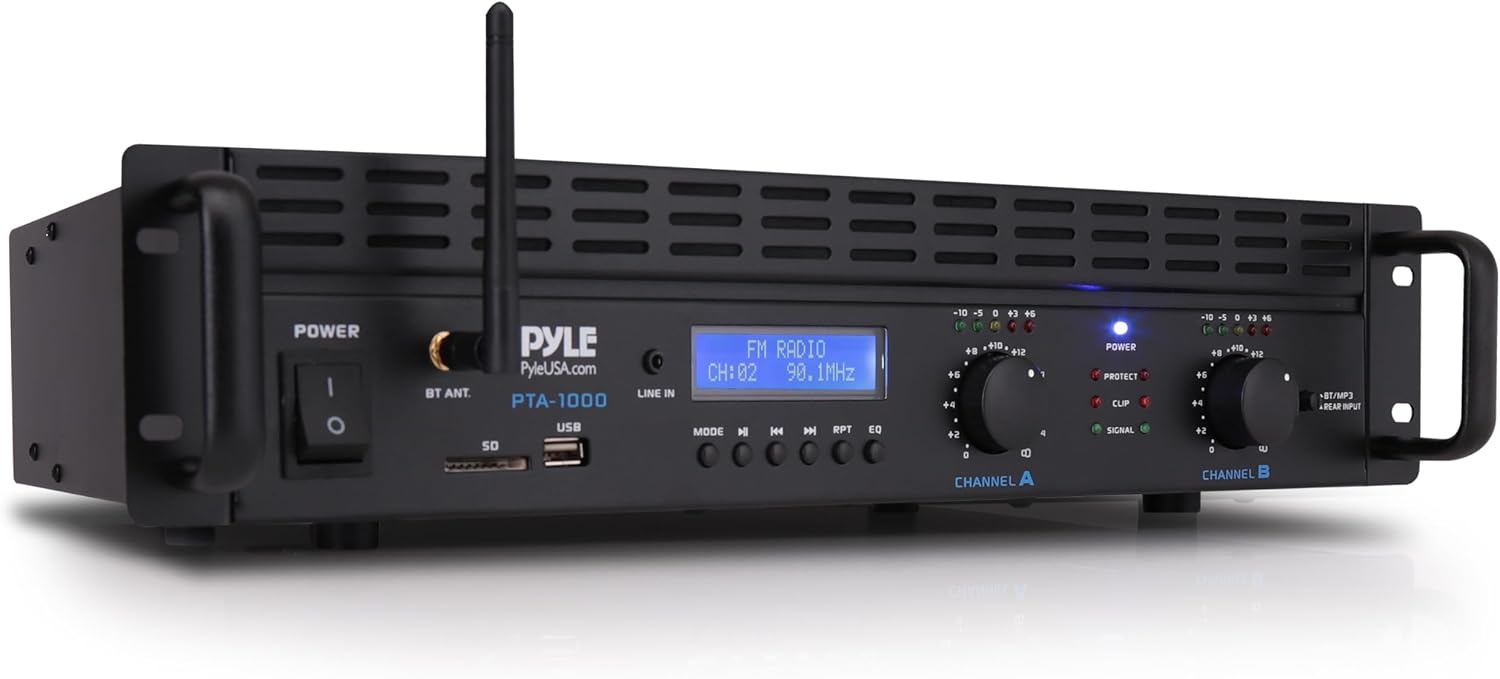
The Pyle PTA1000BT is a 2-channel power amplifier designed for DJs, small venues, recording studios, and audio professionals who need reliable amplification without breaking the bank. With 2000W peak power in bridged mode and flexible stereo or mono configurations, this unit handles everything from small events to medium-sized installations. The rack-mountable design makes it perfect for integration into professional audio systems.
The standout feature is undoubtedly the Bluetooth connectivity, which allows wireless streaming from smartphones and tablets. Combined with multiple wired inputs including XLR and TRS connectors, this amplifier offers genuine flexibility for modern audio setups. The front panel LCD display with ID3 format support and LED level meters provides clear visibility into signal levels and system status, helping you maintain optimal audio quality without clipping.
Build quality is solid for the price point, with a sturdy metal chassis and professional-grade connectors throughout. The built-in cooling fan actively circulates air to prevent thermal issues during extended use, which is critical for reliability in live sound applications. The compact 19-inch width fits standard audio racks, though the 3.5-inch height means it won't hog excessive vertical space.
The main limitation is that this is a pure power amplifier without onboard effects, EQ, or digital signal processing. You'll need to handle tone shaping and effects elsewhere in your signal chain. Additionally, the 120V minimum supply voltage requirement may require attention depending on your location and available power infrastructure.
Overall, the Pyle PTA1000BT delivers excellent value for users seeking powerful, straightforward amplification with modern wireless connectivity. It's a no-nonsense amplifier that focuses on clean power delivery and flexibility rather than feature bloat, making it ideal for professionals who know exactly what they need from their gear.
Power Output: 2000W peak in bridged mode, 1000W per channel in stereo mode
Input Connectors: 2x 1/4 inch TRS jacks, 2x XLR connectors
Output Connectors: 3x Speakon connectors (A/B/Bridged), 2x speaker terminal binding posts
Connectivity: Bluetooth wireless streaming, USB-A input with MP3 player support
Impedance: 4-8 ohms compatible
Dimensions: 19.09 x 9.84 x 3.54 inches (L x W x H)
Mounting: Rack-mountable standard configuration
Power Supply: 120V minimum AC, 220V nominal
Cooling: Built-in ventilation fan for thermal management
Display: LCD with ID3 format support, LED level indicators for left and right channels
DJs and Mobile Entertainers: The Bluetooth connectivity and compact rack-mount design make this ideal for DJs who need wireless music streaming and portable amplification for events and parties.
Small Venues and Bars: Perfect for powering house systems in small clubs, restaurants, and bars where professional amplification is needed without excessive cost or complexity.
Recording Studios: Studio professionals can use this as a monitor amplifier or for powering studio reference speakers in secondary monitoring setups.
Audio Professionals: Sound engineers and installers appreciate the flexible connectivity options and reliable performance for fixed installations and touring applications.
Budget-Conscious Buyers: Anyone seeking powerful, professional-grade amplification at an accessible price point without sacrificing core functionality or build quality.
What to Look for in an Amplifier with XLR Inputs
Power Output and Speaker Compatibility
The amplifier’s power rating must match your speakers’ requirements. Look for RMS wattage ratings at specific impedances (like 4 or 8 ohms). An underpowered amp can distort when pushed, while an overpowered one risks damaging your speakers if mismatched. Consider if you need a stereo, bridged mono, or multi-channel configuration for your application.
For home theater enthusiasts, understanding power needs is especially important. You can explore more on this in our dedicated guide to the best power amplifiers for home theater. Matching power correctly ensures dynamic headroom and clear sound at all volume levels.
Input and Output Flexibility
Beyond the essential XLR input, consider what other connections you need. Many professional amps offer combo jacks (XLR/TRS), RCA inputs for consumer gear, and even digital inputs like USB or Bluetooth. Output options are equally vital, including binding posts, SpeakON connectors for secure speaker links, and dedicated subwoofer or preamp outputs.
This flexibility allows you to connect various sources, from a digital audio player to a traditional turntable setup. For those building a sophisticated system, a dedicated preamplifier can offer superior control. Our review of the best preamplifiers for audiophiles dives deeper into this critical component.
Form Factor and Intended Use
Your amplifier’s physical design should suit its environment. Portable combo amps are ideal for gigging musicians. Rack-mountable units are perfect for permanent installations in studios or DJ booths. For desktop or living room use, a compact, aesthetically pleasing integrated amplifier or preamp is often the best choice.
Think about cooling as well. High-power amps generate heat and often include quiet fans or substantial heatsinks. A rack-mounted unit with forced-air cooling is built for continuous duty, while a desktop model might rely on passive convection. The right form factor ensures reliable performance and seamless integration into your space.
Additional Features and Sound Shaping
<!–Many modern amplifiers include built-in digital signal processing (DSP), crossover filters, limiters, and equalization. These tools are invaluable for tailoring the sound to your room or protecting your speakers. For musicians, onboard effects like reverb or delay can be a major convenience. For home audio, features like a high-pass filter (HPF) are key for integrating a subwoofer into a 2.1 system.
These features move an amplifier from being a simple power source to an active component in your signal chain. They offer greater control and can often eliminate the need for additional outboard gear, simplifying your setup. For a deep dive into feature-rich home audio components, check out our list of the best integrated amplifiers for audiophiles.
Final Thoughts
Choosing the right amplifier with XLR inputs ultimately depends on balancing power, connectivity, and features with your specific use case and budget. For the touring musician or band needing reliable, high-power amplification, the Crown XLS1002 2-Channel Class D DriveCore stands out with its professional pedigree and robust feature set. For the home audio enthusiast seeking to build a refined, flexible system around a quality DAC and preamp, the Fosi Audio ZH3 DAC Headphone Amp offers exceptional versatility and sound quality in a desktop-friendly package. We hope this focused comparison empowers you to find the perfect amplifier to elevate your audio experience.
Frequently Asked Questions
Why are XLR inputs important on an amplifier?
XLR inputs provide a balanced connection, which uses three conductors to cancel out electromagnetic interference picked up along the cable. This is crucial for maintaining a clean, noise-free signal, especially when running cables over long distances, such as on a stage or in a studio. This makes them the professional standard for microphones and line-level signals.
Can I connect a regular RCA output to an XLR input on an amplifier?
Yes, but it requires a specific adapter cable (RCA to XLR) and does not provide a balanced connection. The signal will remain unbalanced, which is generally fine for short cable runs in a home environment. For optimal performance and noise rejection over longer distances, it’s better to use equipment with matching balanced (XLR) or unbalanced (RCA) connections throughout the chain.
What’s the difference between a power amplifier and an integrated amplifier?
A power amplifier’s sole job is to take a line-level signal and amplify it to drive speakers. It typically has no volume control or input switching. An integrated amplifier combines a preamplifier (which handles source selection, volume control, and often tone adjustment) with a power amplifier in one chassis. Many models in our roundup, like the best amplifiers with bluetooth 5.0, are integrated designs for convenience.
Do I need a special preamp if my amplifier has XLR inputs?
Not necessarily. If your source device (like a mixer, audio interface, or DAC) has XLR outputs, you can connect it directly to the amplifier’s XLR inputs. The need for a separate preamp arises if you require more input options, advanced tone control, or a higher-quality volume control than what your source or integrated amplifier provides. The amplifier itself provides the final power amplification stage.





Write Your Review
No reviews yet. Be the first to share your experience!