

You’ve spent hours crafting the perfect song, rehearsing your podcast script, or preparing your live stream. Yet, when you hit record, your voice sounds thin, muffled, or buried in noise. The missing link between your talent and a professional-grade recording is often the audio interface. This crucial piece of studio gear converts your voice into digital data, and its quality directly determines the clarity, richness, and detail captured in every take.
This guide is for singers, voice actors, podcast hosts, and content creators who demand pristine vocal reproduction. We have reviewed a curated selection of interfaces known for their clean preamps, high-resolution conversion, and features designed to make vocals shine. Whether you’re setting up a home studio for the first time or upgrading your professional rig, finding the right tool is essential. For a broader look at interfaces optimized for the human voice, explore our related guide on the best audio interfaces for clear voice.

Pros
- Exceptional value for money with solid build quality and professional features typically found in higher-priced interfaces
- Intuitive design with independent controls for each input channel allows quick adjustments without software complexity
- Plug-and-play USB-C setup eliminates driver frustration and gets users recording within minutes of unboxing
- Versatile input options support condenser mics, dynamic mics, guitars, keyboards, and line-level devices
- Real-time direct monitoring eliminates latency issues that frustrate performers during vocal and instrument recording
Cons
- Maximum 48kHz sample rate limits professional studio applications requiring higher resolution recording like 96kHz or 192kHz
- 2-channel configuration restricts simultaneous multi-track recording for complex music production workflows
- 3-month warranty period is relatively brief compared to competitors offering extended protection plans
The AMZ-UTHHF USB audio interface represents an excellent entry point for anyone launching a home recording setup. Whether you are a podcaster, musician, content creator, or streamer, this compact device delivers the essential features needed for professional-quality audio capture without overwhelming beginners or straining budgets.
The standout feature is undoubtedly the 48V phantom power combined with dual XLR/TRS combo inputs, enabling use of professional condenser microphones alongside dynamic mics, guitars, and keyboards. Real-world performance proves solid across all input types, with the direct monitoring function providing zero-latency playback that makes recording vocals and instruments genuinely enjoyable. The adjustable echo effect adds creative flexibility for karaoke, livestreaming, and vocal performances.
Build quality feels reassuringly solid for the price point, with a compact footprint that respects desk real estate while offering independent gain controls for each input channel. The USB Type-C connectivity ensures compatibility across modern devices, and setup is genuinely plug-and-play without driver headaches that plague many budget interfaces.
The primary limitations stem from the 48kHz maximum sample rate and 2-channel configuration, which rule out professional studio work requiring higher resolution recording or complex multi-track sessions. The 3-month warranty is also shorter than ideal, though customer feedback suggests reliability is not a concern for typical use cases.
For beginners, hobbyists, and content creators seeking straightforward, dependable audio recording without complexity or excessive cost, this interface delivers remarkable value. It handles podcasts, YouTube videos, Twitch streams, guitar practice, and basic music production admirably, making it a smart choice for launching your creative audio journey.
Audio Inputs: 2x XLR/TRS combo inputs, 1x instrument input
Audio Output: Headphone output with independent monitor volume control
Connectivity: USB Type-C
Phantom Power: 48V switchable for condenser microphones
Sample Rate: Maximum 48kHz
Channels: 2-channel audio recording
Echo Effect: Adjustable echo control for enhanced sound quality
Direct Monitoring: Real-time, low-latency monitoring with independent control
Compatible Operating Systems: Windows PC, macOS, iOS
Dimensions: Compact desktop footprint
Weight: 1.5 pounds
Warranty: 3-month manufacturer warranty
Podcasters: Dual XLR inputs accommodate co-hosts or guest interviews with professional audio quality and direct monitoring for confident delivery.
Musicians and Guitarists: Dedicated instrument input plus phantom-powered condenser mic input enables recording vocals and instruments simultaneously with zero-latency monitoring.
Content Creators: Straightforward controls and USB-C compatibility work seamlessly with streaming software for YouTube, Twitch, and TikTok productions.
Singers and Vocalists: 48V phantom power supports professional condenser mics while echo effect control adds creative enhancement for vocal performances and karaoke.
Beginners and Hobbyists: Simple setup, intuitive controls, and affordable price eliminate barriers to entry for anyone starting their recording journey.
Home Studio Owners: Compact design respects limited desk space while delivering features typically reserved for professional-grade interfaces.

Pros
- Exceptional audio quality with industry-leading 123 dB conversion and low noise floor
- True zero-latency monitoring eliminates CPU strain and processing delays
- Dual headphone outputs with independent mixes are rare at this price point
- Comprehensive software bundle adds significant value and eliminates need for additional purchases
- Colorful display with intuitive controls and customizable themes improves workflow efficiency
Cons
- No user reviews available yet, so real-world reliability and long-term performance remain unverified
- Limited to 2 channels, which may restrict users needing multi-track simultaneous recording
The Antelope Audio Zenith 2 is a professional USB-C audio interface built for content creators, musicians, and podcasters who refuse to compromise on sound quality. Whether you're streaming live, recording vocals, capturing guitar tones, or hosting interviews, this device handles it all with the sophistication of a studio-grade setup in a compact, portable form factor.
What truly sets the Zenith 2 apart is its onboard DSP engine, which delivers real-time effects processing with zero latency. Unlike traditional interfaces that rely on your computer's CPU, you can monitor through compression, EQ, distortion, and amp simulations instantly without lag. The dual independent headphone mixes are a game-changer for collaborative sessions, allowing you to send different monitor mixes to multiple users simultaneously. Add the Smart Vocal Chain and integrated loopback for system audio, and you have a streaming powerhouse that rivals interfaces costing significantly more.
The audio conversion quality is exceptional, with 123 dB of dynamic range at 32-bit/192 kHz resolution. The dual console-grade preamps deliver 75 dB of clean gain, making it effortless to work with demanding microphones like the Shure SM7B. The build quality feels solid, with a vibrant color display that replaces typical LED indicators, offering intuitive navigation and customizable themes that adapt to your workflow. The included software bundle, featuring Bitwig Studio Essentials and 75+ premium effects, eliminates the need for additional purchases and provides immediate creative tools.
The main limitation is the 2-channel configuration, which restricts simultaneous multi-track recording for those needing more inputs. Additionally, as a relatively new product with no user reviews yet, long-term reliability remains to be proven in the field. The $299 price point may also feel steep for casual hobbyists, though professionals will recognize the value proposition immediately.
The Zenith 2 delivers professional-grade audio quality, innovative features like dual headphone mixes, and comprehensive software inclusion in a user-friendly package. It's an excellent choice for anyone serious about streaming, podcasting, or music production who wants studio performance without studio complexity.
Live Streamers and Content Creators: The integrated loopback, Smart Vocal Chain, and dual headphone mixes make this ideal for YouTube, Twitch, and podcast production. Monitor your voice separately from system audio while delivering polished output to viewers.
Home Studio Guitarists: The virtual guitar rig with amp/cab simulations, distortion, compression, and noise gating provides authentic tones with zero latency. Record finished guitar tracks without CPU overhead or external gear.
Podcast Hosts and Interviewers: Dual headphone mixes let guests hear their own voice at different levels than the host. Professional preamps handle any microphone, and the included software provides everything needed for production.
Mobile Musicians: USB-C bus-powered operation and class-compliant design work on PC, Mac, iOS, and Android instantly. Perfect for recording on the go without drivers or complex setup.
Audio Conversion: 123 dB dynamic range, 32-bit/192 kHz maximum sample rate, elite AD/DA conversion
Inputs/Outputs: 2 XLR inputs with dual console-grade preamps, 75 dB clean gain, 2 independent headphone outputs
Connectivity: USB-C bus-powered, class-compliant (driver-free), includes USB-C to USB-A adapter
Compatibility: Windows, macOS, iOS, Android
Physical: Weight 1.07 kg, colorful display with customizable themes and responsive peak meters
Included Software: Bitwig Studio Essentials DAW, Lifeline Lite Bundle, 3-month Antelope Cosmos membership, 75+ premium effects plugins
In the Box: Zenith 2 unit, USB-C cable, USB-C to USB-A adapter, Getting Started Guide

Pros
- Exceptional analog warmth and character from UA's trusted preamp and compressor designs
- Included software bundle rivals interfaces costing twice as much, offering real professional tools
- Genuine multi-platform support including iPad and iPhone for true mobile recording freedom
- Compact and lightweight at 790g, making it genuinely portable without sacrificing build quality
- Highest-in-class sample rate at 192 kHz ensures future-proof recording capability
Cons
- iPhone recording requires additional Lightning to USB Camera Adapter, adding extra cost and complexity
- No onboard DSP processing means CPU-intensive plug-in use depends on your computer's power
- Limited to 2-in/2-out configuration, which may feel restrictive for larger recording sessions or band setups
The Universal Audio Volt 276 is a professional-grade 2-in/2-out USB audio interface designed for modern creators who refuse to compromise on sound quality. Whether you're a musician recording at home, a producer collaborating remotely, a content creator streaming live, or a podcaster seeking broadcast-quality audio, this interface delivers studio-caliber results in a remarkably compact package.
What truly sets the Volt 276 apart is its integrated analog processing: a vintage mic preamp modeled after UA's legendary 610 design and a built-in 1176 compressor that adds warmth and punch to every recording. These aren't afterthoughts but core components that give this interface its distinctive sonic character. The included software bundle is equally impressive, featuring the award-winning LUNA DAW, classic LA-2A and 1176 compressors, Pultec EQs, and the PolyMAX Synth, tools that professional studios invest thousands in separately.
The build quality reflects Universal Audio's heritage, with a solid aluminum chassis and premium components throughout. At just 790 grams and measuring roughly 7 inches wide, it's genuinely portable without feeling cheap or compromised. The interface supports 192 kHz recording across Mac, Windows, iPad, and iPhone, offering flexibility that most competitors don't match. Connection is handled via USB-C, ensuring modern compatibility and reliable data transfer.
Some limitations exist: iPhone users need an additional Lightning adapter, and the 2-in/2-out channel count may feel constraining for larger recording projects. Additionally, all plug-in processing runs on your computer's CPU rather than dedicated onboard DSP, which could impact performance on underpowered systems.
The Volt 276 represents exceptional value for serious home recordists and mobile professionals. Its combination of genuine analog character, professional software, and true cross-platform support makes it a standout choice in its price range, earning strong recommendation for anyone seeking album-quality recordings with real studio sound.
Audio Specifications: 2-in/2-out USB audio interface with 192 kHz maximum sample rate and full-spectrum frequency response. Features vintage mic preamp mode and integrated 1176-style analog compressor.
Connectivity: USB-C connection compatible with Personal Computer, Mac, iPad, iPhone (iOS 14+), and MIDI devices. Requires external power supply; iPhone recording requires Apple Lightning to USB Camera Adapter.
Physical Specifications: Dimensions 7.24 inches W x 4.69 inches D x 2.64 inches H. Weight 790 grams. Compact form factor suitable for portable and stationary studio setups.
Software & Compatibility: Includes LUNA Digital Audio Workstation and UAD plug-in suite. Compatible with Ableton, Melodyne, Virtual Drummer, Marshall, and Ampeg. Supports Windows and macOS operating systems.
Warranty: One year manufacturer warranty included with purchase.
Best For: Home and mobile recording enthusiasts, professional musicians and producers, livestreamers and content creators, podcasters, and anyone prioritizing analog warmth and professional sound in a portable package.
Consider This If: You value authentic analog character and legendary UA sound, need genuine cross-platform recording capability, want professional-grade software included without extra expense, or require portability without sacrificing quality.
Skip If: You need more than 2-in/2-out channels regularly, depend on onboard DSP processing to reduce CPU load, or work exclusively with a single operating system where more specialized interfaces might offer better value.
Setup Considerations: Plan for external power supply and, if recording on iPhone, budget for the Lightning to USB Camera Adapter. Ensure your computer meets LUNA DAW requirements for smooth performance with multiple plug-ins. Mac and Windows users will experience seamless integration, while iPad and iPhone users should verify iOS 14 or later compatibility.
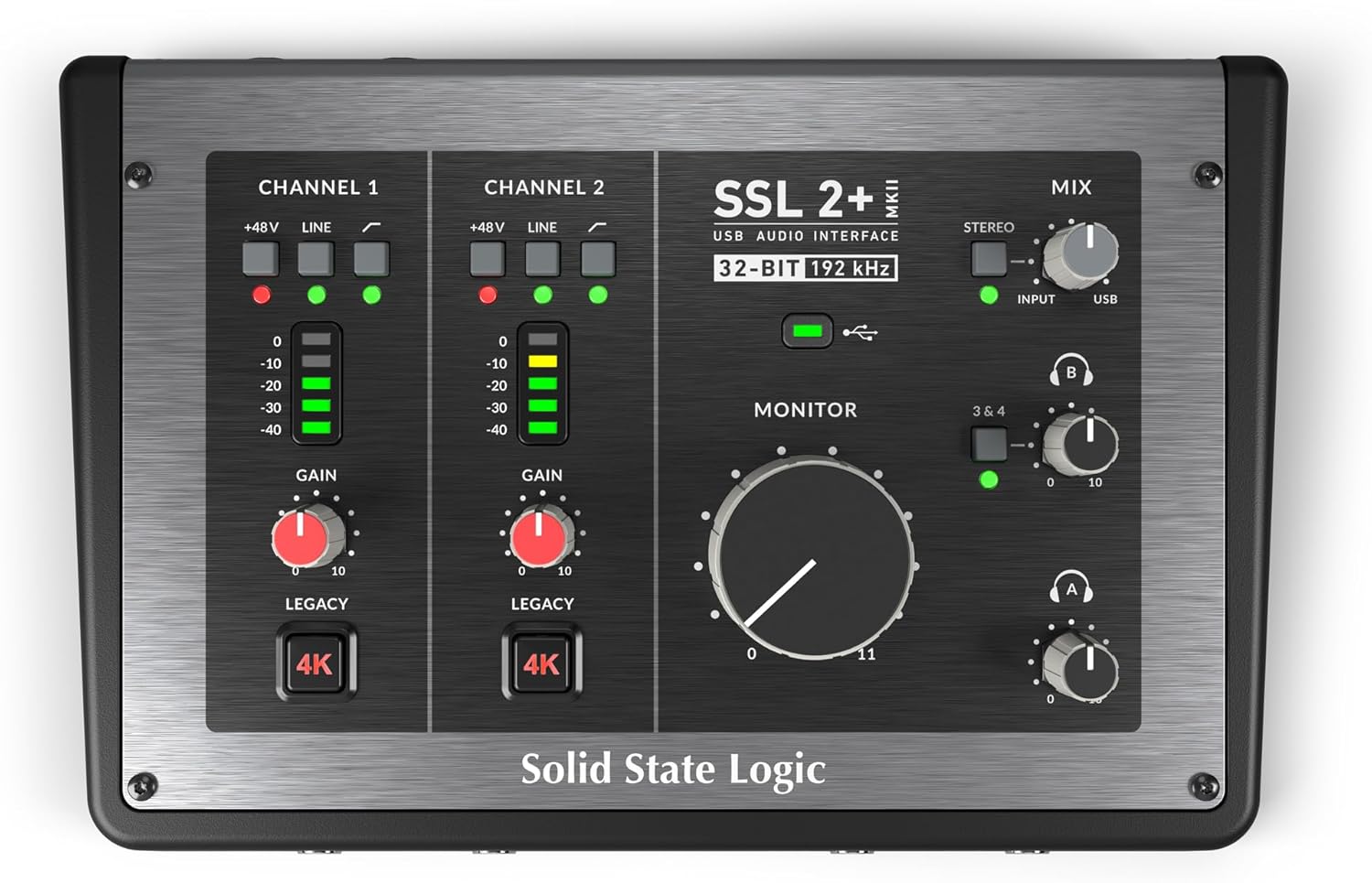
Pros
- Exceptional zero-latency performance eliminates monitoring delay for real-time recording
- Dual independent headphone outputs with separate volume controls enable simultaneous different mixes
- Built-in DI functionality on front inputs removes need for external DI boxes for guitars and keyboards
- Legacy 4K analog enhancement adds professional SSL character to vocal and instrument tracking
- Premium analog interface with physical knobs and buttons preferred by professional engineers over touchscreens
Cons
- Microphone preamp gain requires careful calibration and runs near maximum on some condenser mics
- Main volume knob is plastic rather than metal, which may feel less durable than expected at this price point
- Limited to 2x4 I/O configuration, which may constrain users needing more simultaneous inputs or outputs
The SSL 2+ MKII is a professional audio interface that brings decades of SSL's mixing console heritage into a compact, bus-powered format. Designed for producers, podcasters, engineers, and musicians, this interface prioritizes sound quality and ease of use without requiring external power supplies or complex setup procedures.
The standout feature is genuine zero-latency monitoring combined with dual independent headphone outputs, each with its own volume control. This enables real-time recording without monitoring delay and allows collaborative sessions where artists and producers hear different mixes simultaneously. The 32-bit/192 kHz converters with Legacy 4K analog enhancement deliver the classic SSL "air" and harmonic character that professionals have relied on for decades, adding polish to vocals and instruments without additional plugins.
Build quality impresses with premium analog controls, stainless steel construction, and responsive knobs and buttons that feel substantial and professional. The interface includes built-in DI functionality on front 1/4" inputs, eliminating the need for external DI boxes when connecting guitars, keyboards, or other high-impedance instruments. The dual XLR mic preamps and four 1/4" line outputs provide flexible routing for most home studio and portable recording scenarios.
The primary consideration is that microphone preamp gain operates near maximum on some condenser microphones, leaving limited headroom for gain adjustment. Additionally, the main volume knob uses plastic rather than metal construction, which some users may find less durable than expected. The 2x4 I/O configuration works well for solo recording but may feel limiting for those requiring simultaneous multi-track recording or more complex routing.
The SSL 2+ MKII delivers professional audio quality, intuitive analog controls, and genuine zero-latency performance in a portable package. It represents excellent value for producers and engineers upgrading from entry-level interfaces while remaining accessible for musicians beginning their recording journey.
Audio I/O: 2 XLR mic preamps, 2 x 1/4" line/hi-Z inputs, 2 discrete headphone outputs, 4 x 1/4" line outputs
Audio Specifications: 32-bit/192 kHz AD/DA converters, 48V phantom power, high-pass filters, stereo loopback, Legacy 4K analog enhancement
Connectivity: USB-C bus-powered, MIDI I/O on 5-pin DIN jacks, compatible with Windows and macOS
Physical: Stainless steel construction, 6.18 x 9.21 x 2.76 inches, 1.94 pounds
Software: SSL Production Pack software bundle included, supports major DAWs including Cubase Pro
Best For: Home studio producers, music engineers, podcasters, and musicians who prioritize audio quality and zero-latency monitoring. Ideal for those upgrading from entry-level interfaces or working in collaborative tracking sessions.
Perfect If You: Record vocals and instruments simultaneously, need independent headphone mixes for artist and producer, prefer analog controls over digital displays, work with guitars and keyboards requiring DI connectivity, or want professional SSL sound without purchasing a mixing console.
Consider Alternatives If: You require more than 4 simultaneous audio inputs, need extensive MIDI connectivity beyond basic I/O, or prioritize the lowest possible price over sound quality and features.
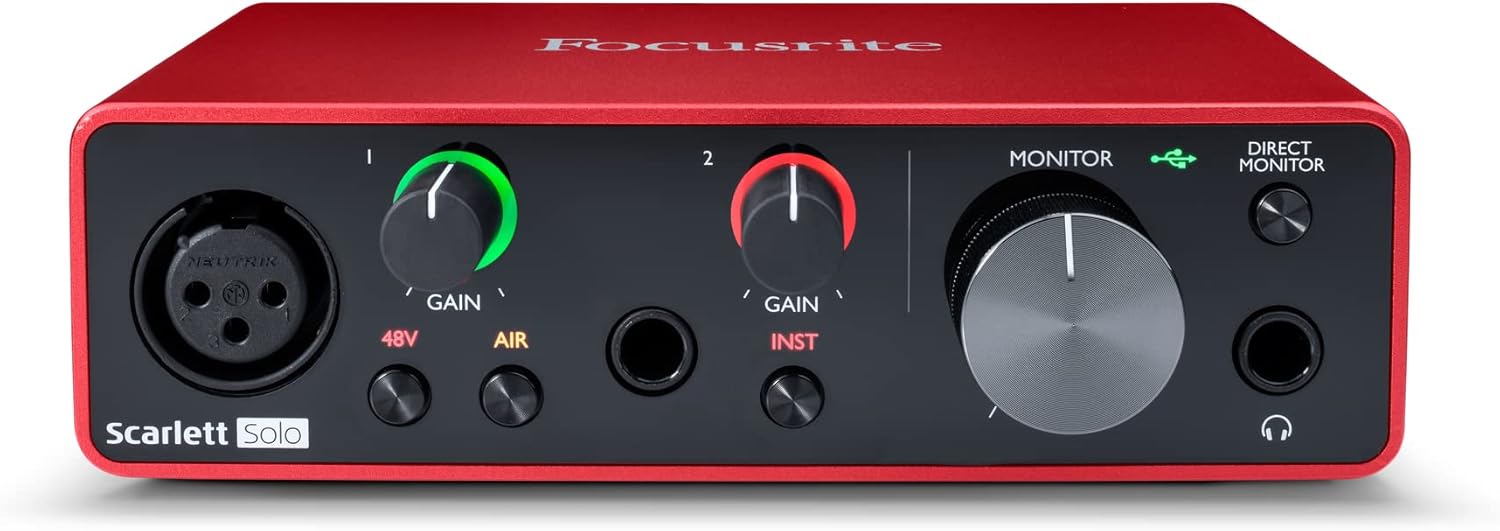
Pros
- Excellent preamp quality produces bright, clear recordings with minimal noise floor
- Air mode adds professional polish to vocal and acoustic recordings without additional equipment
- Compact design perfect for home studios, bedroom producers, and mobile recording setups
- Included software suite eliminates need for expensive DAW purchases
- Highly reliable brand with strong reputation in professional audio industry
Cons
- Single microphone input limits simultaneous multi-instrument recording capabilities
- May require audio driver updates for optimal performance on some Windows systems
- Learning curve for beginners unfamiliar with audio interface operation and gain staging
The Focusrite Scarlett Solo 3rd Gen is a professional USB audio interface designed for musicians, podcasters, and content creators who demand studio-quality recordings without the complexity of larger mixing consoles. This compact device bridges the gap between budget-friendly entry-level gear and expensive professional equipment, making it ideal for home studios, bedroom producers, and anyone serious about capturing professional-grade audio.
The standout feature is undoubtedly the high-performance microphone preamp paired with the innovative Air mode, which adds extra clarity and presence to vocals and acoustic instruments. The two high-headroom instrument inputs eliminate clipping and distortion, ensuring your guitar, bass, and other instruments shine through with clarity. Recording at up to 24-bit/192kHz resolution means your productions retain all sonic nuances, while the Gain Halo visual feedback system helps you nail perfect levels every time.
Build quality reflects Focusrite's professional heritage, with a solid metal chassis and intuitive front-panel controls that feel responsive and durable. The USB-C connectivity provides fast, reliable data transfer and modern compatibility with both Mac and Windows systems. The included software bundle (Pro Tools Intro+, Ableton Live Lite, Cubase LE) gives you everything needed to start producing immediately without additional software purchases.
The primary limitation is the single microphone input, which restricts simultaneous multi-track vocal or acoustic recording. Additionally, some Windows users report requiring driver updates for optimal performance. The learning curve for gain staging and audio interface operation may challenge complete beginners, though the included documentation is comprehensive.
The Focusrite Scarlett Solo 3rd Gen represents exceptional value for serious hobbyists and semi-professional creators. Its combination of pristine preamp quality, professional converters, intuitive design, and included software makes it the go-to choice for anyone upgrading from computer microphones or entry-level interfaces. The three-year warranty provides confidence in your investment.
Audio I/O: 1 XLR microphone input, 2 high-impedance instrument inputs, 2 balanced line outputs, headphone output
Audio Quality: 24-bit/192kHz recording and playback resolution with high-performance converters
Connectivity: USB-C to computer, compatible with all major audio recording software
Channels: 2 channels (stereo)
Features: Switchable Air mode, Gain Halo visual feedback, low-noise outputs, headphone monitoring
Software Included: Pro Tools Intro+, Ableton Live Lite, Cubase LE, Hitmaker Expansion
Warranty: 3-year manufacturer warranty worldwide
Compatible Devices: Microphones, instruments, personal computers, headphones, studio monitors
Who Should Buy: Musicians recording at home, podcasters seeking professional audio quality, guitarists and bassists needing quality instrument preamps, content creators upgrading from built-in computer audio, and producers working with limited space.
Who Should Look Elsewhere: Users needing simultaneous multi-microphone recording, those requiring extensive analog mixing features, or professionals running high-channel-count studios requiring more I/O options.
Setup Tips: Ensure your computer meets USB-C requirements and install drivers before first use. Spend time learning gain staging with the Gain Halo visual indicator to avoid clipping. Experiment with Air mode on different sources to understand its impact on your recordings.
Value Comparison: At this price point, the Scarlett Solo 3rd Gen outperforms competitors by offering superior preamp quality, professional software bundle, and proven brand reliability. The included software alone typically costs $200+ if purchased separately.

Pros
- Exceptional audio quality with ESS Sabre DAC and headphone amplifier rivaling dedicated standalone units costing hundreds more
- Industry-leading low latency at 2.5ms makes it perfect for live guitar, keyboard, and vocal recording without monitoring delay
- Built-in LCD metering display is unique in its class, providing clear visual feedback for optimal level management
- Compact, portable form factor with USB-C connectivity makes it ideal for mobile studios and remote recording setups
- Includes comprehensive software bundle and comes with a 2-year warranty backing the build quality
Cons
- Limited to 2-in/2-out configuration, which may not suit users needing more simultaneous inputs for larger recording sessions
- Single USB-C port means you cannot daisy-chain additional devices without a hub, potentially limiting workflow flexibility
- Windows users may experience initial channel configuration issues requiring manual loopback settings adjustment
The MOTU M2 is a professional-grade USB-C audio interface designed for home recording studios, content creators, musicians, and producers who refuse to compromise on audio quality while maintaining a reasonable budget. Its 2-in/2-out configuration with dual microphone preamps makes it perfect for recording vocals and instruments, podcasting, or streaming with pristine clarity and minimal latency.
What sets the M2 apart is its use of ESS Sabre32 Ultra DAC technology, typically found in audio interfaces costing thousands of dollars. This delivers a stunning 120dB dynamic range on outputs and an exceptionally clean -129dBu EIN on microphone inputs. The headphone amplifier alone rivals dedicated standalone units, making this interface equally valuable for mixing and mastering work. Real-time monitoring latency of just 2.5ms at 96kHz means you can confidently record guitars, keyboards, and vocals without the distracting lag that plagues many budget interfaces.
The build quality is immediately apparent when you interact with the device. Smooth, weighted knobs with premium feel, responsive buttons, and a sturdy physical construction inspire confidence. The full-color LCD display showing real-time level meters for all inputs and outputs is a standout feature rarely found at this price point, eliminating guesswork when setting recording levels. The compact 7.5 x 4.25 x 1.75 inch footprint with USB-C connectivity makes it genuinely portable for musicians moving between studios or recording on location.
The main limitation is the 2-in/2-out channel count, which restricts simultaneous recording to two sources. Windows users have occasionally reported initial channel configuration quirks requiring manual loopback settings adjustment, though this is easily resolved. The single USB-C port means external hubs are necessary if you need to connect other peripherals simultaneously.
The MOTU M2 represents exceptional value for anyone serious about recording quality. Whether you're tracking professional vocals, streaming with multiple guests, or building a portable studio, this interface delivers audio fidelity and performance that justifies its reputation as a best-in-class mid-tier solution.
Connectivity and Compatibility: USB-C audio interface compatible with Windows and macOS via expertly engineered MOTU drivers. Also supports iOS for mobile recording workflows.
Audio Specifications: 24-bit/192kHz maximum sample rate. 120dB dynamic range on main outputs. Microphone preamp noise floor of -129dBu EIN. 2.5ms round-trip latency at 96kHz with 32-sample buffer. ESS Sabre32 Ultra DAC on main outputs and headphone output.
I/O Configuration: 2 microphone/line inputs with dedicated preamps. 2 main analog outputs. 1 headphone output. DIN MIDI in/out jacks. Full-color LCD metering display for all inputs and outputs.
Physical Specifications: Dimensions 7.5 inches deep x 4.25 inches wide x 1.75 inches high. Weight 612 grams. USB-powered with physical power switch. Includes 6GB of free software content.
Warranty: 2-year manufacturer warranty included with purchase.
Perfect For: Home recording enthusiasts, singer-songwriters, podcast producers, streamers, content creators, guitar and keyboard players, and producers seeking professional audio quality on a realistic budget. Also ideal for audiophiles who value the ESS Sabre DAC technology and premium headphone amplification.
Consider Alternatives If: You need more than 2 simultaneous inputs for large ensemble recording, require extensive MIDI connectivity beyond basic in/out, or need bus-powered operation without a dedicated power supply.
Best Use Cases: Bedroom recording studio setup. Mobile recording and field production. Podcast and stream audio capture. Mixing and mastering with a high-quality DAC and headphone amp. Guitar and keyboard performance recording with minimal latency. Audiophile-grade home listening through the premium DAC and headphone amplifier.

Pros
- Exceptional audio quality and low noise floor at a fraction of the cost of higher-end interfaces
- Blazingly fast USB drivers deliver class-leading low latency for responsive live monitoring
- Unique color LCD display provides real-time visual feedback for precise gain staging and level control
- Powerful headphone amplifier drives high-impedance headphones without dedicated amp needed
- Includes comprehensive software bundle and XLR cable, providing excellent value out of the box
Cons
- Limited to 2x2 channel configuration, which may not suit users needing more simultaneous inputs or outputs
- USB-C connectivity requires quality cables and compatible computers, potential compatibility consideration for older systems
- Setup and driver configuration require attention to detail, particularly regarding sample rates and buffer settings for optimal performance
The MOTU M2 is a professional-grade 2x2 USB-C audio interface designed for musicians, producers, podcasters, and content creators who demand pristine audio quality without the premium price tag. Its compact size and straightforward feature set make it ideal for home studios, mobile recording setups, and anyone seeking reliable audio capture and monitoring capabilities.
At the heart of the M2 lies ESS Sabre32 Ultra DAC technology, the same converter found in high-end interfaces costing thousands of dollars. This translates to a measured 120 dB dynamic range on outputs, exceptional headphone amplification that rivals dedicated amps, and ultra-clean mic preamps with -129 dBu equivalent input noise. Real-world performance is equally impressive, with users consistently praising the clarity and fidelity of recordings, whether capturing vocals, acoustic instruments, or podcast dialogue.
The standout feature is the full-color LCD display with detailed level meters for all inputs and outputs, a rarity in this price category. Combined with MOTU's expertly engineered USB drivers, the M2 achieves class-leading 2.5ms round trip latency at 96 kHz, enabling responsive live monitoring through your computer without the delay that plagues many budget interfaces. This makes it genuinely usable for real-time guitar, keyboard, or vocal monitoring while recording.
Build quality is solid and straightforward, with a compact aluminum chassis that feels durable and professional. The interface includes a generous software bundle featuring Ableton Live Lite, MOTU Performer Lite, 100+ instruments, and 6GB of loops and samples, plus a quality XLR-XLR cable. Some users report that optimal performance requires attention to USB cable quality and proper sample rate configuration, particularly on Windows systems, though this is a minor consideration for users willing to invest time in setup.
The MOTU M2 represents exceptional value for anyone seeking professional audio quality in a portable, user-friendly package. Its combination of premium converter technology, low latency, visual feedback, and included software makes it a compelling choice for both beginners upgrading from basic interfaces and professionals seeking a reliable secondary unit. Highly recommended for serious hobbyists and professionals on a budget.
Audio Specifications
Dynamic Range: 120 dB (outputs), -129 dBu EIN (mic inputs)
Sample Rate: Up to 192 kHz
Latency: 2.5ms round trip at 96 kHz with 32 sample buffer
Converter Technology: ESS Sabre32 Ultra DAC
Physical Specifications
Channels: 2x2 (2 inputs, 2 outputs)
Connectivity: USB-C
Weight: 1.46 kg
Model Number: 3120
UPC: 745150759186
Included Software
MOTU Performer Lite
Ableton Live Lite
100+ instruments
6GB of loops and sample packs
XLR-XLR cable
Compatibility
Operating System: Windows and Mac
Audio Input: USB
Best for: Personal computers with USB-C ports
Ideal For
Home studio musicians and producers seeking professional audio quality on a budget
Podcasters and content creators needing reliable mic input with low latency monitoring
Gamers wanting superior audio quality and responsive mic monitoring for streaming
Mobile recording enthusiasts requiring a portable, USB-powered interface
Musicians upgrading from basic interfaces or needing a secondary unit for live use
Not Ideal For
Users requiring more than 2 simultaneous audio inputs or outputs
Those needing legacy USB-A connectivity without adapters
Anyone seeking a fully integrated solution with built-in preamps, effects, or mixing capabilities beyond basic monitoring

Pros
- Exceptional audio quality with no background noise, even at budget price point
- Truly plug-and-play functionality works immediately on Windows, Mac, and Linux systems
- Dual combo jacks provide maximum flexibility for microphones, guitars, and line-level sources
- Lightweight and compact form factor ideal for desk space and portability
- Zero-latency monitoring enables confident tracking without hearing delay or echo
Cons
- LED illumination on gain knobs does not function as prominently displayed in product images
- Requires careful gain adjustment when connecting instruments with built-in preamps to avoid clipping
- Limited to 2 input channels, which may not suit users needing more simultaneous inputs
The PIYONE Q2 is a 2x2 USB-C audio interface designed for home recordists, podcasters, guitarists, and content creators who want professional-grade sound without complexity. It bridges the gap between budget-friendly and professional-quality recording, making it an ideal first interface for beginners or a secondary interface for established creators.
The standout feature is its genuine plug-and-play operation. Simply connect the USB-C cable to your computer, and the interface is recognized immediately on Windows, Mac, and Linux systems without any driver installation. The 24-bit/192kHz audio resolution captures professional-quality recordings with excellent clarity and minimal noise. The zero-latency direct monitoring feature eliminates tracking delays, allowing you to hear yourself in real-time without the frustrating latency that plagues cheaper interfaces. Dual XLR/TRS combo inputs with 48V phantom power provide flexibility for condenser microphones, dynamic mics, guitars, and line-level sources.
Build quality and design are impressive for the price. The compact form factor fits easily on any desk without consuming valuable space. The illuminated control knobs create a modern, professional aesthetic that looks great in any studio setup. The interface feels solid and well-constructed, with ergonomic knobs and buttons positioned for comfortable operation during long recording sessions.
One notable drawback is that the LED illumination on the gain knobs does not function as prominently as shown in product images, which may disappoint users specifically drawn to this visual feature. Additionally, users must exercise caution when adjusting gain levels with instruments that have built-in preamps, as excessive gain can cause clipping. The 2-channel limitation means this interface cannot handle multiple simultaneous inputs beyond two sources.
Verdict: The PIYONE Q2 delivers exceptional value for beginners and budget-conscious creators seeking professional audio quality without complexity. Its combination of studio-grade sound, zero-latency monitoring, and truly plug-and-play setup makes it an excellent choice for home recording, podcasting, and content creation. Recommended for anyone starting their recording journey or needing a reliable portable interface.
Audio Quality: 24-bit resolution, 192kHz maximum sample rate, high-performance converters, low-noise design
Connectivity: USB-C port (handles both data transfer and bus power), 3.5mm headphone jack
Inputs: 2 XLR/TRS combo jacks, 48V phantom power supply
Channels: 2 input channels, 2 output channels
Features: Zero-latency direct monitoring, monitor mix function, loopback capability, illuminated control knobs, class-compliant design
Compatibility: Mac, Windows PC, Linux, iOS (via USB-C adapter)
Physical: Compact portable design, 0.74 kg weight, Alloy Red finish
Warranty: 2-year limited warranty
Ideal For: Beginner recording artists, podcasters, singer-songwriters, content creators, home studio enthusiasts, and anyone seeking professional audio quality without complex setup requirements.
Perfect Use Cases: Recording vocals with condenser microphones, capturing acoustic guitar performances, podcasting and voice-over work, streaming with professional audio quality, music production on a budget, portable recording for travel or mobile content creation.
Not Ideal For: Users requiring more than 2 simultaneous inputs, professional studios with extensive I/O requirements, or those specifically seeking prominent LED illumination effects on control knobs.

Pros
- Professional audio quality at an affordable price point, delivering 24-bit/192kHz resolution comparable to interfaces costing twice as much
- Versatile connectivity with both XLR and instrument inputs plus headphone monitoring allows handling multiple audio sources and use cases
- Included ProStudio software and ASIO driver support unlock advanced routing and low-latency capabilities for serious streamers and producers
- Genuinely portable and compact design with intuitive controls makes it practical for home studios, mobile setups, and travel
- Strong cross-platform compatibility and DAW support ensure this interface works with virtually any modern recording or streaming software
Cons
- Limited to 2 channels, restricting simultaneous recording of multiple instruments or complex multi-track setups without additional gear
- Phantom power and preamp features depend on proper driver installation and software configuration, which may challenge complete beginners
- No built-in effects or processing, requiring external plugins or software for audio enhancement beyond basic routing and monitoring
The MAONO PS22 Lite is a compact USB audio interface designed for recording enthusiasts, podcasters, guitarists, and content creators who demand professional sound quality without the complexity or expense of larger systems. This device punches well above its weight, offering studio-grade specifications in a palm-sized form factor that fits any creative workspace.
The standout feature is undoubtedly the 24-bit/192kHz recording capability paired with a 106dB dynamic range, ensuring every nuance of your performance is captured with clarity and depth. The dual-input design handles both XLR microphones (with 56dB preamp gain and 48V phantom power) and guitar or line-level instruments, making it genuinely versatile for mixed creative work. The included ProStudio Routing Software with ASIO driver support opens possibilities for live streamers, enabling virtual channels and loopbacks for complex broadcast scenarios without latency issues.
Build quality reflects the premium positioning, with an ergonomic design featuring a dynamic light ring that indicates input status and a side-mounted headphone jack reducing cable clutter. The intuitive preset modes for recording, live broadcast, and instruments mean switching between creative tasks takes seconds, while the plug-and-play functionality works across Mac, Windows, and iPad platforms. Direct monitoring provides real-time audio feedback essential for getting performances right on the first take.
The primary limitation is the 2-channel configuration, which restricts simultaneous multi-track recording unless you're layering overdubs. Additionally, while the interface excels at capture and routing, it lacks onboard effects or processing, meaning you'll rely on software plugins for audio enhancement. Setup requires proper driver installation and software configuration, which may initially challenge absolute beginners despite the intuitive interface design.
The MAONO PS22 Lite delivers exceptional value for podcasters, guitarists, vocalists, and streamers seeking professional audio quality in a portable, user-friendly package. Its combination of high-resolution recording, versatile inputs, advanced routing software, and cross-platform compatibility makes it a smart investment for anyone serious about audio production without the premium price tag.
Audio Quality: 24-bit/192kHz recording resolution with 106dB dynamic range for professional-grade sound capture.
Inputs: 1 XLR input for microphones with 56dB preamp gain and 48V phantom power, 1 dedicated instrument input with impedance adjustment for guitars and line-level sources.
Connectivity: USB connection with included USB-A/USB-C to USB-C cable. Plug-and-play compatibility with Mac, Windows, and iPad.
Channels: 2-channel interface for stereo recording and monitoring.
Software Support: ASIO drivers, ProStudio Routing Software included. Compatible with Avid Pro Tools, Ableton Live, Logic Pro, Cubase, GarageBand, FL Studio, Studio One, plus streaming platforms like OBS, Twitch, YouTube, TikTok, and Discord.
Design: Compact palm-sized form factor with dynamic light ring indicator, ergonomic construction, and side-mounted headphone monitoring jack.
Best For: Podcasters and voice actors seeking warm, clear vocals with minimal noise. Guitarists and musicians recording demos or full productions. Content creators streaming to Twitch, YouTube, or TikTok. Home studio builders wanting professional results on a budget. Anyone transitioning from built-in computer audio to proper recording equipment.
Consider This If: You need simultaneous recording of multiple instruments, look elsewhere for 4+ channel interfaces. You want onboard effects and processing, you'll need to budget for software plugins. You're a complete beginner, allow time to learn driver installation and basic DAW setup.
Why Choose PS22 Lite Over Alternatives: The combination of 24-bit/192kHz recording, dual-input versatility, included ProStudio software, and compact design offers exceptional value. Many competitors at this price lack phantom power or advanced routing capabilities. The cross-platform compatibility and extensive DAW support ensure future-proof investment.

Pros
- Exceptional value for the price with professional-grade specs and build quality comparable to premium brands
- True plug-and-play functionality makes it accessible for beginners while offering advanced features for professionals
- 48V phantom power support eliminates the need for separate power supplies when using condenser microphones
- Low-latency drivers enable real-time monitoring during recording sessions without audio delay
- Compact, portable design works seamlessly across multiple devices including computers, tablets, and smartphones
Cons
- USB-C power input has reported reliability issues in some units, though USB connectivity remains functional
- Occasional static output reported by users, typically resolved by power cycling the device
- Maximum sample rate specification shows 48 kHz in some documentation despite 192kHz capability claims, creating potential confusion
The Kmise USB Audio Interface is a compact, all-in-one recording solution designed for guitarists, vocalists, podcasters, and content creators who demand professional sound quality without the professional price tag. This device integrates microphone input, instrument input, headphone output, and speaker output into a single unit, eliminating cable clutter and simplifying your recording setup.
The standout feature is its 24-bit/192kHz recording resolution combined with built-in 48V phantom power, allowing you to connect professional condenser microphones directly without additional equipment or power supplies. The ultra-low latency drivers enable real-time monitoring during recording, which is essential for vocal tracking, guitar overdubs, and podcast production where immediate feedback matters. Users consistently praise the sturdy metal construction and responsive knobs that feel professional despite the affordable price point.
Setup is genuinely effortless: connect via USB 3.0 to any Mac, PC, or compatible mobile device and start recording immediately without installing complex drivers. The compact 6.5-inch width fits easily into any home studio or portable recording rig, making it equally suitable for bedroom producers and traveling musicians.
Some users have reported occasional static output or USB-C power input issues in rare cases, though these appear to be isolated hardware defects rather than design flaws. Power cycling typically resolves static issues. The device performs reliably for everyday recording tasks, and multiple reviewers have noted the build quality rivals well-known premium brands at a fraction of the cost.
For anyone starting a home studio, upgrading from onboard computer audio, or seeking a portable recording interface, the Kmise USB Audio Interface delivers exceptional value. It successfully bridges the gap between beginner-friendly operation and professional-grade sound quality, making it an intelligent choice for podcasters, musicians, and voice actors on a budget.
Audio Resolution: 24-bit/192kHz recording resolution
Phantom Power: 48V phantom power with single-press activation switch
Connectivity: USB 3.0 Type-A connection
Channels: 2 channels
Inputs: Microphone input, instrument/line input
Outputs: Headphone output, speaker output
Latency: Ultra-low latency professional drivers
Compatibility: Mac, PC, iOS, Android, guitar, laptop, smartphone, tablet
Dimensions: 6.5 inches W x 3.5 inches D x 1.5 inches H
Weight: 1.5 pounds
Warranty: 6-month manufacturer warranty
Model: MI8423-KUS
Podcasters: The all-in-one design with multiple inputs and low-latency monitoring makes podcast recording and editing straightforward without external equipment.
Home Studio Musicians: Guitarists and vocalists benefit from the 24-bit/192kHz resolution, phantom power support, and real-time monitoring for tracking and overdubbing.
Content Creators: Streamers and voice actors appreciate the compact size, plug-and-play setup, and professional condenser microphone compatibility for broadcast-quality audio.
Budget-Conscious Beginners: The accessible price point and simple operation make this ideal for anyone starting their first home recording setup without overwhelming complexity.
Traveling Musicians: The portable form factor and multi-device compatibility work perfectly for musicians who record on the go or between multiple locations.
Buying Guide for Vocal Clarity
Preamplifier Quality
The preamp is the first circuit your microphone signal hits. Its job is to amplify your voice to a usable level without adding noise or distortion. For vocal clarity, you need a preamp with a low noise floor and plenty of clean gain. This ensures your quiet passages remain detailed and your loud belts don’t clip.
Analog-to-Digital Conversion
This component determines how accurately your analog voice is translated into digital bits. Look for interfaces boasting 24-bit/192kHz resolution for capturing the full frequency spectrum and dynamic range of your vocals. High-quality converters preserve the subtle harmonics and textures that give your voice its unique character.
Phantom Power and Connectivity
Most studio condenser microphones, the gold standard for vocal detail, require 48V phantom power. Ensure your chosen interface provides this. Also, consider your input needs: a combo XLR/TRS jack offers maximum flexibility for microphones and instruments. For more on managing your signal levels, which is crucial for clean recordings, see our resource on the best audio interfaces with gain control.
Monitoring and Latency
Zero-latency monitoring via a direct hardware path is non-negotiable for vocalists. Hearing your voice in real-time, without a distracting digital delay, allows for a more natural and confident performance. Some interfaces also offer blend controls to mix the direct signal with playback from your computer.
Final Thoughts
Selecting the right audio interface is a pivotal step toward capturing your voice with the fidelity it deserves. For those seeking an exceptional balance of legendary analog character and modern features, the Universal Audio Volt 276 USB Audio Interface stands out. Its vintage mode and onboard compression can instantly polish a vocal track. Meanwhile, beginners and budget-conscious creators will find tremendous value in the straightforward performance and proven reliability of the Focusrite Scarlett Solo 3rd Gen USB-C Audio. For a complete overview of all options in this category, visit our main audio interfaces page.
Frequently Asked Questions
What makes an audio interface good for vocals?
A great vocal interface combines a quiet, transparent preamplifier with high-resolution analog-to-digital converters. This pairing ensures your voice is amplified cleanly and captured with all its nuances intact. Features like 48V phantom power for condenser mics and zero-latency monitoring are also essential for professional results.
Do I need a very expensive interface for clear vocals?
Not necessarily. While high-end interfaces offer superior components and extra features, many affordable models in 2026 provide excellent vocal clarity. The key is to prioritize the fundamentals: a good preamp and solid converters. Many budget-friendly options now include these, making professional-quality vocal recording accessible to everyone.
Can I use an audio interface for podcasting and streaming?
Absolutely. In fact, a dedicated interface often provides much better audio quality than a computer’s built-in sound card. Look for models with loopback functionality, which allows you to blend your microphone with audio from your computer (like music or game sound) for polished live streams or podcast interviews. Some advanced models even include built-in DSP effects for real-time vocal enhancement.
What additional features should I look for?
Beyond core audio quality, consider usability features. A clear metering system, like the large LED level meters on the MOTU M2, helps prevent clipping. Some interfaces offer onboard DSP effects, compression, or EQ for shaping your sound without taxing your computer. For at-a-glance control, interfaces with display screens provide detailed feedback on levels and settings.


Write Your Review
No reviews yet. Be the first to share your experience!