

Whether you’re laying down a vocal track, starting a podcast, or live-streaming a gaming session, the audio interface is the unsung hero of your setup. It’s the critical link between your microphone, instruments, and your computer, responsible for converting your sound into pristine digital audio. The wrong choice can introduce noise, latency, and frustration, while the right one becomes an invisible, reliable partner in your creative process. This guide is designed to cut through the technical jargon and help you identify the audio interface that perfectly aligns with your specific goals, from simple voiceovers to full-band recordings.

Pros
- Exceptional analog warmth and character from UA's trusted preamp and compressor designs
- Included software bundle rivals interfaces costing twice as much, offering real professional tools
- Genuine multi-platform support including iPad and iPhone for true mobile recording freedom
- Compact and lightweight at 790g, making it genuinely portable without sacrificing build quality
- Highest-in-class sample rate at 192 kHz ensures future-proof recording capability
Cons
- iPhone recording requires additional Lightning to USB Camera Adapter, adding extra cost and complexity
- No onboard DSP processing means CPU-intensive plug-in use depends on your computer's power
- Limited to 2-in/2-out configuration, which may feel restrictive for larger recording sessions or band setups
The Universal Audio Volt 276 is a professional-grade 2-in/2-out USB audio interface designed for modern creators who refuse to compromise on sound quality. Whether you're a musician recording at home, a producer collaborating remotely, a content creator streaming live, or a podcaster seeking broadcast-quality audio, this interface delivers studio-caliber results in a remarkably compact package.
What truly sets the Volt 276 apart is its integrated analog processing: a vintage mic preamp modeled after UA's legendary 610 design and a built-in 1176 compressor that adds warmth and punch to every recording. These aren't afterthoughts but core components that give this interface its distinctive sonic character. The included software bundle is equally impressive, featuring the award-winning LUNA DAW, classic LA-2A and 1176 compressors, Pultec EQs, and the PolyMAX Synth, tools that professional studios invest thousands in separately.
The build quality reflects Universal Audio's heritage, with a solid aluminum chassis and premium components throughout. At just 790 grams and measuring roughly 7 inches wide, it's genuinely portable without feeling cheap or compromised. The interface supports 192 kHz recording across Mac, Windows, iPad, and iPhone, offering flexibility that most competitors don't match. Connection is handled via USB-C, ensuring modern compatibility and reliable data transfer.
Some limitations exist: iPhone users need an additional Lightning adapter, and the 2-in/2-out channel count may feel constraining for larger recording projects. Additionally, all plug-in processing runs on your computer's CPU rather than dedicated onboard DSP, which could impact performance on underpowered systems.
The Volt 276 represents exceptional value for serious home recordists and mobile professionals. Its combination of genuine analog character, professional software, and true cross-platform support makes it a standout choice in its price range, earning strong recommendation for anyone seeking album-quality recordings with real studio sound.
Audio Specifications: 2-in/2-out USB audio interface with 192 kHz maximum sample rate and full-spectrum frequency response. Features vintage mic preamp mode and integrated 1176-style analog compressor.
Connectivity: USB-C connection compatible with Personal Computer, Mac, iPad, iPhone (iOS 14+), and MIDI devices. Requires external power supply; iPhone recording requires Apple Lightning to USB Camera Adapter.
Physical Specifications: Dimensions 7.24 inches W x 4.69 inches D x 2.64 inches H. Weight 790 grams. Compact form factor suitable for portable and stationary studio setups.
Software & Compatibility: Includes LUNA Digital Audio Workstation and UAD plug-in suite. Compatible with Ableton, Melodyne, Virtual Drummer, Marshall, and Ampeg. Supports Windows and macOS operating systems.
Warranty: One year manufacturer warranty included with purchase.
Best For: Home and mobile recording enthusiasts, professional musicians and producers, livestreamers and content creators, podcasters, and anyone prioritizing analog warmth and professional sound in a portable package.
Consider This If: You value authentic analog character and legendary UA sound, need genuine cross-platform recording capability, want professional-grade software included without extra expense, or require portability without sacrificing quality.
Skip If: You need more than 2-in/2-out channels regularly, depend on onboard DSP processing to reduce CPU load, or work exclusively with a single operating system where more specialized interfaces might offer better value.
Setup Considerations: Plan for external power supply and, if recording on iPhone, budget for the Lightning to USB Camera Adapter. Ensure your computer meets LUNA DAW requirements for smooth performance with multiple plug-ins. Mac and Windows users will experience seamless integration, while iPad and iPhone users should verify iOS 14 or later compatibility.
Pros
- Exceptional zero-latency performance eliminates monitoring delay for real-time recording
- Dual independent headphone outputs with separate volume controls enable simultaneous different mixes
- Built-in DI functionality on front inputs removes need for external DI boxes for guitars and keyboards
- Legacy 4K analog enhancement adds professional SSL character to vocal and instrument tracking
- Premium analog interface with physical knobs and buttons preferred by professional engineers over touchscreens
Cons
- Microphone preamp gain requires careful calibration and runs near maximum on some condenser mics
- Main volume knob is plastic rather than metal, which may feel less durable than expected at this price point
- Limited to 2x4 I/O configuration, which may constrain users needing more simultaneous inputs or outputs
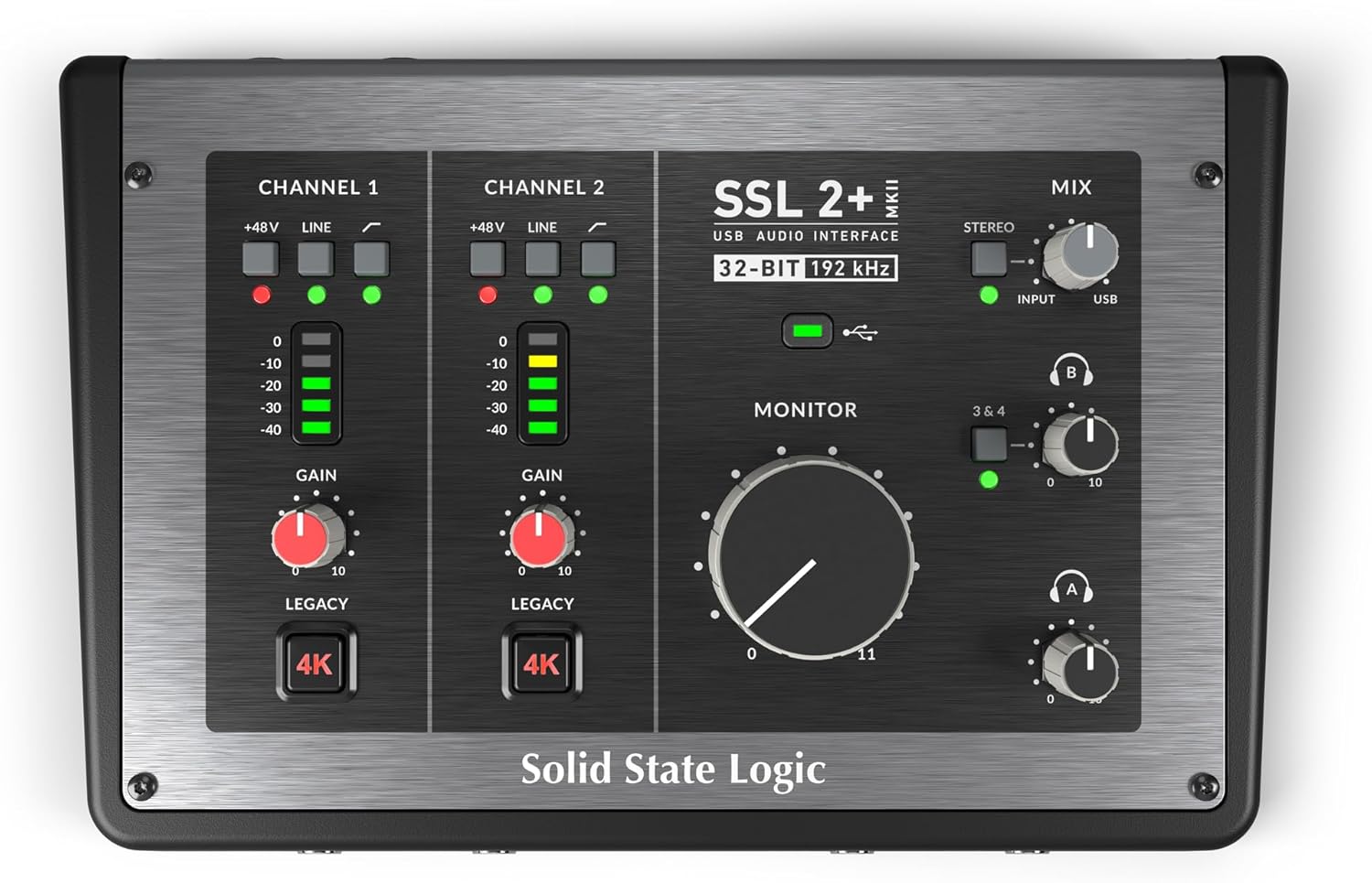
The SSL 2+ MKII is a professional audio interface that brings decades of SSL's mixing console heritage into a compact, bus-powered format. Designed for producers, podcasters, engineers, and musicians, this interface prioritizes sound quality and ease of use without requiring external power supplies or complex setup procedures.
The standout feature is genuine zero-latency monitoring combined with dual independent headphone outputs, each with its own volume control. This enables real-time recording without monitoring delay and allows collaborative sessions where artists and producers hear different mixes simultaneously. The 32-bit/192 kHz converters with Legacy 4K analog enhancement deliver the classic SSL "air" and harmonic character that professionals have relied on for decades, adding polish to vocals and instruments without additional plugins.
Build quality impresses with premium analog controls, stainless steel construction, and responsive knobs and buttons that feel substantial and professional. The interface includes built-in DI functionality on front 1/4" inputs, eliminating the need for external DI boxes when connecting guitars, keyboards, or other high-impedance instruments. The dual XLR mic preamps and four 1/4" line outputs provide flexible routing for most home studio and portable recording scenarios.
The primary consideration is that microphone preamp gain operates near maximum on some condenser microphones, leaving limited headroom for gain adjustment. Additionally, the main volume knob uses plastic rather than metal construction, which some users may find less durable than expected. The 2x4 I/O configuration works well for solo recording but may feel limiting for those requiring simultaneous multi-track recording or more complex routing.
The SSL 2+ MKII delivers professional audio quality, intuitive analog controls, and genuine zero-latency performance in a portable package. It represents excellent value for producers and engineers upgrading from entry-level interfaces while remaining accessible for musicians beginning their recording journey.
Audio I/O: 2 XLR mic preamps, 2 x 1/4" line/hi-Z inputs, 2 discrete headphone outputs, 4 x 1/4" line outputs
Audio Specifications: 32-bit/192 kHz AD/DA converters, 48V phantom power, high-pass filters, stereo loopback, Legacy 4K analog enhancement
Connectivity: USB-C bus-powered, MIDI I/O on 5-pin DIN jacks, compatible with Windows and macOS
Physical: Stainless steel construction, 6.18 x 9.21 x 2.76 inches, 1.94 pounds
Software: SSL Production Pack software bundle included, supports major DAWs including Cubase Pro
Best For: Home studio producers, music engineers, podcasters, and musicians who prioritize audio quality and zero-latency monitoring. Ideal for those upgrading from entry-level interfaces or working in collaborative tracking sessions.
Perfect If You: Record vocals and instruments simultaneously, need independent headphone mixes for artist and producer, prefer analog controls over digital displays, work with guitars and keyboards requiring DI connectivity, or want professional SSL sound without purchasing a mixing console.
Consider Alternatives If: You require more than 4 simultaneous audio inputs, need extensive MIDI connectivity beyond basic I/O, or prioritize the lowest possible price over sound quality and features.

Pros
- Exceptional audio quality and clarity that rivals interfaces at significantly higher price points
- Class A preamp design captures natural tone and richness in vocal and acoustic recordings
- Solid metal construction feels premium and withstands portable use without degradation
- Dual headphone outputs with independent control provide professional monitoring options
- Straightforward setup with included USB-C cable and broad OS compatibility
Cons
- Headphone output may require external amplification for high-impedance or demanding headphones
- Printed logos on the interface can fade over time with regular use
- Limited to 2 channels of simultaneous recording, which may constrain multi-track live capture
The Audient iD4 MKII is a professional-grade audio interface designed for home recording enthusiasts, podcast producers, and content creators who demand studio-quality sound without the bulk or complexity of larger mixing consoles. Its compact footprint and robust feature set make it an excellent choice for bedroom studios, mobile recording setups, and anyone upgrading from budget-tier interfaces.
The standout feature is undoubtedly the Class A microphone preamp, borrowed from Audient's high-end ASP8024 HE console. Users consistently report remarkable clarity and natural tone reproduction in vocal recordings, with the preamp capturing subtle nuances while maintaining clean gain across a wide range of microphone types. The JFET instrument input adds analog warmth and character to guitar and bass recordings, while the dual headphone outputs with independent monitor mixing and panning enable flexible monitoring during sessions.
Build quality is genuinely impressive for the price. The all-metal chassis feels substantial and professional, with tactile knobs that inspire confidence during use. The new USB-C connector eliminates the need for multiple cables and provides improved power delivery compared to the original iD4. At 740 grams with compact dimensions of 133x120x40.7mm, it's genuinely portable while maintaining a desktop-friendly footprint.
A few considerations exist. The headphone output, while clean, may struggle with high-impedance studio headphones and could benefit from an external amplifier in demanding scenarios. Additionally, the printed logos can fade with regular handling, though this is purely cosmetic. The interface maxes out at 2 simultaneous recording channels, which is appropriate for its positioning but worth noting for multi-track live recording scenarios.
Verdict: The iD4 MKII delivers exceptional value and professional sound quality that justifies its investment. Whether you're recording vocals, instruments, or podcasts, the Class A preamp and thoughtful feature set provide tools typically found in much more expensive interfaces. It's a genuine step up from consumer-grade alternatives and an excellent choice for serious home recordists.
Connectivity and Compatibility: USB-C connection with support for Mac, PC, and iOS devices. Includes 1-meter USB-C cable. Frequency response up to 96 kHz with maximum sample rate of 96 kHz.
Audio Channels and I/O: 2 channels of simultaneous recording. Includes 3.5mm and 6.3mm headphone connectors with dual independent headphone outputs featuring monitor mix and panning control. JFET instrument input and XLR microphone input with Class A preamp.
Physical Specifications: Dimensions 133mm x 120mm x 40.7mm (5.2 x 4.72 x 1.57 inches). Weight 740 grams. All-metal chassis construction. Available in black.
Included Software: Steinberg Cubase LE, Cubasis LE 2, Retrologue 2 Synth, TwoNotes Wall of Sound, and Loopmasters Sample Pack. 3-year manufacturer warranty.
Who Should Buy: The iD4 MKII is ideal for home recording producers, podcast creators, musicians recording vocals or instruments, and anyone upgrading from entry-level interfaces like the Scarlett 2i2. It's particularly suited for those prioritizing microphone preamp quality and seeking professional sound in a compact package.
Who Should Consider Alternatives: If you require more than 2 simultaneous recording channels or need extensive MIDI connectivity, larger interfaces may be more appropriate. Similarly, if budget is the primary concern, entry-level options exist at lower price points, though they lack the sonic quality of the iD4 MKII.
Setup Considerations: The interface works immediately upon connection with most operating systems. For optimal headphone monitoring, consider pairing with quality studio headphones or an external headphone amplifier if using high-impedance models. The dual headphone outputs with independent panning make it excellent for collaborative recording or client monitoring scenarios.
Value Assessment: Compared to similarly-priced interfaces, the iD4 MKII stands out for its Class A preamp quality and build construction. Users consistently report it punches above its weight class, delivering sound quality typically associated with interfaces at significantly higher price points.

Pros
- Exceptional sound quality at an affordable price point with professional-grade converters
- Auto Gain and Clip Safe features eliminate guesswork and prevent ruined takes
- Includes industry-leading software and plugin bundle worth hundreds separately
- Minimal latency and simple setup makes it accessible for beginners and professionals alike
- Air Mode adds musical character and presence without complex EQ adjustments
Cons
- Limited to 2 inputs and 2 outputs, so users requiring more channels will need to upgrade
- Air Mode's second preset may not suit all vocal types and requires some experimentation
- USB-C cable included, but USB-A adapters not provided for older computers
The Focusrite Scarlett 2i2 4th Gen is a professional USB-C audio interface designed for musicians, podcasters, content creators, and home studio enthusiasts. Whether you're recording vocals, guitars, drums, or streaming, this compact interface delivers studio-quality sound with intelligent features that make recording intuitive and forgiving. It's the interface of choice for bedroom producers and professional touring musicians alike.
The standout feature is the combination of studio-grade converters with 120dB dynamic range, matched to equipment found in world-class recording studios, paired with intelligent Auto Gain and Clip Safe technology. Auto Gain automatically sets optimal recording levels for your microphone or instrument, while Clip Safe prevents distortion from sudden loud peaks. The two ultra-low-noise mic preamps offer 69dB of analog gain, handling even demanding dynamic microphones without struggling. Air Mode adds musical presence and harmonic richness, lifting vocals and guitars forward in the mix with the character of a large-format console.
Build quality is excellent for the price, with a sleek, durable aluminum chassis and intuitive front-panel controls. The amped headphone output delivers full volume through any headphones with independent control, and USB-C connectivity provides bus power directly from your computer with virtually zero latency. Setup is remarkably simple: connect your mic or guitar, plug in USB, launch your DAW, and start recording. The included software bundle (Pro Tools Intro+, Ableton Live Lite, Cubase LE, and Hitmaker Expansion) provides professional tools right out of the box.
The primary limitation is the 2-input, 2-output configuration, which may feel restrictive if you need to record multiple sources simultaneously or require more complex routing. Additionally, Air Mode's second preset cuts midrange aggressively, which works beautifully on some sources but may require switching back to Air Mode 1 or disabling it entirely for certain vocal types. The included USB-A to USB-C cable works perfectly, though older computers may need adapters.
Verdict: The Scarlett 2i2 4th Gen is an exceptional value for anyone serious about recording quality audio at home. Its combination of professional sound, intelligent features, and comprehensive software bundle makes it the industry standard for entry-level and mid-level home studios. Highly recommended for beginners and professionals alike.
Audio Inputs and Outputs: 2 microphone/line inputs, 2 hi-Z instrument inputs, 2 line outputs, headphone output with independent volume control
Audio Quality: 24-bit/192kHz resolution, 120dB dynamic range, 20Hz-20kHz frequency response
Connectivity: USB-C (includes USB-A to USB-C cable), compatible with Mac OS, Windows OS, and iOS
Microphone Preamps: 2 ultra-low-noise preamps with 69dB analog gain, Auto Gain, and Clip Safe features
Physical Dimensions: 7.09 inches wide x 4.61 inches deep x 1.87 inches tall, weighs 1.7 pounds
Software Included: Pro Tools Intro+, Ableton Live Lite, Cubase LE, Hitmaker Expansion (includes Auto-Tune Access, Softube Marshall Silver Jubilee, Native Instruments MASSIVE)
Warranty: 3-year manufacturer warranty with 24/7/365 support
Perfect For: Home recording enthusiasts, singer-songwriters, bedroom producers, podcasters, guitarists, streamers, and anyone upgrading from built-in computer audio. This interface is also ideal for musicians who gig with laptops and need reliable, portable audio I/O.
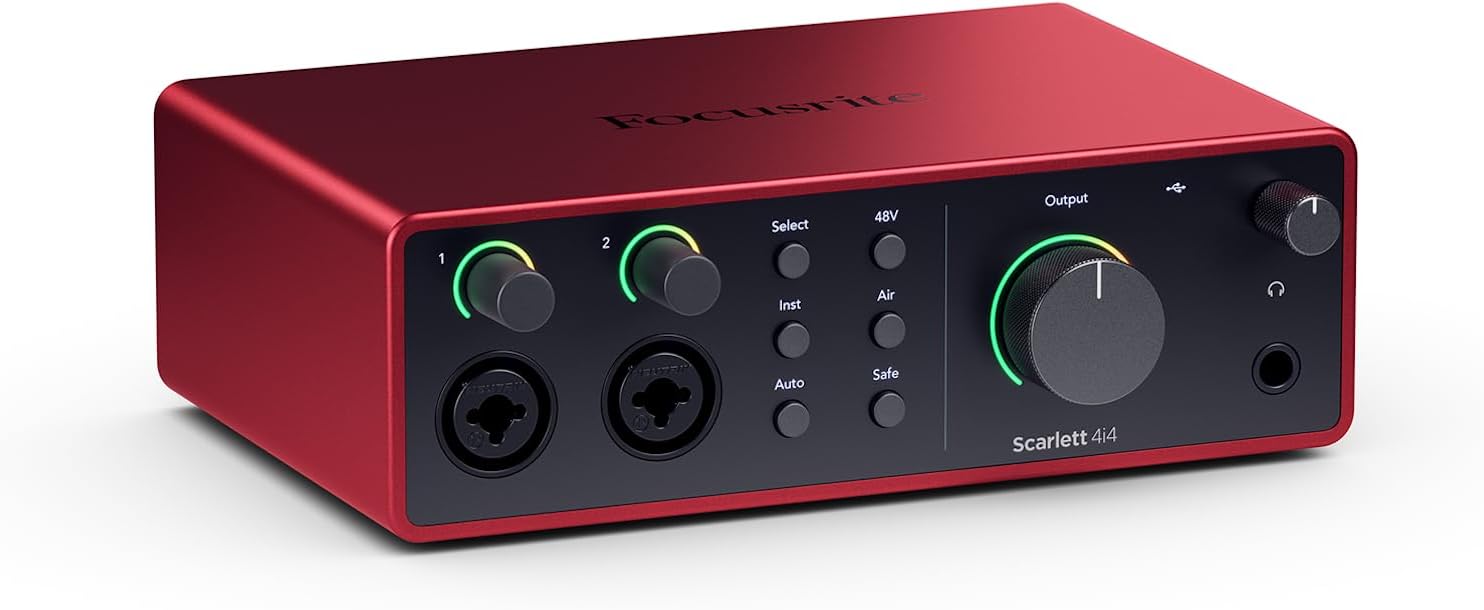
May Not Be Ideal For: Studios requiring more than 2 simultaneous inputs, or users needing extensive analog I/O routing. If you frequently record full bands or require MIDI I/O, consider the Scarlett 4i4 instead.
Comparison Note: The Scarlett 2i2 4th Gen represents the sweet spot between affordability and professional quality. It's the industry standard for entry-level home studios and competes favorably with interfaces costing significantly more.

Pros
- Outstanding audio quality with quiet, transparent preamps that capture full warmth and clarity from microphones
- Premium all-metal build quality feels professional and portable enough for travel between studios
- Dual headphone outputs with independent monitoring provide flexibility for collaborative recording sessions
- USB-C connector offers faster, more stable connection than older USB standards with simplified cable management
- Excellent value for professional-grade preamps at mid-range pricing compared to competitor offerings
Cons
- No physical power switch requires unplugging to fully disconnect, which some users find inconvenient
- Steeper learning curve than some competitors due to unique control layout and menu system
- May experience connectivity loss when computer enters sleep mode on some systems
The Audient iD14 MKII is a professional-grade USB audio interface designed for home studio recording, music production, and content creation. It targets serious musicians, podcast producers, and audio engineers who demand studio-quality sound without the price tag of larger mixing consoles. This interface bridges the gap between budget-friendly options and enterprise-level gear.
The standout feature is the dual Class-A microphone preamps, borrowed directly from Audient's professional ASP8024 HE mixing console. Users consistently report that these preamps deliver exceptional clarity, warmth, and detail, with remarkably low noise floors that capture every nuance of vocals and instruments. The new USB-C connector provides faster data transfer and improved power delivery compared to the original iD14, while the dual headphone outputs enable independent monitoring for collaborative sessions. Real-world testing shows the interface drives high-impedance headphones effortlessly with clean, detailed reproduction.
Build quality is exceptional throughout. The all-metal chassis feels substantial and professional, with a compact footprint that fits easily on crowded studio desks while remaining portable enough for mobile recording setups. The included 1m USB-C cable and software bundle (Cubase LE, Retrologue 2, and sample packs) provide immediate production capability out of the box.
Potential drawbacks include the lack of a dedicated power switch and occasional sleep-mode connectivity issues on certain computer configurations. The control layout also requires a brief learning period compared to more straightforward interfaces, though users report this complexity becomes intuitive with minimal practice.
The Audient iD14 MKII delivers professional preamp quality and build standards that justify its mid-range price point. It represents an excellent upgrade path for producers outgrowing entry-level interfaces while remaining accessible to those building their first serious home studio setup.
Connectivity and Compatibility
USB-C connector with high-speed data transfer. Compatible with Mac, PC, and iOS devices. Includes 1m USB-C cable. Supported software: Steinberg Cubase LE, Cubasis LE 2, Retrologue 2 Synth, TwoNotes Wall of Sound, Waldorf Edition 2 LE, and Loopmasters Sample Pack.
Audio Performance
Maximum sample rate: 96 kHz. 4 channels total. Two Class-A microphone preamps derived from Audient's ASP8024 HE console. Dual headphone outputs for independent monitoring. Exceptional headroom and low-noise amplification for transparent audio capture.
Physical Specifications
Dimensions: 173 x 120 x 62 mm (6.81 x 4.72 x 2.44 inches). Weight: 1250g (2.75 lbs). All-metal chassis construction. Available in black finish. Compact desktop form factor with portability for mobile studio applications.
Warranty and Support
3-year manufacturer warranty. Backed by Audient's professional audio reputation. Model number: iD14MKII. UPC: 656942526773.
Ideal For
Home studio professionals seeking transparent, high-quality preamps. Music producers upgrading from budget interfaces. Podcast and voiceover creators requiring clean vocal capture. Recording engineers building portable studio setups. Musicians pairing with quality microphones and headphones for critical monitoring and recording.
May Not Be Ideal For
Users requiring extensive MIDI connectivity or analog I/O options. Those needing simple plug-and-play functionality without learning control layouts. Budget-conscious beginners with minimal production requirements. Users requiring onboard effects processing or DSP capabilities.
Best Paired With
Quality condenser microphones like Rode NT1 or similar. Closed-back monitoring headphones like Sennheiser HD650 or Audio-Technica AT2020. Professional studio monitors for mix referencing. Acoustic treatment for optimal recording environment.
Pros
- Exceptional build quality with transparent, low-noise MAX-HD preamps ideal for modern microphones
- Fender-engineered instrument inputs provide authentic, responsive guitar and bass recording capabilities
- Studio One Pro software included saves hundreds on DAW investment for new producers
- Auto Gain feature eliminates guesswork and accelerates workflow for faster recording sessions
- Flexible control options via front panel, Universal Control app, or Studio One integration
Cons
- Physical dimensions do not account for BNC connector depth, potentially exceeding stated width in compact setups
- Product registration process has experienced occasional issues requiring customer support intervention
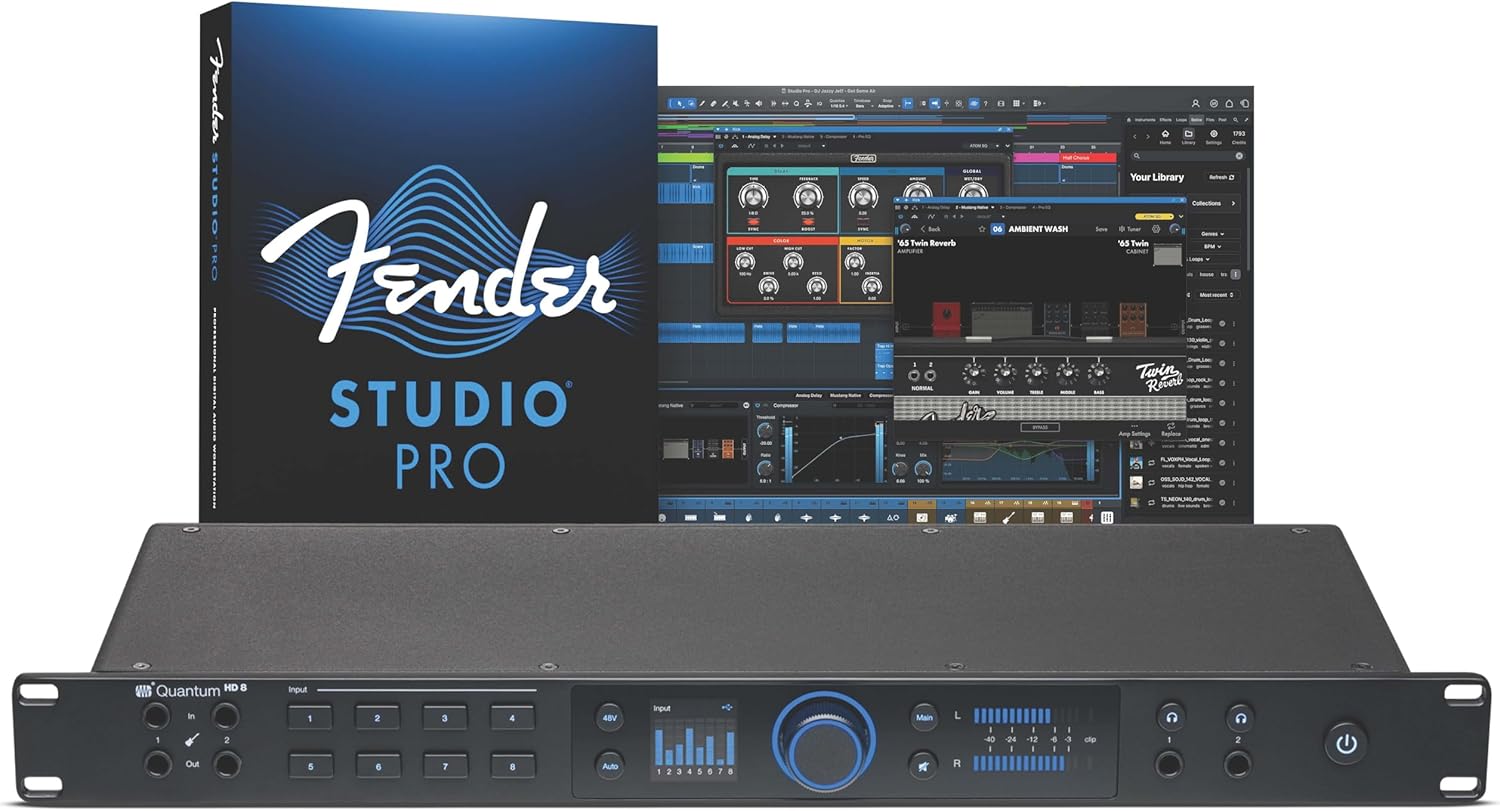
The PreSonus Quantum HD 8 represents the culmination of three decades of audio interface innovation, delivering professional-grade recording capabilities for project studios, full band setups, and serious producers. This 26x30 interface combines eight high-definition MAX-HD mic preamps with Fender-engineered instrument inputs, creating a versatile platform for capturing everything from intimate vocal recordings to complete band sessions. The included Studio One Pro perpetual license adds substantial value, eliminating the need for a separate DAW investment.
What truly sets the Quantum HD 8 apart is its thoughtful feature set designed for real-world recording scenarios. The eight MAX-HD mic preamps deliver +75dB of gain with exceptional transparency and low noise, making them ideal for today's most popular microphones. The Auto Gain button intelligently sets perfect levels automatically, while re-amp outputs enable creative sound design by letting you send DAW audio to physical amps and pedals for re-recording. At 192kHz/32-bit resolution, the converters and low-latency custom driver ensure your entire signal chain maintains pristine audio quality from input to output.
The interface excels in both form and function, featuring an illuminated push encoder for intuitive gain and volume control plus responsive LED metering for visual feedback. Universal Control app compatibility means you can manage critical preamp functions from your phone, tablet, or desktop without interrupting your creative flow. The Fender collaboration brings credibility for guitarists and bassists seeking instruments inputs specifically engineered for their needs, not generic audio inputs retrofitted for guitar use.
Minor considerations include the physical dimensions not accounting for BNC connector depth in the published specifications, which could affect extremely compact rack setups. The premium pricing reflects its professional-grade components and included software, positioning it above entry-level interfaces but competitive with other flagship models. Some users have reported occasional product registration delays, though PreSonus support reportedly responds quickly to resolve these issues.
The Quantum HD 8 delivers exceptional value for serious musicians and producers ready to invest in reliable, feature-rich recording hardware. Its combination of high-quality preamps, Fender-engineered instrument inputs, included professional software, and intuitive control options make it an outstanding choice for anyone building or upgrading a project studio. Highly recommended for full band recordings, professional home studios, and producers who demand transparent, low-latency performance.
Audio Specifications
Maximum Sample Rate: 192 kHz
Bit Depth: 32-bit
Connectivity: USB-C
Input/Output Channels: 26x30
Frequency Response: 20Hz to 20kHz
Mic Preamps: 8x MAX-HD with +75dB gain
Physical Specifications
Dimensions: 19 inches W x 8.6 inches D x 1.7 inches H
Weight: 6.3 pounds
Connectors: BNC connectors on rear panel
Control Interface: Illuminated push encoder with LED metering
Software and Compatibility
Included Software: Studio One Pro (perpetual license)
Control App: Universal Control (mobile and desktop)
Compatible Devices: Personal computers, headphones
Operating System: Windows and Mac compatible
Warranty and Support
Manufacturer Warranty: 2 years
Manufacturer: PreSonus
Model Number: Quantum HD8
UPC: 673454012211
Who Should Buy This Interface
The Quantum HD 8 is ideal for project studio owners, full band recording setups, professional home studios, guitarists and bassists seeking Fender-engineered inputs, and producers who value included professional software. It suits anyone recording multiple instruments simultaneously and needing low-latency performance for real-time monitoring.
Key Considerations Before Purchase
Verify your desk or rack depth accounts for BNC connector protrusion beyond the stated 8.6-inch depth measurement. Confirm USB-C compatibility with your computer setup. Consider whether the eight mic preamps and 26x30 channel count match your typical recording scenarios. Ensure you have adequate power supply for the interface and connected devices.
Setup and Getting Started
The interface includes Studio One Pro, eliminating the need for separate DAW purchase. Use the Universal Control app to manage preamp functions remotely. The Auto Gain feature accelerates initial setup by automatically optimizing input levels. Register your product with PreSonus promptly to activate the included software licenses and access support resources.
Maximizing Your Investment
Explore the re-amp outputs for creative sound design experiments with different amp and pedal combinations. Use the illuminated encoder for hands-on gain staging during recording sessions. Leverage the Fender-engineered instrument inputs for authentic guitar and bass tone capture. Access preamp controls via Studio One integration for seamless workflow without external app switching.

Pros
- Industry-leading real-time plugin processing lets you record through professional-grade effects and preamp emulations instantly
- Comprehensive plugin bundle valued at thousands of dollars is included, providing exceptional value for professional workflows
- Dual Unison preamps deliver authentic analog character with the flexibility of digital recall and switching
- Room-corrected monitoring with Sonarworks integration ensures mixes translate accurately across playback systems
- Compact form factor with professional connectivity makes it ideal for both studio and portable setups
Cons
- Premium price point positions it as an investment for serious professionals rather than hobbyists or beginners
- Requires Thunderbolt 3 connectivity, limiting compatibility with older computers or non-Thunderbolt equipped systems
- Steep learning curve for users unfamiliar with UAD ecosystem and plugin-based workflows
The Universal Audio Apollo Twin X DUO Gen 2 is a flagship audio interface designed for professional studios, content creators, and serious musicians who refuse to compromise on sound quality. This Thunderbolt 3 interface combines pristine analog-to-digital conversion with powerful DSP processing, making it a complete solution for recording, mixing, and mastering work.
What truly sets the Apollo Twin X apart is its Unison preamp technology, which allows you to record through authentic emulations of legendary analog gear in real-time. Whether you want the character of a Neve 1073, API 512c, or Manley ELOP, you can capture that tonal signature directly on your tracks. The dual Unison preamps, combined with DUO Core DSP processing, deliver the sonic quality expected from top-tier professional studios, all accessible from your desktop.
Build quality reflects Universal Audio's decades of engineering excellence. The interface feels solid and professional, with intuitive controls and a well-designed layout. The included Monitor Correction powered by Sonarworks transforms any listening environment into a reference-quality mixing space, while Auto-Gain functionality streamlines the recording process by automatically optimizing input levels across multiple channels.
The main consideration is the investment required and Thunderbolt 3 dependency. This interface demands a modern computer with Thunderbolt 3 connectivity and targets professionals who value the included plugin suite and real-time processing capabilities. For those needs, the value proposition is exceptional.
The Apollo Twin X DUO Gen 2 represents the pinnacle of desktop audio interface design for professionals. Its combination of legendary preamp emulations, comprehensive plugin library, and pristine audio conversion makes it a worthwhile investment for anyone serious about producing music or content at the highest level.
Connectivity: Thunderbolt 3
Audio Channels: 32 channels I/O
Sample Rate: Up to 192 kHz
Preamps: Dual Unison mic preamps with real-time plugin processing
Audio Inputs: XLR, Auxiliary
DSP Processing: DUO Core DSP engine
Compatible DAWs: Pro Tools, Logic Pro, Cubase, Live, Studio One
Operating Systems: Windows, macOS
Included Plugins: 200+ UAD DSP and Native plugins including Auto-Tune, Capitol Chambers, EL8 Distressor, and more
Warranty: 1 year manufacturer warranty
Best For: Professional recording studios, music producers, audio engineers, and serious musicians who prioritize sound quality and workflow efficiency. Ideal for those already invested in the UAD ecosystem or looking to leverage professional-grade plugin processing during recording.
Consider Alternatives If: You need USB connectivity, work exclusively with budget constraints, or prefer interfaces with onboard mixing features rather than plugin-based processing.

Pros
- Exceptional I/O flexibility with ADAT, S/PDIF, and MIDI support for integrating external gear
- Intelligent gain management tools eliminate guesswork and reduce recording errors
- Professional converter quality rivals interfaces costing significantly more
- Includes substantial software bundle that adds real production value
- Reliable Focusrite build quality with 3-year manufacturer warranty
Cons
- Some users report a learning curve with continuous-turn knobs requiring visual confirmation of settings
- Rare power delivery issues reported by isolated users, though Amazon return policy provides protection
- Premium price point may be steep for hobbyists just starting out
The Focusrite Scarlett 18i16 4th Gen is a professional audio interface designed for serious home studio producers, recording engineers, and musicians who need extensive I/O connectivity and studio-grade sound quality. With 18 inputs and 16 outputs, this interface serves as the central hub for complex recording setups, hardware integration, and multitrack production workflows.
What sets this interface apart is its combination of professional-grade components and intelligent workflow tools. The four 4th generation microphone preamps deliver an impressive 69dB of gain, capable of capturing everything from whisper-quiet vocals to hard-hitting drums without compromise. The 24-bit/192kHz converters sourced from Focusrite's flagship RedNet range provide a 122dB dynamic range that rivals much more expensive interfaces. The Air modes add harmonic character and presence that gives recordings the polish of classic studio consoles, while Auto Gain and Clip Safe modes handle real-time level optimization so you can concentrate on the performance rather than technical adjustments.
Build quality is solid throughout, with a compact footprint that doesn't consume excessive desk real estate despite its impressive feature set. The interface connects via USB-C and works seamlessly across Mac, Windows, and iOS platforms. The included software bundle, featuring Pro Tools Intro+, Ableton Live Lite, Cubase LE, and professional effects, provides immediate production capability without additional software purchases.
The primary drawback involves the continuous-turn knobs on the interface, which require you to reference the display indicators for level confirmation rather than relying on tactile stops. This takes minor adjustment time for users transitioning from older Scarlett models. Additionally, while extremely rare, a small number of users have reported power delivery issues, though Amazon's return policy ensures protection against defective units.
The Focusrite Scarlett 18i16 4th Gen delivers exceptional value for professional and semi-professional studios. Its extensive connectivity, superior audio quality, and intelligent gain management make it an excellent choice for recording, mixing, and complex hardware integration. This interface rewards serious producers with the tools and sound quality needed to create professional recordings at home.
Connectivity and I/O: 18 inputs and 16 outputs including four XLR microphone inputs, two Hi-Z instrument inputs, eight line inputs, ADAT, S/PDIF, and MIDI I/O. USB-C connection supports Mac OS, Windows OS, and iOS.
Audio Quality: 24-bit resolution at up to 192kHz sample rate. 122dB dynamic range. Four 4th generation mic preamps with 69dB gain. Hi-Z inputs for direct instrument connection.
Physical Specifications: Dimensions 9.43 inches wide by 6.66 inches deep by 2.38 inches tall. Weight 3.8 pounds. Includes external power supply and USB cable.
Software and Support: Compatible with all audio recording software. Includes Pro Tools Intro+, Ableton Live Lite, Cubase LE, and Hitmaker Expansion. Three-year manufacturer warranty included.
Ideal For: Recording engineers and producers who need extensive I/O for multitrack recording, hardware integration, and complex routing. Musicians and producers working with multiple external instruments, processors, and effects. Anyone seeking professional-grade audio quality without the expense of traditional studio consoles.
Consider Alternatives If: You're a beginner looking for a simple 2-in/2-out interface for basic recording. You need Thunderbolt connectivity instead of USB-C. You require more than four microphone preamps on a single interface.

Pros
- Exceptional audio quality with no background noise, even at budget price point
- Truly plug-and-play functionality works immediately on Windows, Mac, and Linux systems
- Dual combo jacks provide maximum flexibility for microphones, guitars, and line-level sources
- Lightweight and compact form factor ideal for desk space and portability
- Zero-latency monitoring enables confident tracking without hearing delay or echo
Cons
- LED illumination on gain knobs does not function as prominently displayed in product images
- Requires careful gain adjustment when connecting instruments with built-in preamps to avoid clipping
- Limited to 2 input channels, which may not suit users needing more simultaneous inputs
The PIYONE Q2 is a 2x2 USB-C audio interface designed for home recordists, podcasters, guitarists, and content creators who want professional-grade sound without complexity. It bridges the gap between budget-friendly and professional-quality recording, making it an ideal first interface for beginners or a secondary interface for established creators.
The standout feature is its genuine plug-and-play operation. Simply connect the USB-C cable to your computer, and the interface is recognized immediately on Windows, Mac, and Linux systems without any driver installation. The 24-bit/192kHz audio resolution captures professional-quality recordings with excellent clarity and minimal noise. The zero-latency direct monitoring feature eliminates tracking delays, allowing you to hear yourself in real-time without the frustrating latency that plagues cheaper interfaces. Dual XLR/TRS combo inputs with 48V phantom power provide flexibility for condenser microphones, dynamic mics, guitars, and line-level sources.
Build quality and design are impressive for the price. The compact form factor fits easily on any desk without consuming valuable space. The illuminated control knobs create a modern, professional aesthetic that looks great in any studio setup. The interface feels solid and well-constructed, with ergonomic knobs and buttons positioned for comfortable operation during long recording sessions.
One notable drawback is that the LED illumination on the gain knobs does not function as prominently as shown in product images, which may disappoint users specifically drawn to this visual feature. Additionally, users must exercise caution when adjusting gain levels with instruments that have built-in preamps, as excessive gain can cause clipping. The 2-channel limitation means this interface cannot handle multiple simultaneous inputs beyond two sources.
Verdict: The PIYONE Q2 delivers exceptional value for beginners and budget-conscious creators seeking professional audio quality without complexity. Its combination of studio-grade sound, zero-latency monitoring, and truly plug-and-play setup makes it an excellent choice for home recording, podcasting, and content creation. Recommended for anyone starting their recording journey or needing a reliable portable interface.
Audio Quality: 24-bit resolution, 192kHz maximum sample rate, high-performance converters, low-noise design
Connectivity: USB-C port (handles both data transfer and bus power), 3.5mm headphone jack
Inputs: 2 XLR/TRS combo jacks, 48V phantom power supply
Channels: 2 input channels, 2 output channels
Features: Zero-latency direct monitoring, monitor mix function, loopback capability, illuminated control knobs, class-compliant design
Compatibility: Mac, Windows PC, Linux, iOS (via USB-C adapter)
Physical: Compact portable design, 0.74 kg weight, Alloy Red finish
Warranty: 2-year limited warranty
Ideal For: Beginner recording artists, podcasters, singer-songwriters, content creators, home studio enthusiasts, and anyone seeking professional audio quality without complex setup requirements.
Perfect Use Cases: Recording vocals with condenser microphones, capturing acoustic guitar performances, podcasting and voice-over work, streaming with professional audio quality, music production on a budget, portable recording for travel or mobile content creation.
Not Ideal For: Users requiring more than 2 simultaneous inputs, professional studios with extensive I/O requirements, or those specifically seeking prominent LED illumination effects on control knobs.

Pros
- Exceptional audio clarity and gain headroom suitable for dynamic and condenser XLR microphones
- Intuitive touch controls with visual LED feedback eliminate the learning curve for beginners
- Wave Link software provides powerful routing capabilities without requiring external mixers
- Compact desktop footprint fits seamlessly into any streaming or podcasting setup
- Solid build quality with included 150cm USB-C cable and 2-year manufacturer warranty
Cons
- AI noise cancellation feature has limitations with persistent background noise like fans and room ambience
- Requires Windows 11 or macOS 14.2 and higher, excluding older system compatibility
- Some users report the onboard effects sound overly processed if not carefully tuned
The Elgato Wave XLR MK.2 is a professional-grade USB audio interface designed for content creators who demand studio-quality sound without complex setup. It's perfect for streamers, podcasters, and remote professionals who want to elevate their XLR microphone performance with minimal effort. The device bridges the gap between entry-level and professional audio gear by delivering serious power in a compact, user-friendly package.
What sets this interface apart is its combination of raw power and accessibility. The 80dB gain is genuinely impressive, allowing you to drive even quiet condenser microphones to broadcast levels. The ultra-low-latency monitoring at 24-bit, 48kHz resolution ensures you hear exactly what your audience hears with zero perceptible delay. The onboard DSP effects processor unifies voice enhancement, compression, and EQ in a single signal chain, meaning you can achieve polished audio without juggling multiple software plugins. Touch controls with customizable LED lighting make real-time adjustments intuitive, while Wave Link integration provides advanced routing for multi-application setups.
The build quality reflects Elgato's commitment to creator tools. The interface feels solid and premium with a thoughtful industrial design that complements professional workspaces. The included 150cm USB-C cable provides flexibility for desktop placement, and the compact footprint won't clutter your desk. The 2-year warranty demonstrates manufacturer confidence in longevity and reliability.
The primary limitation is that the AI noise cancellation feature struggles with persistent environmental noise like fans and room ambience, so you may still need acoustic treatment for optimal results. Additionally, the onboard effects can sound overly processed if not carefully adjusted, requiring some audio knowledge to dial in properly. System requirements are fairly current, requiring Windows 11 or macOS 14.2 or higher.
The Elgato Wave XLR MK.2 represents excellent value for creators serious about audio quality. It delivers professional-grade features in an accessible package that doesn't require deep technical knowledge. Whether you're upgrading from basic USB microphones or replacing aging audio interfaces, this device will noticeably improve your sound and streamline your workflow.
Audio Performance: 80dB gain, 24-bit resolution at 48kHz, 192kHz maximum sample rate, 2 channels, ultra-low-latency monitoring
Connectivity: USB-C to USB-C cable included (150cm), compatible with Laptop and Personal Computer
Compatibility: Windows 11 and higher, macOS 14.2 and higher, Stream Deck integration, Wave Link software required
Physical: 11.36 ounces, compact desktop form factor with touch controls and customizable LED feedback
Warranty: 2-year manufacturer warranty included
Best For: Content creators, streamers, podcasters, and remote professionals who use professional XLR microphones and want studio-quality audio without complex setup.
Ideal If You: Already own a quality XLR microphone, need ultra-low-latency monitoring, want built-in effects processing, or use Elgato's Stream Deck ecosystem.
Consider Alternatives If: You require extensive noise cancellation, use only USB microphones, have older computer systems, or prefer analog mixing consoles.
What to Consider Before You Buy
Input/Output Configuration
Your first decision is how many sources you need to record simultaneously. A solo podcaster can thrive with a simple 2-input interface like the Focusrite Scarlett 2i2 4th Gen USB-C Audio. For recording a singer-songwriter with an acoustic guitar and a microphone, two inputs are also sufficient. If you plan to record a drum kit, a full band, or multiple podcast hosts with separate mics, you’ll need more. Look for interfaces with 4, 8, or more preamps, like the PreSonus Quantum HD 8 26 x 30, or models with digital ADAT expansion ports to connect external preamp racks in the future.
Sound Quality and Preamps
The microphone preamplifier is the heart of an interface. It boosts the tiny signal from your mic to a usable level, and a good one does this cleanly without adding hiss or distortion. Brands like Audient leverage their high-end console heritage, as heard in the Class A preamps of the Audient Audio Interface iD4 MKII. Others add character; the Solid State Logic 2 MKII Plus USB-C Audio includes its iconic ‘4K’ analog enhancement for a touch of console warmth. For capturing every detail with natural sound, prioritize interfaces known for transparent, high-headroom preamps.
Connectivity and Workflow Features
Modern interfaces almost universally use USB-C for fast, reliable connection and often bus power. Consider your physical setup: do you need MIDI ports for keyboards, dedicated monitor outputs, or multiple headphone jacks? Software integration is also key. Many bundles include DAWs and plugin suites, like the extensive software pack with the Universal Audio Volt 276 USB Audio Interface. Features like loopback (for streaming audio from your computer back into a recording) and zero-latency monitoring are essential for streamers and vocalists who need to hear themselves in real time without delay.
Your Primary Use Case
Your main activity dictates priorities. Music producers need pristine audio conversion and often dedicated DSP for plugins, as found in the Universal Audio Apollo Twin X DUO Gen 2 with UAD. Podcasters and streamers should prioritize easy-to-use mixers, onboard effects, and clean vocal clarity, which the Elgato Wave XLR MK.2 USB Audio Interface and DSP provides. Guitarists need a dedicated Hi-Z input with enough gain for passive pickups. Always match the tool to the task for the best results. For more guidance on specific sound profiles, explore our category page on audio interfaces.
Final Thoughts
Selecting an audio interface is about finding the balance between your current needs and future aspirations. For most musicians and creators starting their journey, the Focusrite Scarlett 2i2 4th Gen USB-C Audio offers an unbeatable combination of sound quality, reliable performance, and an exceptional software bundle that gets you recording immediately. If your focus is squarely on achieving broadcast-quality clear voice for podcasting or streaming with powerful, easy-to-use controls, the dedicated Elgato Wave XLR MK.2 USB Audio Interface and DSP is a purpose-built powerhouse that simplifies your audio workflow. Whichever path you choose, investing in a quality interface from our reviewed selection is the definitive first step toward professional-sounding audio.
Frequently Asked Questions
Do I need an audio interface if I have a USB microphone? Not necessarily. A good USB mic is an excellent all-in-one solution for beginners. However, an interface paired with an XLR microphone offers greater flexibility, superior sound quality potential, and the ability to easily upgrade your mic in the future without replacing your entire audio setup.
What is phantom power, and when do I need it? Phantom power (usually labeled 48V) is a +48-volt current sent through the XLR cable. It is required to operate condenser microphones, which are popular for vocals, acoustic instruments, and studio recording due to their sensitivity and detail. Dynamic microphones, like the classic Shure SM58, do not require phantom power.
Can I use an audio interface with my phone or tablet? Many modern interfaces are class-compliant and will work with iOS devices (iPhone/iPad) and some Android devices, often with a specific adapter. This is great for mobile recording. Always check the product specifications for confirmed compatibility with your specific mobile device before purchasing.
How important is the bit depth and sample rate? For most home studio applications, recording at 24-bit/48kHz is the professional standard and is more than sufficient. It provides a high dynamic range and accurate reproduction. Higher rates like 192kHz are available on many interfaces but offer diminishing returns for typical music and voice work, while creating much larger audio files. Explore our broader recording and musical instruments guides for more technical deep dives.


Write Your Review
No reviews yet. Be the first to share your experience!