

Your creative vision often demands more than just a microphone and a guitar. Whether you are recording a full drum kit, capturing a live podcast with multiple hosts, or integrating a suite of synthesizers, your audio interface is the critical hub. A multi-channel model transforms those complex ideas into reality by providing the necessary inputs and outputs for professional-grade recording.
This guide is for musicians, producers, and content creators ready to expand beyond basic stereo recording. We have assessed leading interfaces to help you navigate the options for your hybrid studio. For simpler needs, our review of the best single channel audio interfaces offers a focused alternative.

Pros
- Exceptional mic preamp quality with +75 dB gain handles demanding microphones and delicate ribbon mics without external boosters
- Flexible I/O configuration supports multi-mic drums, full bands, synth-heavy setups, and hardware-focused workflows
- DC-coupled outputs and 5-pin MIDI I/O provide tight integration with modular synths, keyboards, and drum machines
- Standalone mixer and mic pre modes enable operation without a computer for live mixing or classroom use
- Included Fender Studio Pro DAW with premium amp modeling eliminates need for additional software purchases
Cons
- Large 19-inch width requires dedicated desk space and may not suit compact or portable studio setups
- No reviews currently available to validate real-world performance and user experiences
The Fender Quantum LT 16 is a flagship audio interface designed for professional studios, hybrid setups, and creators who need expansive I/O without sacrificing quality. This 16-in, 8-out USB-C interface targets multi-instrument musicians, electronic producers, recording engineers, and anyone integrating substantial outboard gear into their workflow.
At the heart of the LT 16 are eight MAX-HD microphone preamps delivering an impressive +75 dB of clean, low-noise gain. This transparency and headroom make capturing drum kits, full orchestras, Foley sessions, and fragile ribbon microphones effortless without external preamp boosters. Combined with six front-panel XLR/TRS combo inputs and eight rear-panel TRS line inputs with selectable +4 dBu / -10 dBV operation, the interface provides extraordinary flexibility for integrating synthesizers, mixers, outboard effects, and multi-mic setups.
Build quality reflects Fender's professional heritage, with a solid 19-inch wide chassis, balanced TRS outputs, and a powerful headphone amplifier for accurate monitoring. The inclusion of DC-coupled outputs unlocks direct CV control for modular and analog synth rigs, while 5-pin MIDI I/O ensures tight hardware synchronization. Custom low-latency drivers and pristine converters deliver responsive monitoring ideal for tracking, mixing, and streaming. Advanced standalone functionality including Mixer Mode and Mic Pre Mode allows operation without a computer for live mixing or classroom applications.
The primary drawback is the $399.99 price tag and 19-inch width, which may challenge bedroom producers or those with compact desk space. Additionally, the interface currently lacks user reviews to validate real-world performance claims, though specifications and feature set are comprehensive.
The Fender Quantum LT 16 is an exceptional choice for professional and semi-professional studios prioritizing I/O flexibility, preamp quality, and hybrid workflow integration. The included Fender Studio Pro DAW with premium amp modeling adds significant value. Recommended for recording engineers, electronic musicians, and multi-instrument creators who demand maximum connectivity and professional sound quality.
Connectivity and I/O: 16 inputs, 8 outputs via USB-C. Six front-panel XLR/TRS combo inputs, eight rear-panel TRS line inputs, two Fender-designed instrument inputs, balanced TRS outputs, 5-pin MIDI I/O, DC-coupled outputs for CV control.
Microphone Preamps: Eight MAX-HD mic preamps with +75 dB of gain, low-noise design, selectable +4 dBu / -10 dBV operation on line inputs.
Audio Quality: Maximum sample rate 192 kHz, high-quality converters, low-latency custom drivers, powerful headphone amplifier with high headroom.
Physical Specifications: Dimensions 19 inches wide x 5 inches deep x 1.75 inches tall. Weight 4.8 pounds.
Compatibility: USB-C connection, compatible with Windows and macOS. Supports Fender Studio Pro and all major audio recording software.
Warranty: 2-year manufacturer warranty included.
Who Should Buy: Professional recording engineers, electronic musicians, multi-instrument creators, podcast producers, livestreamers, and anyone building a hybrid studio with substantial outboard gear. Ideal for drum recording, ensemble tracking, synth-heavy production, and hardware-focused workflows.
Who May Want to Consider Alternatives: Bedroom producers on tight budgets, mobile musicians requiring portability, or those needing fewer than eight mic inputs. Beginners may find the extensive I/O overwhelming if not planning to expand their setup.
Key Considerations: Verify your desk has adequate space for the 19-inch width. Ensure USB-C compatibility with your computer. The included Fender Studio Pro DAW provides excellent value, but compatibility with your preferred DAW is important. The DC-coupled outputs and MIDI I/O are valuable for synth integration but unnecessary for basic recording setups.
Value Assessment: At $399.99, the LT 16 offers professional-grade preamp quality, exceptional I/O flexibility, standalone functionality, and included premium software. The price is competitive for interfaces in this I/O class and represents strong value for serious creators planning long-term studio growth.
Pros
- Exceptional audio quality with studio-grade converters and 192kHz sample rate capability
- Intelligent recording features like Auto Gain and Clip Safe eliminate guesswork and failed takes
- Air mode adds musical presence and harmonic richness to vocals and guitars
- Included software suite provides professional recording, production, and mastering tools immediately
- Reliable performance with zero driver issues reported in customer reviews
Cons
- Requires high-impedance headphones for optimal headphone output performance, limiting some accessory choices
- Some gaming and specialized software can cause driver crashes requiring system restart
- Learning curve involved in configuring MIDI and audio routing within DAW software
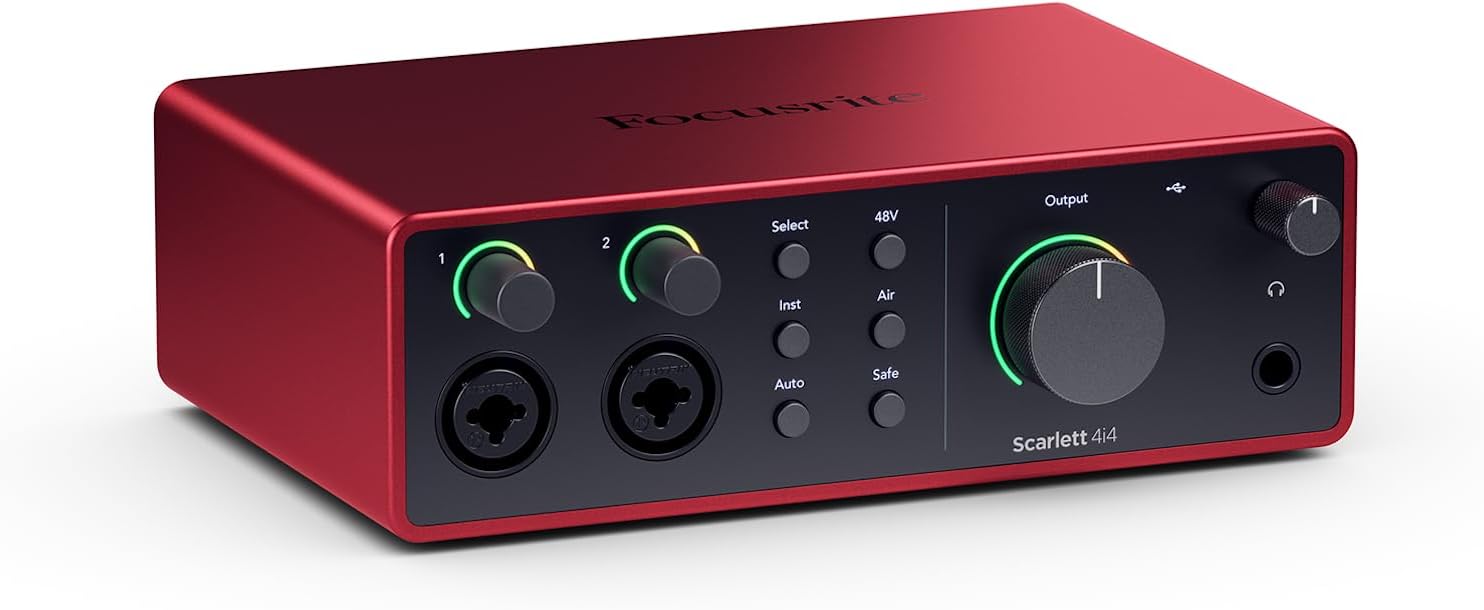
The Focusrite Scarlett 4i4 4th Gen is a professional audio interface designed for musicians, producers, podcasters, and content creators who need reliable, studio-quality sound capture. This USB-C interface combines professional-grade audio converters with intelligent recording features that make it accessible to beginners while satisfying experienced engineers.
The standout feature is the dual ultra-low-noise Scarlett 4th Gen mic preamps paired with studio-grade converters boasting a massive 120dB dynamic range, matching equipment found in the world's biggest recording studios. The innovative Air mode adds musical presence and harmonic richness to vocals and guitars, while Auto Gain and Clip Safe features automatically set perfect recording levels and prevent clipping, meaning you capture keeper takes without obsessing over gain staging.
Build quality is solid and compact, measuring just 7.09 inches wide and weighing 2.2 pounds, making it portable for mobile recording setups. The interface offers versatile I/O with 2 Hi-Z instrument inputs for guitars and synths, 4 line inputs, 4 line outputs, and MIDI I/O to accommodate any recording scenario. USB-C connectivity delivers low-latency performance critical for streaming and real-time monitoring.
The included software bundle is exceptional value, featuring Pro Tools Intro+, Ableton Live Lite, Cubase LE, and the Hitmaker Expansion with professional plugins from XLN Audio, Softube, and Native Instruments. Some users report occasional driver crashes with certain gaming software, though this appears rare and resolved with system restart.
The Scarlett 4i4 4th Gen delivers professional audio quality and intelligent features at a mid-range price point, backed by a 3-year warranty and round-the-clock support. Whether you're recording music, podcasts, or content, this interface provides the tools and sound quality to produce broadcast-ready results.
Audio Performance: 120dB dynamic range, 24-bit/192kHz maximum sample rate, 20kHz frequency response. Dual ultra-low-noise Scarlett 4th Gen mic preamps with Air mode.
I/O Configuration: 2 Scarlett 4th Gen mic preamps, 2 Hi-Z instrument inputs, 4 line inputs, 4 line outputs, MIDI In/Out, headphone output with high-impedance support.
Connectivity: USB-C with included USB-C to USB-A adaptor and 5V 3A power supply. Compatible with Mac OS, Windows OS, and iOS.
Physical Specs: 7.09 inches wide x 5.08 inches deep x 2.32 inches tall, 2.2 pounds. Includes USB-C cable and power supply.
Software Included: Pro Tools Intro+, Ableton Live Lite, Cubase LE, Hitmaker Expansion with premium plugins and virtual instruments.
Best For: Musicians recording guitars, vocals, and keyboards; music producers and beat makers; podcasters and content creators; streamers needing low-latency monitoring; anyone upgrading from budget interfaces who wants professional sound quality.
Consider If You: Need versatile I/O for multiple instruments and MIDI devices simultaneously; want included professional software to start producing immediately; require reliable, crash-free performance for critical recording sessions; value portability and compact design; prefer established brands with excellent customer support.
May Not Be Ideal If: You need more than 2 mic inputs simultaneously; you work exclusively with gaming software that has driver compatibility issues; you require XLR outputs instead of line-level outputs; budget is below $250.

Pros
- MIDAS preamps deliver clean, low-noise signal path comparable to much more expensive interfaces
- Intuitive plug-and-play setup with minimal driver hassle on both Mac and Windows systems
- Robust build quality and metal construction designed to withstand years of studio use
- Four simultaneous inputs and outputs provide flexibility for multi-track recording and live streaming
- Outstanding value proposition offering professional-grade specs at entry-level pricing
Cons
- Some users report occasional driver compatibility issues on certain Windows OS versions
- MIDI functionality may require additional configuration compared to audio I/O setup
- Limited customer support documentation compared to higher-end competitors
The Behringer U-PHORIA UMC404HD is a compact 4x4 USB audio interface engineered for home studio owners, podcasters, content creators, and mobile recording professionals. It delivers professional-grade audio quality at a price point that makes it accessible to anyone serious about recording but budget-conscious. The interface has earned respect from experienced audio engineers and casual users alike for punching well above its price class.
The standout feature is the inclusion of four MIDAS-designed mic preamps with +48V phantom power, which typically appear only on interfaces costing two to three times as much. Users consistently praise the clean, low-noise signal path and the ability to capture vocals and instruments with clarity and detail. The 24-bit/192 kHz resolution ensures future-proof audio quality, while ultra-low latency streaming supports real-time monitoring during recording sessions. Compatibility with Pro Tools, Ableton Live, Cubase, and other major DAWs means you can integrate it into virtually any existing workflow.
Build quality reflects Behringer's partnership with MIDAS and acquisition of Music Tribe assets. The metal chassis feels solid and impact-resistant, designed to handle the rigors of studio use and travel. The interface is compact at just 11.5 inches wide, making it ideal for portable recording setups or tight desk spaces. Balanced XLR and 1/4-inch outputs ensure professional connectivity to studio monitors and mixing equipment.
The main drawbacks involve driver setup on certain Windows systems and MIDI configuration, which some users find less intuitive than audio I/O setup. A small percentage of users report compatibility issues, though this appears to be system-specific rather than a widespread product defect. Driver support for Mac OS is notably streamlined, with native OS integration requiring minimal configuration.
The Behringer UMC404HD represents genuine value in the audio interface market. It combines professional-grade components, solid engineering, and proven reliability at a price that makes it the obvious choice for anyone building a home studio or upgrading from entry-level equipment. Experienced audio professionals and beginners alike will find it a capable, dependable tool that won't compromise recording quality.
Audio Specifications: 24-bit/192 kHz resolution, 10 Hz to 43 kHz frequency response (0/+0.3 dB). Maximum input levels: Microphone -4 dBu, Line +20 dBu, Instrument -3 dBu. Four MIDAS-designed mic preamps with +48V phantom power.
Connectivity: USB 2.0 interface with 4 inputs/4 outputs plus 1x MIDI I/O. Balanced XLR and 1/4-inch TRS connectors for main outputs. Supports both Mac OS X and Windows XP or higher.
Compatibility: Works with Avid Pro Tools, Ableton Live, Steinberg Cubase, Reaper, Audacity, and other major DAWs. Native driver support for Mac OS, simple driver installation for Windows.
Physical Dimensions: 11.5 inches D x 5.12 inches W x 1.81 inches H. Weight: 2.7 pounds. Rugged metal chassis with impact-resistant construction.
Ideal For: Home studio owners, podcasters, content creators, musicians recording at home, audio engineers on a budget, and anyone upgrading from entry-level USB interfaces. Perfect for mobile recording setups and professional use in tight spaces.
Experience Level: Suitable for beginners through advanced users. The plug-and-play setup welcomes newcomers, while the professional-grade preamps and specifications satisfy experienced engineers.
Use Cases: Music production and multi-track recording, podcast and voiceover recording, live streaming with high-quality audio, instrument recording, vocal tracking, and field recording with a portable setup.
Pros
- Exceptional build quality with transparent, low-noise MAX-HD preamps ideal for modern microphones
- Fender-engineered instrument inputs provide authentic, responsive guitar and bass recording capabilities
- Studio One Pro software included saves hundreds on DAW investment for new producers
- Auto Gain feature eliminates guesswork and accelerates workflow for faster recording sessions
- Flexible control options via front panel, Universal Control app, or Studio One integration
Cons
- Physical dimensions do not account for BNC connector depth, potentially exceeding stated width in compact setups
- Product registration process has experienced occasional issues requiring customer support intervention
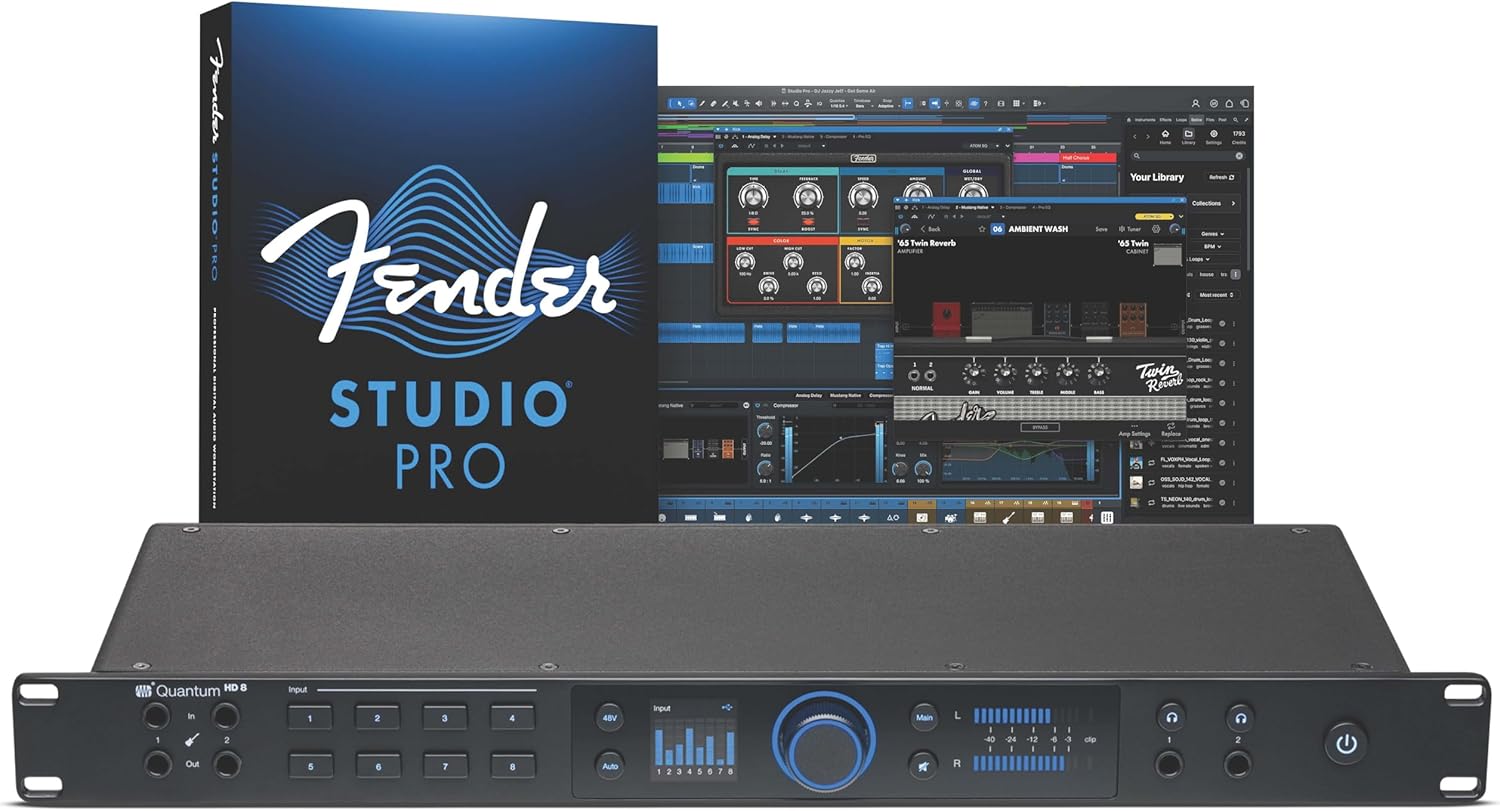
The PreSonus Quantum HD 8 represents the culmination of three decades of audio interface innovation, delivering professional-grade recording capabilities for project studios, full band setups, and serious producers. This 26x30 interface combines eight high-definition MAX-HD mic preamps with Fender-engineered instrument inputs, creating a versatile platform for capturing everything from intimate vocal recordings to complete band sessions. The included Studio One Pro perpetual license adds substantial value, eliminating the need for a separate DAW investment.
What truly sets the Quantum HD 8 apart is its thoughtful feature set designed for real-world recording scenarios. The eight MAX-HD mic preamps deliver +75dB of gain with exceptional transparency and low noise, making them ideal for today's most popular microphones. The Auto Gain button intelligently sets perfect levels automatically, while re-amp outputs enable creative sound design by letting you send DAW audio to physical amps and pedals for re-recording. At 192kHz/32-bit resolution, the converters and low-latency custom driver ensure your entire signal chain maintains pristine audio quality from input to output.
The interface excels in both form and function, featuring an illuminated push encoder for intuitive gain and volume control plus responsive LED metering for visual feedback. Universal Control app compatibility means you can manage critical preamp functions from your phone, tablet, or desktop without interrupting your creative flow. The Fender collaboration brings credibility for guitarists and bassists seeking instruments inputs specifically engineered for their needs, not generic audio inputs retrofitted for guitar use.
Minor considerations include the physical dimensions not accounting for BNC connector depth in the published specifications, which could affect extremely compact rack setups. The premium pricing reflects its professional-grade components and included software, positioning it above entry-level interfaces but competitive with other flagship models. Some users have reported occasional product registration delays, though PreSonus support reportedly responds quickly to resolve these issues.
The Quantum HD 8 delivers exceptional value for serious musicians and producers ready to invest in reliable, feature-rich recording hardware. Its combination of high-quality preamps, Fender-engineered instrument inputs, included professional software, and intuitive control options make it an outstanding choice for anyone building or upgrading a project studio. Highly recommended for full band recordings, professional home studios, and producers who demand transparent, low-latency performance.
Audio Specifications
Maximum Sample Rate: 192 kHz
Bit Depth: 32-bit
Connectivity: USB-C
Input/Output Channels: 26x30
Frequency Response: 20Hz to 20kHz
Mic Preamps: 8x MAX-HD with +75dB gain
Physical Specifications
Dimensions: 19 inches W x 8.6 inches D x 1.7 inches H
Weight: 6.3 pounds
Connectors: BNC connectors on rear panel
Control Interface: Illuminated push encoder with LED metering
Software and Compatibility
Included Software: Studio One Pro (perpetual license)
Control App: Universal Control (mobile and desktop)
Compatible Devices: Personal computers, headphones
Operating System: Windows and Mac compatible
Warranty and Support
Manufacturer Warranty: 2 years
Manufacturer: PreSonus
Model Number: Quantum HD8
UPC: 673454012211
Who Should Buy This Interface
The Quantum HD 8 is ideal for project studio owners, full band recording setups, professional home studios, guitarists and bassists seeking Fender-engineered inputs, and producers who value included professional software. It suits anyone recording multiple instruments simultaneously and needing low-latency performance for real-time monitoring.
Key Considerations Before Purchase
Verify your desk or rack depth accounts for BNC connector protrusion beyond the stated 8.6-inch depth measurement. Confirm USB-C compatibility with your computer setup. Consider whether the eight mic preamps and 26x30 channel count match your typical recording scenarios. Ensure you have adequate power supply for the interface and connected devices.
Setup and Getting Started
The interface includes Studio One Pro, eliminating the need for separate DAW purchase. Use the Universal Control app to manage preamp functions remotely. The Auto Gain feature accelerates initial setup by automatically optimizing input levels. Register your product with PreSonus promptly to activate the included software licenses and access support resources.
Maximizing Your Investment
Explore the re-amp outputs for creative sound design experiments with different amp and pedal combinations. Use the illuminated encoder for hands-on gain staging during recording sessions. Leverage the Fender-engineered instrument inputs for authentic guitar and bass tone capture. Access preamp controls via Studio One integration for seamless workflow without external app switching.

Pros
- Authentic analog coloration from eight built-in vintage preamps eliminates need for external gear
- Exceptional value with included LUNA DAW and extensive UAD plug-in library worth thousands separately
- Versatile connectivity supports Mac, PC, iOS, and iPadOS for mobile recording flexibility
- Expandable architecture lets you scale I/O by daisy-chaining multiple interfaces
- Professional rack-mount design and solid construction suitable for permanent studio installations
Cons
- Requires computer or iPad with sufficient processing power to run LUNA DAW and UAD plug-ins
- Single USB 2.0 port may limit simultaneous connectivity compared to modern USB 3.0 interfaces
The Universal Audio Volt 876 is a professional 24x28 USB audio interface designed for serious music producers, recording engineers, and studios seeking integrated analog character and modern digital capabilities. This rack-mount unit combines eight vintage preamps with classic 1176-style compressors directly on the front panel, delivering the sound quality and workflow of a high-end analog console without requiring separate outboard gear.
The standout features include 32-bit/192kHz audio conversion, full compatibility across Mac, Windows, iOS, and iPadOS platforms, and an impressive suite of included UAD plug-ins and the LUNA Digital Audio Workstation. The AI-powered recording tools like Voice Control and Instrument Detection streamline session creation, while full recall of interface settings and two low-latency cue mixes ensure professional-grade monitoring and collaboration capabilities.
Build quality is excellent, with the 13.9 lb unit featuring a professional rack-mount design suitable for permanent studio installations or mobile touring setups. The XLR audio inputs and USB Type-C connectivity provide reliable connections, while the ability to combine up to three Volt 876 interfaces or integrate with Apollo and ADAT equipment offers significant scalability for growing studios.
The main drawback is the premium $899 price point, which positions this interface primarily toward professional and semi-professional users rather than hobbyists. Additionally, the single USB 2.0 port is somewhat dated compared to newer USB 3.0 interfaces, though it remains functional for most recording scenarios.
Overall, the Volt 876 represents exceptional value for professionals who want authentic analog sound combined with modern DAW capabilities and AI-assisted recording tools, all in one integrated solution backed by Universal Audio's legendary reputation.
Audio Specifications: 24x28 channels, 32-bit resolution, 192kHz maximum sample rate, XLR audio inputs with onboard preamps and compression.
Connectivity: One USB 2.0 port with USB Type-C connector, compatible with Mac, Windows, iOS, and iPadOS.
Physical Specifications: Rack-mount professional styling, 13.9 lbs weight, Model VOT876.
Included Software: LUNA Digital Audio Workstation, UAD plug-in suite including LA-2A, 1176 compressors, Pultec EQs, PolyMAX Synth, Showtime '64 Guitar Amp, and more. UAD Console app with Assistive Auto-Gain and session recall.
Warranty: Limited lifetime warranty from Universal Audio.
Best For: Professional recording studios, music producers seeking integrated analog and digital solutions, engineers requiring mobile recording with iPad compatibility, and facilities wanting to expand I/O by daisy-chaining multiple interfaces.
Consider This If: You prioritize authentic analog tone, need a complete recording solution with included DAW and plug-ins, require professional-grade monitoring with low-latency cue mixes, or want expandable architecture for future growth.
May Not Be Ideal If: You're on a tight budget under $500, need the absolute latest USB 3.0 connectivity, prefer standalone interfaces without mandatory software dependencies, or only require basic recording capabilities without advanced features.
Key Decision Points: Evaluate whether the included LUNA DAW and UAD plug-in value justifies the premium price compared to competitors. Confirm your computer has sufficient power to run the software. Verify USB 2.0 compatibility with your existing setup. Consider whether you'll utilize the expandability features for future growth.

Pros
- Exceptional value for the number of inputs and professional preamp quality included
- MIDAS preamp technology delivers clean, transparent sound with minimal noise floor
- Flexible monitoring options and dual independent headphone outputs ideal for band recording and DJ setups
- ADAT expansion capability allows future growth without replacing the interface
- Solid build quality and proven reliability in home and professional studios
Cons
- USB 2.0 connection may experience bandwidth limitations with maximum channel count at 96kHz on some systems
- Steep learning curve for the comprehensive monitoring and routing options if new to audio interfaces
- Requires optional ADA8200 expansion module to reach full 16-preamp capacity, adding to total cost
The Behringer UMC1820 is a professional-grade USB audio interface designed for home studios, content creators, and musicians who need serious I/O without breaking the bank. With 18 inputs, 20 outputs, and 8 MIDAS-designed mic preamps built-in, this interface handles complex recording scenarios from multi-track band sessions to podcast production with ease.
The standout feature is the inclusion of genuine MIDAS preamp technology, which typically commands premium pricing. These preamps deliver clean, transparent gain with minimal coloration, making them ideal for recording vocals, acoustic instruments, and drums. The 24-bit/96kHz resolution ensures audiophile-quality recordings, and the ultra-low latency monitoring lets you track without delay, critical for maintaining performance timing and energy.
Build quality is solid with a professional-grade chassis that feels substantial without excessive weight. The 24-inch width fits standard studio racks, and the layout logically organizes the extensive I/O. The dual independent headphone outputs with individual level control and A/B cueing are particularly valuable for band recording scenarios where the engineer and performer need different mixes.
The main drawback is the USB 2.0 connection, which can strain bandwidth when using all 18 inputs and 20 outputs simultaneously at 96kHz. Additionally, the comprehensive monitoring matrix takes time to master if you're new to professional interfaces. The expandable ADAT I/O is excellent for future growth, but reaching full 16-preamp capacity requires purchasing the separate ADA8200 module.
Overall, the UMC1820 represents exceptional value for serious home recordists and small studios. Its combination of professional preamp quality, extensive connectivity, and flexible monitoring makes it a versatile workhorse that grows with your needs.
Audio Specifications
Resolution: 24-bit/96kHz
Channels: 18 inputs, 20 outputs
Mic Preamps: 8 MIDAS-designed with 48V phantom power
Connectivity: USB 2.0, ADAT optical I/O, S/PDIF, MIDI
Latency: Ultra-low latency monitoring
Physical Specifications
Dimensions: 24.35 inches W x 7.2 inches D x 4 inches H
Weight: 4 pounds
Compatibility: Mac OS X, Windows XP and higher
Software Support: Pro Tools, Ableton Live, Cubase, and other major DAWs
Ideal For
Home studio owners and project-based musicians needing professional preamp quality at accessible pricing. Band recording situations requiring multiple simultaneous inputs and independent headphone mixes. Podcasters and content creators who want clean microphone inputs with professional monitoring options. Audio engineers seeking expandable I/O via ADAT for future growth.
May Not Be Ideal For
Producers requiring Thunderbolt or USB 3.0 speeds for maximum channel count at highest sample rates. Those needing more than 8 built-in preamps without additional purchases. Users seeking a compact portable interface, as the 24-inch width prioritizes connectivity over portability.

Pros
- Exceptional audio quality with no background noise, even at budget price point
- Truly plug-and-play functionality works immediately on Windows, Mac, and Linux systems
- Dual combo jacks provide maximum flexibility for microphones, guitars, and line-level sources
- Lightweight and compact form factor ideal for desk space and portability
- Zero-latency monitoring enables confident tracking without hearing delay or echo
Cons
- LED illumination on gain knobs does not function as prominently displayed in product images
- Requires careful gain adjustment when connecting instruments with built-in preamps to avoid clipping
- Limited to 2 input channels, which may not suit users needing more simultaneous inputs
The PIYONE Q2 is a 2x2 USB-C audio interface designed for home recordists, podcasters, guitarists, and content creators who want professional-grade sound without complexity. It bridges the gap between budget-friendly and professional-quality recording, making it an ideal first interface for beginners or a secondary interface for established creators.
The standout feature is its genuine plug-and-play operation. Simply connect the USB-C cable to your computer, and the interface is recognized immediately on Windows, Mac, and Linux systems without any driver installation. The 24-bit/192kHz audio resolution captures professional-quality recordings with excellent clarity and minimal noise. The zero-latency direct monitoring feature eliminates tracking delays, allowing you to hear yourself in real-time without the frustrating latency that plagues cheaper interfaces. Dual XLR/TRS combo inputs with 48V phantom power provide flexibility for condenser microphones, dynamic mics, guitars, and line-level sources.
Build quality and design are impressive for the price. The compact form factor fits easily on any desk without consuming valuable space. The illuminated control knobs create a modern, professional aesthetic that looks great in any studio setup. The interface feels solid and well-constructed, with ergonomic knobs and buttons positioned for comfortable operation during long recording sessions.
One notable drawback is that the LED illumination on the gain knobs does not function as prominently as shown in product images, which may disappoint users specifically drawn to this visual feature. Additionally, users must exercise caution when adjusting gain levels with instruments that have built-in preamps, as excessive gain can cause clipping. The 2-channel limitation means this interface cannot handle multiple simultaneous inputs beyond two sources.
Verdict: The PIYONE Q2 delivers exceptional value for beginners and budget-conscious creators seeking professional audio quality without complexity. Its combination of studio-grade sound, zero-latency monitoring, and truly plug-and-play setup makes it an excellent choice for home recording, podcasting, and content creation. Recommended for anyone starting their recording journey or needing a reliable portable interface.
Audio Quality: 24-bit resolution, 192kHz maximum sample rate, high-performance converters, low-noise design
Connectivity: USB-C port (handles both data transfer and bus power), 3.5mm headphone jack
Inputs: 2 XLR/TRS combo jacks, 48V phantom power supply
Channels: 2 input channels, 2 output channels
Features: Zero-latency direct monitoring, monitor mix function, loopback capability, illuminated control knobs, class-compliant design
Compatibility: Mac, Windows PC, Linux, iOS (via USB-C adapter)
Physical: Compact portable design, 0.74 kg weight, Alloy Red finish
Warranty: 2-year limited warranty
Ideal For: Beginner recording artists, podcasters, singer-songwriters, content creators, home studio enthusiasts, and anyone seeking professional audio quality without complex setup requirements.
Perfect Use Cases: Recording vocals with condenser microphones, capturing acoustic guitar performances, podcasting and voice-over work, streaming with professional audio quality, music production on a budget, portable recording for travel or mobile content creation.
Not Ideal For: Users requiring more than 2 simultaneous inputs, professional studios with extensive I/O requirements, or those specifically seeking prominent LED illumination effects on control knobs.

Pros
- Exceptional multichannel playback solution offering best value for 7.1 surround sound capability
- Clean, noise-free audio output verified by live performance users
- Plug-and-play compatibility across Windows and Mac OS X systems
- Portable form factor with USB-C power eliminates cable clutter and external power dependencies
- Reliable build quality with strong customer satisfaction for multitrack backing track playback
Cons
- Quality control concerns reported by some users regarding RCA connector durability and internal stability
- Limited to USB connectivity, may require adapters for legacy audio equipment setups
- Mixed user feedback suggests performance may vary depending on specific hardware configurations
The ESI GIGAPORT eX is a multichannel audio interface specifically engineered for DJs, live performers, and music producers who require professional-grade surround sound capabilities without premium pricing. This compact device delivers 7.1 channel support, making it ideal for backing track playback, complex DJ setups, and professional live sound applications where multiple audio outputs are essential.
The standout feature is undoubtedly the 24-bit/192kHz audio quality combined with 8 RCA outputs and dual headphone jacks, offering exceptional flexibility for mixing scenarios. Users report clean, noise-free performance during live events, and the device integrates seamlessly with popular DAWs and DJ software. The USB Type-C power delivery means you can operate the interface directly from your laptop without additional power cables, enhancing portability for mobile setups.
Design-wise, the GIGAPORT eX maintains a compact footprint at just 4.72 inches wide, making it practical for crowded DJ booths or studio environments. The build feels solid with quality components, though some users have reported durability concerns with RCA connectors on certain units, suggesting potential quality control inconsistencies in production batches.
The primary drawback is the reliance on USB connectivity, which may require adapters if integrating with older analog equipment. Additionally, while most users praise the audio quality, occasional reports of internal movement or connector issues indicate that build consistency could be improved at this price point.
Overall, the ESI GIGAPORT eX represents excellent value for DJs and performers seeking affordable multichannel audio solutions. When functioning properly, it delivers studio-quality sound with professional features at a fraction of enterprise-level pricing. Recommended for bands using backing tracks, mobile DJs, and producers needing reliable multitrack playback capabilities.
Connectivity and Power: USB Type-C powered connection with no external power adapter required. Compatible with Windows and Mac OS X 10.9 or later.
Audio Performance: Maximum sample rate of 192 kHz with 24-bit resolution. Supports full 7.1 channel surround sound playback for immersive audio experiences.
I/O Configuration: 8 RCA audio outputs for flexible routing, dual headphone jacks for simultaneous monitoring, and RCA audio inputs for source connectivity.
Physical Dimensions: Measuring 4.72 inches wide by 2.76 inches deep by 0.79 inches high, with a lightweight design at 0.37 kg for easy portability and space-efficient placement.
Warranty and Support: Comprehensive 2-year manufacturer warranty with 24/7 customer support from US and Germany-based technical teams.
Ideal For: Professional DJs, live performance bands using backing tracks, music producers working with surround sound content, and audio engineers requiring multichannel playback solutions without premium pricing.
Perfect Use Cases: Mobile DJ setups requiring 7.1 surround capabilities, performing bands needing reliable multitrack backing track playback, DaVinci Resolve users seeking dedicated multichannel audio output, and studios transitioning to USB-powered audio solutions.
Not Recommended For: Users requiring analog-only connectivity, those needing professional XLR balanced outputs, or producers exclusively working with stereo audio who don't need multichannel capability.
How to Choose Your Multi-Channel Interface
Assess Your Current and Future Input Needs
Start by counting your simultaneous sound sources. A vocalist with an acoustic guitar might only need two channels. A full band recording could require eight or more for drums alone.
Look for interfaces with a combination of XLR, TRS, and Hi-Z inputs for maximum flexibility. Consider models with ADAT optical inputs, like the Behringer UMC1820, which allow for significant expansion later. If your setup is simpler, our guide to the best dual channel audio interfaces covers excellent two-input options.
Prioritize Preamplifier Quality and Features
The microphone preamp is your first point of contact with your sound. It must be clean, quiet, and provide ample gain. Interfaces like the Universal Audio Volt 876 include vintage-inspired preamps and compression for instant character.
Features like +48V phantom power for condenser mics, high-impedance (Hi-Z) switches for guitars, and pad attenuators are essential. Evaluate whether you need ultra-transparent preamps or ones that add musical color to your recordings right at the source.
Evaluate Connectivity and Driver Stability
Modern interfaces typically connect via USB-C for fast, reliable data transfer and bus power. Ensure the interface is class-compliant for Mac/iOS or has dedicated, stable drivers for Windows to avoid latency issues during critical sessions.
Output options are equally important. You need balanced main outputs for studio monitors, dedicated headphone amps with separate volume control, and possibly additional line outputs for connecting outboard gear or sending a separate mix to performers.
Consider Included Software and Workflow Tools
Many interfaces come bundled with valuable software. This can include a Digital Audio Workstation (DAW), plugin suites, and virtual instruments. The Focusrite Scarlett 4i4, for example, includes a comprehensive software package that jumpstarts any project studio.
Also, look for workflow enhancements like loopback functionality for streaming, standalone operation modes, and companion control apps. These features streamline your process, letting you focus on creativity rather than technical hurdles. For interfaces renowned for their sonic performance, explore our list of the best audio interfaces with natural sound.
Final Thoughts
Selecting the right multi-channel audio interface is an investment in your creative workflow. For those seeking an exceptional balance of pristine audio quality, robust software, and reliable performance in a compact format, the Focusrite Scarlett 4i4 4th Gen USB-C Audio is a standout choice. Alternatively, if your project studio demands high channel counts on a sensible budget, the expandable Behringer UMC1820 Audiophile 18×20 USB Audio/MIDI offers tremendous value and flexibility, making professional multi-track recording accessible to all.
Frequently Asked Questions
What is the main advantage of a multi-channel audio interface?
The primary benefit is the ability to record multiple sound sources simultaneously with independent control. This is essential for capturing live drums, recording a band, or hosting multi-person podcasts where each microphone needs its own discrete track for later mixing and editing.
How many channels do I realistically need for home recording?
Most home studio producers find a 4-channel interface to be a versatile starting point. It allows for recording a stereo pair plus two additional sources, such as a vocalist and a DI bass. For more elaborate setups, 8-channel units provide room for growth. You can learn more about different configurations on our main audio interfaces category page.
Can I connect an external preamp to my audio interface?
Yes, absolutely. Most multi-channel interfaces include dedicated line-level inputs that bypass the internal preamps. This lets you use external microphone preamplifiers, channel strips, or analog synthesizers, giving you access to different sonic characteristics and higher-quality conversion.
What does ‘ADAT input’ mean on an interface?
An ADAT optical input allows you to connect an external 8-channel microphone preamp or converter box via a single fiber-optic cable. This effectively adds 8 more inputs to your interface, making it a cost-effective way to expand your system’s capacity as your needs grow in 2026 and beyond.


Write Your Review
No reviews yet. Be the first to share your experience!