

You invested in planar magnetic headphones for their breathtaking clarity, wide soundstage, and lightning-fast transient response. Now, you might find your music sounds flat or lacks impact when connected to your computer or a basic interface. The culprit is often insufficient power. Planar magnetic drivers are notoriously power-hungry and revealing, meaning they demand a clean, robust signal to perform at their best.
This guide is for music producers, audiophiles, and content creators who want to unlock the full potential of their planar magnetic headphones. We have assessed several leading audio interfaces, focusing specifically on their headphone output sections’ ability to deliver the current and voltage swing these headphones crave without introducing noise or distortion. The right interface will transform your listening and mixing experience.

Pros
- Exceptional audio conversion quality with mastering-grade specifications trusted by Grammy Award-winning professionals
- Comprehensive zero-latency monitoring system eliminates CPU overload while tracking with effects
- Versatile connectivity options accommodate virtually any studio setup from microphones to outboard gear
- Advanced headphone monitoring with four independent mixes and calibration profiles for accurate performer feedback
- Generous software bundle including DAW and plugins provides tremendous value for complete recording setup
Cons
- Complex feature set requires learning curve for users unfamiliar with professional audio interfaces
- Limited real-world user reviews available to validate long-term reliability and performance
The Antelope Audio Discrete 8 Oryx represents the pinnacle of professional audio interface design, engineered for mastering studios, recording facilities, and serious producers who refuse to compromise on audio fidelity. This eight-channel interface combines discrete Class-A preamp design with flagship AD/DA conversion technology, making it a comprehensive solution for capturing, processing, and monitoring professional-quality recordings.
The standout feature is the integration of Antelope's Synergy Core DSP and FPGA platform, which delivers zero-latency monitoring through over 90 analog-modeled effects including compressors, EQs, tape machines, guitar amps, and reverbs. This hardware-accelerated approach means you can monitor through world-class effects without burdening your CPU, a critical advantage during tracking sessions. The eight discrete preamps deliver up to 75dB gain with ultra-low noise performance, while the two Hi-Z inputs simplify direct guitar and bass recording with responsive, transparent signal capture.
Build quality and design reflect professional studio standards, with the interface offering 26x38 simultaneous I/O including ADAT, S/PDIF, reamp outputs, and four independent headphone outputs. The X-Feed headphone processing technology recreates natural stereo imaging for more accurate mixing decisions, while headphone calibration profiles and customizable EQ ensure optimal monitoring across all four outputs. Standalone mode operation allows the interface to function independently of a computer, providing flexibility for live tracking and performance scenarios.
The primary consideration is the premium investment required, positioning this interface for professional studios rather than casual home recordists. Additionally, the comprehensive feature set demands familiarity with professional audio workflows to fully leverage capabilities like real-time microphone modeling and advanced routing options. The inclusion of Bitwig Studio Essentials and 75+ plugins substantially increases perceived value and eliminates the need for additional software purchases.
The Antelope Audio Discrete 8 Oryx delivers mastering-grade audio quality, zero-latency monitoring capabilities, and professional-grade connectivity in a single interface. For recording studios, mastering facilities, and serious producers prioritizing audio fidelity and advanced monitoring workflows, this interface represents a worthy investment that will serve as the foundation of a professional recording setup for years to come.
Audio Conversion: 130dB AD/DA converters, 64-bit AFC clocking technology
Preamps: 8 discrete Class-A preamps, up to 75dB gain, ultra-low noise performance, 2 Hi-Z inputs
Processing: Synergy Core DSP and FPGA platform, 90+ analog-modeled effects, zero-latency monitoring
I/O Configuration: 26x38 simultaneous I/O, ADAT, S/PDIF, reamp outputs, 4 independent headphone outputs, footswitch input, DC-coupled outputs
Connectivity: USB-C, compatible with Mac and Windows
Software Included: Bitwig Studio Essentials DAW, 75+ premium plugins, 3-month Antelope Cosmos membership
Features: Real-time microphone modeling, X-Feed headphone processing, headphone calibration profiles, standalone mode, talkback functionality, custom routing presets
Who Should Buy This: Professional recording studios, mastering facilities, experienced audio engineers, and serious producers who require mastering-grade audio quality, zero-latency monitoring, and comprehensive I/O connectivity. Ideal for tracking vocals, drums, guitars, and full band sessions with professional monitoring capabilities.
Who Might Look Elsewhere: Home studio beginners or hobbyists on limited budgets should consider more entry-level interfaces. Users seeking simpler, more straightforward interfaces without advanced DSP capabilities may find the feature set overwhelming.
Key Considerations: Evaluate your studio's I/O requirements and ensure you have adequate USB-C connectivity on your computer. Consider whether the included software bundle aligns with your DAW preferences. Factor in the learning curve for advanced features like microphone modeling and custom headphone mixing.
Value Proposition: The combination of mastering-grade converters, eight preamps, zero-latency DSP effects, and included software makes this interface a comprehensive professional recording solution. While the investment is substantial, the quality and capabilities justify the cost for professional applications.

Pros
- Exceptional sound quality at an affordable price point with professional-grade converters
- Auto Gain and Clip Safe features eliminate guesswork and prevent ruined takes
- Includes industry-leading software and plugin bundle worth hundreds separately
- Minimal latency and simple setup makes it accessible for beginners and professionals alike
- Air Mode adds musical character and presence without complex EQ adjustments
Cons
- Limited to 2 inputs and 2 outputs, so users requiring more channels will need to upgrade
- Air Mode's second preset may not suit all vocal types and requires some experimentation
- USB-C cable included, but USB-A adapters not provided for older computers
The Focusrite Scarlett 2i2 4th Gen is a professional USB-C audio interface designed for musicians, podcasters, content creators, and home studio enthusiasts. Whether you're recording vocals, guitars, drums, or streaming, this compact interface delivers studio-quality sound with intelligent features that make recording intuitive and forgiving. It's the interface of choice for bedroom producers and professional touring musicians alike.
The standout feature is the combination of studio-grade converters with 120dB dynamic range, matched to equipment found in world-class recording studios, paired with intelligent Auto Gain and Clip Safe technology. Auto Gain automatically sets optimal recording levels for your microphone or instrument, while Clip Safe prevents distortion from sudden loud peaks. The two ultra-low-noise mic preamps offer 69dB of analog gain, handling even demanding dynamic microphones without struggling. Air Mode adds musical presence and harmonic richness, lifting vocals and guitars forward in the mix with the character of a large-format console.
Build quality is excellent for the price, with a sleek, durable aluminum chassis and intuitive front-panel controls. The amped headphone output delivers full volume through any headphones with independent control, and USB-C connectivity provides bus power directly from your computer with virtually zero latency. Setup is remarkably simple: connect your mic or guitar, plug in USB, launch your DAW, and start recording. The included software bundle (Pro Tools Intro+, Ableton Live Lite, Cubase LE, and Hitmaker Expansion) provides professional tools right out of the box.
The primary limitation is the 2-input, 2-output configuration, which may feel restrictive if you need to record multiple sources simultaneously or require more complex routing. Additionally, Air Mode's second preset cuts midrange aggressively, which works beautifully on some sources but may require switching back to Air Mode 1 or disabling it entirely for certain vocal types. The included USB-A to USB-C cable works perfectly, though older computers may need adapters.
Verdict: The Scarlett 2i2 4th Gen is an exceptional value for anyone serious about recording quality audio at home. Its combination of professional sound, intelligent features, and comprehensive software bundle makes it the industry standard for entry-level and mid-level home studios. Highly recommended for beginners and professionals alike.
Audio Inputs and Outputs: 2 microphone/line inputs, 2 hi-Z instrument inputs, 2 line outputs, headphone output with independent volume control
Audio Quality: 24-bit/192kHz resolution, 120dB dynamic range, 20Hz-20kHz frequency response
Connectivity: USB-C (includes USB-A to USB-C cable), compatible with Mac OS, Windows OS, and iOS
Microphone Preamps: 2 ultra-low-noise preamps with 69dB analog gain, Auto Gain, and Clip Safe features
Physical Dimensions: 7.09 inches wide x 4.61 inches deep x 1.87 inches tall, weighs 1.7 pounds
Software Included: Pro Tools Intro+, Ableton Live Lite, Cubase LE, Hitmaker Expansion (includes Auto-Tune Access, Softube Marshall Silver Jubilee, Native Instruments MASSIVE)
Warranty: 3-year manufacturer warranty with 24/7/365 support
Perfect For: Home recording enthusiasts, singer-songwriters, bedroom producers, podcasters, guitarists, streamers, and anyone upgrading from built-in computer audio. This interface is also ideal for musicians who gig with laptops and need reliable, portable audio I/O.
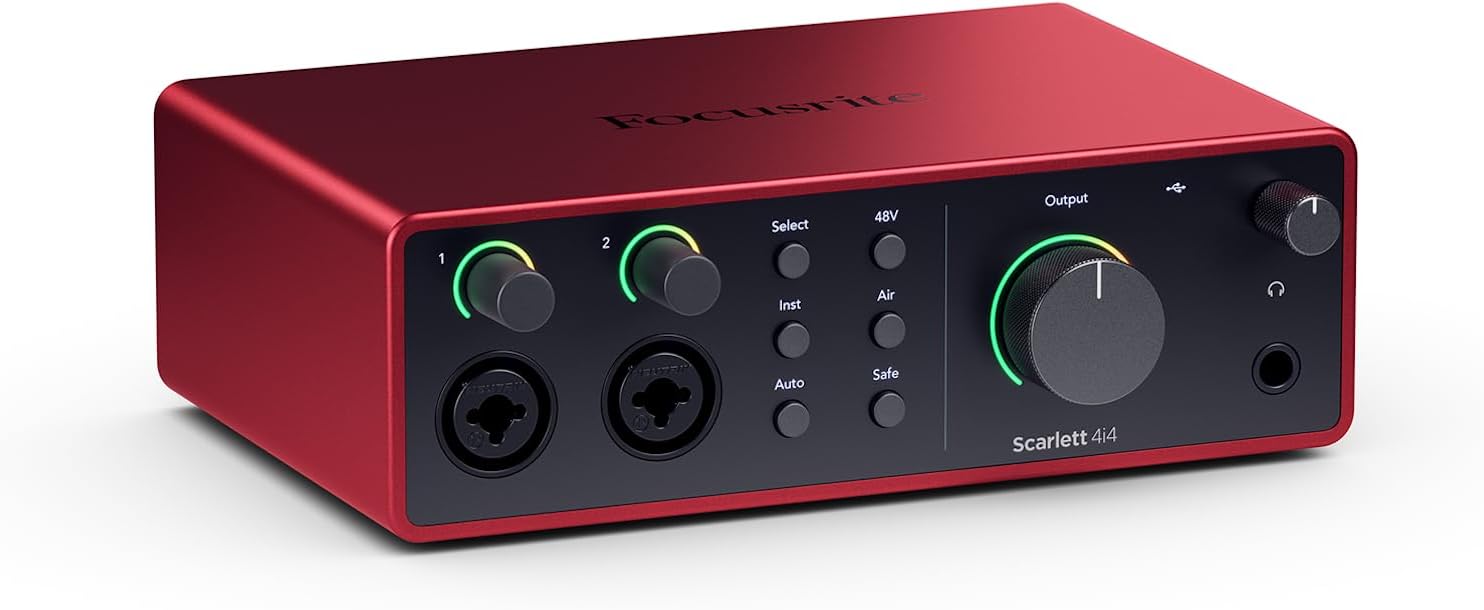
May Not Be Ideal For: Studios requiring more than 2 simultaneous inputs, or users needing extensive analog I/O routing. If you frequently record full bands or require MIDI I/O, consider the Scarlett 4i4 instead.
Comparison Note: The Scarlett 2i2 4th Gen represents the sweet spot between affordability and professional quality. It's the industry standard for entry-level home studios and competes favorably with interfaces costing significantly more.

Pros
- Outstanding audio quality with quiet, transparent preamps that capture full warmth and clarity from microphones
- Premium all-metal build quality feels professional and portable enough for travel between studios
- Dual headphone outputs with independent monitoring provide flexibility for collaborative recording sessions
- USB-C connector offers faster, more stable connection than older USB standards with simplified cable management
- Excellent value for professional-grade preamps at mid-range pricing compared to competitor offerings
Cons
- No physical power switch requires unplugging to fully disconnect, which some users find inconvenient
- Steeper learning curve than some competitors due to unique control layout and menu system
- May experience connectivity loss when computer enters sleep mode on some systems
The Audient iD14 MKII is a professional-grade USB audio interface designed for home studio recording, music production, and content creation. It targets serious musicians, podcast producers, and audio engineers who demand studio-quality sound without the price tag of larger mixing consoles. This interface bridges the gap between budget-friendly options and enterprise-level gear.
The standout feature is the dual Class-A microphone preamps, borrowed directly from Audient's professional ASP8024 HE mixing console. Users consistently report that these preamps deliver exceptional clarity, warmth, and detail, with remarkably low noise floors that capture every nuance of vocals and instruments. The new USB-C connector provides faster data transfer and improved power delivery compared to the original iD14, while the dual headphone outputs enable independent monitoring for collaborative sessions. Real-world testing shows the interface drives high-impedance headphones effortlessly with clean, detailed reproduction.
Build quality is exceptional throughout. The all-metal chassis feels substantial and professional, with a compact footprint that fits easily on crowded studio desks while remaining portable enough for mobile recording setups. The included 1m USB-C cable and software bundle (Cubase LE, Retrologue 2, and sample packs) provide immediate production capability out of the box.
Potential drawbacks include the lack of a dedicated power switch and occasional sleep-mode connectivity issues on certain computer configurations. The control layout also requires a brief learning period compared to more straightforward interfaces, though users report this complexity becomes intuitive with minimal practice.
The Audient iD14 MKII delivers professional preamp quality and build standards that justify its mid-range price point. It represents an excellent upgrade path for producers outgrowing entry-level interfaces while remaining accessible to those building their first serious home studio setup.
Connectivity and Compatibility
USB-C connector with high-speed data transfer. Compatible with Mac, PC, and iOS devices. Includes 1m USB-C cable. Supported software: Steinberg Cubase LE, Cubasis LE 2, Retrologue 2 Synth, TwoNotes Wall of Sound, Waldorf Edition 2 LE, and Loopmasters Sample Pack.
Audio Performance
Maximum sample rate: 96 kHz. 4 channels total. Two Class-A microphone preamps derived from Audient's ASP8024 HE console. Dual headphone outputs for independent monitoring. Exceptional headroom and low-noise amplification for transparent audio capture.
Physical Specifications
Dimensions: 173 x 120 x 62 mm (6.81 x 4.72 x 2.44 inches). Weight: 1250g (2.75 lbs). All-metal chassis construction. Available in black finish. Compact desktop form factor with portability for mobile studio applications.
Warranty and Support
3-year manufacturer warranty. Backed by Audient's professional audio reputation. Model number: iD14MKII. UPC: 656942526773.
Ideal For
Home studio professionals seeking transparent, high-quality preamps. Music producers upgrading from budget interfaces. Podcast and voiceover creators requiring clean vocal capture. Recording engineers building portable studio setups. Musicians pairing with quality microphones and headphones for critical monitoring and recording.
May Not Be Ideal For
Users requiring extensive MIDI connectivity or analog I/O options. Those needing simple plug-and-play functionality without learning control layouts. Budget-conscious beginners with minimal production requirements. Users requiring onboard effects processing or DSP capabilities.
Best Paired With
Quality condenser microphones like Rode NT1 or similar. Closed-back monitoring headphones like Sennheiser HD650 or Audio-Technica AT2020. Professional studio monitors for mix referencing. Acoustic treatment for optimal recording environment.

Pros
- Exceptional soundstage and imaging clarity, especially noticeable in stereo recordings and spatial audio
- Exceptional comfort during multi-hour listening sessions with zero listener fatigue reported
- Outstanding value proposition compared to competitors like Audeze LCD3 and HiFiMan HE560
- Improved build quality from earlier revisions, with refined connectors and construction
- Versatile compatibility with laptops, desktops, tablets, and mobile devices via 3.5mm jack
Cons
- Open-back design means sound leakage, not suitable for shared spaces or isolation-focused use
- Requires quality source material to shine, may reveal poor audio recordings
- Headband durability concerns noted by some users despite recent quality improvements
The Monolith M1060 is a professional-grade, open-back planar magnetic headphone designed for audiophiles, music producers, and serious listeners who refuse to compromise on sound quality. Whether you are mixing music, mastering tracks, or simply rediscovering your favorite albums, these headphones deliver the detailed aural landscape expected from high-end studio equipment.
The standout feature is the 106mm planar magnetic driver technology. Unlike traditional dynamic drivers, planar drivers use a flat membrane surrounded by magnets to produce sound with significantly lower distortion, superior bass response, and pinpoint imaging. Users consistently report hearing new details in familiar recordings, precise instrument placement across the stereo field, and an overall sense of musical clarity that justifies the professional-grade classification.
Build quality reflects Monoprice's commitment to rugged design and rigid quality control. The wood enclosure, faux leather earpads, and padded headband combine durability with comfort. Recent design revisions improved connector reliability and overall construction, addressing early feedback from the audio community. The 50 ohm impedance makes these headphones easy to drive from any device, eliminating the need for expensive amplification, though a quality DAC and amplifier will further enhance performance.
The open-back design creates an immersive, holographic listening experience that mimics a live performance rather than isolating sound inside your head. This is ideal for critical listening and professional work but unsuitable for environments where sound leakage matters. Additionally, these headphones reveal both the strengths and weaknesses of your source material, so quality recordings are essential to fully appreciate their capabilities.
Final verdict: The Monolith M1060 represents exceptional value for anyone seeking professional-quality audio without the premium price tag. With genuine customer-driven improvements and consistent praise from audio professionals, these headphones earn their place in any serious listener's collection.
Driver Technology: 106mm Planar Magnetic Driver
Audio Performance: Frequency Response 20 Hz - 20,000 Hz, 50 Ohm Impedance, 10 Watt Maximum Power Handling
Design: Open-Back Over-Ear with Rounded Earpiece Shape
Connectivity: Wired 3.5mm Jack with Retractable Cable
Materials: Wood Enclosure, Faux Leather Earpads, Padded Headband
Compatibility: Laptops, Desktops, Tablets, Smartphones, Cellphones
Weight: 4.16 ounces (Lightweight Design)
Model: Monoprice M1060, Series 116050
Who Should Buy: Music producers, audio engineers, mastering professionals, audiophiles, and serious music enthusiasts who prioritize sound quality and comfort. These headphones excel for critical listening, studio work, and discovering new details in your music collection.
Who Should Skip: Users needing sound isolation, those working in shared spaces, or anyone requiring wireless connectivity. Open-back design is unsuitable for commuting or environments where sound leakage is problematic.
Amplification Recommendation: While the 50 ohm impedance allows direct connection to any device, pairing with a quality DAC and amplifier like the Schiit Fulla or Magni Modi stack will maximize performance and reveal the full potential of the planar drivers.
Source Material: These headphones are highly revealing and perform best with well-recorded music. Compressed audio or poor recordings may sound less impressive than on lesser headphones, so quality streaming services or lossless audio are recommended.
Choosing Your Interface: A Buyer’s Guide
Headphone Amplifier Power and Quality
The most critical factor is the headphone amplifier’s output capability. Look for specifications indicating high output power into low impedance, often measured in milliwatts (mW). A robust amp provides ample current to properly control the planar magnetic driver’s diaphragm, ensuring tight bass and dynamic peaks. The quality of this amplification circuit is equally vital for a noise-free, transparent signal path.
Interfaces with dedicated, high-current headphone amps will prevent your planar magnetics from sounding compressed or veiled. For a deeper dive into power requirements, our guide on the best audio interfaces for high impedance headphones covers related technical considerations.
Digital-to-Analog Converter (DAC) Performance
Your headphones can only reproduce the signal they receive. A high-performance DAC is responsible for converting digital audio files into an analog signal with exceptional accuracy. Key metrics include a high dynamic range (measured in dB) and low total harmonic distortion (THD).
Superior DACs reveal the subtle details and spatial cues that planar magnetic headphones are famous for resolving. This translates to a more immersive and accurate listening or mixing environment. For interfaces known for clean output, explore our list of the best low distortion audio interfaces.
Connectivity and Future-Proofing
Consider your current and future needs. How many microphones or instruments will you record simultaneously? Do you need to connect studio monitors or outboard gear? While a simple two-input interface like the best dual channel audio interfaces suits many, others may require expandability via ADAT optical inputs for more channels.
Also, ensure the interface has the correct physical connections for your setup, such as USB-C for modern computers. Planning ahead prevents the need for an upgrade when your project scope expands. For complex setups, our review of the best Multi-Channel audio interfaces is a valuable resource.
Monitoring Features and Software
Advanced monitoring features can significantly enhance your workflow. Look for interfaces with multiple independent headphone outputs, each with its own level control. This is essential for collaborative recording sessions. Some models offer built-in DSP effects for zero-latency monitoring, allowing you to hear reverb or compression while recording without straining your computer’s CPU.
The included software bundle also adds value. A capable Digital Audio Workstation (DAW) and a selection of professional-grade plugins can jumpstart your productions. Many of the top options we evaluated come with substantial software packages. You can find more interfaces with strong monitoring sections in our article on the best audio interfaces with headphone amplifiers.
Final Thoughts
Selecting the right audio interface is the key to unleashing the detailed, dynamic sound your planar magnetic headphones are capable of. For most home studio creators seeking a perfect balance of pristine sound, powerful amplification, and straightforward operation, the Focusrite Scarlett 2i2 4th Gen USB-C Audio is an outstanding and reliable choice. If your work demands professional-grade conversion, extensive connectivity, and advanced DSP-powered monitoring for critical listening, the flagship Antelope Audio Discrete 8 Oryx represents the pinnacle of performance for demanding planar magnetic headphones.
Frequently Asked Questions
Why do planar magnetic headphones need a special audio interface?
Planar magnetic headphones have a different electrical load compared to typical dynamic drivers. They often have a low impedance but low sensitivity, meaning they require more current from the amplifier to reach loud volumes and control the large driver diaphragm properly. A standard interface or computer output may not supply enough clean power, resulting in weak, distorted, or thin sound.
What should I look for in an interface’s specs for planar magnetics?
Focus on the headphone output power specification, usually given as a power rating (e.g., 100mW into 32Ω) or a maximum output level. Higher numbers generally indicate a more capable amplifier. Also, look for a high dynamic range (e.g., 110dB or more) and low THD+N for the DAC, ensuring the signal sent to the amp is as clean and detailed as possible. The audio interfaces category page is a good starting point for comparing different models.
Can I use a separate headphone amplifier with my audio interface?
Yes, this is a common and effective solution. You can connect a dedicated external headphone amplifier to the line outputs of your audio interface. This setup can provide even more power and potentially higher sound quality than the interface’s built-in amp. It allows you to choose an interface based on its preamp and conversion quality, while selecting a headphone amp specifically designed to drive demanding loads.
Are there any interfaces to avoid for planar magnetic headphones?
You should be cautious with very budget-oriented interfaces or those not primarily designed for professional monitoring. Interfaces that draw power solely from USB without a robust internal power supply may struggle to deliver the sustained current planar magnetic headphones need, especially at higher volumes. Always review the manufacturer’s specifications for headphone output power before purchasing.


Write Your Review
No reviews yet. Be the first to share your experience!