

Most phones and many laptops have dropped the headphone jack, and the ones that kept it often put a cheap audio circuit behind it. A USB DAC adapter fixes both problems: it takes digital audio from a USB-C or USB-A port, converts it to analog, and drives a pair of wired headphones or speakers. The Best USB DAC Adapters range from simple dongles that just restore a 3.5mm jack to small amplifiers built for demanding headphones, and the right one depends on what you plug it into and what you plug into it.
This roundup is for phone owners who want their wired earbuds back, PC and console players who need a headset jack with a working microphone, and listeners with harder-to-drive headphones. We compared connector type, published sample rate, output power and impedance range where listed, microphone support, build, and platform compatibility. More options live in our cables and adapters section of the headphones and earbuds accessories category.
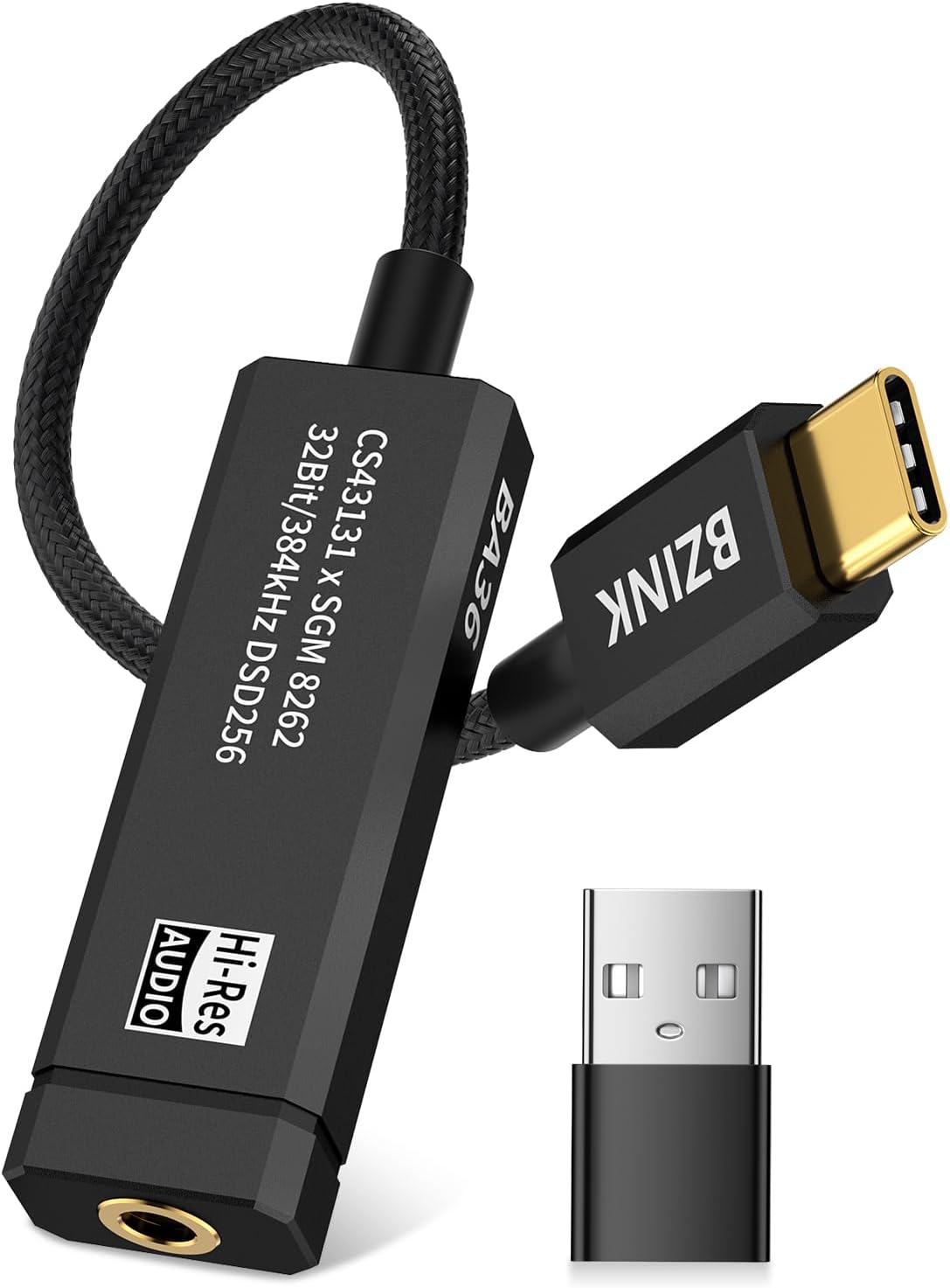
Pros
- Exceptional audio quality with professional-grade DAC chipset suitable for critical listening and studio work
- Impressive power output handles demanding headphones that many portable DACs cannot drive effectively
- Truly plug-and-play with zero software installation required across all compatible devices
- Excellent build quality using premium materials that justify the mid-range price point
- Strong customer satisfaction with 4.4-star rating and ranked #33 in headphone adapters category
Cons
- Limited to 3.5mm output only, incompatible with newer wireless or balanced XLR connections
- May require USB-C power delivery on some devices for optimal performance at maximum output levels
- Compact size could make the connector feel fragile during frequent travel use
The BZINK BA36 is a premium USB-C to 3.5mm digital audio converter designed for audiophiles, musicians, and mobile professionals who refuse to compromise on sound quality. This portable DAC adapter transforms any USB-C device into a high-fidelity audio source, making it essential for iPhone 15 users, Android enthusiasts, and laptop owners seeking lossless audio reproduction on the go.
What sets the BA36 apart is its dual-chip architecture combining CS43131 and SGM8262 processors, enabling Hi-Res audio decoding at 32bit/384kHz resolution. The 227mW output power at 32 ohms is genuinely impressive for a dongle-sized device, successfully driving high-impedance studio headphones and monitoring equipment without audible distortion. The measured specifications of >125dB signal-to-noise ratio and -110dB total harmonic distortion demonstrate genuine engineering excellence rather than marketing hyperbole.
Build quality reflects premium positioning with an aluminum alloy shell and silver-plated oxygen-free copper cabling. The compact, lightweight design makes it genuinely portable for daily commuting, travel, or studio sessions. The included USB-A adapter adds versatility for older devices, while the 20-month warranty and responsive customer support provide real peace of mind for this investment.
The primary limitation is the single 3.5mm output connection, which may feel restrictive for users preferring balanced audio or wireless connectivity. Additionally, some devices may require active USB-C power delivery to achieve maximum output levels, though most modern smartphones handle this automatically.
The BZINK BA36 represents outstanding value for serious listeners seeking portable Hi-Res audio without the premium pricing of boutique brands. Its combination of technical performance, build quality, and genuine usability makes it a compelling choice for anyone with a USB-C device and quality headphones.
Audio Performance: Hi-Res audio support up to 32bit/384kHz, dual CS43131 + SGM8262 DAC chipset, 227mW output at 32 ohms, impedance support 16Ω to 600Ω, signal-to-noise ratio >125dB, THD+N -110dB
Connectivity: USB Type-C input, 3.5mm stereo jack output, plug-and-play operation with no driver installation required
Compatibility: iPhone 15 series, Android smartphones and tablets, iPad, USB-C laptops and computers, universal across iOS and Android platforms
Physical: Aluminum alloy shell with metallic finish, silver-plated oxygen-free copper cable, lightweight and compact design, weight 37.65g
Package Contents: BA36 USB-C to 3.5mm adapter, USB-A adapter, 20-month limited warranty, 24-hour email support
Who Should Buy: This DAC is ideal for audiophiles with USB-C devices, music producers needing portable monitoring solutions, gamers seeking competitive audio advantages, and commuters who value lossless audio quality on mobile devices.
Who Should Skip: Users exclusively using older USB-A devices, those requiring wireless audio output, or listeners satisfied with standard smartphone audio quality may not justify the investment.
Key Considerations: Verify your headphones are 3.5mm compatible, ensure your USB-C device supports USB audio output (all modern iPhones and Android flagships do), and consider whether you need the included USB-A adapter for legacy device support.
Value Assessment: At this price point, the BA36 offers superior performance compared to basic adapters while remaining significantly more affordable than boutique audiophile DACs. The dual-chip architecture and measured audio specifications deliver genuine technical advantages that justify the investment for quality-conscious listeners.
How We Picked
Rankings here reflect published specifications and manufacturer product details rather than in-house measurements. We first sorted the adapters by host connector (USB-C for phones, tablets, and newer laptops; USB-A for desktops and consoles), then compared the figures each maker publishes: maximum sample rate, output power into a given load, supported headphone impedance, and signal-to-noise ratio. Makers measure these differently, so we treat them as rough guides rather than direct comparisons.
We also checked practical details that matter day to day: microphone and in-line remote support, notes about what does not work (such as Apple headphone remotes or high-impedance headphones), build materials, included adapters, and warranty terms.
The Picks at a Glance
Apple USB-C to 3.5mm Adapter
Apple’s adapter does one thing: it lets headphones or speakers with a standard 3.5mm plug connect to a USB-C device. Apple says it works with devices that have a USB-C connector and support iOS 10 or later. It suits iPhone and iPad owners who want a plain, first-party dongle. See the Apple USB-C to 3.5mm Adapter.
- Pros: First-party option for Apple USB-C devices.
- Pros: Simple, no setup described.
- Cons: No published sample rate, output power, or impedance figures.
- Cons: Product data says nothing about microphone or remote support.
Phoie USB-C to 3.5mm Adapter (2-Pack)
Phoie sells two USB-C dongles in one pack, so you can leave one in a bag and one at a desk. The listing gives 48,000 samples per second, a 92dBFS signal-to-noise ratio, call noise reduction, and in-line control for answering calls, pausing, and volume, though Apple EarPods volume control is not supported. Named devices include recent iPhone, Samsung Galaxy, and Google Pixel models. Each adapter measures 5 x 0.4 x 0.25 inches. Check the Phoie USB-C Audio Adapter 2-Pack.
- Pros: Two adapters in the pack.
- Pros: In-line call and playback controls supported.
- Cons: Lower 48kHz ceiling than most picks here.
- Cons: Warranty is listed both as lifetime and as 2 years.
Creative Sound Blaster Play! 3
Creative’s USB adapter (model SB1730) targets Windows PCs and Macs, with a maximum sample rate of 96kHz. It accepts headsets with either a single combined plug or split headphone and mic plugs, so no Y-splitter is needed, and it works without drivers. Optional control panel software adds audio enhancements and profiles for several earphone brands. It measures 5.43 x 0.87 x 0.37 inches and weighs 2.1 ounces. See the Sound Blaster Play! 3.
- Pros: Handles both single-plug and split-plug headsets.
- Pros: Companion software for tuning.
- Cons: Listing does not mention a USB-C plug, so phones and USB-C laptops may need an adapter.
- Cons: No output power or impedance range published.
UGREEN USB to 3.5mm Adapter (USB-A)
This UGREEN adapter adds a TRRS headset jack to a USB-A port, supporting both CTIA and OMTP headsets. Output reaches 24-bit/96kHz (the mic does not), and UGREEN lists a 95 dB signal-to-noise ratio. It has an aluminum alloy shell and a nylon braided cable rated for 10,000+ bends. Compatibility covers Windows, Linux, Raspberry Pi, Macs, PS5, PS4, Switch 2, and Chromebooks. It supports headphones under 50 ohms, not high-impedance models. View the UGREEN USB Audio Adapter.
- Pros: Broad console and computer compatibility.
- Pros: Braided cable with a published bend rating.
- Cons: Not for headphones at or above 50 ohms.
- Cons: No Apple headphone line control.
BZINK BA31 USB-C DAC
The BA31 uses CX31993 and MAX97220 chips and supports up to 32-bit/384kHz. BZINK lists 63mW at 32 ohms, a 16 to 600 ohm impedance range, 20Hz to 40kHz frequency response, and SNR above 115dB. The body is CNC-machined anodized aluminum, the cable uses silver-plated single-crystal copper rated for 15,000+ flexes, and a USB-A adapter is included, with a 20-month warranty. See the BZINK BA31 DAC Adapter.
- Pros: Works on USB-C or USB-A with the included adapter.
- Pros: Detailed published specs.
- Cons: Modest output power next to the BA36 and FiiO KA11.
- Cons: No mention of in-line remote support.
BZINK BA36 USB-C DAC Amplifier
BZINK’s BA36 steps up to dual CS43131 chips plus an SGM8262 and lists up to 227mW at 32 ohms, a 16 to 600 ohm range, SNR and DNR above 125dB, and 32-bit/384kHz decoding. It has an aluminum alloy shell, silver-plated oxygen-free copper cable, and a USB-A adapter in the box. It suits listeners with high-impedance over-ear headphones. View the BZINK BA36 DAC Amp.
- Pros: Highest output power listed at 32 ohms in this group.
- Pros: Includes a USB-A adapter.
- Cons: Warranty listed as 20 months in features but 1 year in the spec sheet.
- Cons: No microphone or remote support described.
MOSWAG USB to 3.5mm Adapter
MOSWAG’s USB-A adapter adds a TRRS headset jack with 16-bit/48kHz output and a listed 95 dB SNR. It supports CTIA and OMTP headsets but not TS or TRS microphones, and it lists Windows, Mac, Linux, Chromebook, Raspberry Pi, PS4, and PS5. It has an aluminum shell and nylon braided cable. MOSWAG warns that left and right channels may be reversed on iOS and PS4. See the MOSWAG USB Audio Adapter.
- Pros: Simple headset jack for PCs and consoles.
- Pros: Aluminum shell and braided cable.
- Cons: Lowest listed resolution here.
- Cons: Possible left and right channel reversal on some platforms.
UGREEN USB-C Audio Adapter with 60W Charging
This UGREEN model solves the single-port problem: it pairs a 3.5mm jack with a USB-C port for PD charging up to 60W, supporting PD, QC, AFC, and PPS, so you can listen while charging. Data transfer is not supported. The DAC supports up to 32-bit/384kHz, and the cable is braided nylon with a magnetic connection and aluminum alloy case. UGREEN lists recent iPhone, Galaxy, and Pixel phones, iPads, MacBooks, and Steam Deck, but not Amazon Fire Max. Check the UGREEN USB-C Audio and Charging Adapter.
- Pros: Charge and listen from one USB-C port.
- Pros: Long named compatibility list.
- Cons: Larger than a single-function dongle.
- Cons: No Apple line control, and no output power published.
FiiO KA11
The FiiO KA11 is tiny, at about 1.7 x 0.4 x 0.4 inches and roughly 0.3 ounce, yet FiiO lists 245mW at 16 ohms and 200mW at 32 ohms from its CS43131 DAC and op-amp. Published figures include 32-bit/384kHz, SNR of 125dB, and THD+N under 0.0006%. A UAC1.0 mode, switched in the FiiO Control app, lets it work with Switch and PS5. FiiO offers it with a USB-C or Lightning connector. See the FiiO KA11 DAC.
- Pros: Strong listed output in a very small body.
- Pros: Console mode for Switch and PS5.
- Cons: Console mode needs the companion app to set up.
- Cons: No USB-A adapter mentioned in the listing.
What to Look For in a USB DAC Adapter
Start with the port
USB-C dongles fit phones, tablets, and recent laptops; USB-A adapters suit desktops and consoles. Some USB-C models ship with a USB-A adapter, which covers both. If your laptop already has a headphone jack but sounds noisy, our guide to audio adapters for laptops explains other fixes.
Match power to your headphones
Earbuds and most portable headphones need little power, so a basic dongle is enough. High-impedance studio and audiophile headphones need more drive; check the published impedance range and output power before buying, and skip any adapter whose listing excludes them.
Check mic and remote support
Gaming headsets and call earbuds use a four-pole TRRS plug. Look for TRRS, CTIA, or OMTP in the listing, and note any exclusions for Apple remotes. If you just need a cable from the adapter to speakers, our 3.5mm audio cables and short audio cables roundups help.
Do not overpay for sample rate
A 384kHz rating looks impressive, but most streamed music is delivered at far lower rates. Output power, low noise, and build quality usually matter more in daily use. Shoppers on a tight budget can compare our budget audio adapter picks.
Who Should Skip These
Skip a USB DAC if your headphones are wireless and you are happy with Bluetooth, or if your device’s built-in jack already sounds clean to you. Owners of large desktop headphones who listen mainly at a desk may be better served by a full-size desktop DAC and amplifier with its own power supply.
For the charging pass-through model, use a reputable, UL listed USB-C PD charger and an undamaged cable rated for the wattage, and unplug it if it becomes unusually hot.
Final Thoughts
For a simple phone fix, the Apple adapter or the Phoie 2-pack will do. PC and console players needing a headset mic should look at the UGREEN USB-A model, MOSWAG, or the Creative Sound Blaster Play! 3 for split-plug headsets. Owners of demanding headphones should choose the FiiO KA11 or BZINK BA36, while the BZINK BA31 sits between. If your phone has one port, the UGREEN charging model is the practical answer.
Frequently Asked Questions
Do USB DAC adapters need drivers?
Most picks here are described as plug and play with no drivers. The FiiO KA11 needs its app only to enable UAC1.0 mode for consoles, and the Creative software is optional.
Will my headset microphone work?
With TRRS adapters such as the UGREEN USB-A model and MOSWAG, yes, provided your headset uses a four-pole plug. The Creative Play! 3 also handles split mic plugs.
Can I charge my phone while using one?
Only with the UGREEN 60W charging model, which adds a USB-C PD port. The others occupy your only port.




Write Your Review
No reviews yet. Be the first to share your experience!