

You’ve assembled a great TV and speakers, but your home theater feels flat. The sound lacks depth, and switching between your game console, streaming box, and turntable is a mess of cables and remote controls. The missing link is often the central brain of the system: the AV receiver.
This guide is for anyone ready to elevate their entertainment setup without overspending. We’ve evaluated the leading options to bring you three of the most capable AV receivers available today. Each offers a distinct blend of power, features, and connectivity to transform your living room into a true cinematic escape.
Pros
- Exceptionally slim design at just 4 inches tall, saving valuable rack or cabinet space compared to traditional receivers
- Comprehensive 4K HDR video support including Dolby Vision and eARC ensures future-proof compatibility with modern TVs
- HEOS multi-room audio ecosystem allows seamless whole-home streaming from Spotify, TuneIn, Netflix, and more
- Triple voice assistant compatibility with Alexa, Google Assistant, and Siri offers maximum smart home flexibility
- Built-in MM phono preamp is a rare and welcome addition for vinyl enthusiasts at this price point
Cons
- At 50 watts per channel, power output may fall short for larger rooms or those wanting to drive demanding floor-standing speakers
- The 5.2 channel configuration limits expansion for users who want to move toward Dolby Atmos height channel setups in the future
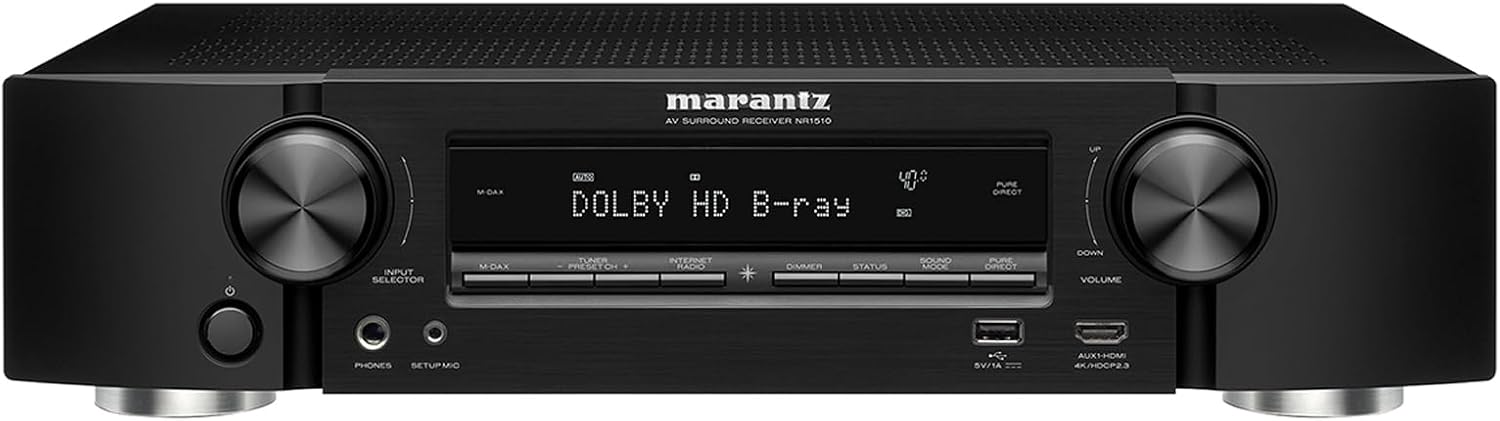
The Marantz NR1510 is a 5.2 channel AV receiver designed for home theater enthusiasts who demand high-fidelity audio and 4K video performance without the bulk of a traditional full-size unit. At just 4 inches tall, it is purpose-built for living rooms, media consoles, and AV cabinets where space is at a premium. It suits both first-time home theater builders and experienced audiophiles looking to downsize their setup.
On the performance side, the NR1510 delivers Dolby TrueHD and DTS-HD Master Audio decoding, ensuring lossless surround sound from Blu-ray discs and streaming sources. The six HDMI inputs, including a convenient front-panel port, support 4K at 60Hz, Dolby Vision, HLG, HDR10, and eARC, making it fully compatible with the latest televisions and source devices. The built-in HEOS platform adds robust multi-room audio capability, letting you stream music throughout your home from services like Spotify and TuneIn.
The slim chassis is impressively well-built for its size, maintaining the premium Marantz aesthetic with a clean front panel and solid construction. The included setup assistant with a graphical user interface makes initial configuration straightforward, even for users new to AV receivers. The inclusion of a MM phono preamp is a standout design decision that adds real everyday value for vinyl lovers.
The primary drawback is the 50 watts per channel output, which is adequate for average-sized rooms but may struggle in larger spaces or with power-hungry speaker systems. Additionally, the 5.2 channel limit means users planning a future Dolby Atmos upgrade will need to look at higher-tier models. Those seeking more power or overhead speaker support should factor this into their decision.
Overall, the Marantz NR1510 is a compelling and well-rounded AV receiver that excels in compact installations. Its combination of 4K HDR passthrough, lossless audio decoding, multi-room streaming, voice control, and a built-in phono stage makes it one of the most feature-rich slim receivers available. For anyone building a space-conscious home theater, it is a highly recommended choice.
Channels: 5.2 Channel Surround Sound Configuration with 50 watts per channel output power, suitable for standard home theater speaker setups.
Video: Full 4K Ultra HD at 60Hz with support for Dolby Vision, HDR10, HLG, BT.2020 color space, and eARC for enhanced audio return from compatible TVs.
Connectivity: 6 HDMI inputs (including 1 front-panel) and 1 HDMI output with full HDCP 2.2 support. Additional connectivity includes USB, Bluetooth, Wi-Fi, and a built-in MM phono preamp for turntables.
Streaming and Smart Home: Built-in HEOS multi-room audio, compatible with Spotify, TuneIn, and Netflix. Supports Amazon Alexa, Google Assistant, and Apple Siri voice control. Integrates with Josh and Control4 smart home systems.
Dimensions and Warranty: 14.5 inches deep, 17.3 inches wide, and 4.1 inches tall, weighing approximately 18 lbs. Backed by a 3-year manufacturer warranty. Model number NR1510, ASIN B07PVS35R6.
If you are considering the Marantz NR1510, the first question to ask is whether a 5.2 channel configuration meets your needs. This setup supports a front left, center, front right, and two surround speakers plus a subwoofer, which is ideal for most living rooms and dedicated media spaces. If you are planning a Dolby Atmos setup with height channels, you will need to step up to a 7.2 or 9.2 channel receiver.
Room size matters when evaluating the 50-watt-per-channel output. For rooms up to around 300 square feet with standard efficiency speakers, the NR1510 performs confidently. For larger spaces or speakers with low sensitivity ratings, consider whether additional power headroom would be beneficial before purchasing.
The slim form factor is a genuine advantage if your TV stand or AV cabinet has limited vertical clearance. At just over 4 inches tall, it fits where most traditional receivers cannot, making it especially popular for modern low-profile furniture setups. Pair it with HEOS-compatible speakers to unlock the full multi-room audio potential and get the most value from your investment.

Pros
- Exceptional power delivery compared to competitors in its price range, with 200W total power supply
- Next-generation HDMI connectivity supports 8K resolution and high frame rate gaming up to 120Hz
- Comprehensive streaming service support includes Spotify, Tidal, Amazon Music HD, and more
- Easy banana plug speaker connections and included calibration microphone simplify installation
- Flexible speaker configuration supports 5.1.2 Atmos or traditional 7.2 setups based on your needs
Cons
- Online-only manual makes troubleshooting difficult if you need quick reference without internet access
- Room correction occasionally defaults speakers to 'large' setting, requiring manual adjustment
- Requires a powered subwoofer for optimal performance, adding additional cost to your setup
The Yamaha RX-V6A is a 7.2-channel AV receiver engineered for home theater enthusiasts and gamers who demand powerful amplification without premium pricing. This mid-range receiver combines modern connectivity with robust audio performance, making it suitable for anyone building or upgrading a surround sound system with streaming capabilities and next-generation console support.
The standout feature is its impressive 100-watt-per-channel output, delivering noticeably more power than comparably priced competitors. Users report that when paired with a quality powered subwoofer, the V6A fills living rooms with dynamic, clear sound that handles both dialogue-heavy movies and action sequences with ease. The receiver supports Dolby Atmos and DTS:X surround formats, enabling height virtualization and immersive audio positioning that elevates your viewing experience significantly.
Design and connectivity are well-executed for the price point. The receiver features seven HDMI inputs supporting 8K/60Hz and 4K/120Hz passthrough, future-proofing your setup for upcoming gaming consoles and streaming content. The MusicCast ecosystem enables multi-room audio streaming, while built-in support for Alexa, Google Assistant, and Siri provides convenient voice control. The included YPAO room calibration microphone automatically optimizes speaker distances and levels, though some users report needing minor manual adjustments afterward.
Primary drawbacks include an online-only manual that complicates troubleshooting, and the requirement for a powered subwoofer to achieve the receiver's full potential. Additionally, the interface complexity may challenge users unfamiliar with AV receiver setup, though extensive customization options appeal to experienced enthusiasts willing to invest time in configuration.
The Yamaha RX-V6A delivers excellent value for budget-conscious home theater builders seeking powerful amplification, modern HDMI standards, and streaming flexibility. Its performance exceeds expectations at its price point, making it a solid choice for anyone prioritizing sound quality and future-ready connectivity over premium aesthetics or cutting-edge processing features.
Audio Performance: 7.2 channels, 100 watts per channel, 200 watts total power supply, Dolby Atmos with height virtualization, DTS:X surround sound
HDMI Connectivity: 7 HDMI inputs with 1 eARC output, HDMI 2.1 with HDCP 2.3, supports 8K/60Hz, 4K/120Hz, Dolby Vision, and HDR10+
Wireless & Streaming: Wi-Fi, Bluetooth (SBC/AAC), AirPlay 2, MusicCast multi-room, supports Spotify, Tidal, Amazon Music HD, Pandora, SiriusXM, Napster, Deezer, and Qobuz
Voice Control: Compatible with Amazon Alexa, Google Assistant, and Apple Siri via AirPlay 2
Room Calibration: YPAO R.S.C. multipoint automatic calibration with included microphone
Physical: 17.3 inches wide by 14.9 inches deep by 6.25 inches tall, 4.5 kg weight, black finish, includes remote controller and AM/FM antenna
Warranty: 3-year manufacturer warranty
Who Should Buy This Receiver: The RX-V6A suits home theater builders seeking powerful amplification and modern streaming features without paying premium prices. It's ideal for gamers upgrading to next-generation consoles, cord-cutters streaming multiple services, and anyone wanting multi-room audio capability. Best suited for those comfortable with configuration and willing to invest in a quality powered subwoofer.
Who Should Look Elsewhere: If you prefer plug-and-play simplicity with minimal setup, consider receivers with simpler interfaces. Those needing 4K/120Hz gaming without any compromises might explore newer flagship models. Budget-conscious buyers unwilling to purchase a separate subwoofer should evaluate 5.1-channel alternatives that perform adequately without one.
Setup Considerations: Plan to spend time configuring the receiver's extensive settings using the online manual. Budget for a quality powered subwoofer, as the V6A's 7.2 configuration requires one for optimal bass response. Ensure adequate ventilation around the receiver and use banana plugs for speaker connections to simplify wiring. Allow 30-60 minutes for YPAO calibration and manual fine-tuning of speaker levels.
Competitive Comparison: The RX-V6A offers superior power delivery compared to entry-level competitors while maintaining affordability. It trades some processing features found in flagship models for practical amplification and connectivity. Users upgrading from older Onkyo or Denon receivers consistently report improved sound quality and reliability at a lower price point.

Pros
- Outstanding audio quality with crisp, clear surround sound that significantly improves over older receivers
- Comprehensive streaming ecosystem including Spotify, Apple AirPlay, Chromecast, and Sonos compatibility
- Advanced calibration technology delivers professional-grade sound setup without expert installation
- Robust 8K/4K video support with HDMI 2.1 ensures compatibility with current and future content standards
- Reliable Sony build quality with proven track record of long-term durability
Cons
- Zone 2 setup can be confusing for users unfamiliar with multi-zone receiver configurations
- 165 watts per channel may require quality speakers to fully realize the receiver's audio capabilities
- Setup and speaker wiring requires some technical knowledge despite the graphical interface guide
The Sony STR-AN1000 is a premium 7.2-channel A/V receiver designed for home theater enthusiasts who demand both cutting-edge video performance and immersive surround sound. This unit targets users upgrading from older receivers to 4K and 8K systems, particularly those seeking Dolby Atmos and object-based audio without the complexity of professional installation.
The standout feature is the integration of Dolby Atmos, DTS:X, and Sony's proprietary 360 Spatial Sound Mapping, which creates a genuinely immersive audio experience. Users consistently praise the crisp, clear sound quality and the dramatic improvement over previous-generation receivers. The Digital Cinema Auto Calibration IX automatically optimizes speaker settings, eliminating guesswork from setup. With 6 HDMI inputs supporting 8K and HDMI 2.1, the receiver future-proofs your system against upcoming content standards.
Build quality reflects Sony's reputation for reliability, with a solid construction that weighs 16 ounces and measures 16.93 inches wide. The receiver integrates seamlessly into modern smart homes through Chromecast Built-in, Apple AirPlay, Spotify Connect, and Works With Sonos, allowing flexible streaming from multiple devices. Google Assistant voice control adds convenience for hands-free operation and system management.
The main drawback is that multi-zone configuration (Zone 2 and Zone 3) can confuse first-time users, and the 165-watt output requires quality speakers to truly shine. Additionally, initial setup and speaker wiring demands some technical familiarity despite the helpful graphical interface.
Overall, the Sony STR-AN1000 delivers exceptional value for home theater enthusiasts seeking a reliable receiver with modern streaming capabilities, professional audio calibration, and future-ready 8K support. It's an excellent choice for upgrading existing systems or building new ones from scratch.
Audio Output: 7.2-channel configuration, 165 watts per channel at 6 ohms, 1 kHz, 0.9% THD
Video Connectivity: 6 HDMI inputs, 2 HDMI outputs, HDMI 2.1 support for 8K and 4K/120Hz passthrough. Supports H.264 and H.265/HEVC video encoding
Audio Formats: Dolby Atmos, DTS:X, Dolby Digital, DTS-ES, and other standard surround formats. Supports Dolby Vision, HDR10, Hybrid Log Gamma, and IMAX Enhanced video formats
Streaming Technologies: Bluetooth, Wi-Fi, Chromecast Built-in, Apple AirPlay, Spotify Connect, Works With Sonos
Control: Google Assistant voice control, graphical setup interface, remote included
Additional Features: Digital Cinema Auto Calibration IX, 360 Spatial Sound Mapping, Zone 2 and Zone 3 multi-room capability, Ethernet and USB connectivity
Power Requirements: 120V 60Hz, 240W consumption. Dimensions: 16.93 inches W x 13.03 inches D x 6.14 inches H. Warranty: 1 year manufacturer coverage
Who Should Buy: Home theater enthusiasts upgrading to 4K or 8K systems, users seeking immersive Dolby Atmos audio, those wanting seamless multi-room streaming, and anyone prioritizing Sony reliability and support
Who Should Consider Alternatives: Budget-conscious buyers seeking basic surround sound without 8K support, users needing simpler setup without multi-zone configuration, or those preferring different brand ecosystems
Setup Considerations: Ensure you have quality speakers to maximize the 165-watt output. Allow time to understand Zone 2 and Zone 3 configurations if planning multi-room audio. The graphical setup interface helps, but some technical familiarity is beneficial for optimal speaker calibration
Integration Tips: Leverage Works With Sonos if you have existing Sonos speakers. Use Chromecast Built-in for easy streaming from Android devices, Apple AirPlay for iOS integration, and Spotify Connect for music streaming. Google Assistant integration allows voice control of receiver functions and connected smart home devices
Long-Term Value: The 8K support and HDMI 2.1 connectivity ensure compatibility with future content standards. Sony's track record for receiver durability means this unit should provide reliable performance for many years, making it a solid investment for serious home theater setups
Buying Guide: What to Look For
Audio Format and Channel Support
The audio decoding capabilities define your immersive experience. Look for support for object-based formats like Dolby Atmos and DTS:X. These create a three-dimensional soundscape with overhead effects.
Channel configuration is equally important. A 5.2 channel receiver supports a traditional surround setup, while 7.2 channels allow for more speaker placement, crucial for a larger room. Consider your current and future speaker plans. For the ultimate immersive movie experience, Atmos support is a key differentiator.
Video Connectivity and Future-Proofing
Your receiver must handle the latest video signals from your sources. HDMI 2.1 support is essential for high-frame-rate 4K and 8K content, especially important for next-gen gaming consoles. Check for sufficient inputs for all your devices.
Also, confirm support for HDR formats like Dolby Vision, HDR10, and HLG. These technologies ensure you see the full color and contrast range intended by filmmakers. This future-proofing is vital for both gamers and movie enthusiasts.
Wireless Features and Multi-Room Audio
<!–Modern receivers are connectivity hubs. Built-in Wi-Fi and Bluetooth allow for easy music streaming from your phone. Support for streaming protocols like AirPlay 2, Chromecast, and Spotify Connect offers more flexibility.
Multi-room audio systems, such as Yamaha’s MusicCast or the HEOS platform found in Marantz receivers, let you expand sound throughout your home. You can play music in sync across different rooms or choose different songs for each space. This transforms the receiver from a home theater component into a whole-home audio solution, perfect for those who love whole-home music.
Room Calibration and Ease of Use
Every room acoustically shapes sound. A good auto-calibration system uses a provided microphone to analyze your room’s size, speaker distances, and acoustic properties. It then automatically adjusts settings for optimal sound.
Look for systems like YPAO (Yamaha), Audyssey, or Sony’s Digital Cinema Calibration. A user-friendly on-screen setup guide is also invaluable, making what can be a complex process much more manageable for everyone. Exploring our broader AV receivers category can provide more context on these technologies.
Final Thoughts
Your choice ultimately depends on your specific needs and room setup. For those with space constraints or a focus on elegant, high-fidelity audio in a compact system, the Marantz NR1510 UHD AV Receiver is a superb choice. If you desire cutting-edge video support for 8K and high-frame-rate gaming alongside robust multi-room features, the YAMAHA RX-V6A 7.2-Channel AV Receiver represents excellent value and future-ready performance. Whichever path you choose, you’re investing in the heart of a truly captivating home entertainment experience.
Frequently Asked Questions
What is the main difference between a 5.2 and a 7.2 channel AV receiver?
A 5.2 channel receiver can power five main speakers (front left/right, center, surround left/right) and two subwoofers. A 7.2 channel receiver adds two additional channels, typically for rear surround or front height speakers, creating a more enveloping sound field. This is especially beneficial for larger rooms or for achieving more precise Dolby Atmos or DTS:X effects.
Do I need an AV receiver if I just bought a soundbar?
Typically, no. A soundbar is an all-in-one audio solution designed for simplicity and space saving. An AV receiver is a separate component designed to connect and power multiple, individual speakers for a more customizable and powerful surround sound system. If you’re looking for a simpler upgrade, you might explore dedicated soundbars instead.
How important is HDMI 2.1 for an AV receiver in 2026?
HDMI 2.1 is increasingly important, especially for gamers and early adopters of 8K TVs. It supports higher video resolutions (8K), higher refresh rates (4K at 120Hz), and features like Variable Refresh Rate (VRR) and Auto Low Latency Mode (ALLM). If you own a PlayStation 5, Xbox Series X, or a high-end PC, an HDMI 2.1 compatible receiver ensures you get the full performance from your gear.
Can I use any speakers with an AV receiver?
Most modern AV receivers are compatible with a wide range of passive speakers (speakers that require power from the receiver). The key is to match the receiver’s power output and impedance rating with the specifications of your speakers. It’s always a good practice to check compatibility, but receivers in this category are generally designed to work with popular bookshelf, floor-standing, and surround speaker models.




Write Your Review
No reviews yet. Be the first to share your experience!