

You’ve assembled a great TV and speakers, but your home theater feels flat. The sound lacks depth, and switching between your game console, streaming box, and turntable is a mess of cables and remote controls. The missing link is often the central brain of the system: the AV receiver.
This guide is for anyone ready to elevate their entertainment setup without overspending. We’ve evaluated the leading options to bring you three of the most capable AV receivers available today. Each offers a distinct blend of power, features, and connectivity to transform your living room into a true cinematic escape.
Pros
- Exceptionally slim design at just 4 inches tall, saving valuable rack or cabinet space compared to traditional receivers
- Comprehensive 4K HDR video support including Dolby Vision and eARC ensures future-proof compatibility with modern TVs
- HEOS multi-room audio ecosystem allows seamless whole-home streaming from Spotify, TuneIn, Netflix, and more
- Triple voice assistant compatibility with Alexa, Google Assistant, and Siri offers maximum smart home flexibility
- Built-in MM phono preamp is a rare and welcome addition for vinyl enthusiasts at this price point
Cons
- At 50 watts per channel, power output may fall short for larger rooms or those wanting to drive demanding floor-standing speakers
- The 5.2 channel configuration limits expansion for users who want to move toward Dolby Atmos height channel setups in the future
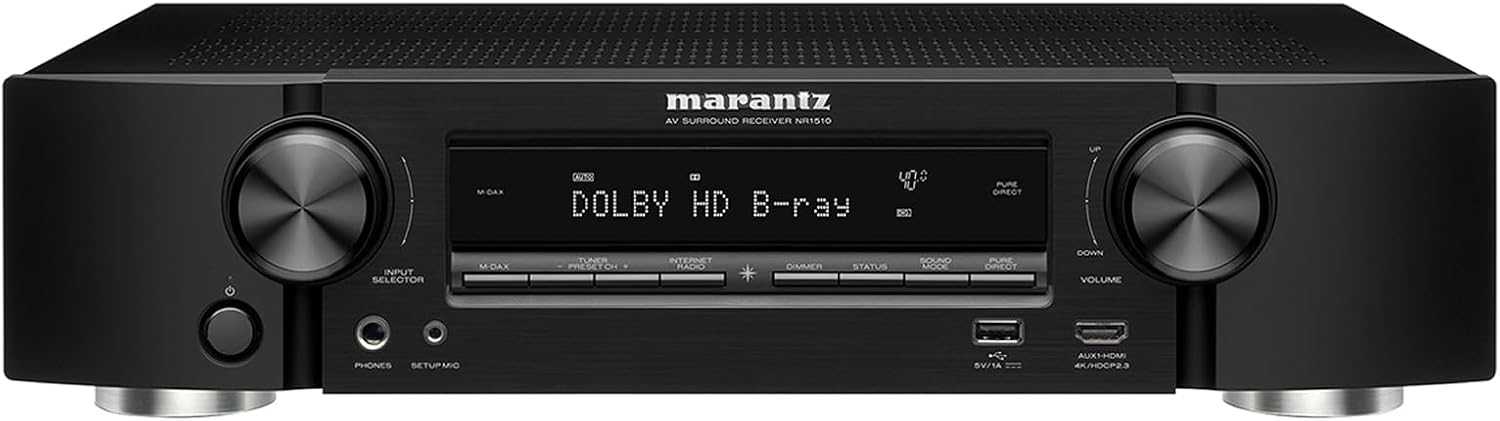
The Marantz NR1510 is a 5.2 channel AV receiver designed for home theater enthusiasts who demand high-fidelity audio and 4K video performance without the bulk of a traditional full-size unit. At just 4 inches tall, it is purpose-built for living rooms, media consoles, and AV cabinets where space is at a premium. It suits both first-time home theater builders and experienced audiophiles looking to downsize their setup.
On the performance side, the NR1510 delivers Dolby TrueHD and DTS-HD Master Audio decoding, ensuring lossless surround sound from Blu-ray discs and streaming sources. The six HDMI inputs, including a convenient front-panel port, support 4K at 60Hz, Dolby Vision, HLG, HDR10, and eARC, making it fully compatible with the latest televisions and source devices. The built-in HEOS platform adds robust multi-room audio capability, letting you stream music throughout your home from services like Spotify and TuneIn.
The slim chassis is impressively well-built for its size, maintaining the premium Marantz aesthetic with a clean front panel and solid construction. The included setup assistant with a graphical user interface makes initial configuration straightforward, even for users new to AV receivers. The inclusion of a MM phono preamp is a standout design decision that adds real everyday value for vinyl lovers.
The primary drawback is the 50 watts per channel output, which is adequate for average-sized rooms but may struggle in larger spaces or with power-hungry speaker systems. Additionally, the 5.2 channel limit means users planning a future Dolby Atmos upgrade will need to look at higher-tier models. Those seeking more power or overhead speaker support should factor this into their decision.
Overall, the Marantz NR1510 is a compelling and well-rounded AV receiver that excels in compact installations. Its combination of 4K HDR passthrough, lossless audio decoding, multi-room streaming, voice control, and a built-in phono stage makes it one of the most feature-rich slim receivers available. For anyone building a space-conscious home theater, it is a highly recommended choice.
Channels: 5.2 Channel Surround Sound Configuration with 50 watts per channel output power, suitable for standard home theater speaker setups.
Video: Full 4K Ultra HD at 60Hz with support for Dolby Vision, HDR10, HLG, BT.2020 color space, and eARC for enhanced audio return from compatible TVs.
Connectivity: 6 HDMI inputs (including 1 front-panel) and 1 HDMI output with full HDCP 2.2 support. Additional connectivity includes USB, Bluetooth, Wi-Fi, and a built-in MM phono preamp for turntables.
Streaming and Smart Home: Built-in HEOS multi-room audio, compatible with Spotify, TuneIn, and Netflix. Supports Amazon Alexa, Google Assistant, and Apple Siri voice control. Integrates with Josh and Control4 smart home systems.
Dimensions and Warranty: 14.5 inches deep, 17.3 inches wide, and 4.1 inches tall, weighing approximately 18 lbs. Backed by a 3-year manufacturer warranty. Model number NR1510, ASIN B07PVS35R6.
If you are considering the Marantz NR1510, the first question to ask is whether a 5.2 channel configuration meets your needs. This setup supports a front left, center, front right, and two surround speakers plus a subwoofer, which is ideal for most living rooms and dedicated media spaces. If you are planning a Dolby Atmos setup with height channels, you will need to step up to a 7.2 or 9.2 channel receiver.
Room size matters when evaluating the 50-watt-per-channel output. For rooms up to around 300 square feet with standard efficiency speakers, the NR1510 performs confidently. For larger spaces or speakers with low sensitivity ratings, consider whether additional power headroom would be beneficial before purchasing.
The slim form factor is a genuine advantage if your TV stand or AV cabinet has limited vertical clearance. At just over 4 inches tall, it fits where most traditional receivers cannot, making it especially popular for modern low-profile furniture setups. Pair it with HEOS-compatible speakers to unlock the full multi-room audio potential and get the most value from your investment.
Buying Guide: What to Look For
Audio Format and Channel Support
The audio decoding capabilities define your immersive experience. Look for support for object-based formats like Dolby Atmos and DTS:X. These create a three-dimensional soundscape with overhead effects.
Channel configuration is equally important. A 5.2 channel receiver supports a traditional surround setup, while 7.2 channels allow for more speaker placement, crucial for a larger room. Consider your current and future speaker plans. For the ultimate immersive movie experience, Atmos support is a key differentiator.
Video Connectivity and Future-Proofing
Your receiver must handle the latest video signals from your sources. HDMI 2.1 support is essential for high-frame-rate 4K and 8K content, especially important for next-gen gaming consoles. Check for sufficient inputs for all your devices.
Also, confirm support for HDR formats like Dolby Vision, HDR10, and HLG. These technologies ensure you see the full color and contrast range intended by filmmakers. This future-proofing is vital for both gamers and movie enthusiasts.
Wireless Features and Multi-Room Audio
<!–Modern receivers are connectivity hubs. Built-in Wi-Fi and Bluetooth allow for easy music streaming from your phone. Support for streaming protocols like AirPlay 2, Chromecast, and Spotify Connect offers more flexibility.
Multi-room audio systems, such as Yamaha’s MusicCast or the HEOS platform found in Marantz receivers, let you expand sound throughout your home. You can play music in sync across different rooms or choose different songs for each space. This transforms the receiver from a home theater component into a whole-home audio solution, perfect for those who love whole-home music.
Room Calibration and Ease of Use
Every room acoustically shapes sound. A good auto-calibration system uses a provided microphone to analyze your room’s size, speaker distances, and acoustic properties. It then automatically adjusts settings for optimal sound.
Look for systems like YPAO (Yamaha), Audyssey, or Sony’s Digital Cinema Calibration. A user-friendly on-screen setup guide is also invaluable, making what can be a complex process much more manageable for everyone. Exploring our broader AV receivers category can provide more context on these technologies.
Final Thoughts
Your choice ultimately depends on your specific needs and room setup. For those with space constraints or a focus on elegant, high-fidelity audio in a compact system, the Marantz NR1510 UHD AV Receiver is a superb choice. If you desire cutting-edge video support for 8K and high-frame-rate gaming alongside robust multi-room features, the YAMAHA RX-V6A 7.2-Channel AV Receiver represents excellent value and future-ready performance. Whichever path you choose, you’re investing in the heart of a truly captivating home entertainment experience.
Frequently Asked Questions
What is the main difference between a 5.2 and a 7.2 channel AV receiver?
A 5.2 channel receiver can power five main speakers (front left/right, center, surround left/right) and two subwoofers. A 7.2 channel receiver adds two additional channels, typically for rear surround or front height speakers, creating a more enveloping sound field. This is especially beneficial for larger rooms or for achieving more precise Dolby Atmos or DTS:X effects.
Do I need an AV receiver if I just bought a soundbar?
Typically, no. A soundbar is an all-in-one audio solution designed for simplicity and space saving. An AV receiver is a separate component designed to connect and power multiple, individual speakers for a more customizable and powerful surround sound system. If you’re looking for a simpler upgrade, you might explore dedicated soundbars instead.
How important is HDMI 2.1 for an AV receiver in 2026?
HDMI 2.1 is increasingly important, especially for gamers and early adopters of 8K TVs. It supports higher video resolutions (8K), higher refresh rates (4K at 120Hz), and features like Variable Refresh Rate (VRR) and Auto Low Latency Mode (ALLM). If you own a PlayStation 5, Xbox Series X, or a high-end PC, an HDMI 2.1 compatible receiver ensures you get the full performance from your gear.
Can I use any speakers with an AV receiver?
Most modern AV receivers are compatible with a wide range of passive speakers (speakers that require power from the receiver). The key is to match the receiver’s power output and impedance rating with the specifications of your speakers. It’s always a good practice to check compatibility, but receivers in this category are generally designed to work with popular bookshelf, floor-standing, and surround speaker models.



Write Your Review
No reviews yet. Be the first to share your experience!