

Choosing the right amplifier is the cornerstone of any great audio system. Whether you’re powering a pair of bookshelf speakers for intimate listening or driving a full PA setup for a live event, a 2-channel amplifier provides the essential link between your source and your sound. The wrong choice can lead to weak performance, distortion, or a complete mismatch for your needs.
This guide is crafted for music enthusiasts, DJs, and home audio builders who want clear, powerful, and reliable amplification. We have assessed six leading models across different applications, from compact Class D amps to robust professional rack units. Our goal is to help you cut through the specifications and find the amplifier that fits your specific scenario. For a broader look at amplification technology, explore our category page for Amplifiers.
Pros
- Excellent sound clarity with balanced highs, mids, and bass across all input sources
- Phono input eliminates the need for a separate turntable preamp, saving money and desk space
- Bluetooth connection is quick to pair and remains stable during extended listening sessions
- Compact low-profile design fits standard AV furniture without any awkward modifications
- Highly rated by a large number of verified buyers, reflecting consistent real-world reliability
Cons
- Maximum volume output may feel limited for larger rooms or listeners who prefer concert-level loudness
- 2-channel stereo only, so it is not suitable for home theater surround sound setups
- No digital optical or coaxial inputs, which may frustrate users wanting to connect modern TVs or DACs directly
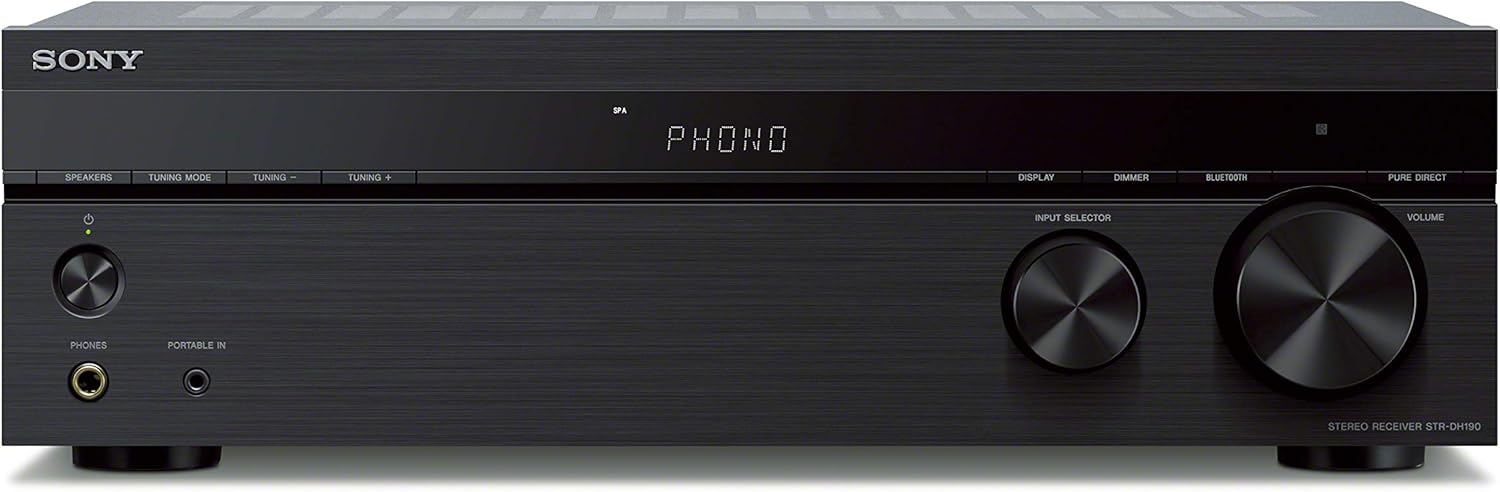
The Sony STRDH190 is a 2-channel home stereo receiver designed for music lovers who want a clean, capable hub for multiple audio sources. Whether you are spinning vinyl, streaming from a phone, or tuning into FM radio, this receiver handles it all in one compact unit. It is particularly well suited to first-time stereo system builders and returning audiophiles who value simplicity over complexity.
Sound performance is the STRDH190's strongest suit. With 100 watts per channel and Sony's large-capacity power transformer, the receiver delivers a composed, detailed soundstage with crisp highs and solid bass. Customer feedback consistently praises its clarity at moderate to high volumes, and High-Resolution Audio support means the unit can resolve fine details that compressed streaming formats often obscure.
The feature set is thoughtfully chosen for its target audience. The built-in phono preamp is a genuine convenience for turntable users, while Bluetooth pairing is described by owners as fast and reliable. The A/B speaker switching is a practical bonus, allowing two pairs of speakers to run simultaneously or independently for multi-room flexibility. A full-size headphone jack and 30-preset FM tuner round out the everyday usability.
On the design side, the STRDH190's low-profile chassis at just over 5 inches tall is a real-world advantage for anyone working with a standard AV cabinet. Build quality feels solid for the price point, and the included remote adds a layer of convenience that budget receivers often skip. The unit weighs 17 pounds, which speaks to the substantial internal components rather than hollow construction.
The main limitations are its 2-channel-only configuration, which rules it out for surround sound duties, and a lack of digital inputs for users wanting to connect a TV or external DAC. Volume headroom in very large rooms can also feel modest. That said, for a stereo-focused listener who values vinyl, Bluetooth, and clean audio in one tidy package, the STRDH190 is a genuinely impressive and well-rounded receiver.
Model: Sony STRDH190 | Color: Black | Channels: 2 (Stereo) | Output Power: 100W x 2 (8 ohms, 1 kHz) | Total Wattage: 200W
Speaker Impedance: 6 to 16 ohms | Inputs: Phono input, 4x stereo RCA, 3.5mm aux | Outputs: Stereo RCA, A/B speaker terminals, 1/4-inch headphone jack
Wireless: Bluetooth (2.4 GHz, max output 5.0 dBm) | FM Tuner: 30 station presets | Audio Format: WMA, High-Resolution Audio
Dimensions: 11"D x 17"W x 5.2"H | Weight: 17.1 lbs | Power: AC 120V, 60 Hz | Warranty: 1 year limited
In the Box: Receiver, remote control (RMT-AA400U), batteries, FM antenna | ASIN: B078WFDR8D | UPC: 027242908383
If you are shopping for your first stereo receiver, the STRDH190 is one of the most complete entry-level options available. It covers all the essential bases: Bluetooth streaming, FM radio, a phono stage for turntables, and enough inputs for a CD player, TV audio output, and more. You will not need to buy a separate phono preamp, which keeps your total system cost down.
Pairing advice: this receiver works best with bookshelf or floor-standing speakers rated between 6 and 16 ohms. Popular matches noted by owners include Yamaha bookshelf speakers and classic Bose 301s. For turntable users, Sony's own PS-LX310BT is a frequently recommended companion that integrates seamlessly with the STRDH190's phono input.
Consider your room size before purchasing. The 100-watt-per-channel rating is more than adequate for small to medium rooms, but listeners in large open-plan spaces who prefer very high volume levels may eventually want to step up to a higher-powered model. For most living rooms and dedicated listening spaces, however, the power on offer is genuinely sufficient.
This receiver is not the right choice if you need surround sound for a home theater setup, or if you want to connect a modern TV via optical or coaxial digital audio. For those use cases, a dedicated AV receiver would be a better fit. But as a pure stereo music receiver with broad source compatibility, the STRDH190 is hard to beat at its price point.
How to Choose Your 2-Channel Amplifier
Power Output and Speaker Compatibility
Matching your amplifier’s power output to your speakers is critical. You need enough clean power to drive your speakers to your desired volume without clipping or causing damage. Check the amplifier’s RMS wattage per channel at specific impedance levels, like 4 or 8 ohms, and compare it to your speakers’ power handling.
A professional model like the Crown XLi800 Two-channel offers high continuous power for demanding live sound, while a home receiver like the Sony STRDH190 provides ample power for bookshelf speakers. Underpowering can be as problematic as overpowering, so aim for a good match. Understanding these specs is key, similar to selecting from the best solid state amplifiers.
Intended Use and Features
Your primary use case dictates the necessary features. For a simple desktop or patio setup, a compact amplifier with Bluetooth, like the Fosi Audio BT20A, offers incredible convenience and saves space. For a dedicated hi-fi listening room, you might prioritize a receiver with a phono input for a turntable and multiple source connections.
DJs and installers should look for rack-mountable designs with robust cooling, professional inputs like XLR and SpeakON, and bridgeable modes for mono subwoofer use, features found in the Rockville RPA5. Consider if you need tone controls, a built-in DAC, or zone switching. Modern needs often include wireless streaming, a feature highlighted in our guide to the best amplifiers with streaming.
Amplifier Class and Sound Quality
Amplifier class (A, AB, D, etc.) influences efficiency, heat generation, and sonic character. Class AB amplifiers, common in many receivers, are known for a warm, traditional sound but generate more heat. Class D amplifiers, like the Fosi Audio BT20A Pro, are highly efficient, run cool, and are often very compact, making them ideal for space-constrained applications.
While Class D technology has advanced tremendously, some purists still prefer the linearity of Class A or AB designs for critical listening. The choice often comes down to a balance between power efficiency, physical size, and the specific sonic signature you prefer. You can delve deeper into this topic in our review of the best class D amplifier for 2026.
Connectivity and Build Quality
Examine the input and output options. Basic setups may only need RCA inputs, while pro audio gear requires balanced XLR or 1/4″ TRS connections to reduce noise. Speaker output options vary from simple binding posts to secure SpeakON connectors. Ensure the amplifier has the ports you need now and possibly for future upgrades.
Build quality directly impacts longevity and reliability. A home stereo receiver should have a sturdy chassis and a clean internal layout. Professional power amplifiers must have robust construction, effective cooling systems with quiet fans, and comprehensive protection circuits to handle tough touring or installation environments. This durability is a hallmark of well-designed audio components across our Home Audio recommendations.
Final Thoughts
Selecting the best 2-channel amplifier ultimately depends on aligning its capabilities with your audio ambitions. For those seeking professional-grade power and reliability in a live sound or installation context, the Crown XLi800 Two-channel stands as a proven workhorse. Conversely, if your priority is a feature-rich, compact solution for everyday home listening with modern conveniences like Bluetooth, the Fosi Audio BT20A Pro Bluetooth 5.0 Amplifier delivers impressive performance and flexibility. Whichever path you choose, a quality amplifier is an investment that unlocks the full potential of your speakers and source material.
Frequently Asked Questions
What is the main advantage of a 2-channel amplifier?
A 2-channel amplifier is designed to power two separate speakers or two sides of a stereo pair with dedicated amplification for each channel. This setup provides superior stereo imaging, separation, and often more power per channel compared to multi-channel AV receivers, making it ideal for pure music listening and professional audio applications.
Can I use a professional power amplifier for home audio?
Yes, you can. Professional amplifiers like the Crown XLi800 often offer exceptional power, robust build, and clean sound for the price. However, they may lack certain home-audio features like tone controls, multiple input switching, or a remote control. They can also have louder cooling fans, so placement might be a consideration for a quiet living room.
Do I need a receiver or just an amplifier?
An amplifier only increases the power of an audio signal to drive speakers. A receiver, like the Sony STRDH190 2-ch Home Stereo Receiver with Phono, includes an amplifier but also has a radio tuner, input selection for multiple sources (like a phono preamp for turntables), and often volume/tone controls. Choose an amplifier if you have a separate preamp or source selector; choose a receiver for an all-in-one solution.
How important is Bluetooth in an amplifier for 2026?
Bluetooth connectivity has become a highly valued feature for its convenience in streaming music from phones, tablets, and computers. It eliminates the need for physical cables. For casual listening and multi-purpose spaces, it’s a significant benefit. For critical, high-fidelity setups, audiophiles may still prefer a wired connection to avoid any potential compression, though modern Bluetooth codecs have greatly improved audio quality.





Write Your Review
No reviews yet. Be the first to share your experience!