

You’ve invested in a quality turntable and a collection of cherished records, but something feels missing. The sound lacks the warmth, detail, and punch you expected from your vinyl. Often, the bottleneck isn’t your speakers or cartridge, but the humble phono preamplifier. This crucial component amplifies your turntable’s faint signal and applies the precise RIAA equalization needed to hear your music as intended.
This guide is for vinyl enthusiasts seeking to unlock their system’s full potential without a prohibitive cost. We focus on two highly capable preamplifiers that deliver exceptional performance and modern features, all while staying within a sensible budget. For those considering even more economical options, our review of the best phono preamplifiers under $100 provides excellent alternatives.
Pros
- Exceptional connectivity options covering modern wireless and legacy analog sources in one device
- Low-noise microphone preamp makes this suitable for podcasting, streaming, and professional audio work
- 3-band EQ and subwoofer crossover provide real control over your sound signature
- Compact form factor with flexible mounting options fits any audio setup without taking up space
- aptX Lossless Bluetooth 5.3 ensures high-quality wireless audio streaming from compatible devices
Cons
- Limited information on app control or remote functionality for managing settings from a distance
- Rack-mountable design may feel overly industrial for casual home listening environments
- No built-in amplification, so you'll need separate powered speakers or an amplifier for audio output
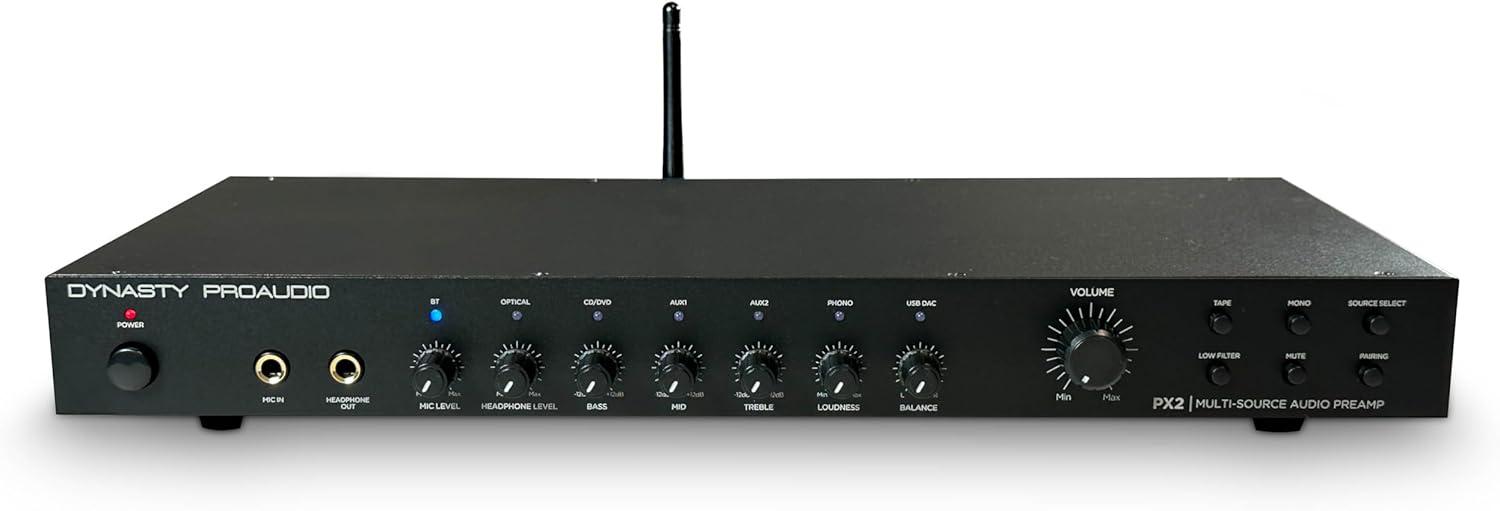
The Dynasty ProAudio PX2 is a professional-grade preamp designed for anyone seeking to consolidate multiple audio sources into a single, clean interface. Whether you're building a home hi-fi system, setting up a recording studio, or running a podcast setup, this preamp acts as the central hub for all your audio needs. Its combination of modern wireless connectivity and classic analog inputs makes it a bridge between legacy equipment and contemporary streaming devices.
What truly sets the PX2 apart is its commitment to audio fidelity without compromise. The optimized low-noise circuitry ensures that every source you connect delivers pristine sound with zero distortion and a wide frequency response. The 3-band EQ gives you control to shape the sound to your room and preferences, while the dedicated low-cut crossover lets you properly integrate a subwoofer for balanced bass response. The built-in RIAA phono preamp is a welcome addition for vinyl enthusiasts, eliminating the need for a separate turntable preamp.
Build quality reflects its professional heritage. The 1U rack-mountable chassis feels solid and purposeful, with removable feet that let you use it in a rack, on a shelf, or on a tabletop. Connectivity is comprehensive: four RCA line inputs, optical S/PDIF, USB DAC, Bluetooth 5.3 with aptX Lossless support, and even a front-panel 1/4-inch mic input with its own low-noise preamp. The four-output configuration including headphone and subwoofer outputs provides flexibility for complex audio routing.
The main limitation is that this is a preamp only, meaning you'll need powered speakers or a separate amplifier to actually hear anything. Additionally, while the feature set is extensive, there's minimal information about remote control capabilities, so physical adjustment of the 3-band EQ may be necessary. For the price, these are minor tradeoffs given the professional functionality on offer.
The Dynasty ProAudio PX2 delivers exceptional value for home audio enthusiasts and professionals alike. If you need a reliable, feature-rich preamp that handles everything from vinyl to Bluetooth with equal grace, this is a solid choice that won't break the bank.
Connectivity: Bluetooth 5.3 with aptX Lossless, USB DAC (PCM stereo), 4x RCA line inputs, 1x RCA phono input with RIAA preamp, 1x S/PDIF optical input, 1/4-inch front-panel mic/line input, 1/4-inch stereo headphone output
Audio Processing: 3-band EQ, low-cut crossover for subwoofer integration, low-noise microphone preamp, optimized low-noise circuitry
Outputs: Full-range stereo RCA, crossover RCA, subwoofer mono RCA, 1/4-inch stereo headphone jack
Physical Design: 1U rack-mountable chassis with removable feet, compact form factor suitable for racks, tables, or shelves
Frequency Response: Wide frequency response with zero distortion and ultra-low noise floor
Who Should Buy This: The PX2 is ideal for home audio enthusiasts wanting to consolidate multiple sources, vinyl collectors, podcasters and content creators, professional audio engineers, and anyone upgrading from basic receiver preamps to dedicated preamp control.
Consider This If: You need a preamp that bridges old and new audio sources without sacrificing sound quality. You value flexibility in routing and output options. You want professional-grade features at a consumer-friendly price. You have both wireless and wired audio sources that need to coexist in one system.
Skip This If: You only need basic preamp functionality for a simple stereo setup. You want an all-in-one solution with built-in amplification. You're looking for a device with extensive app-based remote control features.
Pairing Recommendations: Pair with powered studio monitors or bookshelf speakers for a complete system. Connect powered subwoofers to the dedicated sub output for optimized bass management. Use with a turntable for analog playback or stream via Bluetooth 5.3 from modern devices.

Pros
- Dead silent operation across all inputs with zero audible noise floor
- High-pass filter with multiple settings (80 Hz option) simplifies subwoofer crossover setup
- Solid build quality with gold-plated connectors and responsive remote control
- Tone controls and bypass function provide both flexibility and sonic purity when needed
- Volume memory saves settings per input source for convenient switching between devices
Cons
- Volume knob requires initial setup (turn 3-4 rotations counterclockwise on first use) to prevent speaker damage
- Tone controls add slight dB boost when engaged, so bypass mode recommended for ultimate transparency
- High-pass filter is fixed at preset frequencies rather than continuously variable
The Fosi Audio ZP3 is a compact preamp designed for audiophiles and home theater enthusiasts who need flexible input management without compromising sound quality. It excels in 2.1 channel setups where subwoofer integration is critical, and serves as an excellent upgrade path for those moving away from older preamp designs or integrated amplifiers.
The standout feature is the adjustable high-pass filter, which intelligently routes bass frequencies to a dedicated subwoofer output while sending mids and highs to main speakers. Real-world testing confirms this delivers noticeably improved clarity and detail, with users reporting better instrument separation and reduced muddiness. The balanced XLR connectivity ensures cleaner signal transmission, while the dual RCA inputs accommodate multiple legacy audio sources without signal conversion loss.
Build quality punches above its price point, with premium components including ELNA capacitors, NJR NJU72315 volume IC, and gold-plated RCA jacks that minimize noise and distortion. The remote control feels responsive, and the compact 5x4x2 inch form factor fits seamlessly into any system without dominating shelf space. Controls have satisfying mechanical detents, suggesting durability and precision engineering.
The main drawback is the volume knob behavior, which requires counterclockwise rotation on initial setup to prevent speaker damage from high default levels. Additionally, the high-pass filter uses fixed frequency presets rather than continuous adjustment, though the 80 Hz setting works perfectly for most subwoofer integration scenarios. Tone controls add slight coloration when engaged, making bypass mode the preferred choice for ultimate sonic transparency.
Verdict: The ZP3 delivers exceptional value for audiophiles seeking a neutral, feature-rich preamp with excellent subwoofer management. Its transparent sound signature, solid construction, and flexible connectivity make it an outstanding choice for upgrading legacy systems or building high-quality 2.1 channel setups.
Connectivity: 2 RCA inputs, 1 XLR input, RCA/XLR/Sub-Out outputs, supports balanced XLR and RCA/XLR signal conversion
Audio Processing: 3-level adjustable high-pass filter, bass/treble tone control with bypass function, L/R balance adjustment, volume memory per input source
Components: ELNA capacitors, NJR NJU72315 volume IC, gold-plated RCA jacks, relay-based switching
Physical: Dimensions 5 x 4 x 2 inches, weight 1.09 kg, tabletop mounting, metal construction
Included: Remote control, 12V trigger cord, power cord, user manual
Warranty: 24-month manufacturer coverage
Best For: Audiophiles upgrading older preamps, 2.1 channel system builders, multi-source audio management, subwoofer integration optimization
Setup Tips: On first use, turn the volume knob 3-4 full rotations counterclockwise to set safe default levels. Remember to reduce volume when switching to new inputs. Use bypass mode for maximum transparency, or engage tone controls for subtle sonic customization.
Optimal Use Cases: Connecting turntables, CD players, and streaming devices to power amplifiers; managing multiple audio sources without a full receiver; integrating subwoofers with precise high-pass filtering; upgrading from vintage preamps while maintaining signal integrity
Comparison Consideration: If you prioritize continuous high-pass filter adjustment or need more than 3 inputs, consider larger preamp units. However, for compact form factor combined with excellent sound quality and subwoofer management, the ZP3 offers outstanding value.
Buying Guide for Phono Preamplifiers
Connectivity and Input Versatility
A modern preamp should do more than just connect a turntable. Consider how many sources you plan to use. Look for multiple RCA line inputs, a dedicated phono input with a ground terminal, and digital options like USB or optical inputs. This transforms the unit into a central audio hub for your entire system.
Bluetooth capability, especially with high-quality codecs like aptX, adds tremendous convenience for streaming from your phone or computer. A front-panel headphone output is also a valuable feature for private listening sessions without needing a separate headphone amplifier.
Sound Customization and Control
Basic volume control is a given, but advanced tone shaping can tailor sound to your room and preferences. Look for units offering bass and treble controls, or even a multi-band equalizer. A high-pass filter (HPF) is particularly useful for 2.1 channel setups, directing bass to a subwoofer and cleaning up the midrange from your main speakers.
Balance controls help correct for room acoustics or speaker placement issues. Features like independent volume memory for each input source add a layer of convenience, ensuring consistent listening levels when you switch between your turntable, TV, or streaming device.
Build Quality and Component Selection
The internal components directly influence sound quality and longevity. High-quality capacitors, like the ELNA capacitors found in premium models, contribute to a cleaner, more dynamic sound. Gold-plated RCA jacks ensure a reliable, corrosion-resistant connection for your analog cables.
A robust, low-noise circuit design is paramount for phono stages, where amplifying a very weak signal demands exceptional clarity. The physical construction should feel solid, with smooth, precise controls. For integrated systems, a rack-mountable design offers professional flexibility. Exploring the wider category of turntable and hi-fi accessories can help you build a complete, high-performance setup.
Output Options and System Integration
Your preamp’s outputs determine its compatibility with the rest of your audio chain. Standard RCA outputs are essential, but balanced XLR outputs provide superior noise rejection in longer cable runs, which is ideal for dedicated listening rooms. A dedicated subwoofer output, often with a crossover control, is critical for building a 2.1 system.
Consider how the unit will fit into your existing space. Some designs are meant for discreet placement on a shelf, while others feature a prominent front panel for easy access to controls. If you’re building a more complex system, understanding the role of a preamp within the broader amplifier ecosystem is highly beneficial.
Final Thoughts
Both models reviewed here represent outstanding value, catering to slightly different priorities. For the listener who desires a feature-packed command center with Bluetooth, a microphone input, and extensive connectivity, the Dynasty ProAudio PX2 High Definition Multi-Source is a compelling choice. Conversely, if your focus is on pristine, customizable sound for a dedicated stereo or 2.1 system with balanced connections and premium internal components, the Fosi Audio ZP3 Balanced Preamp for Home Audio excels. Whichever you choose, you can be confident in a significant upgrade to your home audio experience, proving that high fidelity doesn’t require a high price. For more foundational advice on all things home audio, visit our main home audio category.
Frequently Asked Questions
Do I need a phono preamp if my amplifier has a ‘phono’ input?
If your amplifier or receiver has a dedicated, labeled phono input, it contains a built-in phono stage. You can connect your turntable directly to it. However, using a dedicated external phono preamplifier often provides superior sound quality, lower noise, and more adjustment options compared to the basic circuits found in many integrated amplifiers.
What’s the difference between MM and MC phono inputs?
MM (Moving Magnet) and MC (Moving Coil) refer to different types of phono cartridges. They produce different signal levels and require specific loading. Most affordable preamplifiers, including the ones reviewed here, are designed for MM cartridges, which are the most common type. MC cartridges are typically more expensive and require a preamp with a specialized, higher-gain input or a separate head amplifier.
Can a phono preamp improve my existing sound system?
Absolutely. A high-quality external phono preamp is one of the most effective upgrades for a turntable-based system. It can provide greater clarity, a wider dynamic range, a lower noise floor, and more accurate RIAA equalization than a basic built-in stage. This results in more detailed highs, tighter bass, and a more engaging overall listening experience from your records.
How do I choose between a simple phono stage and a multi-source preamp?
Your choice depends on your needs. A simple, dedicated phono stage is perfect if you only play records and your amplifier has other line-level inputs (like for a CD player or streamer). A multi-source preamp, like the Dynasty ProAudio PX2, acts as a switching center and volume control for all your sources, which is ideal if your power amplifier lacks these functions. For a broader look at top options, our guide to the best phono preamplifiers covers all types.




Write Your Review
No reviews yet. Be the first to share your experience!