

You are dialing in the perfect tone on your amp, ready to lay down a riff, but a persistent buzz or hum cuts through the silence. Often, the weakest link in your signal chain isn’t your gear, it is the cable connecting it all. Finding the best audio cables for guitars is about more than just connecting point A to point B, it is about preserving your sound from pickup to speaker without compromise.
This guide cuts through the noise to evaluate two highly-rated instrument cables designed for reliability and clarity. Whether you are setting up a home studio, heading to a gig, or just practicing, the right cable ensures your inspiration translates faithfully. For a broader look at cable quality, our guide on the best audio cables for speakers covers similar principles of signal integrity.

Pros
- Exceptional noise rejection with dual-layer shielding, confirmed by users with high-gain setups
- Superior durability from Kevlar reinforcement means these cables outlast cheaper alternatives
- Flexible nylon braided jacket resists kinking and coils easily for portability
- Solid 1/4 inch connectors fit snugly without wobble or signal dropout
- Outstanding value with two professional-quality cables in one purchase
Cons
- Connectors occasionally require a firm push to seat fully into some jack types
- Not suitable for outdoor touring in extreme weather conditions despite all-weather rating
- Limited connector options compared to premium brands offering right-angle variants
The AA Guitar Cable 10ft 2-Pack is a professional-grade instrument cable designed for electric guitarists, bassists, and keyboard players who demand clean signal transmission without the premium price tag. Each cable features dual-layer shielding and 20AWG 99.99% OFC conductors, making this a solid choice for bedroom studios, rehearsal spaces, and small live venues.
What sets these cables apart is the engineering attention to real-world problems. The dual-layer shielding actively blocks electromagnetic interference, so you get clean tone even when cables cross power lines or sit next to amplifiers. The 20AWG conductor offers significantly more cross-sectional area than standard 22AWG alternatives, resulting in more accurate frequency response and tonal clarity. Users consistently report zero hum or static, even with high-gain amp settings.
Build quality is impressive for the price point. Kevlar reinforcement combined with nylon braiding creates a cable that flexes without kinking or developing dead spots. The 360-degree heat-shrink protection around solder joints prevents the connector failures that plague cheaper cables after months of heavy use. Connectors feel solid with snug fits that maintain consistent signal without wobble.
The main consideration is that connectors occasionally need a firm push to fully seat into some jack types, though this is a minor inconvenience. Additionally, while rated for indoor and outdoor use, these aren't engineered for extreme touring conditions. The straight-to-straight configuration also limits compatibility with pedalboards requiring right-angle connectors.
Bottom line: These cables deliver professional performance and genuine durability at a fraction of boutique brand prices. The two-cable bundle makes them an exceptional value for musicians building home studios or maintaining backup cables for live performance. Backed by lifetime warranty and proven through thousands of verified purchases, the AA Guitar Cable 10ft 2-Pack is a smart investment for any serious player.
Cable Specifications: 20AWG gauge, 99.99% OFC conductor, dual-layer shielding with 360-degree heat-shrink solder joint protection. Kevlar-reinforced nylon braided jacket rated for both indoor and outdoor use.
Connectors: 1/4 inch TS male connectors on both ends, 2-pin configuration, 10 volt maximum rating. Solid metal construction with strain relief and snug fit design.
Dimensions and Compatibility: 10 feet length per cable, straight-to-straight configuration. Compatible with electric guitars, bass guitars, keyboards, amplifiers, and any instrument with standard 1/4 inch TS input jacks.
Package Contents: Two 10-foot guitar cables, lifetime warranty registration card, and customer support contact information.
Who Should Buy: Guitarists and bassists looking for reliable, noise-free cables at budget-friendly prices. Perfect for home studios, rehearsal spaces, and touring musicians who need backup cables. Also ideal for keyboard players and anyone using instruments with standard 1/4 inch connections.
Cable Length Considerations: The 10-foot length provides optimal balance between reach and cable management. Sufficient for connecting guitars to pedalboards and pedalboards to amplifiers, or direct guitar-to-amp connections in typical practice spaces.
When to Upgrade: If you require right-angle connectors for tight pedalboard layouts, consider checking for variant models. For extreme touring conditions with daily setup and teardown, professional touring-grade cables may offer additional durability investment.
Maintenance Tips: Store cables coiled loosely to prevent kinking. Keep connectors clean and dry. The nylon braid is durable but benefits from occasional inspection of the jacket for damage. Lifetime warranty covers manufacturing defects and connector failures.
Pros
- Exceptional build quality for the price, with solid connectors and braided exterior that feel premium
- Completely noise-free performance, even when cables run near power sources or high-interference environments
- Resists tangling and physical damage better than standard rubber cables, holding up to accidental stepping and studio abuse
- Included Velcro strap helps manage cable length and keeps your setup organized
- Versatile compatibility across multiple instruments and audio equipment types
Cons
- TRS design is optimized for stereo signals, so standard mono guitar setups may not fully utilize the cable's capabilities
- Some users report that long-term durability remains unproven despite initial quality feel
- Not ideal for live stage touring if you need extremely heavy-duty, road-tested cables
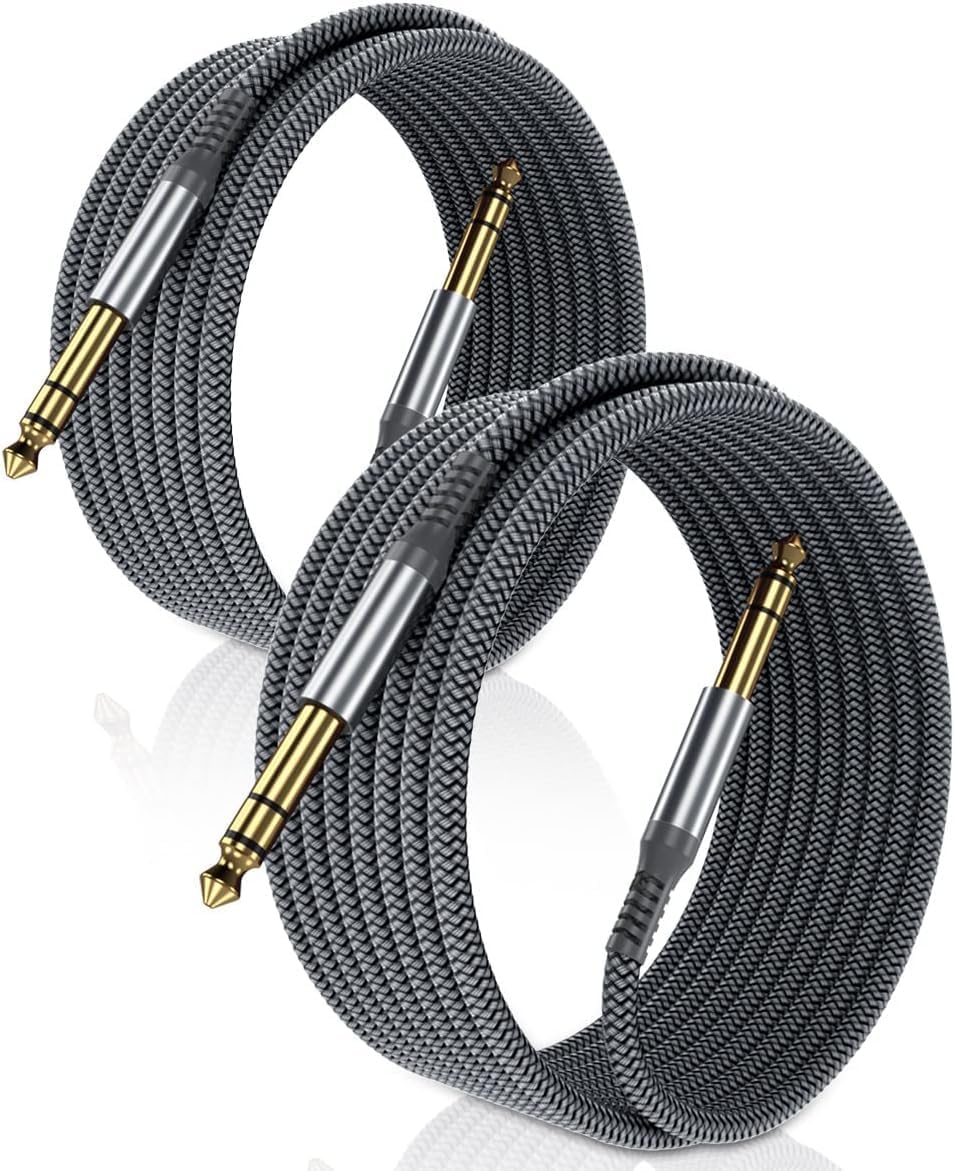
The Elebase 1/4 Inch TRS Instrument Cable 2-Pack is a solid choice for musicians, producers, and audio engineers who need reliable connections without breaking the bank. These 10ft cables are designed for any instrument or audio device with a standard 6.35mm jack, including electric guitars, bass guitars, keyboards, mixers, and amplifiers.
What sets these cables apart is their construction quality. The premium copper conductor minimizes signal loss, while the dual-layer shielding effectively blocks electrical noise and interference that can plague audio setups. The TRS connectors are gold-plated for superior contact and durability. Real-world testing shows zero hum or buzz, even in electrically noisy environments, making these cables suitable for both home studios and live performances.
The braided nylon jacket is noticeably thicker and more robust than typical rubber cables, resisting tangles and physical damage remarkably well. Users report that these cables withstand accidental stepping, coiling abuse, and daily studio wear without visible degradation. The included Velcro strap adds practical value for cable management, and the choice of five color options lets you match your gear aesthetically.
One consideration: these are TRS cables designed for balanced, stereo signals. Standard mono guitar cables (TS type) are technically simpler, though these TRS cables work fine with guitars and bass. If you're exclusively using mono instruments, you're getting slightly more cable than you technically need, but the performance remains excellent.
Overall, this is a high-value product that delivers professional audio quality, impressive durability, and genuine customer satisfaction. The 12-month warranty and responsive customer service provide additional peace of mind for your purchase.
Physical Specifications: Length: 10 feet per cable (20 feet total for 2-pack), Connector Type: 1/4 inch (6.35mm) male-to-male, Cable Type: TRS (Tip/Ring/Sleeve), Number of Pins: 3, Outer Material: Nylon braided jacket with aluminum shell, Weight: 0.41 kg per unit.
Audio Specifications: Premium copper conductor for signal transmission, Dual-layer shielding for noise rejection, Gold-plated TRS connectors for superior contact and durability, Designed for balanced stereo signal transmission.
Compatibility: Works with any audio device featuring 6.35mm jacks including electric guitars, bass guitars, acoustic-electric guitars, keyboards, synthesizers, mixers, amplifiers, studio monitors, and other professional audio equipment.
Included Accessories: 2x 10ft instrument cables, 1x Velcro cable management strap, Sealed anti-static packaging for protection during shipping.
Who Should Buy These Cables: Musicians and producers who need multiple reliable cables for different instruments or setups, home studio owners seeking professional audio quality on a budget, backup cable users who want durable alternatives to premium brands, and anyone using keyboards, mixers, or other balanced audio equipment that benefits from TRS connectivity.
When to Choose Different Cables: If you exclusively use standard mono guitars or bass and need the simplest cable type, basic TS cables might suffice. If you require extremely heavy-duty cables for constant touring and maximum abuse resistance, consider professional-grade touring cables. If you need longer than 10ft lengths, this 2-pack may require multiple purchases.
Cable Care Tips: Coil cables loosely to prevent kinks and internal wire damage, avoid stepping on connectors repeatedly, store in dry conditions away from extreme heat, and test connections regularly for any crackling or intermittent audio issues. The included Velcro strap helps organize cables and reduces tangling.
TRS vs TS Explained: TRS cables have two black bands on the connector tip and carry balanced stereo signals, making them ideal for keyboards, mixers, and professional audio gear. TS cables have one band and carry mono signals, typical for standard guitars and bass. These TRS cables work with both, so you get maximum versatility.
Buying Guide for Guitar Instrument Cables
Shielding and Noise Rejection
Electrical interference from lights, pedals, and other electronics can introduce hum into your signal. Effective shielding is a cable’s first line of defense. Look for cables with dual or multi-layer shielding, which acts as a Faraday cage to block these unwanted frequencies.
This construction ensures that only the signal from your guitar reaches the amplifier. A well-shielded cable is crucial for both live environments with many competing signals and home studios where clean recording is paramount. The importance of robust shielding extends to all audio connections, as discussed in our review of the best audio cables for AV receivers.
Conductor Quality and Durability
The internal conductor carries your guitar’s delicate signal. High-purity oxygen-free copper (OFC) is the standard for minimal signal loss and accurate tone reproduction. A thicker gauge wire, like 20AWG, offers lower resistance than a thinner 22AWG, which can help preserve high-end clarity.
Equally important is the physical protection around that conductor. Cables endure being stepped on, coiled, and uncoiled constantly. Reinforcement with materials like Kevlar, robust jacketing, and strain relief at the connectors prevents internal breakage and extends the cable’s life significantly. You can explore more durable audio solutions in our Cables & Adapters category.
Connector Build and Compatibility
The plug is a critical point of failure. Look for 1/4 inch TS (Tip-Sleeve) or TRS (Tip-Ring-Sleeve) connectors with solid metal housings, preferably aluminum, which resist physical damage. Gold-plated contacts are preferred as they resist corrosion better than nickel, ensuring a consistent connection over time.
A secure connection that does not crackle or cut out when moved is essential. Some designs include internal heat-shrink tubing or molded strain relief to protect the solder joints where the cable meets the plug, a common breaking point. For securing your other gear, consider the stability offered by the best speaker mounts for studio monitors.
Final Thoughts
Your choice in a guitar cable directly impacts your sound’s clarity and your setup’s reliability. For players who prioritize ultimate noise rejection and proven durability backed by a strong warranty, the Guitar Cable 10 ft/3m 2 Pack is an excellent verified option. If you value a sleek design, multiple color choices, and robust construction for a variety of instruments, the Elebase 1/4 Inch TRS Instrument Cable 10FT provides reliable performance and great value, ensuring your music is heard as you intended.
Frequently Asked Questions
What is the difference between a TS and a TRS guitar cable?
A standard guitar cable uses a TS (Tip-Sleeve) connector, which carries a mono, unbalanced signal. A TRS (Tip-Ring-Sleeve) connector can carry a balanced mono signal or a stereo signal. For most electric guitars and basses going into a standard amp input, a TS cable is correct. TRS cables are often used for stereo outputs or balanced connections on certain active electronics or studio gear.
How long should my guitar cable be?
Do expensive guitar cables really sound better?
Beyond a certain point of quality, the law of diminishing returns applies. A well-made cable with good shielding, a solid conductor, and robust connectors will sound clean and reliable. Extremely high-priced cables may offer marginal improvements in materials or esoteric designs, but for most players, the priority should be on verified performance, durability, and noise rejection rather than chasing incremental gains. The core principles of quality construction apply across all audio cables, as seen in our guide to the best audio cables for home theater setup in 2026.



Write Your Review
No reviews yet. Be the first to share your experience!