

Imagine this: you are in the final moments of a competitive match, relying on crisp directional audio to pinpoint an opponent’s location. The wrong audio gear can mean the difference between victory and defeat. For gamers who demand studio-quality sound for streaming, communication, and immersive gameplay, a dedicated audio streamer is a game-changer. This guide reviews top-tier devices designed to deliver professional audio performance, helping you build a superior sonic environment for your gaming sessions.
We have assessed a range of audio streamers, from high-fidelity music transports to integrated streaming interfaces. Each product here serves a distinct purpose, whether you are a casual streamer looking for clean microphone input or an audiophile seeking pristine music playback between games. By understanding your specific needs for connectivity, sound processing, and integration, you can select the ideal tool to elevate your audio from standard to spectacular. Let us explore the top contenders in the market for 2026.

Pros
- True hi-res audio playback up to 192kHz/24-bit with no resampling preserves the original recording quality
- Broad streaming service support including Spotify, TIDAL, Amazon Music, Qobuz, and AirPlay 2 in one affordable device
- Dual voice assistant compatibility with both Alexa and Siri is rare at this price point
- Highly rated by a large number of verified buyers, reflecting consistent real-world reliability
- Small, unobtrusive form factor makes it easy to add to any existing audio setup without clutter
Cons
- AirPlay receiver only, meaning it cannot transmit audio to other AirPlay-enabled speakers or devices downstream
- No Google Cast support, which may disappoint Android-first households or those already invested in a Chromecast ecosystem
- Qobuz Connect is not supported natively and must be accessed through the WiiM Home app instead
The WiiM Mini is a palm-sized wireless audio streamer designed to breathe new life into any existing stereo system, amplifier, or powered speakers. At its core, it bridges the gap between legacy audio hardware and modern streaming platforms, making it an excellent choice for audiophiles, home theater enthusiasts, and anyone who wants smart speaker functionality without scrapping their current setup.
The standout feature is its commitment to uncompromised audio quality. Unlike many competing streamers that resample audio to a fixed rate, the WiiM Mini passes audio through unaltered at up to 192kHz and 24-bit resolution via both its analog and digital optical outputs. This means content from Amazon Music Ultra HD, Qobuz, and personal hi-res libraries arrives at your speakers exactly as the artist intended.
Connectivity is genuinely impressive for the price. The device supports AirPlay 2, Spotify Connect, TIDAL Connect, Amazon Music Cast, Alexa, Siri, DLNA, and NAS streaming, covering virtually every major platform and ecosystem. Multiroom grouping with other WiiM devices, Echo speakers, and HomePods works reliably through the WiiM Home app, making whole-home audio straightforward to set up and manage.
On the physical side, the WiiM Mini is compact at just 2.7 inches square and under an inch tall, finished in a clean matte black. It connects via USB-C for power, a 3.5mm analog output, and a TOSLINK digital optical port, covering most amplifier and DAC input configurations. The build feels solid for the size, though it is clearly designed to sit out of sight rather than on display.
The main limitations to keep in mind are the lack of Google Cast support and the AirPlay receive-only restriction, which means it cannot push audio to other AirPlay devices in a chain. For Apple and Amazon ecosystem users these are non-issues, but Android households relying on Chromecast should consider a different WiiM model. Overall, the WiiM Mini delivers exceptional value as a versatile, high-fidelity streaming upgrade for virtually any audio system.
Connectivity: Wi-Fi (2.4GHz/5GHz), Bluetooth. Supported protocols include AirPlay 2, Spotify Connect, TIDAL Connect, Amazon Music Cast (Alexa Cast), DLNA, and NAS home media server streaming.
Audio Outputs: 3.5mm analog stereo output and TOSLINK digital optical (SPDIF) output. Maximum audio resolution is 192kHz at 24-bit via both outputs, with no resampling applied to the signal chain.
Voice Assistants: Amazon Alexa and Apple Siri are both supported. The device integrates with Alexa routines and Apple Home for smart home automation and voice-controlled playback.
Compatible Devices: Works with amplifiers, DACs, powered speakers, HomePod, Apple TV, Echo devices, tablets, and smartphones. Control is handled through the WiiM Home app (iOS and Android) or supported voice assistants.
Physical: Dimensions are 2.7 inches deep by 2.7 inches wide by 0.9 inches tall. Color is matte black. Power is supplied via USB Type-C. Surround configuration is 2-channel stereo.
Who should buy the WiiM Mini? This streamer is ideal for anyone who already owns a quality amplifier, receiver, or powered speakers and wants to add modern wireless streaming without replacing their hardware. It is particularly well-suited to Apple and Amazon ecosystem users who want AirPlay 2 and Alexa in a single compact device.
Apple vs. Android households: The WiiM Mini is optimized for Apple and Amazon users. AirPlay 2, Siri, and Amazon Music Cast are all supported natively. However, Google Cast is not available on this model. If your household relies heavily on Chromecast or Google Home, consider the WiiM Pro or WiiM Pro Plus, which add Google Cast and additional outputs.
Hi-res audio considerations: To take full advantage of the 192kHz/24-bit capability, you will need a subscription to Amazon Music Ultra HD, Qobuz, or access to a personal hi-res library. TIDAL Masters tops out at 96kHz/24-bit, and standard Spotify streams at compressed quality regardless of the hardware. The digital optical output is recommended for the cleanest signal path to an external DAC.
Multiroom setup tips: The WiiM Mini groups natively with other WiiM devices for synchronized playback, and also joins AirPlay 2 groups with HomePods and Apple TV. For Amazon-based multiroom audio, it integrates into Alexa speaker groups alongside Echo devices. For the most flexible whole-home setup, pairing multiple WiiM units through the WiiM Home app offers the tightest synchronization.
Pros
- Superior sound quality with exceptional clarity, detailed midrange, and punchy bass that rivals dedicated DAC-transport combinations
- Exceptionally well-designed software with extensive features including FIR filters, robust EQ controls, and frequent firmware updates
- Multiple control methods via touchscreen, remote control, and mobile app across iOS, Android, and macOS platforms
- Flexible storage options with dual NVMe bays allowing local music library storage for optimal wireless-free playback
- Premium build quality with CNC-machined aluminum chassis and anodized finishing that feels substantial and professional
Cons
- SFP fiber network modules must be purchased separately, adding extra cost for those seeking optical isolation benefits
- Requires a separate DAC to convert digital output to analog audio, increasing total system cost and complexity
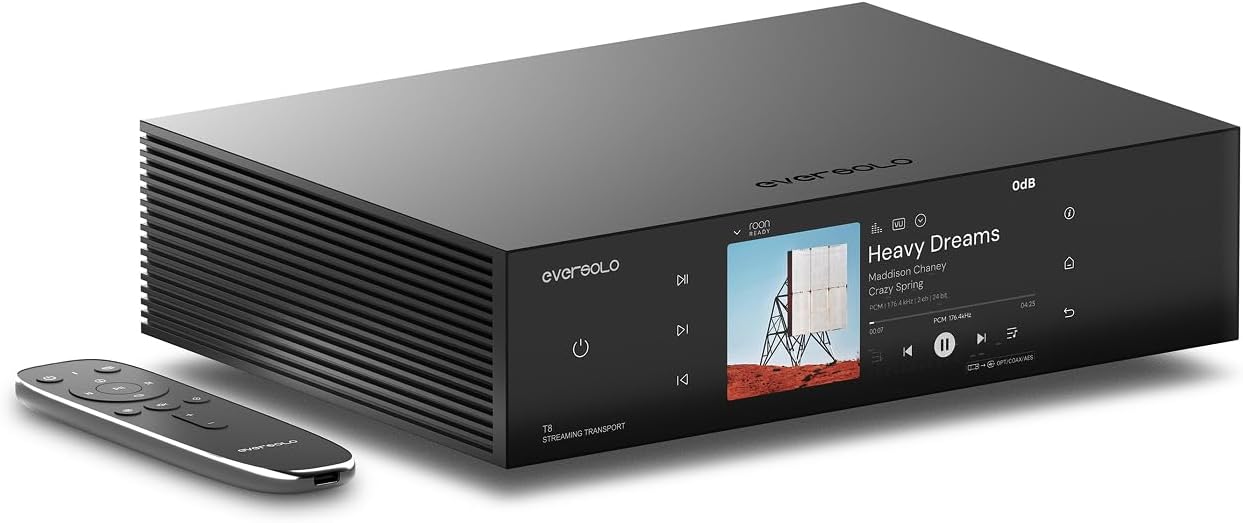
The Eversolo T8 is a professional-grade streaming transport designed for audiophiles and music enthusiasts who demand transparent, high-resolution digital audio. It functions as a dedicated source component that streams music from services like TIDAL and Qobuz, or stores local high-resolution files, then sends pristine digital audio to your DAC via multiple output options. This is the ideal choice for listeners who have invested in quality DAC and amplification but want superior streaming capabilities and jitter reduction.
The standout feature is the dual femtosecond clock architecture with AS318-B series crystal oscillators operating at 49.1520 MHz. This dramatically reduces clock jitter at the source, resulting in noticeably cleaner audio with enhanced detail retrieval, superior vocal tone, and a more three-dimensional soundstage. The fully isolated outputs on all ports eliminate ground loop noise and interference, while support for up to DSD512 and PCM 768kHz ensures compatibility with the most demanding high-resolution audio formats available today.
Build quality is exceptional, featuring a CNC-machined aluminum chassis with anodized finishing that delivers premium aesthetics and mechanical stability. The 6-inch vibrant touchscreen is bright, responsive, and displays real-time VU meters and cover art with excellent attention to detail. Control is intuitive through the touchscreen, included remote, or mobile app on iOS, Android, or macOS devices, making operation smooth from day one.
The proprietary evotune acoustic calibration system is a game-changer for room optimization, automatically compensating for acoustic imperfections while the 10-band parametric EQ lets you fine-tune specific frequencies to your preferences. Integration with Roon, Qobuz Connect, and TIDAL Connect provides seamless access to millions of tracks in lossless quality, while dual NVMe storage bays allow you to build a personal music library for ultimate playback control.
The main considerations are the premium price point and the requirement for a separate DAC to complete your system. However, users consistently report that the T8 justifies its cost through superior sound quality, software sophistication, and build excellence that surpasses competing streaming transports. This is a genuine end-game component for serious music lovers.
Connectivity: Wi-Fi 6, Bluetooth, Ethernet, SFP Fiber Network, Gigabit LAN
Audio Outputs: IIS (8 pinout configurations), Coaxial, AES/EBU (balanced XLR), USB Audio, Optical, USB 3.0 OTG x2
Maximum Resolution: IIS and USB Audio support DSD512 Native and PCM 768kHz 32Bit; Coaxial, AES/EBU, and Optical support PCM 192kHz 24Bit and DoP64
Streaming Services: TIDAL, Qobuz, IDAGIO, Amazon Music, TuneIn Radio, Presto Music, KKBOX, Radio Paradise, Deezer
Display: 6-inch vibrant touchscreen with multiple VU meter visualizers
Clocking: Dual femtosecond clocks with AS318-B series professional audiophile-grade crystal oscillators
Storage: Dual NVMe bays for high-capacity local music library storage
Control Options: Touchscreen, remote control, mobile app (iOS, iPadOS, Android, macOS M-series)
Build: CNC-machined aluminum chassis with anodized finishing
Weight: 4.5 kg
Warranty: 1 year manufacturer
Who Should Buy This: The T8 is ideal for serious audiophiles and music enthusiasts who already own a quality DAC and want a superior streaming transport. It's perfect for those who value high-resolution audio, extensive software features, and premium build quality. If you stream from TIDAL or Qobuz regularly, or maintain a large personal music library, this transport will elevate your listening experience significantly.
Who Should Consider Alternatives: Casual listeners or those on a tight budget should explore more affordable streaming options. If you need a complete all-in-one streaming solution with built-in DAC, integrated amplification, or speakers, you may want to look at different product categories.
Important Considerations: The T8 is a transport only and requires a separate DAC to convert digital audio to analog. Factor this into your total system cost. SFP fiber network modules must be purchased separately if you want optical isolation benefits. Ensure your chosen DAC supports at least one of the T8's output formats (IIS is most common for high-end DACs).
Setup Recommendations: For optimal performance, use the AES/EBU XLR output with a quality digital cable to your DAC, or the IIS connection if your DAC supports it. Take advantage of the dual NVMe storage bays to store your favorite high-resolution files locally, reducing reliance on wireless streaming. Use the evotune acoustic calibration system to automatically optimize sound for your listening room.

Pros
- Exceptional audio clarity and gain headroom suitable for dynamic and condenser XLR microphones
- Intuitive touch controls with visual LED feedback eliminate the learning curve for beginners
- Wave Link software provides powerful routing capabilities without requiring external mixers
- Compact desktop footprint fits seamlessly into any streaming or podcasting setup
- Solid build quality with included 150cm USB-C cable and 2-year manufacturer warranty
Cons
- AI noise cancellation feature has limitations with persistent background noise like fans and room ambience
- Requires Windows 11 or macOS 14.2 and higher, excluding older system compatibility
- Some users report the onboard effects sound overly processed if not carefully tuned
The Elgato Wave XLR MK.2 is a professional-grade USB audio interface designed for content creators who demand studio-quality sound without complex setup. It's perfect for streamers, podcasters, and remote professionals who want to elevate their XLR microphone performance with minimal effort. The device bridges the gap between entry-level and professional audio gear by delivering serious power in a compact, user-friendly package.
What sets this interface apart is its combination of raw power and accessibility. The 80dB gain is genuinely impressive, allowing you to drive even quiet condenser microphones to broadcast levels. The ultra-low-latency monitoring at 24-bit, 48kHz resolution ensures you hear exactly what your audience hears with zero perceptible delay. The onboard DSP effects processor unifies voice enhancement, compression, and EQ in a single signal chain, meaning you can achieve polished audio without juggling multiple software plugins. Touch controls with customizable LED lighting make real-time adjustments intuitive, while Wave Link integration provides advanced routing for multi-application setups.
The build quality reflects Elgato's commitment to creator tools. The interface feels solid and premium with a thoughtful industrial design that complements professional workspaces. The included 150cm USB-C cable provides flexibility for desktop placement, and the compact footprint won't clutter your desk. The 2-year warranty demonstrates manufacturer confidence in longevity and reliability.
The primary limitation is that the AI noise cancellation feature struggles with persistent environmental noise like fans and room ambience, so you may still need acoustic treatment for optimal results. Additionally, the onboard effects can sound overly processed if not carefully adjusted, requiring some audio knowledge to dial in properly. System requirements are fairly current, requiring Windows 11 or macOS 14.2 or higher.
The Elgato Wave XLR MK.2 represents excellent value for creators serious about audio quality. It delivers professional-grade features in an accessible package that doesn't require deep technical knowledge. Whether you're upgrading from basic USB microphones or replacing aging audio interfaces, this device will noticeably improve your sound and streamline your workflow.
Audio Performance: 80dB gain, 24-bit resolution at 48kHz, 192kHz maximum sample rate, 2 channels, ultra-low-latency monitoring
Connectivity: USB-C to USB-C cable included (150cm), compatible with Laptop and Personal Computer
Compatibility: Windows 11 and higher, macOS 14.2 and higher, Stream Deck integration, Wave Link software required
Physical: 11.36 ounces, compact desktop form factor with touch controls and customizable LED feedback
Warranty: 2-year manufacturer warranty included
Best For: Content creators, streamers, podcasters, and remote professionals who use professional XLR microphones and want studio-quality audio without complex setup.
Ideal If You: Already own a quality XLR microphone, need ultra-low-latency monitoring, want built-in effects processing, or use Elgato's Stream Deck ecosystem.
Consider Alternatives If: You require extensive noise cancellation, use only USB microphones, have older computer systems, or prefer analog mixing consoles.

Pros
- Excellent 4K video capture quality with real-time passthrough monitoring at 4K/60Hz
- Professional-grade audio input with Revolution Preamp delivers broadcast-quality sound for XLR microphones
- Dual USB-C connectivity allows simultaneous connection to two computers for flexible streaming setups
- Compact form factor integrates audio interface and video capture into single portable device
- Highly stable performance with OBS Studio and professional software with negligible CPU usage
Cons
- Included UNIFY mixer software has reported stability issues and reliability problems according to user reviews
- Device requires power cycling if left on between sessions, otherwise may not function properly
- Some users experienced audio device disappearance and device lockups in certain applications like Zoom
The RODE Streamer X is a professional-grade integrated audio interface and 4K video capture card designed for content creators, live streamers, podcasters, and video professionals who need to capture and manage multiple audio and video sources simultaneously. This all-in-one solution eliminates the need for separate devices, making it an efficient choice for anyone building a compact production setup.
The standout feature is its ability to capture 4K video at 30fps or 1440p at 60fps while simultaneously handling professional XLR audio input through a Neutrik combo connector paired with RODE's Revolution Preamp. The dual USB-C outputs enable connection to two computers at once, allowing you to capture video from one source while streaming on another. Real-world testing shows excellent compatibility with OBS Studio, Final Cut Pro, Logic Pro, and Adobe Audition, with users reporting smooth 4K/30 video capture and perfectly synced multi-track audio recording.
Build quality is solid with a compact 380g form factor that fits easily into any streaming or production workspace. The device includes a USB-C to USB-C cable and power supply, though it operates via USB power delivery. The onboard wireless receiver adds flexibility by supporting RODE Series IV wireless microphones like the Wireless GO II, allowing cable-free audio capture for dynamic productions.
The primary drawback is the included UNIFY software, which users report has stability issues and occasional bugs. However, the hardware itself remains reliable when used with professional third-party applications. Some users experienced device lockups if left powered on without proper shutdown, requiring a full power cycle to restore function. These software-related issues appear to be addressable through firmware updates rather than hardware limitations.
The RODE Streamer X represents excellent value for professional creators who need integrated audio and video capture capabilities. While the proprietary software needs refinement, the hardware delivers professional performance that justifies the investment for serious content production work. Best results come from using it with established streaming and DAW software rather than relying solely on the included mixer application.
Audio Specifications: 4-channel audio interface with studio-grade Neutrik XLR combo input, TRRS headset jack for headphone input, TRS/XLR output connectors, RODE Revolution Preamp for professional audio capture.
Video Specifications: HDMI video capture up to 4K at 30fps or 1440p at 60fps, HDMI passthrough monitoring up to 4K at 60Hz with zero-latency output, supports HDMI input from cameras, computers, and gaming consoles.
Connectivity: Dual USB-C outputs for simultaneous connection to two computers, onboard wireless receiver for RODE Series IV wireless products, USB-powered with included power supply, frequency response 60Hz.
Physical: Weight 380g, compact integrated design, includes USB-C to USB-C cable and power supply, 2-year extended warranty coverage.
Ideal For: Professional content creators, live streamers on Twitch and YouTube, podcasters, video production professionals, and anyone requiring simultaneous multi-source audio and video capture in a portable format.
Best Use Cases: Live streaming with professional microphones and cameras, instructional video production with voiceover recording, gaming content creation with commentary, professional podcast production, remote presentations with camera and microphone input, multi-track audio recording with video.
Not Ideal For: Users who primarily need basic webcam functionality, those requiring extensive software mixing features without external applications, or budget-conscious buyers seeking entry-level capture solutions.
How to Choose Your Gaming Audio Streamer
Prioritize Your Primary Use Case
Your main activity dictates the best device. Are you primarily streaming your gameplay with live commentary? If so, a dedicated audio interface with premium microphone preamps and mixing software, like the Elgato Wave XLR MK.2 USB Audio Interface and DSP, is essential. It focuses on voice clarity and real-time monitoring.
Conversely, if your goal is to enjoy high-resolution game soundtracks and music from services like Tidal, a transport-focused streamer such as the Eversolo T8 is built for that. Understanding this core distinction prevents you from buying a feature-rich device that misses your fundamental need.
Evaluate Connectivity and Compatibility
<!–Check the inputs and outputs against your existing gear. For console gamers, an interface with HDMI passthrough for video capture is crucial. The RØDE X Streamer X Professional Integrated Audio excels here, combining audio and 4K video capture in one unit.
PC gamers should confirm USB compatibility and software support. Also, consider wireless needs. A device like the WiiM Mini AirPlay 2 Wireless Audio Streamer offers fantastic multiroom audio for ambiance but may lack the direct, low-latency connection required for competitive gaming audio. Always match the ports to your microphone, headphones, speakers, and computer.
Assess Audio Processing and Control
<!–Onboard digital signal processing (DSP) is a massive advantage for streamers. Features like a built-in compressor, noise gate, and equalizer allow you to polish your microphone audio in real time without taxing your computer’s CPU. The Elgato Wave XLR MK.2 integrates this seamlessly with its Wave Link software.
For pure audio playback, look at the supported resolutions and clocking technology. High-end transports use features like dual femtosecond clocks to minimize jitter, ensuring the cleanest possible digital signal is sent to your DAC or amplifier. This results in a more detailed and immersive soundstage for both games and music, a topic also explored in our guide to the best audio streamers for running.
Consider Form Factor and Ecosystem
<!–Your desk space and existing tech ecosystem matter. A compact, single-knob interface keeps your setup clean and simple. A larger unit with a vibrant display, like the Eversolo T8, becomes a centerpiece but requires significant space.
Also, check for integration with other devices you own. If you use a stream deck for controls, ensure compatibility. If you have a collection of portable audio streamers for other uses, you might prioritize a home device that complements them. Choose a device that fits physically and functionally into your unique gaming environment.
Final Thoughts
Selecting the right audio streamer fundamentally enhances your gaming and streaming experience by providing control and clarity. For streamers seeking an all-in-one audio and video solution, the RØDE X Streamer X Professional Integrated Audio is a powerful choice. If your priority is pristine, high-fidelity music playback to set the mood, the Eversolo T8 Music Streamer Transport with Remote delivers an unmatched listening experience. Consider your primary use case to make the most impactful upgrade to your setup this 2026.
Frequently Asked Questions
Do I need an audio interface if my gaming headset has a USB connection?
A dedicated audio interface typically provides superior microphone preamps, more robust audio processing, and greater connectivity flexibility than a standard USB headset. It allows you to use professional XLR microphones and offers finer control over your sound, which is beneficial for streaming and content creation.
What is the benefit of a high-resolution audio streamer for gaming?
While game audio files are often compressed, a high-resolution streamer ensures the digital signal path is as clean as possible. This can reduce audio artifacts and provide a more detailed, spacious soundstage. It is especially valuable for enjoying game soundtracks and immersive atmospheric sounds, similar to the benefits sought in the best audio streamers with ANC.
Can I use a music streamer like the WiiM Mini for my gaming PC audio?
Yes, you can route your PC audio to a device like the WiiM Mini via AirPlay or Bluetooth for wireless speaker playback. However, this may introduce latency, making it unsuitable for competitive gaming where split-second audio cues are critical. It is better suited for casual gaming or background music.
How important is low-latency monitoring for streaming?
Ultra-low-latency monitoring is crucial. It allows you to hear your own voice in real time through your headphones without distracting delay. This prevents you from talking over others and helps you maintain a natural speaking rhythm, which is essential for professional-sounding live streams and communication.


Write Your Review
No reviews yet. Be the first to share your experience!