

You want powerful, detailed audio but lack the space for bulky floor-standing speakers. The solution lies in modern bookshelf speakers, especially those equipped with efficient Class D amplification. This technology packs serious wattage into compact cabinets, delivering room-filling sound without the footprint. Whether you need a simple desktop setup or a full home theater experience, the right speaker and amplifier pairing can transform your listening.
This guide is for anyone seeking an upgrade, from casual listeners to aspiring audiophiles. We have evaluated eight standout products that showcase the synergy between quality drivers and Class D power. You will find options ranging from all-in-one powered systems to flexible component setups. Let us explore the top contenders for the best bookshelf speakers with Class D amplifiers available this 2026.
| Pick | Product | BRD Score | Where to buy |
|---|---|---|---|
| Top Pick 25% OFF |
 Polk Audio T15 Bookshelf Speakers 100W Home |
9.6/10 | View on Amazon.com |
| 27% OFF |
 Edifier R1280T Powered Bookshelf Speakers 42W RMS |
9.8/10 | View on Amazon.com |
Prices and discounts as of Nov 23, 2026 and may have changed. Check Amazon for the current price.
Pros
- Affordable entry point into high-quality home theater audio without sacrificing sound clarity
- Dynamic Balance technology ensures accurate, distortion-free sound across the full frequency range
- Compact dimensions fit easily on shelves, desks, or mounted on walls in virtually any room
- Broad compatibility with AV receivers, stereos, and record players makes them highly versatile
- Strong 5-year warranty provides long-term peace of mind for the investment
Cons
- Passive design requires a separate AV receiver or amplifier, adding to the total system cost
- The 5.25-inch woofer may not produce the deepest bass on its own, so a subwoofer is recommended for full low-end performance
The Polk Audio T15 is a pair of passive bookshelf speakers designed to bring genuine home theater performance to everyday listeners without demanding a premium budget. Aimed at first-time home audio buyers and those expanding an existing setup, these speakers strike a practical balance between size, sound quality, and price. They work equally well as stereo speakers for music, as surround channels in a multi-speaker system, or even as desktop or record player speakers.
At the heart of the T15 is Polk's proprietary Dynamic Balance driver technology, which combines a 5.25-inch woofer with a 0.75-inch tweeter to produce clear, detailed audio across a wide frequency range. The result is crisp treble, a natural midrange, and surprisingly capable bass for a speaker of this size. Support for Dolby and DTS decoding means they integrate seamlessly into modern home theater setups, delivering immersive surround sound without distortion even at higher volumes.
The T15 features a wood enclosure finished in a clean matte black, giving it a timeless look that fits most room aesthetics. Dimensions of 7.25 by 6.5 by 10.63 inches keep the footprint small, and the integrated keyhole slot on the rear cabinet allows for straightforward wall mounting. The included grilles provide a polished appearance and protect the drivers from dust and accidental contact.
There are a couple of practical considerations worth noting. As passive speakers, the T15s require a separate amplifier or AV receiver to function, which is an additional purchase for buyers who do not already own one. While the bass performance is respectable for the speaker size, listeners who enjoy deep, room-filling low frequencies will likely want to pair them with a dedicated subwoofer to fill out the bottom end of the audio spectrum.
Overall, the Polk Audio T15 is a compelling choice for anyone stepping into home audio or looking to expand a budget-friendly surround sound system. The combination of proven Dynamic Balance technology, flexible placement options, broad receiver compatibility, and a solid five-year warranty makes this pair a trustworthy and versatile foundation for any home theater build.
The Polk Audio T15 features a 5.25-inch Dynamic Balance woofer paired with a 0.75-inch tweeter, delivering up to 100 watts of output power. The speakers present an 8-ohm impedance load, making them compatible with a wide range of AV receivers and stereo amplifiers on the market.
Frequency response extends up to 24,000 Hz, ensuring detailed high-frequency reproduction for music and cinematic soundtracks. The enclosure is constructed from wood for improved acoustic resonance and is finished in black with removable fabric grilles. Cabinet dimensions measure 7.25 inches deep, 6.5 inches wide, and 10.63 inches tall.
Connectivity is handled via standard wired speaker terminals, compatible with most bare wire, banana plug, or spade connector configurations. The rear panel includes an integrated keyhole slot for optional wall mounting. Each package includes two speakers, two grilles, and a warranty registration card, and the product is covered by a 5-year parts and labor limited warranty.
If you are new to home audio, the Polk Audio T15 is one of the most approachable starting points available. These passive bookshelf speakers work best when paired with an AV receiver rated between 20 and 100 watts per channel at 8 ohms. Popular budget-friendly receivers from brands like Denon, Yamaha, and Sony pair exceptionally well with the T15 and can be found at accessible price points.
For those building a full surround sound system, Polk's own T-Series lineup is designed to work together. Adding the T50 floor-standing towers as front mains, the T30 center channel for clear dialogue, and a powered subwoofer will complete a 5.1 configuration that shares the same sonic character as the T15s. This makes for a cohesive, well-matched system without the guesswork of mixing different speaker brands.
If you plan to use the T15 primarily for stereo music listening or as desktop speakers, they perform admirably in smaller rooms up to roughly medium size. For larger living spaces or dedicated home theater rooms, consider supplementing with a subwoofer to ensure the low frequencies reach every corner. Wall mounting is a convenient option for rear surround placement, and the built-in keyhole slot makes installation straightforward with standard wall anchors.
Pros
- Dual AUX inputs eliminate the hassle of constantly swapping cables between devices
- Remote control adds genuine convenience for desktop or living room listening setups
- Wood MDF enclosure reduces resonance and enhances acoustic performance over plastic builds
- 42W RMS output is more than sufficient for near-field and mid-room listening environments
- Simple plug-and-play setup with no drivers or software installation needed
Cons
- Frequency response starts at 80Hz, so bass-heavy listeners may want to pair these with a dedicated subwoofer
- No Bluetooth connectivity means wireless streaming from phones or tablets is not supported
- At 4 ohm impedance, pairing with external amplifiers requires careful compatibility checks
The Edifier R1280T is a self-powered 2.0 bookshelf speaker system designed for listeners who want genuine studio-quality audio in a compact, desk-friendly package. With 42 watts of RMS power and a clean stereo output, it suits home office setups, gaming stations, and casual listening rooms equally well. It is an ideal entry point for anyone upgrading from built-in laptop or TV speakers.
The standout feature here is the dual AUX input system, which allows two separate devices to remain connected at the same time. Whether you have a PC and a smartphone plugged in simultaneously, there is no need to unplug and reconnect every time you switch sources. The included remote control adds a layer of everyday convenience that is surprisingly rare at this price point.
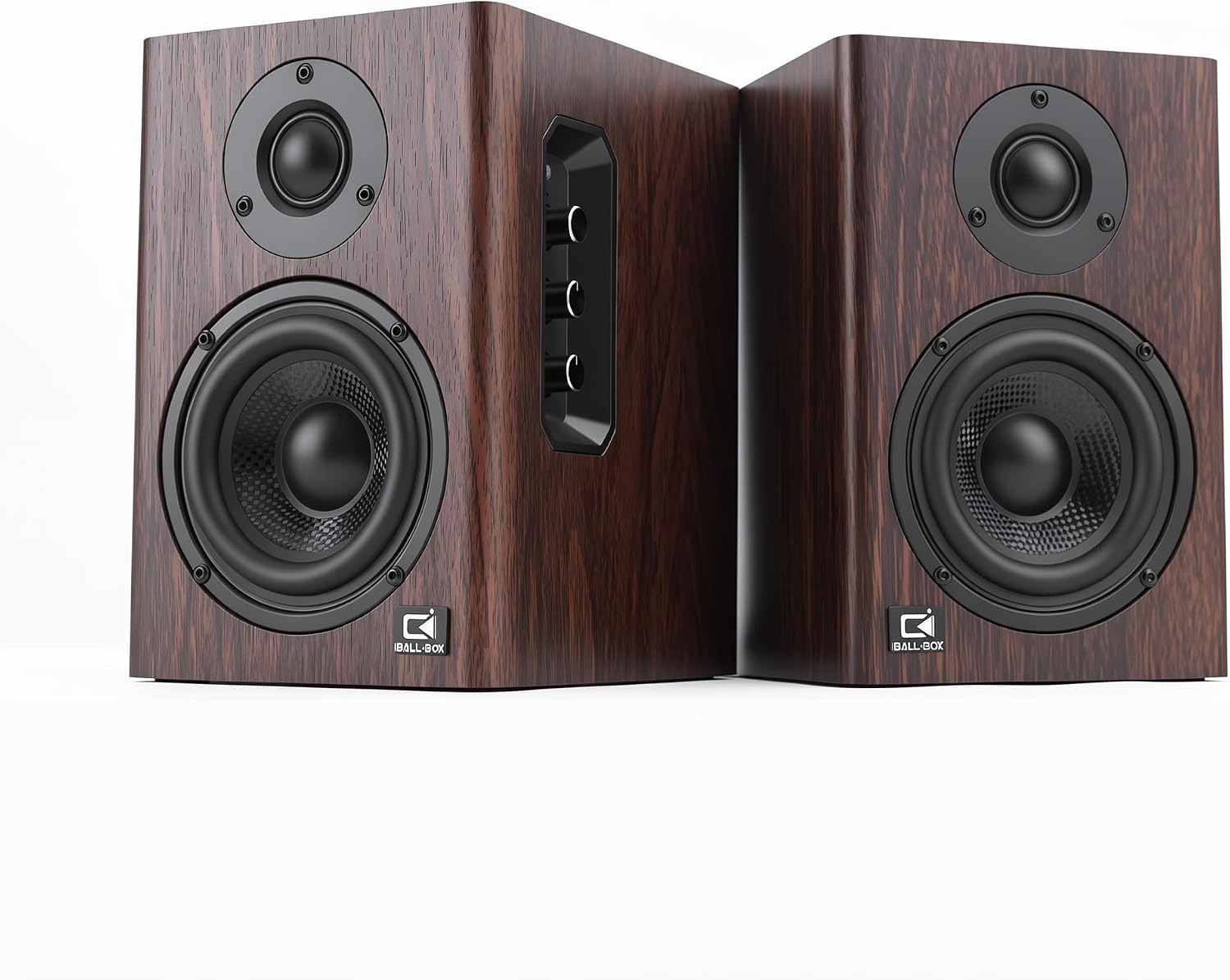
Sound quality is driven by a 13mm silk dome tweeter and a 4-inch full-range woofer, a combination that produces smooth, natural highs and a warm midrange. The MDF wood enclosure is a meaningful upgrade over plastic-bodied competitors, reducing unwanted resonance and giving the speakers a more refined acoustic character. The wood-effect vinyl finish also looks genuinely premium on a desk or bookshelf.
The main limitation is the 80Hz low-frequency cutoff, which means deep bass is not a strong suit for these speakers. Listeners who enjoy bass-heavy genres like electronic or hip-hop may find the low end lacking without an accompanying subwoofer. The absence of Bluetooth is also worth noting for users who prefer wireless streaming from mobile devices.
Overall, the Edifier R1280T delivers exceptional value for a powered bookshelf speaker at its price tier. The combination of dual inputs, remote control, solid build quality, and natural sound tuning makes it a top recommendation for desktop audio, light home studio use, and everyday multimedia listening. It earns its place as one of the best-selling bookshelf speakers in its category.
The Edifier R1280T operates in stereo 2.0 configuration with a total RMS output of 42 watts. The tweeter measures 13mm and uses a silk dome design, while the woofer is a 4-inch dynamic driver. Impedance is rated at 4 ohms with a signal-to-noise ratio of 85dB, ensuring a clean, low-noise audio signal during playback.
Connectivity is handled via dual 3.5mm AUX inputs and dual RCA inputs, covering a wide range of source devices. Input voltage is 120V, making it suitable for North American outlets. The enclosure is constructed from MDF wood with a wood-effect vinyl surface treatment, and the unit ships as a single carton containing both the active and passive speaker.
Frequency response begins at 80Hz and extends through the full audible range. The speaker supports shelf mount and tabletop placement, and the side-panel controls on the active unit allow direct adjustment of volume, bass, and treble. A 2-year manufacturer warranty is included with every unit.
If you are shopping for your first pair of powered bookshelf speakers, the Edifier R1280T is one of the safest choices in its category. It requires no external amplifier, no software setup, and no complex wiring. Simply connect your source device via the AUX or RCA input and you are ready to listen. This makes it ideal for students, remote workers, and casual home listeners.
Consider pairing the R1280T with a small subwoofer if your listening tastes lean toward bass-heavy music or cinematic sound effects. The 80Hz low-frequency floor is adequate for most content, but a subwoofer will fill in the lower octaves for a more complete audio experience. Edifier and other brands offer compatible subwoofers that connect easily via RCA.
For gamers, the R1280T works well as a desktop speaker solution, offering clear directional audio and enough volume for immersive gameplay without disturbing others. For home office users, the remote control and dual inputs mean you can keep both your work computer and personal device connected at all times, switching audio sources effortlessly throughout the day.
Choosing Your Ideal Bookshelf Speaker Setup
Powered vs. Passive: Understanding Your Path
The first decision is between powered (active) and passive speakers. Powered models like the Edifier R1280T have the amplifier built directly into one speaker cabinet. This creates a streamlined, all-in-one solution perfect for simplicity. Passive speakers, such as the Polk Audio T15, require a separate external amplifier like the Fosi Audio models.
Powered speakers offer plug-and-play convenience. Passive systems provide greater long-term flexibility, allowing you to mix and match components as your needs evolve. For a deeper dive into component options, our guide on the best passive bookshelf speakers is a valuable resource.
Amplifier Power and Speaker Sensitivity
Matching amplifier output with speaker sensitivity is crucial for optimal performance. Sensitivity, measured in decibels (dB), indicates how loud a speaker gets with a given amount of power. Higher sensitivity speakers work well with lower-wattage amps. Lower sensitivity models benefit from more powerful amplifiers.
Consider your room size and listening habits. A compact amplifier like the Fosi Audio BT20A provides ample power for near-field desktop listening. For larger spaces or more dynamic range, a higher-output amp like the Fosi Audio TB10D ensures headroom and clean sound at higher volumes.
Connectivity and Input Options
Modern bookshelf speakers should connect seamlessly to your existing gear. Look for versatile inputs like Bluetooth for wireless streaming, RCA for traditional components, and perhaps USB or optical digital connections. The Edifier S355DB exemplifies this with its multi-point Bluetooth and app control.
Think about your primary sources. If you use a turntable, ensure RCA inputs are available, as seen on the Electrohome Huntley speakers. For computer audio, a USB input like on the MEVOSTO speakers offers a direct digital link. Future-proof your setup by choosing speakers with multiple connection paths.
Sound Signature and Driver Quality
The driver materials and cabinet design shape the speaker’s sonic character. Silk dome tweeters, like those in the Edifier P12, often produce smooth, detailed highs. Aluminum or titanium domes can offer more precise, extended treble. The woofer size and cabinet porting influence bass response.
Listen for a balanced sound that suits your preferences. Some users prioritize accurate studio monitoring, while others prefer a warmer, more musical presentation. Features like Digital Signal Processing (DSP), as highlighted in our review of the best bookshelf speakers with DSP, can further refine the audio to your room and taste.
Final Thoughts
Selecting the right bookshelf speakers with Class D amplification elevates your audio experience with impressive efficiency and sound quality. For those seeking a premium, all-in-one powered solution with wireless subwoofer capabilities, the Edifier S355DB 2.1 Powered Bookshelf Speakers deliver room-filling sound and deep bass. Alternatively, if you prefer the flexibility of a component system, pairing the versatile Edifier P12 Passive Bookshelf Speaker with a capable external amplifier like those from Fosi Audio offers excellent customization and upgrade potential. Whichever path you choose, these modern speakers prove that great sound no longer requires massive equipment.
Frequently Asked Questions
Are Class D amplifiers good for bookshelf speakers?
Yes, Class D amplifiers are excellent for bookshelf speakers. Their high efficiency generates less heat and allows for compact designs, perfect for powering speakers in limited spaces. They provide clean, powerful sound that pairs well with the acoustic design of modern bookshelf models.
What is the difference between powered and passive bookshelf speakers?
Powered bookshelf speakers have a built-in amplifier, so you connect your audio source directly to them. Passive speakers require a separate external amplifier or receiver to function. Powered models offer simplicity, while passive setups allow for more customization and future upgrades to individual components.
Can I use bookshelf speakers as front speakers in a home theater?
Absolutely. Many bookshelf speakers, like the Polk Audio T15, are designed specifically for home theater use as front, center, or surround channels. When paired with a capable amplifier and a subwoofer, they can create a compelling surround sound experience. For larger rooms, you might also explore floorstanding speakers as an alternative for the front stage.
How do I connect my turntable to powered bookshelf speakers?
Most powered bookshelf speakers with RCA inputs, such as the Electrohome Huntley or Edifier R1280T, can connect directly to a turntable that has a built-in phono preamp. If your turntable lacks a preamp, you will need an external phono preamplifier between the turntable and the speakers’ RCA input.



Write Your Review
No reviews yet. Be the first to share your experience!