

You know the frustration of listening to music, gaming, or watching a movie and feeling like the audio is flat, compressed, or just not living up to the potential of your headphones or speakers. The culprit is often the low-quality digital-to-analog converter (DAC) built into your computer, phone, or TV. For a surprisingly accessible investment, you can unlock a richer, more detailed, and immersive listening experience. This guide is for anyone seeking a genuine audio upgrade on a sensible budget, reviewing the best DACs under $100 that deliver professional-grade sound for your desktop, gaming rig, or on-the-go listening. We have evaluated several models to help you find the perfect match for your setup.
Pros
- Exceptional audio quality and clarity that rivals DACs costing significantly more, making it outstanding value for money
- Extremely user-friendly setup that works immediately when connected to USB and audio outputs with no driver hassles
- Versatile connectivity with USB-C, optical, and coaxial inputs plus RCA and subwoofer outputs for flexible system integration
- Durable aluminum construction and compact footprint that looks professional while saving desktop space
- Supports highest-resolution audio formats including DSD512 and PCM 768kHz for future-proof listening
Cons
- The input selector knob may initially confuse users who expect volume control, requiring brief familiarization
- Compact size means limited space for component upgrades compared to larger DAC units
- Requires USB power connection, so it cannot operate as a standalone device without a powered source
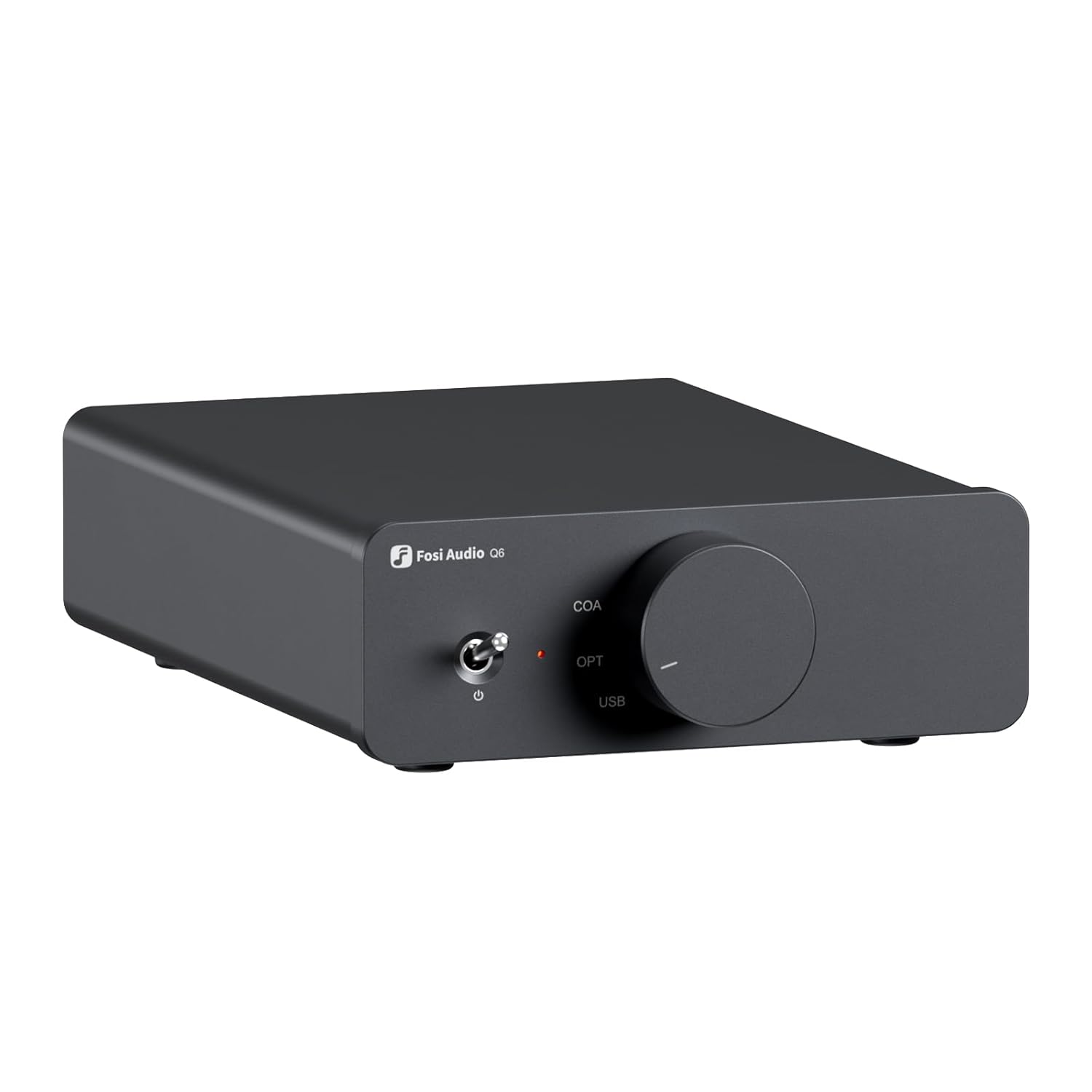
The Fosi Audio Q6 is a desktop digital-to-analog converter designed for anyone looking to dramatically improve their digital audio playback without spending a fortune. Whether you're connecting a streaming device, computer, TV, or CD player to your stereo amplifier, powered speakers, or headphone amp, this compact DAC acts as the crucial bridge that transforms digital signals into beautiful analog sound.
What makes the Q6 truly stand out is its impressive technical foundation combined with real-world listening performance. The AKM AK4493S DAC chip, XMOS XU316 processor, and OPA1612 op-amp work together to support extremely high-resolution audio formats including PCM up to 32bit/768kHz and DSD512. Users consistently report that the sound quality rivals DACs costing significantly more, with praise for clarity, dynamics, and the ability to reveal nuances in music that cheaper converters miss. The measured performance backing this up is equally impressive, with a signal-to-noise ratio exceeding 121dB and distortion below 0.00012%, ensuring clean and accurate conversion.
The design philosophy here is refreshingly practical. The aluminum alloy chassis is built to last, with a sleek profile that fits naturally on any desktop without taking up excessive space. The input selector knob on the front is the only control, making operation intuitive once you understand it switches between USB, optical, and coaxial inputs rather than controlling volume. Connectivity is comprehensive, offering USB-C, optical, and coaxial digital inputs alongside RCA stereo outputs and a dedicated subwoofer output, making it compatible with virtually any audio source and destination.
Setup is genuinely effortless. Many users report simply plugging in the USB connection and audio cables, then immediately enjoying improved sound quality without any driver installation or configuration hassles on Windows, macOS, or Linux. This plug-and-play reliability makes the Q6 accessible to both casual listeners and experienced audiophiles. Some users have even upgraded the internal op-amp to aftermarket components, with excellent results for those seeking further refinement.
The main consideration is that the Q6 requires USB power, so it cannot operate independently. Additionally, while the compact design is a strength for desktop placement, it leaves limited room for internal modifications compared to larger units. Despite these minor points, the Q6 represents outstanding value in the desktop DAC category, delivering professional-grade audio conversion at a price that makes high-resolution audio accessible to everyone.
Audio Performance: Maximum sampling rates of PCM 32bit/768kHz and DSD512 support, Signal-to-Noise Ratio greater than 121dB, Total Harmonic Distortion less than 0.00012%
Processor and Components: AKM AK4493S DAC chip, XMOS XU316 audio processor, OPA1612 operational amplifier
Connectivity: Digital inputs: USB-C, Optical (TOSLINK), Coaxial (RCA). Audio outputs: RCA stereo, Subwoofer output (RCA)
Compatibility: Windows, macOS, Linux, and all USB audio sources including computers, tablets, CD players, and streaming devices
Construction: High-quality aluminum alloy chassis, compact form factor, 2 channels stereo audio, 2.2 pounds
Warranty: 24-month manufacturer warranty included
Who Should Buy This: Music enthusiasts and casual listeners who want noticeably better sound quality from their digital sources, including those upgrading old receivers or amplifiers to work with modern streaming devices and computers. Also ideal for anyone seeking high-resolution audio support without the premium pricing of boutique DAC manufacturers.
Connection Setup: Connect your digital source (computer, streamer, CD player, TV) to one of the three digital inputs using USB-C, optical, or coaxial cable. Connect the RCA outputs to your amplifier, powered speakers, or headphone amplifier. The subwoofer output can feed a powered subwoofer for enhanced bass in your system.
Key Advantages Over Built-in Audio: Most computers, tablets, and televisions have mediocre built-in audio converters. The Q6's superior components and design eliminate the digital noise and distortion inherent in consumer electronics, revealing more detail, clarity, and musicality in your favorite recordings.
Upgrade Potential: While the Q6 performs excellently out of the box, some experienced audiophiles have successfully upgraded the op-amp to higher-performance alternatives, which can provide further refinement. The unit's design accommodates this modification for those interested in tweaking.

Pros
- Exceptional audio quality with professional-grade components that justify the price for serious listeners
- Versatile connectivity with Bluetooth 5.4 LDAC, USB, and dual analog outputs covering every audio source
- Universal headphone compatibility from 16-600Ω impedance handles everything from budget earbuds to high-end audiophile gear
- Intuitive controls with one-button output switching and volume memory reduce daily friction
- Compact desktop footprint with elegant design doesn't dominate your workspace
Cons
- Requires DC 5V/2A power adapter, adding another cable to your desk setup
- Premium pricing puts it above entry-level DACs, though justified by component quality
- No built-in display for input or codec information, relying on indicator lights instead
The AIYIMA DAC A7 is a desktop-class digital-to-analog converter and headphone amplifier designed for anyone serious about audio quality. Whether you're a music producer, competitive gamer, or casual audiophile, this device sits between your computer or phone and your headphones to dramatically improve sound clarity and detail. It combines Bluetooth wireless convenience with traditional wired connectivity, making it adaptable to virtually any listening scenario.
The standout feature is its professional-grade component stack: the ES9038Q2M decoding chip is typically found in high-end audio equipment, paired with OPA1612 op-amps and a TPA6120A2 amplifier chip. Real-world performance delivers on the specs, with a claimed 120dB signal-to-noise ratio and distortion below 0.0003%. The Bluetooth 5.4 implementation supports LDAC and aptX-HD codecs, enabling high-resolution wireless audio up to 96kHz/24-bit. This means you get studio-quality sound even from your phone without wires.
Build quality reflects its price point: the compact titanium gray chassis feels solid and desktop-friendly. The dual output jacks (3.5mm and 6.35mm) with one-button switching is genuinely convenient, eliminating the need to constantly plug and unplug different headphones. The 1500mW power output at 32Ω ensures it can drive everything from low-impedance portable headphones to high-impedance professional studio monitors, with no wimpy sound or distortion.
The main drawback is that you'll need a separate 5V/2A power adapter, adding another cable to your desk. Additionally, there's no digital display showing input source or Bluetooth codec information, though indicator lights provide basic feedback. At this price point, some users might expect more visual feedback about what's actually playing.
Overall, the AIYIMA DAC A7 delivers exceptional value for serious listeners who want measurable improvements in audio quality. The combination of high-end components, wireless convenience, and universal headphone compatibility makes it one of the better choices in the mid-range DAC market. Recommended for anyone upgrading from their computer's built-in audio.
DAC Chip: ES9038Q2M Hi-Fi grade decoding chip
Amplifier Chip: TPA6120A2 headphone amplifier with OPA1612x4 op-amps
Audio Performance: Signal-to-noise ratio 120dB or higher, total harmonic distortion 0.0003% or lower
Bluetooth: Bluetooth 5.4 with Qualcomm QCC3084 chip, supports LDAC and aptX-HD codecs, up to 96kHz/24-bit resolution
Headphone Impedance Range: 16-600 ohms
Output Power: 1500mW at 32 ohms
Connectors: Dual 3.5mm and 6.35mm headphone outputs, USB input, separate power input
Power Requirements: DC 5V, minimum 2A
Compatibility: Windows, macOS, Linux, iOS, Android (driverless)
Design: Compact titanium gray chassis with independent power and audio circuits
Who Should Buy This: The AIYIMA DAC A7 is ideal for music enthusiasts, gamers, content creators, and anyone using high-quality headphones. If you're spending more than $100 on headphones, a dedicated DAC and amplifier will noticeably improve your listening experience. It's also perfect for desktop setups where you want to consolidate multiple audio sources into one high-quality hub.
Who Might Skip It: If you primarily use budget headphones under $50 or only listen to compressed audio formats, the improvements may be subtle. Similarly, if your setup is already optimized with separate DAC and amp components, this all-in-one approach might not add value.
Key Considerations: Ensure your headphones are at least 16 ohms impedance (virtually all modern headphones are). You'll need a 5V/2A power adapter nearby. The Bluetooth codec support depends on your source device, so check if your phone or computer supports LDAC for wireless high-resolution audio. The dual output jacks mean you can leave headphones permanently connected and switch between them with one button.
Setup Tips: Place the DAC on your desk within reach of your audio sources. Use a quality USB cable if connecting to a computer. Enable LDAC in your phone's developer settings if available for best wireless quality. The device automatically remembers your last input and volume, so daily operation is seamless.

Pros
- Exceptional audio clarity and detail with professional-grade DAC chip and optimized circuit design for low distortion
- Versatile connectivity with USB Type C, optical, and coaxial inputs compatible with virtually any audio source
- Powerful amplification drives high-impedance headphones with ease while maintaining clean, detailed sound
- Intuitive physical controls for bass and treble adjustments allow quick sound tuning without menu navigation
- Solid build quality with aluminum housing and premium feel inspires confidence in long-term reliability
Cons
- USB Type C port serves dual purpose for both charging and audio input, which may limit simultaneous phone charging while using the DAC
- Requires separate USB-A to USB-C cable for some devices, adding minor complexity to initial setup
- May require driver installation on some older PC systems for full compatibility
The Fosi Audio K5 Pro is a premium desktop DAC and headphone amplifier designed for gamers, music enthusiasts, and anyone seeking superior audio quality from their PS5, PC, Mac, or mobile device. This compact unit functions as an external sound card, converting digital audio signals into clean analog output while simultaneously amplifying headphones to their full potential.
What sets the K5 Pro apart is its impressive technical foundation. Built around the renowned Texas Instruments NE5532 op-amp chip, this DAC achieves exceptionally low distortion (THD at 0.003%) and a noise floor that rivals much more expensive equipment. The multiple connectivity options, including USB Type C, optical, and coaxial inputs, ensure compatibility with virtually any modern audio source. Users report noticeably improved audio clarity, better spatial imaging in games, and the ability to hear subtle details like footsteps and directional cues that competitive gamers value.
The physical design deserves praise. The all-aluminum chassis feels solid and premium, with rubber feet that prevent vibration and movement on desktop surfaces. The rotary knobs for volume, bass, and treble adjustment provide satisfying tactile feedback and allow real-time sound customization without diving into software menus. The compact footprint makes it unobtrusive in any gaming or music setup, while the dual headphone and microphone jacks eliminate cable clutter.
One consideration is the dual-purpose USB Type C port, which handles both power and audio input simultaneously. While this design is clever and space-efficient, it means you cannot charge a phone while using the DAC. Additionally, some older PC systems may require driver installation for full compatibility, though most modern computers recognize it immediately as a supported audio device.
The K5 Pro delivers exceptional value for the price, offering studio-quality audio conversion and powerful headphone amplification that transforms gaming and music listening experiences. Whether you're a competitive gamer seeking audio clarity, a music lover wanting better sound quality, or someone tired of weak onboard audio, this DAC amp combo represents a smart upgrade that pays dividends immediately.
Audio Specifications
USB Type C input: 24-bit/96kHz maximum sampling rate
Optical/Coaxial input: 24-bit/192kHz maximum sampling rate
Total Harmonic Distortion (THD): Less than 0.003%
Signal-to-Noise Ratio (SNR): Greater than or equal to 110dB
Output power: 1000mW at 16 ohms, 500mW at 32 ohms, 300mW at 64 ohms, 150mW at 128 ohms, 80mW at 300 ohms
Connectivity
Inputs: USB Type C, Optical (SPDIF), Coaxial (RCA)
Outputs: 3.5mm headphone jack, RCA stereo outputs, 3.5mm microphone input
Headphone impedance support: 16 ohms to 300 ohms
Physical Specifications
Housing: Aluminum chassis with rubber feet
Controls: Combined power and volume button (long press to power on), separate bass and treble controls, input mode selector
Included accessories: 3.5mm headphone splitter, 2-in-1 USB Type A/C to Type C cable, optical cable, user manual
Who Should Buy the K5 Pro
The Fosi Audio K5 Pro is ideal for PS5 and PC gamers seeking audio advantages, audiophiles wanting better sound from their computers, and anyone with high-impedance headphones that their current equipment struggles to drive. It's also excellent for content creators, streamers, and music producers who need clean audio conversion without breaking the bank.
Compatibility Considerations
The K5 Pro works seamlessly with PS5 via USB-A to USB-C cable connection. PC and Mac users benefit from plug-and-play compatibility on most modern systems, though older Windows installations may require driver setup. The dual USB Type C port handles both power and audio, so ensure your source device has USB Type C capability or use the included USB-A to USB-C adapter cable.
Headphone Pairing
This DAC excels with high-impedance headphones (100 ohms and above) that struggle with standard headphone outputs. However, it also drives sensitive IEMs beautifully thanks to its low noise floor. The bass and treble controls allow customization for different headphone signatures, making it versatile across various audio gear.
Setup Tips
For optimal performance, use the included cables when possible. When connecting to powered speakers or subwoofers via RCA outputs, ensure proper gain staging to avoid distortion. The optical and coaxial inputs support higher resolution audio (up to 192kHz), so prioritize these connections for critical listening when available.

Pros
- Exceptional power output drives both sensitive IEMs and high-impedance full-size headphones with clarity
- Browser-based EQ customization saves profiles directly to device without requiring additional software
- Dual connectivity options (USB-C and USB-A) work seamlessly with Android, iOS, Windows, and macOS
- Compact aluminum construction at 110g makes it genuinely portable for travel and daily use
- Competitive pricing offers professional-grade DAC-amplifier features at accessible price point
Cons
- Not water resistant, limiting use in wet environments or outdoor conditions
- Browser-based EQ interface requires learning curve to optimize custom sound profiles effectively
- Some early units reported rare quality control issues with channel distortion after extended use
The CrinEar Protocol Max is a portable DAC-amplifier designed for serious listeners who want studio-quality sound from their mobile devices and computers. It combines dual Cirrus Logic CS43198 DAC chips with dual SG Micro amplifiers to deliver both pristine digital-to-analog conversion and powerful amplification in a compact 110-gram aluminum chassis. This device targets audiophiles, music producers, and discerning music fans who refuse to compromise on sound quality when away from their desktop setup.
The standout feature is its 600mW balanced 4.4mm output, which delivers enough power to drive demanding headphones like the Sennheiser HD 650 at comfortable volumes around 25-30% instead of 50-60% on typical sources. The 10-band parametric equalizer accessed through a web browser allows precise sound tuning without installing apps, and custom profiles save directly to the device. Real-world users report transformative improvements in headphone performance, with the ability to compensate for frequency response issues and personalize the listening experience across different audio sources.
Design and build quality impress with the sleek aluminum enclosure, dual output options (balanced 4.4mm and single-ended 3.5mm), and thoughtful controls including volume and playback buttons. The device includes both USB-C and USB-A adapters, ensuring compatibility with Android phones, iPhones via USB-C, Windows computers, and macOS systems. Dual power modes provide flexibility between extended battery life in Eco mode and maximum output performance in Boost mode for demanding listening sessions.
The primary drawback is lack of water resistance, which restricts use in wet environments. Additionally, the browser-based EQ interface requires some learning and experimentation to dial in optimal sound profiles, though most users find this intuitive after initial setup. A small number of early units experienced rare quality control issues, though newer batches appear to have resolved these concerns.
The Protocol Max represents genuine value for portable audio enthusiasts seeking professional-grade DAC-amplification with extensive customization capabilities. Its combination of dual premium DAC chips, powerful amplification, customizable EQ, and universal device compatibility makes it one of the most feature-rich portable audio solutions available at this price point. Highly recommended for anyone serious about portable audio quality.
Audio Components: Dual Cirrus Logic CS43198 DAC chips, Dual SG Micro SGM8262-2 operational amplifiers, 0.2 ohm output impedance, 20 Hz to 384 kHz frequency response.
Power Output: 600mW maximum via balanced 4.4mm connection, with Eco and Boost power modes for battery optimization or maximum performance.
Connectivity: USB-C and USB-A inputs, balanced 4.4mm output, single-ended 3.5mm output, compatible with Android, iOS, Windows, and macOS devices.
Design: Aluminum enclosure, 110g weight, push-button controls with volume and playback functions, includes USB-C to USB-C cable and USB-C to USB-A adapter.
Warranty: 1-year manufacturer warranty covering defects and malfunctions during normal use.
Who Should Buy: The Protocol Max is ideal for audiophiles, portable audio enthusiasts, music producers, and anyone with high-impedance headphones seeking better amplification and sound customization. Perfect for travel, commuting, or office use with laptops and smartphones.
Compatibility Check: Verify your headphones have either 4.4mm balanced or 3.5mm single-ended connectors. The device works with any USB-C or USB-A equipped device including iPhones with USB-C, Android phones, Windows PCs, and Mac computers.
Setup Tips: Download the browser interface to your computer, connect the Protocol Max via USB, and spend time experimenting with the 10-band EQ to find your preferred sound signature. Save custom profiles for different headphone models to switch between them easily.
Power Modes: Use Eco mode for extended battery life during casual listening, switch to Boost mode when driving demanding headphones or for maximum audio clarity during critical listening sessions.
Not Recommended If: You need water resistance for outdoor or wet environments, prefer app-based controls over browser interfaces, or exclusively use wireless headphones without wired connections.
Buying Guide: How to Choose Your DAC
Desktop vs. Portable Design
Your primary use case dictates the ideal form factor. A compact desktop DAC, like the models from Fosi Audio, is perfect for a permanent home office or entertainment center setup. They often offer more robust input/output options and draw power from a wall outlet. For mobility with a laptop, phone, or handheld gaming device, a truly portable DAC-amplifier is essential. These are bus-powered and designed for easy transport. Our guide on the best desktop DAC-AMPs explores this category in greater detail.
Connectivity and Inputs
Consider what devices you need to connect. A versatile DAC should have the inputs for your sources. USB-C is now standard for computers and modern phones. Optical and coaxial inputs are crucial for connecting to TVs, game consoles, or CD players. Some models also include Bluetooth for wireless convenience, though this often comes at a slight cost to maximum audio fidelity compared to a wired connection.
Output Power and Headphone Support
<!–If you plan to drive headphones directly from the DAC, pay close attention to its amplifier section. Check the supported impedance range and output power. Models with higher power output can properly drive demanding over-ear headphones, while all should handle efficient in-ear monitors (IEMs) with ease. Some units feature both single-ended (3.5mm) and balanced (4.4mm) outputs for greater compatibility and potential performance gains. For more on powerful compact solutions, see our roundup of the best portable DAC-AMPs.
Key Features and Sound Customization
Look for features that match your needs. Gamers might prioritize a dedicated microphone input. Audiophiles may value a high-performance DAC chipset from brands like AKM or ESS. Advanced users might seek parametric equalization (PEQ) for precise sound shaping. Simpler models focus on a clean, neutral signal path. It’s about finding the right balance between essential performance and the extra tools you will actually use.
Final Thoughts
Upgrading your audio with one of the best DACs under $100 is a remarkably effective way to enhance your daily media consumption. Whether you need the versatile connectivity of a compact desktop unit for your home theater or the powerful, customizable output of a portable device for your headphones, there is a validated option here for you. For users building a dedicated desktop listening station, the Fosi Audio Q6 Mini Desktop DAC offers exceptional value and connectivity. Meanwhile, listeners seeking maximum flexibility and power on the go should strongly consider the feature-packed Protocol Max | Portable DAC-Amplifier with 10-Band for its unique sound tailoring capabilities.
Frequently Asked Questions
Will a DAC under $100 really make a noticeable difference?
Absolutely. The DACs in this range use dedicated, high-quality audio chips that far surpass the basic components found in most consumer electronics. The difference is often heard as greater clarity, more defined instrument separation, and a wider, more immersive soundstage compared to your computer or phone’s built-in output.
Do I need a separate amplifier if I buy a DAC?
It depends on the product. Many modern units, like the ones reviewed here, are DAC-amplifier combos. They contain both the converter and a headphone amplifier in one box, so no separate amp is needed to drive headphones. If you are connecting to a stereo amplifier or powered speakers, you only need the DAC function. You can explore dedicated best DAC-AMPs for more integrated solutions.
What is the main benefit of a balanced headphone output?
A balanced connection, typically using a 4.4mm or XLR connector, can provide more power to your headphones and often results in a lower noise floor and improved channel separation. This can lead to a cleaner, more dynamic sound, especially with high-impedance or power-hungry headphones.
How do I connect a DAC to my TV or game console?
For modern TVs and consoles like the PS5 or Xbox Series X, you will typically use an optical audio cable (Toslink). You connect the optical output from your TV or console to the optical input on the DAC. This bypasses the TV’s internal audio processing and sends a pure digital signal to your high-quality DAC for superior sound conversion.


Write Your Review
No reviews yet. Be the first to share your experience!