

You’ve assembled a high-quality amplifier and a pair of pristine studio monitors or powered speakers. Now, you need the final piece to unlock their full potential: a desktop DAC with a balanced XLR output. This connection isn’t just for professionals; it provides superior noise rejection and signal integrity, especially over longer cable runs, ensuring your music arrives exactly as intended. This guide is for audiophiles and home audio enthusiasts looking to build or upgrade a system with clean, detailed sound, focusing on DACs that offer this crucial professional-grade connection.
We have assessed a range of popular desktop DACs from respected brands in the category. Whether you need a pure DAC, a versatile all-in-one unit with a headphone amplifier, or a network streaming solution, our comparison will help you identify the right device for your specific needs. For more options on balanced desktop audio components, explore our guide on the best balanced desktop DACs.

Pros
- Exceptional codec support including LDAC and aptX HD enables true hi-res wireless audio streaming
- Versatile multi-output design with all outputs active simultaneously allows flexible routing in complex audio setups
- Commercial-ready features like custom Bluetooth naming and passcode protection are rare at this price point
- Responsive customer support praised in multiple reviews for quick and effective troubleshooting
- Solid build quality with a satin black alloy chassis and reliable long-term performance confirmed by real-world users
Cons
- Power adapter is not included in the box, which may be an inconvenience for first-time buyers who need to source one separately
- RCA, coaxial, and XLR cables are also not included, adding potential extra cost to get fully connected out of the box
- Functions only as a receiver, not a transmitter, so users hoping to send audio from a TV or stereo to Bluetooth headphones will need a different device
The blafili B3 is a professional Bluetooth 5.1 audio receiver designed to add wireless streaming capability to existing wired sound systems. It is aimed at a wide audience ranging from home audiophiles and hi-fi enthusiasts to AV installers working in schools, churches, gyms, and commercial venues. Rather than replacing your amplifier or speakers, it slots seamlessly into any setup as a high-quality wireless front end.
The standout feature of the B3 is its combination of a Qualcomm QCC5125 Bluetooth chipset and an ESS ES9018K2M DAC. Together, these components deliver stable wireless connectivity and audiophile-grade audio conversion with low noise, low distortion, and a wide dynamic range. Codec support is comprehensive, covering LDAC, aptX HD, aptX Low Latency, aptX, AAC, and SBC, meaning the B3 can extract the best possible audio quality from virtually any Bluetooth source device.
Connectivity is a genuine strength of this unit. All four output types, including balanced XLR, RCA, optical Toslink, and coaxial, can operate simultaneously, giving users maximum flexibility in routing audio to multiple destinations. The removable RP-SMA antenna supports a wireless range of up to 100 feet, and real-world reviewers have confirmed solid, uninterrupted connections across large spaces like school theaters. The silent pairing mode, which eliminates the beeps and voice prompts common on cheaper receivers, is a thoughtful touch for professional and quiet environments.
On the downside, the B3 ships without a power adapter, RCA cable, coaxial cable, or XLR cable, so buyers should budget for accessories. It is also strictly a receiver and cannot transmit audio from a TV or stereo to Bluetooth headphones, a point the manufacturer is upfront about but which can catch some buyers off guard. The USB DAC functionality is a welcome bonus but is limited to 16-bit 48kHz resolution rather than higher PCM rates.
Overall, the blafili B3 represents exceptional value for a professional-grade Bluetooth receiver. It earns high praise from audiophiles, PA installers, and commercial users alike for its sound quality, build, and feature set. For anyone looking to add reliable, high-resolution wireless audio to a wired system, the B3 is one of the most capable and well-rounded options available at this price.
Bluetooth Version: 5.1 with Qualcomm QCC5125 chipset. Supported Codecs: LDAC, aptX HD, aptX Low Latency, aptX, AAC, SBC. DAC: ESS ES9018K2M for low noise and wide dynamic range audio conversion.
Outputs: Balanced XLR (L+R), RCA (L+R), Optical Toslink, Coaxial. All outputs operate simultaneously. USB DAC: Plug-and-play, up to 16-bit 48kHz. Wireless Range: Up to 33 meters (100 feet) with included RP-SMA antenna.
Display: 1.3-inch diagonal status screen. Dimensions: 3 inches deep x 5.6 inches wide x 1.5 inches high. Weight: 0.24 kg. Power: USB-C 5V (adapter not included). Warranty: 3-year manufacturer warranty.
In the Box: blafili B3 unit, removable RP-SMA antenna, USB to USB-C power cable, optical cable, 4 self-adhesive feet bumpers, quick start guide. Note: power adapter, RCA cable, coaxial cable, and XLR cables are not included.
The blafili B3 is the right choice if you already own a wired audio system, such as a hi-fi amplifier, powered speakers, a PA mixer, or an AV receiver, and want to add high-quality Bluetooth streaming without sacrificing sound quality. It is not suitable for driving passive speakers directly, and it cannot send audio from a TV or stereo to wireless headphones or Bluetooth speakers.
For home audiophiles, the LDAC and aptX HD codec support means you can stream at near-lossless quality from a compatible Android phone or Sony device. Pair it with a tube amplifier or high-end integrated amp via the balanced XLR outputs for the cleanest possible signal path. The ESS DAC ensures the analog conversion is transparent and detailed.
For commercial or institutional installers, the customizable Bluetooth device name and optional 4-digit passcode are key differentiators. These features let you manage multiple units in the same building without confusion or unauthorized connections. The silent pairing behavior and long antenna range make it well-suited for permanent rack-mount installs in theaters, chapels, gyms, and conference rooms.
Before purchasing, make sure you have a USB-C power adapter available, as one is not included. You will also need to source your own RCA, XLR, or coaxial cables depending on your setup. Only an optical cable is provided in the box. If you need to stream audio from a TV to Bluetooth headphones, this device will not fulfill that role and you should look for a Bluetooth transmitter instead.

Pros
- Exceptional sound quality with noticeably wider soundstage and cleaner tonality after break-in period
- Multiple connectivity options cover virtually every audio source from TVs to computers to smartphones
- Excellent build quality with premium components and thoughtful design details throughout
- Remote control with preamp bypass switch offers convenient volume management and system flexibility
- Outstanding value for high-resolution audio capability, punching well above its price point
Cons
- Learning curve for beginners unfamiliar with balanced audio connections and DAC functionality
- Stock op-amps provide clean sound but may lack bass heft compared to upgraded alternatives for critical listeners
The Fosi Audio ZD3 is a flagship desktop DAC preamp engineered for audiophiles, music producers, and home theater enthusiasts seeking high-resolution audio conversion without excessive complexity. It bridges the gap between entry-level and professional-grade equipment, offering studio-quality sound at an accessible price point. Whether you're upgrading dusty studio monitors, building a dedicated listening system, or integrating multiple audio sources into one cohesive setup, the ZD3 delivers the connectivity and performance to make it happen.
At the heart of the ZD3 lies an impressive quad-chipset architecture: XMOS XU316 for digital processing, ES9039Q2M for analog conversion, QCC3031 for Bluetooth, and LME49720 op-amps for amplification. This combination supports DSD512 and PCM up to 32bit/768kHz, ensuring you hear every detail your music files contain. Real-world users report a noticeably airier soundstage with reduced listening fatigue, suggesting the ZD3 truly extracts performance from high-resolution sources. The fully balanced signal path minimizes noise and distortion, while five input options (USB, Bluetooth, Optical, Coax, HDMI ARC) mean you'll never need another converter.
The design philosophy emphasizes both form and function. The compact chassis features an elegant 1.5-inch OLED display showing input selection and volume levels with crystal clarity. The included remote control eliminates the need to reach the unit, while the preamp bypass switch lets you integrate the ZD3 into existing systems without compromising signal integrity. Build quality feels premium throughout, with audiophile-grade components and thoughtful details like 12V trigger connectors for synchronized power management with other equipment.
The primary limitation is the learning curve for newcomers unfamiliar with balanced audio connections and DAC operation. Additionally, while the stock TI op-amps deliver clean, clear sound, some critical listeners upgrading from higher-end equipment may find the bass response slightly less hefty than desired, though this remains a minor consideration at this price level. The ZD3 also requires careful cable selection to maximize performance, which adds a small additional investment.
The Fosi Audio ZD3 represents exceptional value for anyone seeking high-resolution audio conversion with genuine versatility. Its combination of premium chipset, multiple connectivity options, intuitive controls, and outstanding build quality make it the ideal centerpiece for modern home audio systems. Whether paired with powered speakers, integrated into a stereo amplifier setup, or used as a TV audio hub, the ZD3 consistently delivers sound quality that exceeds expectations and justifies its position as a best-seller in the digital audio conversion category.
Audio Processing Chipset: XMOS XU316 + ES9039Q2M + QCC3031 + LME49720
Maximum Audio Resolution: DSD512, PCM 32bit/768kHz
Inputs: USB, Bluetooth 5.0, Optical (TOSLINK), Coaxial (RCA), HDMI ARC
Outputs: Balanced XLR (2), Unbalanced RCA (2)
Display: 1.5-inch OLED display
Control: Remote control included, preamp bypass switch, 12V trigger in/out
Channels: 2 (stereo)
Dimensions: Compact desktop form factor
Weight: 2.7 pounds
Warranty: 24 months manufacturer warranty
Who Should Buy the ZD3: The ZD3 is ideal for music enthusiasts upgrading from basic audio setups, home theater installers seeking TV integration, music producers working with studio monitors, and anyone wanting to unlock high-resolution audio from their digital music library. It's perfect for those with multiple audio sources who want one elegant solution.
Who Might Want to Look Elsewhere: If you need headphone-only output without speaker connections, or if you require extreme bass response from stock components, consider alternative options. Those with extremely tight budgets may find entry-level DACs sufficient, though the ZD3's versatility often justifies the investment.
Setup Tips: Allow 50+ hours of break-in time for optimal sound quality. Use quality interconnect cables to maximize the balanced XLR outputs. The HDMI ARC input eliminates cable clutter when connecting modern TVs. The preamp bypass mode works best when integrating with existing preamps or receivers.
Pairing Recommendations: The ZD3 pairs exceptionally well with the Fosi Audio ZA3 amplifier for a complete, cohesive system. It also integrates seamlessly with powered speakers, traditional stereo amplifiers, and modern AV receivers.

Pros
- Exceptional musicality and detail retrieval that users consistently praise for revealing new dimensions in familiar music
- Versatile R2R architecture with NOS/OS modes provides flexibility for different listening preferences and source materials
- Comprehensive connectivity and powerful headphone amplification make it a true desktop hub for audio
- 10-band PEQ with intuitive app control enables precise sound customization without external EQ hardware
- Excellent build quality with satisfying tactile controls and premium component selection throughout
Cons
- Optical TOSLINK input limited to 96kHz maximum, restricting high-resolution streaming from some sources
- Front panel LED halo lights can become intrusive in dim lighting conditions despite brightness adjustment
- Requires proper setup and understanding of NOS/OS modes to achieve optimal sound quality, not plug-and-play for casual users
The FiiO K13 R2R is a desktop audio powerhouse designed for serious music listeners who demand both sonic quality and versatility. This DAC and headphone amplifier combination serves as a central hub for any desktop audio setup, whether you're using high-end headphones, powered speakers, or integrating into a larger home audio system. It's built for audiophiles who appreciate musicality and want the tools to shape their sound precisely.
What truly sets the K13 R2R apart is its proprietary R2R DAC architecture, which uses 192 ultra-precise 0.1% thin-film resistors to create a uniquely musical presentation. The dual NOS/OS modes give you real flexibility: Non-Oversampling mode preserves the original sampling rate for a natural, organic quality, while Oversampling mode upsamples to 384kHz for enhanced clarity and technical performance. Users consistently report that the K13 reveals details and musicality in their favorite recordings that other DACs simply miss, creating an engaging listening experience that feels less analytical and more emotionally connected.
The 2400mW headphone amplifier output is genuinely powerful, capable of driving even demanding planar magnetic and high-impedance headphones with authority and control. The 10-band parametric EQ with app and web interface control is a game-changer for customization, allowing you to fine-tune the sound to match your headphones' characteristics or your personal preferences. Connectivity is comprehensive with balanced XLR outputs, dual RCA preamp outputs, 4.4mm balanced headphone jacks, and 6.35mm single-ended outputs, making it adaptable to virtually any audio component.
Build quality is solid throughout, with satisfying tactile controls and premium component selection. The display is functional for a desktop unit, and the front panel knobs have excellent detent feel. One caveat: the LED halo lighting around the front knobs can become distracting in dim rooms despite adjustable brightness levels. Additionally, the TOSLINK optical input maxes out at 96kHz, which may limit high-resolution streaming from certain sources like some network streamers that only output via optical.
The FiiO K13 R2R delivers exceptional value for desktop audiophiles seeking musicality, power, and connectivity in one compact unit. It's not a magic bullet that will transform poor recordings, but it excels at revealing the quality and character inherent in well-mastered music. If you appreciate analog warmth, want R2R DAC technology without the premium price tag, and need flexible desktop audio control, this is a compelling choice that justifies its position as a best seller in its category.
DAC Architecture: Proprietary 4-channel fully differential complementary 24Bit R2R DAC with 192 ultra-precise 0.1% thin-film resistors, 30ppm temperature drift
Audio Modes: NOS (Non-Oversampling) and OS (Oversampling with 384kHz upsampling)
Supported Formats: PCM up to 384kHz/32bit, DSD256
Headphone Output: 2400mW power output, 4.4mm balanced and 6.35mm single-ended jacks
Connectivity: XLR balanced line out, dual RCA outputs, TOSLINK optical (up to 96kHz), USB, Bluetooth 5.4 with LDAC/AAC/SBC codecs
EQ: 10-band parametric equalizer with app and web interface control, preset library and sharing
Dimensions: Compact desktop form factor, 0.7 kg weight
Warranty: 1 year manufacturer warranty
Compatible Devices: PC, Laptop, Smartphone, Tablet, Bluetooth-enabled devices
Who Should Buy: Desktop audiophiles with high-quality headphones, music enthusiasts who value musicality over pure technical metrics, and anyone seeking a versatile audio hub that combines DAC, preamp, and headphone amplifier functions. Ideal for those who want R2R DAC character without the ultra-premium price tag.
Who Might Want to Look Elsewhere: Users whose primary source is limited to TOSLINK optical at high-resolution rates (above 96kHz) may face limitations. Those seeking purely clinical, reference-level sound might prefer delta-sigma DACs. Budget-conscious buyers should note this is mid-range pricing for serious audio gear.
Setup Tips: Experiment with both NOS and OS modes to find which suits your music and headphones best. Use the 10-band PEQ to optimize for your specific headphone model. Take advantage of the balanced XLR outputs if connecting to powered speakers or a separate amplifier for superior signal quality.
Key Considerations: This unit benefits from proper setup and understanding of its features. The LED lighting can be dimmed in preferences if it becomes bothersome. Ensure your USB source can provide adequate power, or use the included power supply for optimal performance. The R2R architecture means this is not a neutral reference tool but rather a musicality-focused component designed to enhance enjoyment of your music collection.

Pros
- Exceptional value as an integrated solution combining DAC, headphone amp, and preamp functionality in one device
- High-quality components and balanced circuit design deliver noticeably cleaner, more detailed sound than separate budget alternatives
- Flexible connectivity and output options make it compatible with virtually any audio source, headphone, or powered speaker system
- Intuitive interface with physical controls and remote, plus customizable EQ and filter options for personalized sound tuning
- Strong output power handles both sensitive IEMs and high-impedance headphones without compromise
Cons
- EQ functionality is limited to headphone output only, not available for preamp output to powered speakers
- Some users report the amplifier section sounds slightly sterile compared to dedicated high-end amplifiers when used as a preamp
- Requires direct USB connection to computers in some setups rather than working through USB docks or hubs
The Fosi Audio ZH3 is a premium all-in-one desktop audio solution designed for audiophiles, music producers, and gamers who demand exceptional sound quality without the clutter of multiple components. It combines a high-performance DAC, powerful headphone amplifier, and balanced preamp into a single compact unit, making it an excellent choice for anyone looking to upgrade their listening experience on a budget.
The ZH3 delivers standout performance through its premium chipset architecture, featuring the respected AKM4493SEQ DAC paired with an XMOS XU316 processor and four OPA1612 amplifiers. It supports up to PCM 768kHz/32bit and DSD512, meaning it can handle virtually any audio format you throw at it. The fully balanced circuitry maintains ultra-low noise at just 1.9μV, resulting in clean, detailed sound with minimal distortion. Real-world testing confirms users hear noticeably improved clarity and soundstage compared to budget DAC/amp combos.
The ZH3 excels in versatility and power delivery. Dual output stages provide 640mW at 32Ω on the 6.35mm single-ended output and an impressive 2570mW at 32Ω on the balanced 4.4mm output, easily driving everything from sensitive IEMs to demanding full-size headphones. The three-level gain switch intelligently matches impedance ranges from 16Ω to 300Ω, eliminating the guesswork of volume matching. Four input types (USB, optical, coaxial, RCA) and four output formats (XLR, RCA, 4.4mm, 6.35mm) provide exceptional flexibility for connecting to any audio ecosystem.
Design and usability are thoughtfully executed. The compact desktop form factor integrates all functions into a clean interface with an OLED display and included remote control, allowing seamless switching between headphone and speaker modes with a double-click. Customization options including bass/treble EQ, six filter types, and swappable op-amps enable you to fine-tune the sound signature to match your preferences. However, note that EQ adjustments only apply to headphone output, not preamp output.
The main consideration is that while the ZH3 performs excellently as a DAC and headphone amp, some users report the amplifier section sounds slightly clinical compared to dedicated high-end power amps when used primarily as a preamp. Additionally, USB connectivity can be finicky with certain dock setups. Despite these minor limitations, the ZH3 represents exceptional value as an integrated solution, delivering studio-quality sound and professional features at an accessible price point.
DAC Specifications: AKM4493SEQ DAC with XMOS XU316 processor, supports PCM up to 768kHz/32bit and DSD512, noise floor 1.9μV.
Amplifier Output: 6.35mm single-ended output 640mW at 32Ω (x2 channels), 4.4mm balanced output 2570mW at 32Ω (x2 channels). Three-level gain switch for impedance range 16Ω to 300Ω.
Inputs: USB, optical (TOSLINK), coaxial (S/PDIF), RCA.
Outputs: 4.4mm balanced, 6.35mm single-ended, XLR (preamp), RCA (preamp).
Additional Features: Bass/treble EQ, 6 filter types, swappable op-amps, 12V trigger input, OLED display, remote control, UAC mode switching for gaming consoles.
Physical: Weight 2.9 lbs, compact desktop form factor. Warranty: 24 months.
Who Should Buy: The ZH3 is ideal for desktop audio enthusiasts, music producers, gamers, and anyone using high-quality headphones or powered speakers who wants a single integrated solution. It's perfect if you currently use separate DAC and amp components and want to simplify your setup while maintaining or improving sound quality.
Headphone Compatibility: The three-level gain switch makes the ZH3 compatible with virtually any headphone or IEM on the market, from ultra-sensitive IEMs (16Ω) to demanding full-size cans (300Ω). The balanced 4.4mm output provides exceptional power for even the most demanding headphones.
Speaker Integration: If you use powered active speakers, the XLR and RCA preamp outputs provide fixed-level outputs perfect for driving studio monitors or high-end powered speakers. Note that EQ adjustments only apply to headphone output.
Gaming and Console Use: UAC mode switching ensures full compatibility with gaming consoles for both music playback and gaming audio, making it a versatile choice for streamers and console gamers.
Setup Considerations: For best results with USB connections, connect directly to your computer rather than through USB docks or hubs. After connecting, manually select the ZH3 as your audio output device in your system sound preferences.

Pros
- R2R architecture delivers warmer, more natural sound character compared to conventional delta-sigma DACs
- Comprehensive input support including COAX, optical, USB, and Bluetooth covers virtually all audio sources
- Native DSD512 processing with direct routing preserves the full dynamic range and nuance of high-resolution audio
- Precision FPGA and femtosecond-grade clock module minimize jitter and timing distortions
- Dual balanced XLR and single-ended RCA outputs provide flexible integration with any audio setup
Cons
- Premium pricing reflects the complexity and precision engineering required for R2R architecture
- Limited to 6 customer reviews suggests niche appeal and smaller user base for troubleshooting reference
- Requires careful setup and source optimization to fully realize the sonic benefits of the R2R design
The Gustard DR70n represents a thoughtful approach to high-resolution audio conversion for discerning listeners. This is not a casual streaming device but rather a precision instrument designed for those who have invested in quality source material and speakers. The R2R architecture sets it apart from mainstream DACs, offering a fundamentally different conversion philosophy that prioritizes sonic purity over modern manufacturing convenience.
What makes the DR70n genuinely compelling is its combination of analog elegance and digital flexibility. The discrete R2R ladder network converts digital signals through resistor-based switching rather than high-frequency pulse modulation, resulting in a more direct and inherently pure signal path. Paired with the custom FPGA and CK01 clock module delivering femtosecond-grade precision, this DAC handles everything from standard PCM streams to native DSD512 files without compromise. The direct DSD routing completely bypasses PCM conversion, preserving the full dynamic range of ultra-high-resolution audio.
Build quality and connectivity reflect professional-grade engineering. The compact aluminum chassis maintains a clean aesthetic while housing the complex analog and digital circuitry. Dual outputs (balanced XLR at 4Vrms and single-ended RCA at 2Vrms) with 100-ohm output impedance provide seamless integration into various audio systems. Support for PCM up to 768kHz, DSD up to DSD512, and Bluetooth 5.0 with LDAC ensures compatibility with virtually any contemporary audio source.
The main consideration is that R2R DACs demand precision manufacturing and come at a premium cost. Additionally, extracting the full sonic benefit requires quality source material and careful system matching. This is equipment for enthusiasts who understand the value of the architecture and are prepared to optimize their entire signal chain.
The Gustard DR70n delivers on its promise of natural, detailed sound through thoughtful engineering and proven R2R topology. For desktop audiophiles seeking transparent digital-to-analog conversion without compromise, this DAC justifies its investment through superior sound quality and comprehensive format support.
Digital Inputs: COAX and optical inputs support PCM 16-24bit at 44.1-192kHz plus DSD DoP64. USB and streamer inputs support PCM 16-32bit at 44.1-768kHz, DSD DoP64-DoP256, and native DSD64-DSD512.
Analog Outputs: Frequency response 20Hz-20kHz (±0.2dB in OS mode). Dynamic range exceeds 111dB, signal-to-noise ratio exceeds 113dB, channel crosstalk measures -125dB at 1kHz. THD+N is less than 0.004% at 1kHz with IMD approximately 0.009% at -2dBFS. RCA output provides 2Vrms fixed level, XLR output provides 4Vrms fixed level, both at 100-ohm impedance.
Connectivity: Bluetooth 5.0 with LDAC, AAC, SBC, and aptX support. USB host compatible with Windows 7/8/10/11 (32/64-bit), macOS, and Linux systems.
Physical: Dimensions 220 x 170 x 50mm (excluding protrusions). Net weight 1.5kg. Power consumption under 10W. AC power supply 115V/230V, 50/60Hz.
Ideal For: Desktop audiophiles with high-resolution music libraries seeking transparent analog conversion. Collectors of SACD-format DSD recordings. Listeners prioritizing sonic purity over convenience. Those with existing quality speaker systems or headphone amplifiers ready for premium DAC integration.
Consider Alternatives If: You primarily stream compressed audio formats or use mobile devices as primary sources. You prefer plug-and-play simplicity over optimized system integration. Your budget is constrained and conventional delta-sigma DACs meet your needs adequately.
Warranty: One-year manufacturer warranty covers defects in materials and workmanship. Professional support available through Fanmusic distribution channels.
Pros
- Exceptional value for professional-grade DAC and amplifier functionality in one unit
- Transparent, neutral sound signature with excellent channel matching from DAC-controlled volume
- Versatile connectivity and multi-platform support across Windows, Mac, Linux, iOS, and Android
- Feature-rich design with customizable EQ and multiple output modes for any audio setup
- Robust 2-year manufacturer warranty provides peace of mind
Cons
- Quality control concerns reported by some users, particularly with headphone jack durability during hot-swapping
- Requires careful handling to avoid damaging connectors, as they lack protective design
- May require learning curve to fully utilize advanced PEQ and system integration features
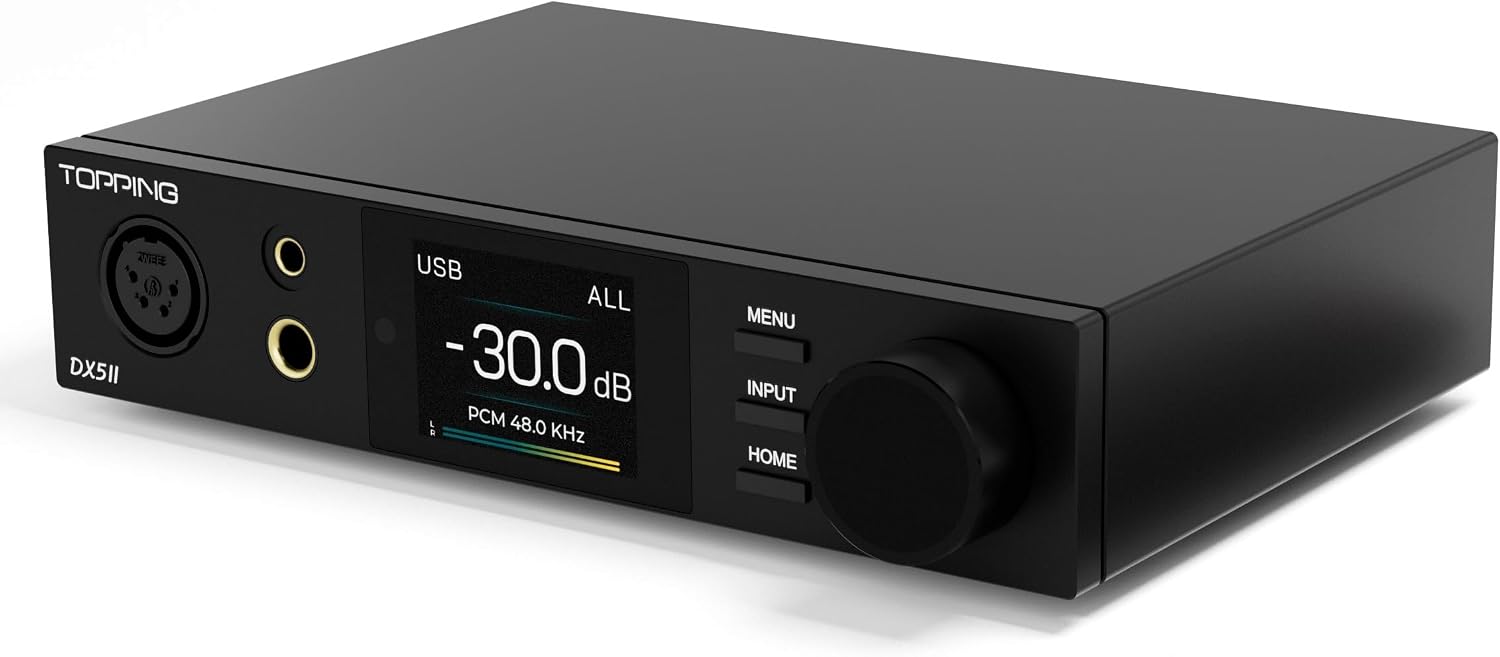
The TOPPING DX5 II is a desktop DAC and headphone amplifier combo designed for serious audiophiles, content creators, and HiFi enthusiasts who demand professional audio quality without the premium price tag. It combines dual ESS9039Q2M DAC chips with a powerful X-Hybrid balanced amplifier in a single compact unit, making it an excellent centerpiece for a high-end audio workstation.
The standout feature is its dual DAC architecture paired with 7600mW of balanced power output, delivering transparent and detailed sound reproduction. The 10-band parametric EQ is a game-changer for customization, allowing users to fine-tune their system to match their headphones, room acoustics, or personal preferences. LDAC Bluetooth 5.1 support brings wireless convenience without sacrificing audio quality, while the Aurora UI display makes navigation and mode switching intuitive and visually appealing.
Build quality is solid with metal and plastic construction, though some users have noted that the headphone jacks lack protective design and can be vulnerable to damage during hot-swapping. The internal power supply and extensive connectivity options, including USB, optical, coaxial, and Bluetooth inputs, make it compatible with virtually any audio source and operating system.
The main drawback is the reported quality control inconsistency with connector durability. Users should avoid frequent hot-swapping of headphone cables and handle connections carefully to prevent premature failure. Despite this concern, the unit delivers exceptional audio performance and versatility for the price.
The TOPPING DX5 II is a smart investment for anyone building a professional-grade desktop audio system or upgrading from consumer-level equipment. It offers the features and performance of much more expensive DAC amplifiers, making it a standout value in the audiophile market.
DAC Chipset: Dual ESS9039Q2M
Audio Format Support: PCM up to 768kHz/32bit, DSD512
Headphone Output Power: 7600mW x2 (balanced)
Audio Processing: 10-band parametric EQ with self-developed IV circuitry
Connectivity: USB, Bluetooth 5.1 (LDAC, aptX Adaptive, aptX HD, AAC, SBC), Coaxial SPDIF, Optical SPDIF
USB Controller: XMOS XU316
Bluetooth Chipset: QCC5125
Display: 2.0 inch Aurora UI with 9 customizable themes
Outputs: 4.4mm balanced headphone jack, 6.35mm single-ended headphone jack
Additional Features: 12V trigger in/out, preamp mode, volume control via DAC
Power Supply: 12V DC internal power supply
Compatibility: Windows, Mac, Linux, iOS, Android
Warranty: 2 years manufacturer
Included Accessories: USB A to USB B cable, remote control, power cable, Bluetooth cable, headphone adapter, quick start guide
Who Should Buy This? The TOPPING DX5 II is perfect for desktop audio enthusiasts, professional audio engineers, musicians, and anyone who wants studio-quality sound from their headphones or active speakers. It's ideal if you own demanding high-impedance headphones, multiple IEMs, or want wireless audio without quality loss.
What Makes It Special? The combination of dual DAC chips, powerful balanced amplification, and 10-band EQ in one unit is rare at this price point. Most competitors force you to choose between a standalone DAC and a separate headphone amp. The parametric EQ allows you to compensate for headphone frequency response issues or room acoustics without external software.
Connectivity Considerations: This unit works with almost any audio source thanks to its multiple inputs. Use USB for computers, optical for CD transports or gaming consoles, Bluetooth for mobile devices, and coaxial for digital streamers. The preamp mode lets you connect it directly to powered speakers or active subwoofers.
Important Notes: Handle the headphone connectors gently and avoid frequent hot-swapping to prevent damage. The unit runs cool and quiet, making it suitable for near-field desktop use. Allow time to explore the PEQ settings and Aurora UI themes to maximize your investment.
How to Choose Your Desktop DAC
Prioritize Your Primary Use Case
Your decision should start with how you plan to use the device most often. If your main goal is to connect a computer or TV to a traditional stereo amplifier and speakers, a dedicated DAC preamp like the Fosi Audio ZD3 Desktop DAC Preamp is an excellent choice. For listeners who also use high-impedance headphones, a combo unit with a powerful built-in amp, such as the Fosi Audio ZH3 DAC Headphone Amp, offers greater versatility. If wireless streaming from your phone or tablet is a priority, ensure the DAC supports high-resolution codecs like LDAC.
Evaluate DAC Architecture and Chipset
The core technology inside the DAC significantly influences its sound signature. Most modern DACs use delta-sigma chips from ESS or AKM, known for their precision and low noise. The TOPPING DX5 II, for example, employs dual ES9039Q2M chips for exceptional measured performance. Alternatively, R2R ladder DACs, like those in the FiiO K13 and Gustard DR70n, offer a distinct, often more “analog” or natural tonal character prized by many enthusiasts. Understanding this basic difference helps narrow your search based on sonic preference.
Check for System Integration Features
Consider how the DAC will fit into your existing setup. Look for a 12V trigger output, which allows the DAC to automatically turn on your connected amplifier or powered speakers. A remote control is invaluable for desktop or living room use. If you plan to drive active studio monitors directly, confirm the unit has a proper preamp function with volume control via its XLR outputs. These small details greatly enhance daily usability and create a seamless, integrated system. For setups involving demanding headphones, you might also consider our review of the best desktop DAC-AMPs for high impedance headphones.
Balance Inputs and Outputs
Ensure the DAC has the inputs you need now and might need later. USB is standard for computer audio, while optical or coaxial inputs are essential for connecting TVs, game consoles, or CD transports. A standout feature like HDMI ARC on the Fosi Audio ZD3 simplifies TV audio integration. On the output side, while XLR is your focus, having both XLR and RCA outputs provides flexibility for connecting to different types of downstream equipment, making the DAC a more future-proof centerpiece for your audio chain.
Final Thoughts
Selecting the right desktop DAC with XLR output is a decisive step toward achieving reference-quality audio in your home. For those seeking an exceptional all-in-one solution that masters both headphone and speaker duties, the FiiO K13 R2R Desktop DAC & Headphone Amp offers a unique and musical R2R experience. Alternatively, if your priority is a pure, feature-packed DAC preamp to serve as the heart of a stereo system, the Fosi Audio ZD3 Desktop DAC Preamp delivers remarkable performance and connectivity, including handy HDMI ARC support. Whichever path you choose, you’re investing in the clarity and balance that only a dedicated DAC can provide.
Frequently Asked Questions
Why is a balanced XLR output important for a desktop DAC?
A balanced XLR connection uses three conductors to carry the audio signal. This design actively cancels out noise and interference picked up by the cable, which is especially beneficial in home environments with many electronic devices. It results in a cleaner, quieter, and more dynamic signal, particularly over cable runs longer than a few feet, making it the preferred connection for critical listening and professional applications.
Can I use a DAC with XLR outputs with my regular RCA-input amplifier?
Yes, but not directly. You would need a dedicated XLR-to-RCA cable or adapter. It is crucial to verify that the DAC’s XLR output is compatible with an unbalanced RCA connection; some units may output too high a voltage. A safer and more flexible approach is to choose a DAC that includes both XLR and RCA outputs, like most models in our comparison, allowing you to connect to virtually any amplifier or powered speaker.
What’s the difference between a DAC preamp and a DAC headphone amp?
A DAC preamp is designed primarily to connect to an external power amplifier or active speakers, providing source switching and volume control. A DAC headphone amp includes a powerful amplifier circuit specifically for driving headphones, often with both single-ended and balanced headphone jacks. Many modern devices, like the Fosi Audio ZH3, combine both functions into a single versatile unit, serving as the central hub for both speaker and headphone listening.
Do I need special software or drivers to use these DACs?
Most DACs reviewed here are class-compliant on modern operating systems like macOS, Linux, Android, and iOS, meaning they will work plug-and-play without additional drivers. For Windows computers and the highest audio resolutions, you may need to install a specific driver provided by the manufacturer. For portable audio needs, explore our list of the best portable USB-C DACs for similar plug-and-play convenience on the go.


Write Your Review
No reviews yet. Be the first to share your experience!