

You have a great TV and a comfortable couch, but your movie nights still lack that heart-pounding, immersive thrill of a real cinema. The sound feels flat, confined to the screen, missing the overhead dimension that makes rain feel like it’s falling on you and helicopters sound like they’re flying through your living room. The secret to unlocking this experience lies in upgrading to a Dolby Atmos capable audio system, and the foundation of that system is a pair of powerful floorstanding speakers.
This guide is for home theater enthusiasts ready to take the plunge into three-dimensional audio. We have carefully reviewed the leading floorstanding speakers equipped for Dolby Atmos, focusing on models from renowned brands like Klipsch and Jamo. Our goal is to help you select the right towers to build a soundstage that truly surrounds you. For those seeking substantial presence, our review of the best large floorstanding speakers offers additional options.

Pros
- Highly efficient and sensitive design means they sound loud and detailed even with modest amplifiers
- Integrated Atmos elevation channel removes the need for additional height speakers in a surround setup
- Consistently praised by verified buyers for crisp, clear sound across music, movies, and TV
- Solid MDF construction feels premium and contributes to tight, resonant bass performance
- Strong value proposition as a closeout model, offering flagship-adjacent performance at a reduced price
Cons
- At roughly 22 inches deep and tall, these are large speakers that require dedicated floor space and may overwhelm smaller rooms
- Some buyers note the Atmos elevation feature is less impactful without a compatible AV receiver, limiting full functionality for stereo-only setups
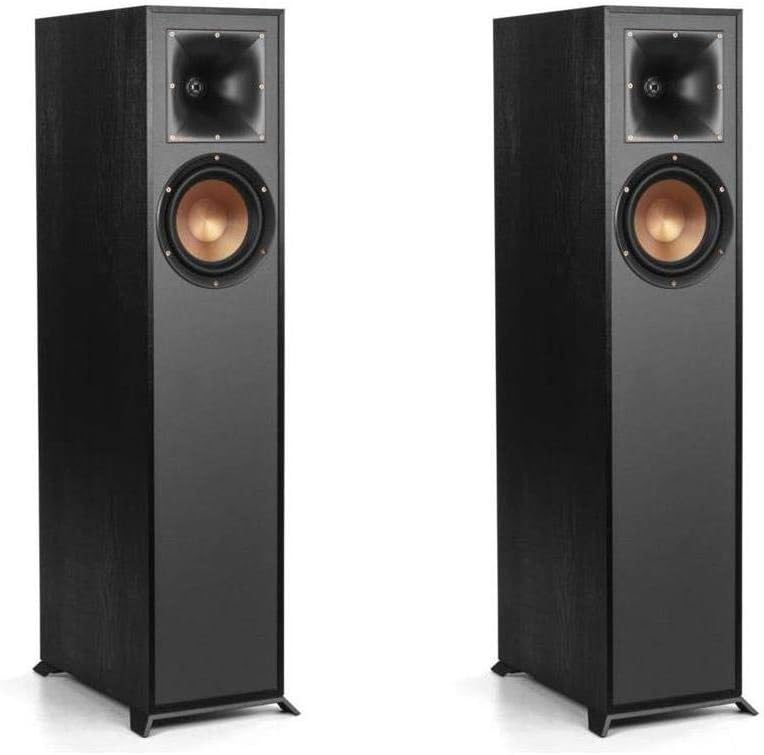
The Klipsch R-26FA is a full-size floorstanding speaker pair designed for home theater enthusiasts and serious music listeners who want immersive, room-filling audio. With built-in Dolby Atmos elevation drivers, these speakers are purpose-built for modern surround sound systems, and they perform just as admirably in a dedicated stereo configuration.
The standout feature is the integrated elevation speaker, which bounces overhead audio off the ceiling to simulate height channels without mounting separate speakers. Combined with the 1-inch aluminum diaphragm compression driver and Klipsch's signature 90x90 Tractrix horn, the high-frequency reproduction is remarkably crisp and airy. Verified buyers consistently highlight the clarity and detail across all types of content, from orchestral music to blockbuster film soundtracks.
Bass performance is handled by dual 6.5-inch copper-spun IMG woofers paired with a front-firing port. The result is deep, well-defined low-end output that holds up at high volumes without becoming muddy or boomy. Multiple reviewers noted these speakers fill large, open living rooms with ease, and several found a dedicated subwoofer unnecessary for everyday listening.
Build quality is a genuine strong point. The MDF cabinet with brushed black polymer veneer feels solid and looks refined, and the dual binding posts add flexibility for bi-wiring or bi-amping. The main drawback is physical size: these are large, heavy speakers that demand floor space and a capable AV receiver to unlock the Atmos functionality. Buyers using a stereo-only amplifier will still enjoy excellent sound, but the elevation driver becomes a passive element.
Overall, the Klipsch R-26FA represents outstanding value for anyone building or upgrading a home theater system. With a near-perfect customer rating backed by hundreds of reviews, and performance that rivals speakers at significantly higher price points, this is a smart buy for audiophiles and casual listeners alike.
Model: Klipsch R-26FA | Color: Black | Enclosure: MDF with brushed black polymer veneer
Tweeter: 1-inch aluminum diaphragm compression driver with 90x90 Tractrix horn | Woofer: Dual 6.5-inch copper-spun IMG woofers | Bass Port: Front-firing reflex port
Power Handling: 100W continuous / 400W peak | Maximum Output: 90W | Input Voltage: 2.83V sensitivity reference
Connectivity: Dual binding posts (bi-wire/bi-amp capable) | Mounting: Freestanding | Dimensions: 22 inches D x 22 inches W x 13 inches H
Special Features: Integrated Dolby Atmos elevation speaker | Warranty: 1 Year Limited | UPC: 846431059725
If you are upgrading from bookshelf speakers or a soundbar and want a significant leap in audio quality, the R-26FA is an excellent entry point into full-size floorstanding performance. They work well in medium to large rooms, ideally open-plan living spaces where their output can fully expand.
To get the most from the Dolby Atmos elevation driver, you will need an AV receiver that supports Atmos height virtualization or object-based audio processing. Popular compatible receivers come from Yamaha, Denon, and Marantz. Buyers using a stereo amplifier will still enjoy excellent two-channel performance, but the elevation channel will not be active.
Because these are efficient, high-sensitivity speakers, they pair well with a wide range of amplifiers, including modestly powered units. However, pairing them with a quality 80 to 150 watt per channel receiver will unlock their full dynamic range. A dedicated subwoofer is optional but can enhance very low bass below 40Hz for dedicated home theater setups.
These speakers are sold as a pair and are intended as front left and right channels. For a complete surround system, Klipsch recommends pairing them with matching Reference Series center and surround speakers for a tonally consistent soundstage throughout the room.
Buying Guide for Dolby Atmos Floorstanding Speakers
Understanding Atmos Implementation
Not all Dolby Atmos floorstanding speakers create overhead sound the same way. The primary method involves integrated upward-firing drivers built into the top of the speaker cabinet. These drivers bounce sound off your ceiling to simulate height channels. Alternatively, some speakers offer dedicated connection terminals for adding separate Atmos elevation modules. Consider your room’s ceiling height and material, as reflective surfaces work best for the bounce method. Explore our dedicated floorstanding speakers category for more foundational information on tower speaker design.
Driver Configuration and Power
The core drivers in a tower speaker determine its overall sound signature and capability. Look for robust woofers, typically 6.5 inches or larger, to handle mid-range and bass frequencies with authority. High-quality tweeters, often horn-loaded in Klipsch models for efficiency, are crucial for clear, detailed highs. Power handling specifications indicate how much amplifier power the speaker can manage, which correlates with volume potential and dynamic headroom. A well-designed multi-way system ensures each frequency band is reproduced accurately.
System Integration and Expandability
<!–Think about your ultimate home theater goals. Are you buying a single pair of towers, or do you plan to build a complete surround system? Some products, like the Klipsch Reference 5.1 Dolby Atmos Home Theater, come as a complete bundle, offering immediate synergy. Others are sold as individual towers, giving you flexibility to mix and match components later. Ensure your chosen speakers have compatible impedance and sensitivity ratings with your existing or planned AV receiver. For the deepest lows, pairing your towers with a dedicated subwoofer is highly recommended.
Aesthetic and Build Quality
Floorstanding speakers are significant pieces of furniture. Their design and finish should complement your room’s decor. Options like walnut veneer or black polymer offer different stylistic choices. Build quality is equally important; cabinets should be rigid and well-braced to minimize unwanted resonance that can color the sound. Magnetic grilles, sturdy binding posts, and thoughtful cable management features all contribute to a premium, user-friendly experience. The construction of a 3-way floorstanding speaker often highlights this level of dedicated acoustic engineering.
Final Thoughts
Upgrading to Dolby Atmos floorstanding speakers is a transformative step for any home entertainment setup. Whether you prioritize the refined, high-performance acoustics of the Klipsch RP-6000F II 2.0 Dual Floorstanding Speaker or seek the outstanding value and ready-to-go immersion of a complete system like the Klipsch Reference 5.1 Dolby Atmos Home Theater, you are investing in an audio experience that pulls you into the heart of the action. The right pair will deliver breathtaking clarity and a truly three-dimensional soundfield for years to come.
Frequently Asked Questions
Do I need a special receiver for Dolby Atmos floorstanding speakers?
Yes, you will need an AV receiver that supports Dolby Atmos processing to decode the height channel information and properly drive the upward-firing speakers or elevation modules. Most modern receivers from the last few years include this feature, but it is essential to verify compatibility before purchasing your speakers.
Can I use Dolby Atmos speakers for regular stereo music listening?
Absolutely. Dolby Atmos floorstanding speakers are full-range stereo speakers first and foremost. When playing standard music or any non-Atmos content, they perform exactly like high-quality traditional towers. The Atmos elevation drivers simply remain inactive, so you get excellent two-channel sound for all your music. For a more compact stereo setup, bookshelf speakers are also a fantastic option.
How important is room setup for the Atmos effect?
Room setup is critical for the optimal Atmos experience. For speakers with upward-firing drivers, a flat, reflective ceiling between 8 and 14 feet high is ideal. The speakers should be placed at the recommended listening position, and most AV receivers include a calibration microphone to automatically adjust timing and levels for your specific room acoustics, which significantly improves the effect.
What is the difference between Atmos-ready and built-in Atmos speakers?
“Atmos-ready” typically means the speaker has terminals to connect separate, add-on elevation modules. “Built-in Atmos” or “integrated Atmos” means the upward-firing drivers are already installed inside the speaker cabinet itself. Built-in models offer a cleaner, all-in-one solution, while Atmos-ready models provide flexibility to upgrade or position the height channels independently.


Write Your Review
No reviews yet. Be the first to share your experience!