

Have you ever felt your high-quality headphones aren’t reaching their full potential when plugged directly into your computer or phone? The built-in audio components in most devices often create a bottleneck, limiting clarity, detail, and power. A dedicated headphone DAC and amplifier is the key to unlocking the true fidelity your audio gear can deliver.
This guide focuses on finding the best headphone DACs under $300, a sweet spot where performance sees a significant leap over basic options. We have reviewed a selection of top models from respected brands like FiiO, TOPPING, and Schiit. Whether you need a compact portable device or a powerful desktop unit, you will find a solution here to elevate your music, gaming, and movie experiences.

Pros
- Exceptional build quality with premium components including custom potentiometer, film capacitors, and 0.5% thin-film resistors
- Versatile compatibility with all headphone types from sensitive IEMs to demanding planar drivers
- Superior sound clarity confirmed by blind listening panels over competing integrated and voltage feedback designs
- True one-box desktop solution combining USB-C DAC input with preamp outputs for speakers
- American-made construction with industry-leading 3-year warranty and proven 13+ year company track record
Cons
- Limited to 115VAC operation, not suitable for 220-240V countries outside North America
- Requires powered speakers or amplifier for speaker output, not a standalone speaker amplifier
- Compact size and desktop orientation may not suit users seeking a larger traditional audio component
The Schiit Magni Unity is a discrete headphone amplifier with integrated Mesh DAC designed for desktop audio enthusiasts who demand superior sound quality without excessive cost. It serves audiophiles, gamers, music producers, and anyone frustrated with motherboard audio quality seeking a meaningful upgrade to their listening experience.
The standout feature is Schiit's proprietary current-feedback discrete topology, a custom-engineered amplifier stage that delivers 10dB better performance than previous Magni models. The integrated USB-C DAC with proprietary digital filter creates a cohesive one-box system, while three gain levels including negative gain ensure compatibility with everything from ultra-sensitive IEMs to power-hungry planar headphones. Real-world users report transformative improvements when pairing it with quality headphones like Sennheiser HD6XX and HiFiMan planar drivers.
Build quality is exceptional throughout. The chassis is metal construction, components include a custom-sorted potentiometer, premium silicon and film capacitors, and precision 0.5% thin-film resistors. The compact desktop footprint feels substantial and durable, with quality knobs and switches. Schiit's decision to manufacture the vast majority of the product in Corpus Christi, Texas reflects commitment to quality control and domestic production.
The primary limitation is 115VAC-only operation, making it unsuitable outside North America. Additionally, the preamp outputs require powered speakers or a separate amplifier for speaker listening, which some users may find inconvenient. The compact form factor, while desktop-friendly, lacks the presence of larger audio components.
The Magni Unity represents excellent value for serious headphone users. Its fully discrete design, modular architecture, comprehensive warranty, and proven performance through blind listening panels make it a compelling choice over mass-produced alternatives. This is a genuine upgrade that transforms how headphones sound, backed by American manufacturing and Schiit's reputation for longevity.
Audio Performance
Output Power: 2.5W (single-ended)
Gain Levels: Three adjustable levels including negative gain for IEMs
Frequency Response: 20 kHz
Impedance: 50,000 ohm
Topology: Current-feedback discrete amplifier stage
Connectivity and Inputs
Primary Input: USB-C (Unison USB DAC)
Headphone Output: 6.35mm jack
Preamp Outputs: RCA connections for powered monitors or amplifiers
Internal DAC: Mesh DAC with proprietary digital filter
Physical Specifications
Color: Black
Weight: 2 pounds
Enclosure Material: Metal chassis
Power Supply: 100% linear power supply
Voltage: 115VAC only (USA, Canada, Mexico)
Warranty and Support
Warranty: 3 years parts and labor
Manufacturer: Schiit Audio (Corpus Christi, Texas)
Design: Modular, non-obsolescent with upgradeable internal DAC card
Ideal Buyers
Audiophiles seeking significant sound improvement over motherboard audio without premium pricing. Gamers and music producers who need accurate, powerful headphone amplification. Users with quality headphones (Sennheiser, HiFiMan, Audeze, etc.) that deserve proper amplification. Desktop setup enthusiasts who value American manufacturing and long-term reliability.
Perfect Use Cases
Primary music listening station for desktop computers and laptops. Hybrid setup combining headphone listening with powered speaker monitoring. Streaming music from phones or tablets via USB-C connection. Professional environments requiring accurate headphone reference monitoring. Upgrade path for users outgrowing integrated audio solutions.
Not Ideal For
Users outside North America due to 115VAC-only operation. Buyers seeking all-in-one speaker amplification without separate powered speakers. Those needing portable headphone amplification. Budget-conscious buyers unwilling to invest in quality audio infrastructure.

Pros
- Exceptional audio quality with dual flagship ES9069Q DACs and THX AAA 78+ amplification
- Versatile connectivity supporting multiple Bluetooth codecs including lossless transmission options
- Flexible three-mode switch optimizes performance whether used with computers, phones, or as standalone DAC
- Comprehensive EQ customization through intuitive app and web interface for tailored listening experience
- Robust build quality with balanced and unbalanced outputs accommodating various audio equipment
Cons
- Learning curve required to fully utilize advanced features like PEQ tuning and multiple connectivity modes
- Limited information on battery life specifications for wireless-only operation scenarios
The FiiO BTR17 is a sophisticated portable Bluetooth DAC and amplifier designed for serious audiophiles and mobile music professionals. This compact device bridges the gap between smartphones, computers, and high-end audio equipment, delivering studio-grade sound quality in a versatile form factor that fits modern listening habits.
What truly sets the BTR17 apart is its dual ES9069Q flagship DAC architecture combined with THX AAA 78+ amplification. With a stunning 130dB dynamic range and -120dB total harmonic distortion, this device produces exceptionally clean audio that reveals details often lost in standard Bluetooth devices. The 650mW output capability ensures powerful, dynamic performance even with demanding headphones, while support for LDAC, aptX Lossless, and aptX Adaptive codecs means you get lossless wireless audio when your source supports it.
The three-mode switching system is genuinely innovative, allowing seamless transitions between PC soundcard, Bluetooth DAC, and smartphone tail amp configurations. Desktop mode is particularly clever, letting you power the device externally while using it as a high-powered amp for your phone without draining its battery. The 10-band parametric EQ with app and web control adds professional-grade customization, supporting adjustments up to 192kHz for true high-resolution tuning.
Build quality feels premium with both 3.5mm unbalanced and 4.4mm balanced outputs, giving you flexibility with virtually any audio equipment. The Bluetooth 5.4 chip provides stable, low-latency connections, and full support for DSD512 and MQA decoding ensures compatibility with the widest range of high-resolution audio formats available today.
The main consideration is the learning curve for maximizing its features and the investment required upfront. However, for anyone serious about portable audio quality, the BTR17 delivers exceptional value and performance that justifies its position as a premium choice in the portable DAC/amp category.
DAC Chips: Dual ESS ES9069Q (32-bit HyperStream architecture, 4th generation)
Amplifier: THX AAA 78+ with 650mW output capability
Bluetooth: Version 5.4, QCC5181 Qualcomm chipset, 2.1Mbps bandwidth
Audio Codecs: LDAC, aptX Lossless, aptX Adaptive (96kHz/24bit), standard Bluetooth codecs
USB Support: 768kHz/32bit, DSD512 hardware decoding, full MQA decoding
Dynamic Range: 130dB
Total Harmonic Distortion: -120dB
Equalization: 10-band parametric EQ up to 192kHz sampling rate via app and web interface
Outputs: 3.5mm unbalanced, 4.4mm balanced
Operating Modes: PC soundcard, Bluetooth DAC/amp, smartphone tail amp with one-click mode switching
Power: Battery with USB power input option for desktop mode
Who Should Buy: The BTR17 is ideal for audiophiles, mobile music producers, and headphone enthusiasts who demand exceptional sound quality on the go. If you use high-end headphones or earbuds and want to maximize their potential, or if you stream lossless audio and want to hear the difference, this device is worth the investment. It's also excellent for content creators needing portable, professional-grade audio monitoring.
Who Might Skip It: Casual listeners content with standard Bluetooth quality will find this overkill. If you primarily use lower-quality audio sources or budget headphones, the BTR17's capabilities will be underutilized. Those seeking a simple plug-and-play solution without learning multiple modes may prefer simpler alternatives.
Key Considerations: Ensure your audio sources support high-resolution codecs like LDAC or aptX Lossless to fully benefit from this device. The three-mode switching is powerful but requires understanding when to use each mode. Budget accordingly, as this is a premium product that reflects its high-end components and capabilities.
Pros
- Exceptional audio quality rivals high-end audiophile headphones when paired with a DAC/amp
- Comfortable enough for all-day wear, especially praised for fitting larger head sizes without excessive clamp force
- Versatile connectivity with multiple plug types ensures compatibility across gaming platforms, PCs, and mobile devices
- Includes premium accessories like dual ear pad sets and multiple cables for different use cases
- Open-back design provides natural soundstage ideal for competitive gaming and critical listening
Cons
- Requires external DAC/amp to reach full potential, limiting plug-and-play convenience from controllers
- Open-back design offers no noise isolation and allows sound leakage, unsuitable for shared spaces or travel
- Microphone setup involves multiple cables which some users find cumbersome compared to integrated solutions
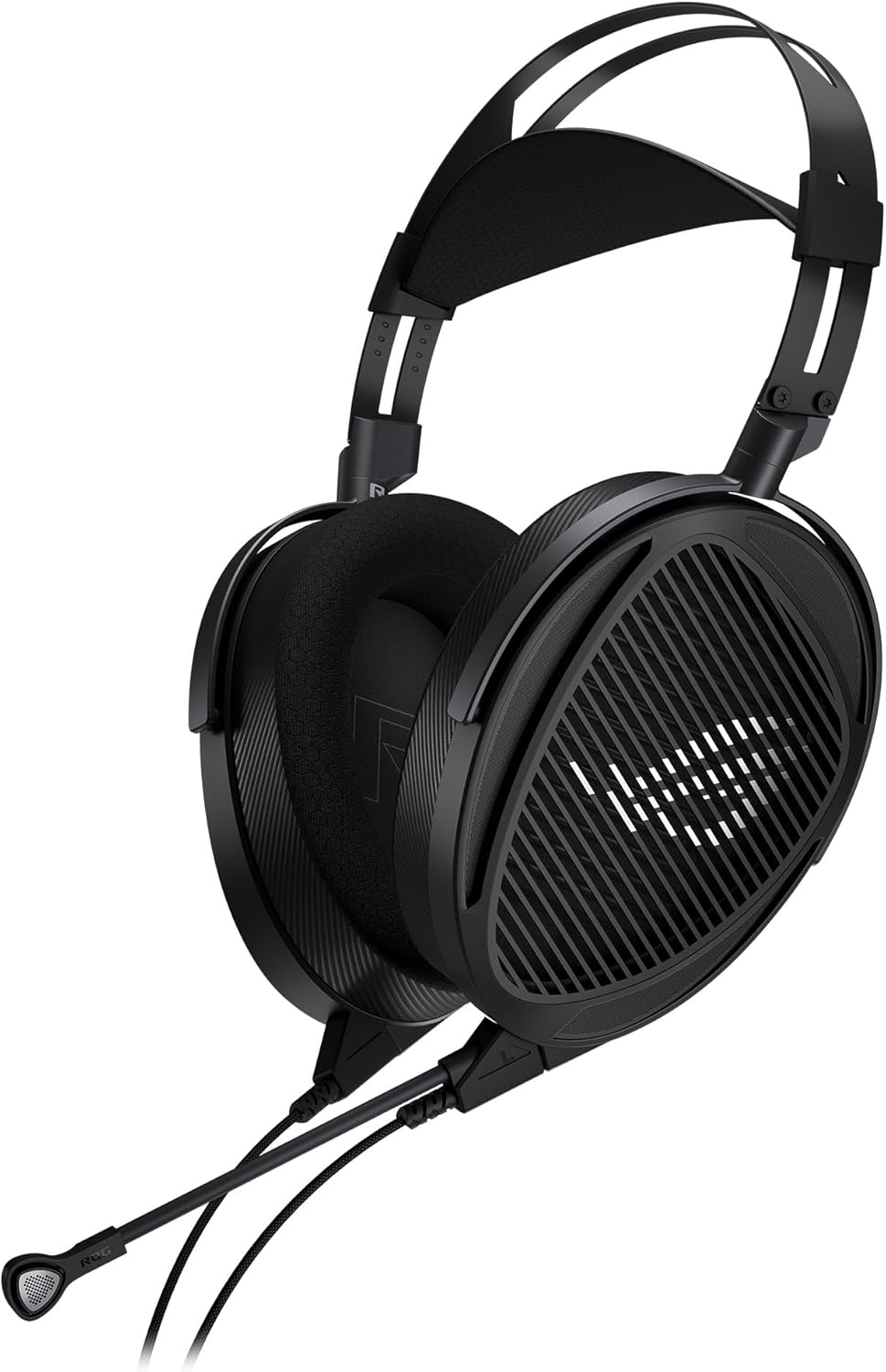
The ASUS ROG Kithara is a hybrid gaming headset that refuses to compromise on audio quality. It targets competitive gamers and music enthusiasts who view their headphones as both a gaming tool and an audiophile investment. The collaboration between ASUS and HIFIMAN brings legitimate high-end audio engineering to the gaming market at a price point that undercuts pure audiophile brands.
The standout feature is the ROG-tuned 100mm HIFIMAN planar magnetic drivers, which deliver exceptional clarity and detail across the entire frequency spectrum. The open-back design creates a vast, natural soundstage with excellent instrument separation, making footsteps and directional cues in competitive shooters more distinguishable than closed-back alternatives. Users consistently report that these headphones punch well above their price point, particularly when connected to a dedicated DAC or amplifier. The warm sonic signature appeals to both gamers seeking immersion and listeners who prefer musical, non-fatiguing audio.
Build quality is robust with a metal frame, reinforced hinges, and premium materials throughout. The eight-level adjustable headband is genuinely accommodating, with particular praise from users with larger head sizes who struggle with traditional gaming headsets. The inclusion of two ear pad sets (hybrid fabric and leatherette) allows users to tune comfort and sound characteristics to their preference. At 11.2 ounces, the weight is reasonable for the build quality, though some users note the headband design can feel loose on smaller heads.
The main drawbacks stem from the open-back design and microphone complexity. Open-back headphones provide zero noise isolation and leak sound significantly, making them unsuitable for shared living spaces or portable use. The detachable boom microphone requires multiple cables to operate, which feels inelegant compared to integrated solutions. Additionally, these headphones demand proper amplification to shine, meaning direct connection to a controller won't deliver optimal performance.
The ASUS ROG Kithara is recommended for serious gamers willing to invest in proper audio equipment and who have the space for open-back headphones. This is not a casual purchase, but rather an entry point into audiophile-grade gaming audio that justifies its cost through sound quality and build durability.
Drivers: 100mm ROG-tuned HIFIMAN planar magnetic drivers
Frequency Response: 8Hz to 55kHz (full range), 20Hz-20kHz (audible spectrum)
Audio Driver Type: Planar Magnetic
Impedance: Not specified by manufacturer
Microphone: Full-band MEMS boom microphone with 20Hz-20kHz response and high SNR
Connectivity: 4.4mm balanced, 3.5mm single-ended, 6.3mm single-ended, USB-C adapter included
Cable Length: 1.8m dual 3.5mm cables
Weight: 11.2 ounces
Design: Open-back over-ear with adjustable headband (8 levels)
Ear Pad Options: ROG hybrid fabric and ROG leatherette sets included
Compatibility: PC, Mac, PlayStation 4/5, Nintendo Switch, iOS, Android, Xbox (via 3.5mm)
Warranty: 1 year
Water Resistance: None
Who Should Buy This: Competitive gamers seeking superior soundstage and directional audio, music enthusiasts new to audiophile equipment, content creators needing quality monitoring headphones, and streamers who want professional-grade audio without excessive cost.
Who Should Skip This: Users in shared living spaces, frequent travelers, those seeking noise isolation, casual console gamers without external audio equipment, and anyone uncomfortable with multi-cable microphone setups.
Pairing Recommendations: These headphones excel when paired with a dedicated DAC/amplifier. Budget-friendly options like Schiit Magni or FiiO K5 Pro will unlock the full potential of the planar drivers. Direct connection to gaming controllers will work but will not deliver the intended audio performance.
Setup Considerations: Plan for desk space if using with a DAC/amp setup. The open-back design requires a quiet environment to avoid disturbing others. The adjustable headband accommodates most head sizes, but try-before-buy is recommended if you have extreme head dimensions or sensitivity to clamp force.
Value Assessment: At this price point, the Kithara offers exceptional value for gamers willing to invest in proper amplification. It outperforms gaming-branded alternatives costing the same amount and provides genuine audiophile sound quality without the premium price tag of pure audio brands.
Pros
- Exceptional value for professional-grade DAC and amplifier functionality in one unit
- Transparent, neutral sound signature with excellent channel matching from DAC-controlled volume
- Versatile connectivity and multi-platform support across Windows, Mac, Linux, iOS, and Android
- Feature-rich design with customizable EQ and multiple output modes for any audio setup
- Robust 2-year manufacturer warranty provides peace of mind
Cons
- Quality control concerns reported by some users, particularly with headphone jack durability during hot-swapping
- Requires careful handling to avoid damaging connectors, as they lack protective design
- May require learning curve to fully utilize advanced PEQ and system integration features
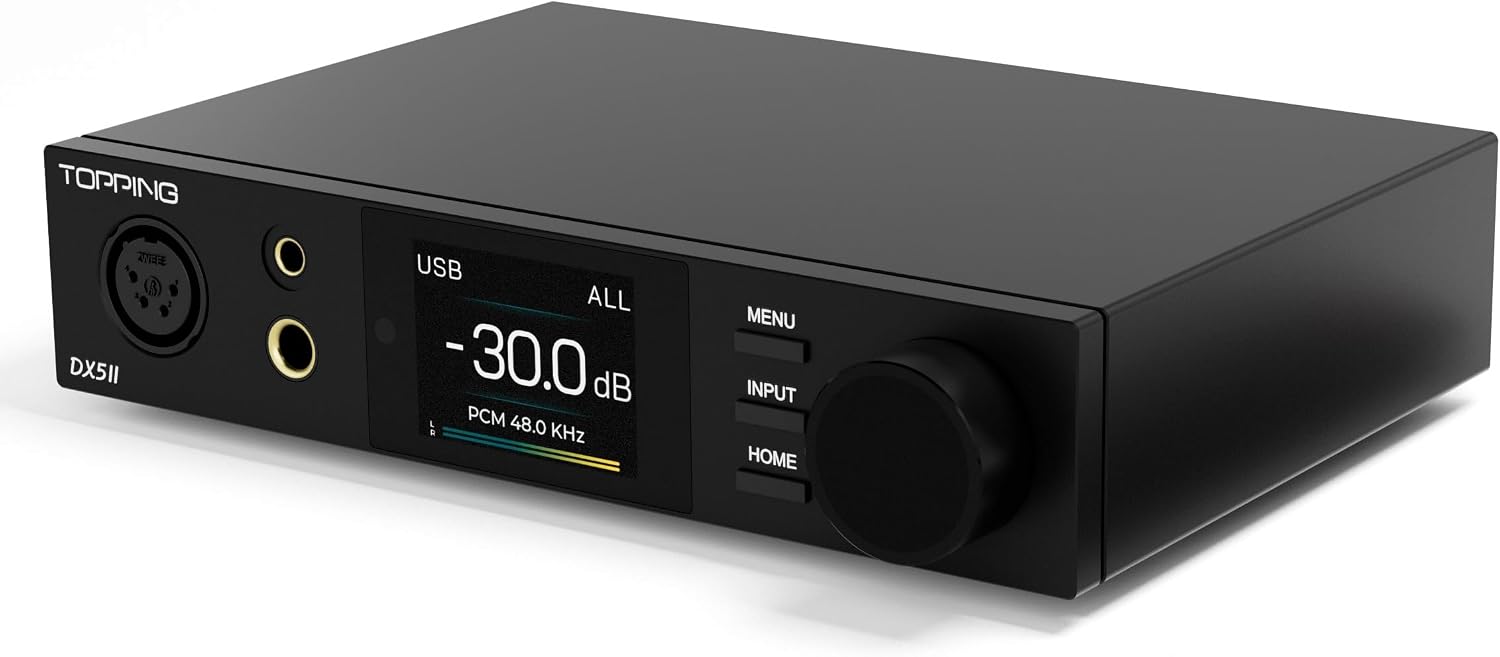
The TOPPING DX5 II is a desktop DAC and headphone amplifier combo designed for serious audiophiles, content creators, and HiFi enthusiasts who demand professional audio quality without the premium price tag. It combines dual ESS9039Q2M DAC chips with a powerful X-Hybrid balanced amplifier in a single compact unit, making it an excellent centerpiece for a high-end audio workstation.
The standout feature is its dual DAC architecture paired with 7600mW of balanced power output, delivering transparent and detailed sound reproduction. The 10-band parametric EQ is a game-changer for customization, allowing users to fine-tune their system to match their headphones, room acoustics, or personal preferences. LDAC Bluetooth 5.1 support brings wireless convenience without sacrificing audio quality, while the Aurora UI display makes navigation and mode switching intuitive and visually appealing.
Build quality is solid with metal and plastic construction, though some users have noted that the headphone jacks lack protective design and can be vulnerable to damage during hot-swapping. The internal power supply and extensive connectivity options, including USB, optical, coaxial, and Bluetooth inputs, make it compatible with virtually any audio source and operating system.
The main drawback is the reported quality control inconsistency with connector durability. Users should avoid frequent hot-swapping of headphone cables and handle connections carefully to prevent premature failure. Despite this concern, the unit delivers exceptional audio performance and versatility for the price.
The TOPPING DX5 II is a smart investment for anyone building a professional-grade desktop audio system or upgrading from consumer-level equipment. It offers the features and performance of much more expensive DAC amplifiers, making it a standout value in the audiophile market.
DAC Chipset: Dual ESS9039Q2M
Audio Format Support: PCM up to 768kHz/32bit, DSD512
Headphone Output Power: 7600mW x2 (balanced)
Audio Processing: 10-band parametric EQ with self-developed IV circuitry
Connectivity: USB, Bluetooth 5.1 (LDAC, aptX Adaptive, aptX HD, AAC, SBC), Coaxial SPDIF, Optical SPDIF
USB Controller: XMOS XU316
Bluetooth Chipset: QCC5125
Display: 2.0 inch Aurora UI with 9 customizable themes
Outputs: 4.4mm balanced headphone jack, 6.35mm single-ended headphone jack
Additional Features: 12V trigger in/out, preamp mode, volume control via DAC
Power Supply: 12V DC internal power supply
Compatibility: Windows, Mac, Linux, iOS, Android
Warranty: 2 years manufacturer
Included Accessories: USB A to USB B cable, remote control, power cable, Bluetooth cable, headphone adapter, quick start guide
Who Should Buy This? The TOPPING DX5 II is perfect for desktop audio enthusiasts, professional audio engineers, musicians, and anyone who wants studio-quality sound from their headphones or active speakers. It's ideal if you own demanding high-impedance headphones, multiple IEMs, or want wireless audio without quality loss.
What Makes It Special? The combination of dual DAC chips, powerful balanced amplification, and 10-band EQ in one unit is rare at this price point. Most competitors force you to choose between a standalone DAC and a separate headphone amp. The parametric EQ allows you to compensate for headphone frequency response issues or room acoustics without external software.
Connectivity Considerations: This unit works with almost any audio source thanks to its multiple inputs. Use USB for computers, optical for CD transports or gaming consoles, Bluetooth for mobile devices, and coaxial for digital streamers. The preamp mode lets you connect it directly to powered speakers or active subwoofers.
Important Notes: Handle the headphone connectors gently and avoid frequent hot-swapping to prevent damage. The unit runs cool and quiet, making it suitable for near-field desktop use. Allow time to explore the PEQ settings and Aurora UI themes to maximize your investment.

Pros
- Exceptional power and transparency with truly neutral, uncolored sound signature
- Versatile all-in-one solution combining high-end DAC, headphone amp, and preamp functionality
- Professional-grade audio customization through 10-band parametric EQ adjustment
- Outstanding value for the feature set and audio performance at this price point
- Multiple input options including USB, Bluetooth 5.1, optical, and coaxial SPDIF
Cons
- Potential durability concerns with headphone jack connectors, especially with repeated hot-swapping
- No batteries included for remote control, requiring separate purchase
- Transparent sound signature may sound clinical to listeners preferring warmer, consumer-friendly tuning
The TOPPING DX5 II is a premium desktop DAC and headphone amplifier designed for serious music enthusiasts, audiophiles, and home studio professionals. This all-in-one solution combines high-resolution digital audio conversion with powerful balanced amplification, making it an excellent centerpiece for a desktop audio system or a versatile addition to an existing setup.
The standout feature is undoubtedly the dual ESS9039Q2M DAC chips paired with the X-Hybrid headphone amplifier delivering 7600mW of balanced power. In real-world use, this means the DX5 II can drive demanding high-impedance headphones and sensitive IEMs with exceptional clarity and zero audible noise floor. The 10-band parametric EQ allows precise sound tuning, giving you complete control over the audio signature rather than being locked into a single sonic character. Support for PCM768kHz/32bit and DSD512 ensures your music is decoded with maximum fidelity.
Build quality is solid with a compact metal and plastic chassis measuring 7.48 x 6.1 x 1.73 inches. The vibrant Aurora UI display with customizable themes makes navigation intuitive, while the pressable knob provides satisfying tactile control. Connectivity is comprehensive, featuring USB, Bluetooth 5.1 with LDAC support, optical SPDIF, and coaxial inputs. The preamp mode and 12V trigger functionality enable seamless integration into larger audio systems or active speaker setups.
One notable drawback is durability concerns around the headphone jacks, particularly with repeated hot-swapping or accidental disconnection. Some users have reported failures after minimal physical stress to the connectors. Additionally, the transparent, neutral sound signature, while technically accurate, may sound clinical to listeners accustomed to warmer or more colored amplifiers.
The TOPPING DX5 II represents exceptional value for discerning listeners seeking a customizable, feature-rich DAC and headphone amplifier. Its combination of high-resolution audio support, powerful balanced output, and extensive connectivity makes it an outstanding choice for desktop audio enthusiasts, music professionals, and anyone wanting to upgrade their listening experience without breaking the bank.
Audio Performance: Dual ESS9039Q2M DAC chips, X-Hybrid balanced headphone amplifier with quad-channel design, 7600mW x2 output power, 10-band parametric EQ adjustment.
Audio Format Support: PCM up to 768kHz/32bit, DSD512 decoding, LDAC, aptX Adaptive, aptX HD, AAC, SBC Bluetooth codecs.
Connectivity: USB (XMOS XU316), Bluetooth 5.1 (QCC5125), Coaxial SPDIF, Optical SPDIF inputs, 4.4mm balanced headphone output, 6.35mm single-ended headphone output, preamp mode, 12V trigger in/out.
Display: 2.0 inch Aurora UI full-color display with 9 customizable themes, pressable knob control.
Compatibility: Windows, Mac, Linux, iOS, Android platforms.
Physical: Weight 3.64 pounds, Dimensions 7.48 x 6.1 x 1.73 inches, Metal and plastic construction, Silver color option.
Best For: Desktop audio enthusiasts, audiophiles with high-impedance headphones or sensitive IEMs, music professionals needing a customizable DAC, anyone building a high-fidelity home audio system, streamers wanting wireless lossless audio quality.
Consider This If: You own demanding headphones that need real power to shine, you want complete control over your audio signature through parametric EQ, you stream music via Bluetooth and want near-lossless quality, you're building a desktop audio stack and need a versatile hub, you value transparent, neutral sound reproduction.
Maybe Skip If: You prefer consumer-friendly, warm sound signatures over clinical accuracy, you frequently hot-swap headphone connections, you need a portable solution, you're on a tight budget with no flexibility, you want a warranty that covers accidental damage.
Pro Tips: Use the 10-band PEQ to tailor the sound to your specific headphones, leverage preamp mode to control active speakers directly, connect your streaming devices to different inputs and switch between them using the intuitive display, enable LDAC on compatible devices for best Bluetooth quality.
How to Choose Your Headphone DAC
Desktop vs. Portable Design
Your primary use case dictates the form factor. A desktop DAC amp, like the Schiit Magni Unity, offers more power and connectivity for a stationary setup. Portable units, such as the FiiO BTR17, provide flexibility for use with phones and on the go. Consider where you will listen most often. For more focused desktop options, explore our guide to the best headphone DACs under $200.
Connectivity and Inputs
Check what inputs you need. USB-C is standard for modern computers and phones. Optical or coaxial inputs are useful for connecting to TVs or game consoles. Bluetooth support, especially with high-quality codecs like LDAC, adds wireless convenience. A device with multiple input options offers greater system integration.
Headphone Compatibility and Power
Ensure the DAC has enough power to drive your headphones. High-impedance models require more robust amplification. Look for units with multiple gain settings or balanced outputs, like those on the TOPPING DX5 II, which can handle demanding headphones. Also, verify the output jacks match your headphones, such as 3.5mm, 6.35mm, or 4.4mm balanced.
Additional Features and Sound Shaping
Modern DACs often include extra features. A preamp output lets you control volume for powered speakers. Parametric EQ (PEQ) allows you to fine-tune the sound signature to your preference. Consider if you value a sleek display, physical knobs, or app control. These features enhance usability and customization. For insights into portable amplification, our review of top portable headphone amplifiers is a valuable resource.
Final Thoughts
Investing in a quality headphone DAC under $300 is one of the most effective upgrades you can make to your audio setup. For listeners who prioritize a pure, powerful desktop experience with a modular design, the Schiit Magni Unity Headphone Amp and Preamp is an outstanding choice built to last. If your lifestyle demands versatility and high-fidelity wireless streaming, the feature-packed FiiO BTR17 Bluetooth 5.4 USB DAC AMP with LDAC offers incredible performance in a pocket-sized form. Whichever model you choose from our selection, you are taking a definitive step toward richer, more detailed, and engaging sound. For a broader look at audio gear, visit our Headphones & Earbuds category.
Frequently Asked Questions
Do I need a DAC if my headphones already sound good?
Yes, a dedicated DAC can still provide a noticeable improvement. It bypasses the lower-quality audio circuitry in your computer, phone, or tablet. This results in a cleaner signal with less noise, greater dynamic range, and more accurate sound reproduction, revealing details you might be missing.
What is the difference between a DAC and a headphone amplifier?
A DAC (Digital-to-Analog Converter) translates digital audio files into an analog signal. A headphone amplifier then boosts that analog signal to a level that can properly drive your headphones. Most devices discussed here are combo units that perform both functions seamlessly. For simpler setups, check our picks for the best headphone DACs under $150.
Is Bluetooth audio quality good enough for a DAC?
Modern Bluetooth codecs like LDAC and aptX Lossless transmit audio at very high bitrates, approaching wired quality. A DAC with high-quality Bluetooth, such as the models featured, ensures the wireless signal is decoded with maximum fidelity. This makes them excellent for convenient, high-performance listening. Learn more about wireless audio trends in our Wireless & Streaming Audio section.
Can I use a DAC with my gaming console or TV?
Many DACs can connect to consoles and TVs, but the required input varies. You typically need a DAC with an optical input, which is a common audio output on TVs and some consoles. Always confirm the output options on your source device and the input options on the DAC for compatibility.





Write Your Review
No reviews yet. Be the first to share your experience!