

You are settling in for movie night, the lights dim, and the opening scene begins. But something is missing. The explosion lacks punch, the soundtrack feels thin, and the entire experience falls flat. The culprit is often weak bass. A true home theater sensation is not just heard, it is felt. The rumble of a spaceship, the thud of a dinosaur’s footstep, the deep notes of a film score: these elements create the emotional weight of cinema.
This guide is for anyone who wants to bring that physical, immersive audio impact home. We have evaluated nine leading home theater systems, prioritizing those engineered to deliver authoritative low frequencies. Whether you crave a simple upgrade for your TV or aspire to build a full-scale cinematic environment, you will find a system here to make your walls shake and your movies come alive.
Pros
- Powerful 750W output with a dedicated 10-inch wireless subwoofer delivers genuinely room-filling, cinematic bass
- Dolby Atmos combined with MultiBeam 3.0 produces an impressively wide and immersive surround soundstage
- PureVoice 2.0 dialogue enhancement is a standout feature for those who struggle to hear speech over loud sound effects
- Extensive connectivity options including HDMI eARC with 4K Dolby Vision passthrough ensure compatibility with virtually any modern TV or source device
- Room calibration and the JBL ONE app make setup and personalization straightforward even for non-audiophiles
Cons
- At this price point, buyers may expect a detachable rear speaker configuration rather than a purely beam-based surround solution
- No built-in voice assistant microphone means you must rely on a separately owned smart speaker device for hands-free voice control
- The soundbar's 37-inch width may not suit smaller TV setups or compact living room arrangements
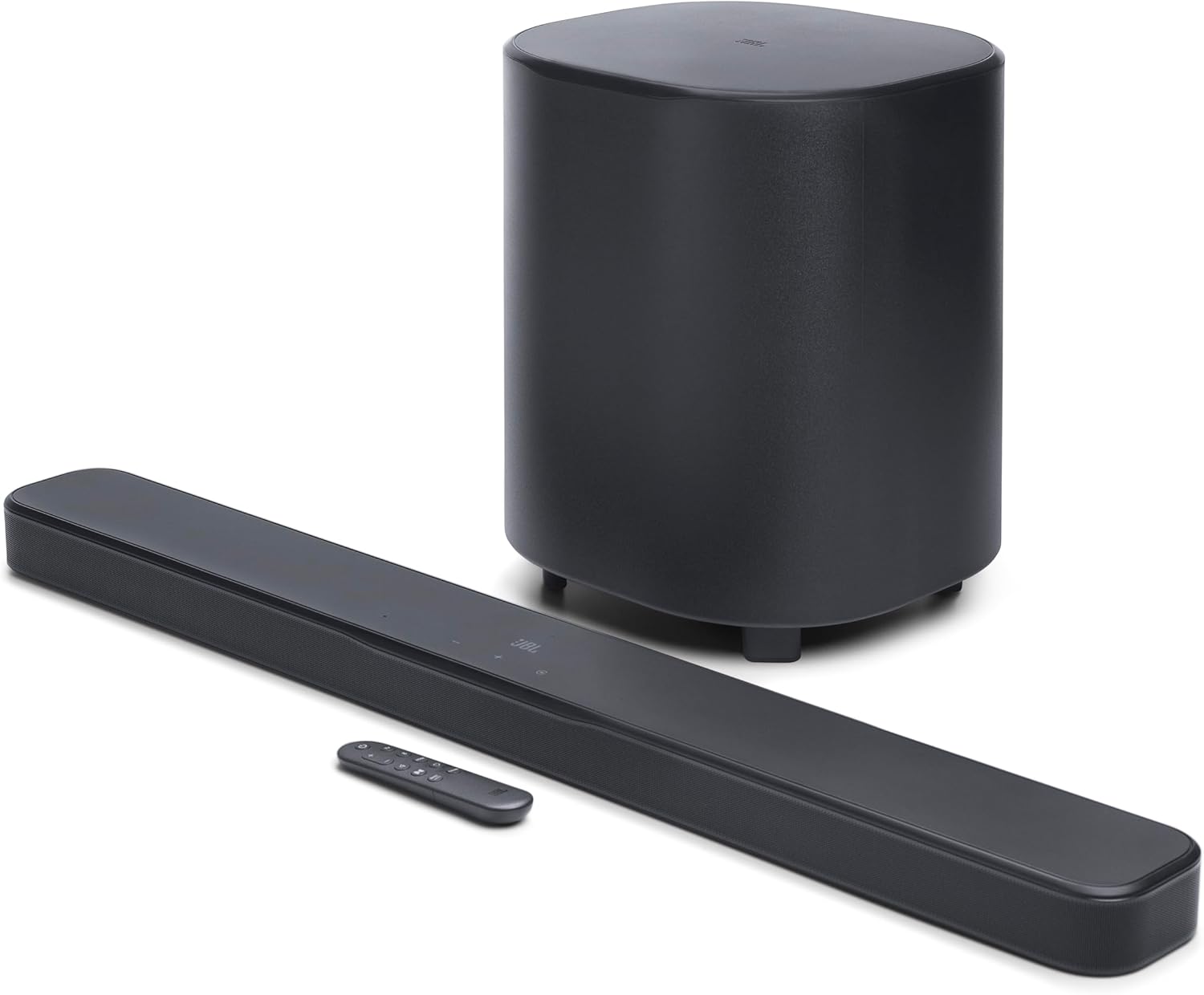
The JBL Bar 500MK2 is a 5.1-channel soundbar system designed for homeowners and entertainment enthusiasts who want a significant audio upgrade over their flat-panel TV's built-in speakers. Priced in the premium mid-range tier, it targets buyers who appreciate cinematic sound quality but prefer a cleaner, cable-light setup over a full discrete surround system. It ships as a complete package including the soundbar unit, a wireless 10-inch subwoofer, wall-mount hardware, an HDMI cable, and a remote control.
The headline features here are genuinely compelling. Dolby Atmos decoding combined with JBL's proprietary MultiBeam 3.0 technology allows the soundbar to project audio beams that bounce off walls and ceilings, creating a convincing three-dimensional soundstage without requiring rear satellite speakers. PureVoice 2.0 is another standout addition, dynamically adjusting dialogue levels relative to ambient scene audio and overall volume so that speech remains consistently clear and intelligible throughout any content.
Build quality follows JBL's established design language: a slim, low-profile bar measuring just 2 inches tall and 37 inches wide that should sit neatly beneath most mid-to-large televisions. The wireless subwoofer is a substantial unit housing a 10-inch driver, and its wireless connection to the soundbar simplifies placement flexibility. The system's 750W total power rating translates to genuinely impactful bass performance, particularly during action sequences and bass-heavy music.
There are a few considerations worth noting. The surround effect relies entirely on beam-steering rather than physical rear speakers, which means the immersive effect can vary depending on room shape and wall materials. Additionally, voice assistant support requires pairing with an external smart speaker rather than using a built-in microphone, which adds a step for those expecting fully integrated voice control. The 37-inch form factor may also feel oversized for smaller display setups.
Overall, the JBL Bar 500MK2 is a strong performer that punches well for its category, offering a rich feature set including room calibration, broad streaming service support, and HDMI eARC with 4K passthrough. For anyone seeking a substantial home theater audio upgrade with minimal installation complexity, this soundbar system is a well-rounded and highly capable choice.
Audio Channels: 5.1 surround sound configuration with dedicated subwoofer channel for low-frequency effects.
Power Output: 750W maximum total system power. Subwoofer features a 10-inch wireless driver with a frequency response starting at 20Hz for deep bass reproduction.
Connectivity: HDMI eARC with 4K Dolby Vision passthrough, optical input, USB port, Bluetooth, Wi-Fi, AirPlay, Google Cast, Spotify Connect, and Tidal Connect. Roon Ready certified for audiophile streaming setups.
Dimensions and Weight: Soundbar measures 4.1 inches deep, 37 inches wide, and 2 inches tall. Total system weight is 24.3 pounds. Supports wall mounting via included L-shaped brackets and template.
Compatibility: Works with televisions, gaming consoles, smartphones, and streaming devices from all major brands. Compatible with Google Assistant and Siri via linked external smart speakers. Managed via the JBL ONE app on iOS and Android. Warranty: 1-year limited manufacturer warranty. Model number: JBLBAR500M2BLKAM.
If you are upgrading from a TV's built-in speakers for the first time, the JBL Bar 500MK2 offers an accessible entry point into premium home theater audio. The included room calibration feature removes the guesswork from setup, and the JBL ONE app provides a user-friendly interface for fine-tuning sound to your personal preference without requiring any technical expertise.
Buyers who already own a smart speaker from Google or Apple will benefit from seamless voice assistant integration, allowing hands-free playback control without reaching for the remote. Those invested in streaming ecosystems will appreciate the broad platform support, covering Spotify, Tidal, Apple AirPlay, and Google Cast in a single device.
If your priority is the absolute most immersive surround experience possible, consider whether a system with physical rear satellite speakers might better suit your needs, particularly in larger or acoustically challenging rooms. The Bar 500MK2's beam-based surround is excellent for most living room environments but may not fully replicate the effect of discrete rear channels in every space.
For gaming enthusiasts, the HDMI input supporting 4K Dolby Vision passthrough means you can route a gaming console through the soundbar without sacrificing video quality, and the powerful subwoofer adds a visceral dimension to action and adventure titles. Overall, the JBL Bar 500MK2 represents strong value for those seeking a feature-rich, easy-to-use soundbar system that genuinely elevates everyday home entertainment.
What to Look for in a Bass-Heavy Home Theater
Subwoofer Size and Technology
The subwoofer is the heart of your bass response. Driver size, measured in inches, is a primary factor. Larger drivers, like the dual 12-inch units found in premium systems, can move more air to produce deeper, more physical low frequencies. Also, look for advanced technologies such as carbon passive radiators or high-excursion drivers. These features help the subwoofer deliver cleaner, more impactful bass without distortion, even at high volumes. For a system that truly prioritizes low-end performance, a dedicated, powerful subwoofer is non-negotiable.
Total System Power and Channel Configuration
Power output, measured in watts, indicates a system’s ability to fill your room with sound, especially during demanding action sequences. Higher wattage often correlates with greater dynamic range and cleaner bass at loud volumes. The channel configuration is equally important. A 5.1 system provides a solid foundation, while systems with height channels, like 5.1.4 or 11.2.6, add a three-dimensional layer to the sound. This spatial audio makes effects like thunder feel like they are coming from above you, deepening the overall immersion. Systems with more dedicated channels distribute the audio load more effectively, allowing the subwoofer to focus purely on the deepest frequencies.
Connectivity and Room Calibration
To experience the highest quality audio formats like lossless Dolby Atmos, your system needs the right connections. HDMI eARC is essential, as it supports the high bandwidth required for these advanced signals, ensuring your deep bass is delivered with all its detail intact. Learn more about this crucial feature in our guide to the best home theater systems with HDMI eARC. Furthermore, automatic room calibration is a game-changer. This technology analyzes your room’s unique acoustics and adjusts the sound output accordingly. It optimizes the bass response to counter issues like standing waves or nulls, ensuring you get consistent, powerful low-end no matter where you are sitting.
System Format and Expandability
Your choice depends on your space and goals. All-in-one soundbar systems with wireless subwoofers and rear speakers offer a fantastic, clutter-free path to immersive surround sound. For the ultimate in customization and future-proofing, a traditional component-based system with a discrete AV receiver provides maximum flexibility. You can upgrade individual speakers or the subwoofer down the line. If you are exploring different setups, our main category page for home theater systems (HTIB) is a great resource. Also, consider your other audio sources; a system with an AUX input offers versatile connectivity for older devices.
Final Thoughts
Upgrading your home audio with a system built for deep bass is an investment in your entertainment. The right choice balances impressive low-frequency performance with features that suit your lifestyle. For those seeking an uncompromising, theater-grade experience that delivers seismic physical impact, the Dragon 11.2.6 Dolby Atmos/DTSX Pro Surround stands in a class of its own. If you desire a more streamlined yet highly capable setup with excellent wireless performance and clear, powerful bass, the ULTIMEA Skywave X50 5.1.4ch Wireless Surround is a compelling and modern solution. Whichever path you choose, you are one step closer to feeling every moment of your favorite films.
Frequently Asked Questions
What makes a home theater system have “deep” bass?
Deep bass refers to the lowest audible frequencies, typically below 60 Hz. A system achieves this through a capable subwoofer with a large driver and sufficient power. Technologies like specialized ports, passive radiators, and robust amplifiers allow the sub to produce these frequencies loudly and cleanly, creating the physical rumble you feel during intense movie scenes.
Is a wireless subwoofer as good as a wired one for home theater?
For most modern home theater systems, yes. Wireless subwoofers in packaged systems are engineered to work seamlessly with the soundbar or receiver, with minimal latency. The primary advantage is placement flexibility, allowing you to position the subwoofer where it sounds best in your room without running cables across the floor. This makes achieving optimal bass response much easier.
Can I add a better subwoofer to my existing soundbar later?
This depends entirely on the soundbar model. Most all-in-one systems have a proprietary wireless connection for their bundled subwoofer and do not support adding a third-party sub. If expandability is important, look for a system with a dedicated subwoofer output or consider a traditional AV receiver-based setup from the start. For systems focused on wireless streaming, check our review of the best home theater systems with bluetooth 5.0.
How do I connect my new home theater system for the best sound quality?
Always use an HDMI cable connected to the HDMI eARC or ARC port on both your TV and sound system for the highest quality audio format support. If your TV lacks HDMI ARC, the next best option is a digital optical audio connection, which still supports surround sound. You can explore systems designed for this in our guide to the best home theater systems with optical input. Ensure all settings on your TV and streaming devices are configured to output audio in the correct format, such as Bitstream or Dolby Digital.





Write Your Review
No reviews yet. Be the first to share your experience!