

You’ve invested in a beautiful home theater or whole-house audio system, but the deep, room-shaking bass you crave feels out of reach. A bulky floor subwoofer disrupts your clean aesthetic and precious living space. The solution lies overhead, hidden from view. In-ceiling subwoofers deliver the powerful low-frequency impact essential for movie explosions and musical depth, all while maintaining a seamless, invisible installation.
This guide is for homeowners and audio enthusiasts who want to complete their surround sound or music system with authoritative bass without sacrificing style. We’ve evaluated leading models to help you find a subwoofer that vanishes into your architecture. For a broader look at ceiling audio, explore our guide to the best round In-Ceiling speakers.
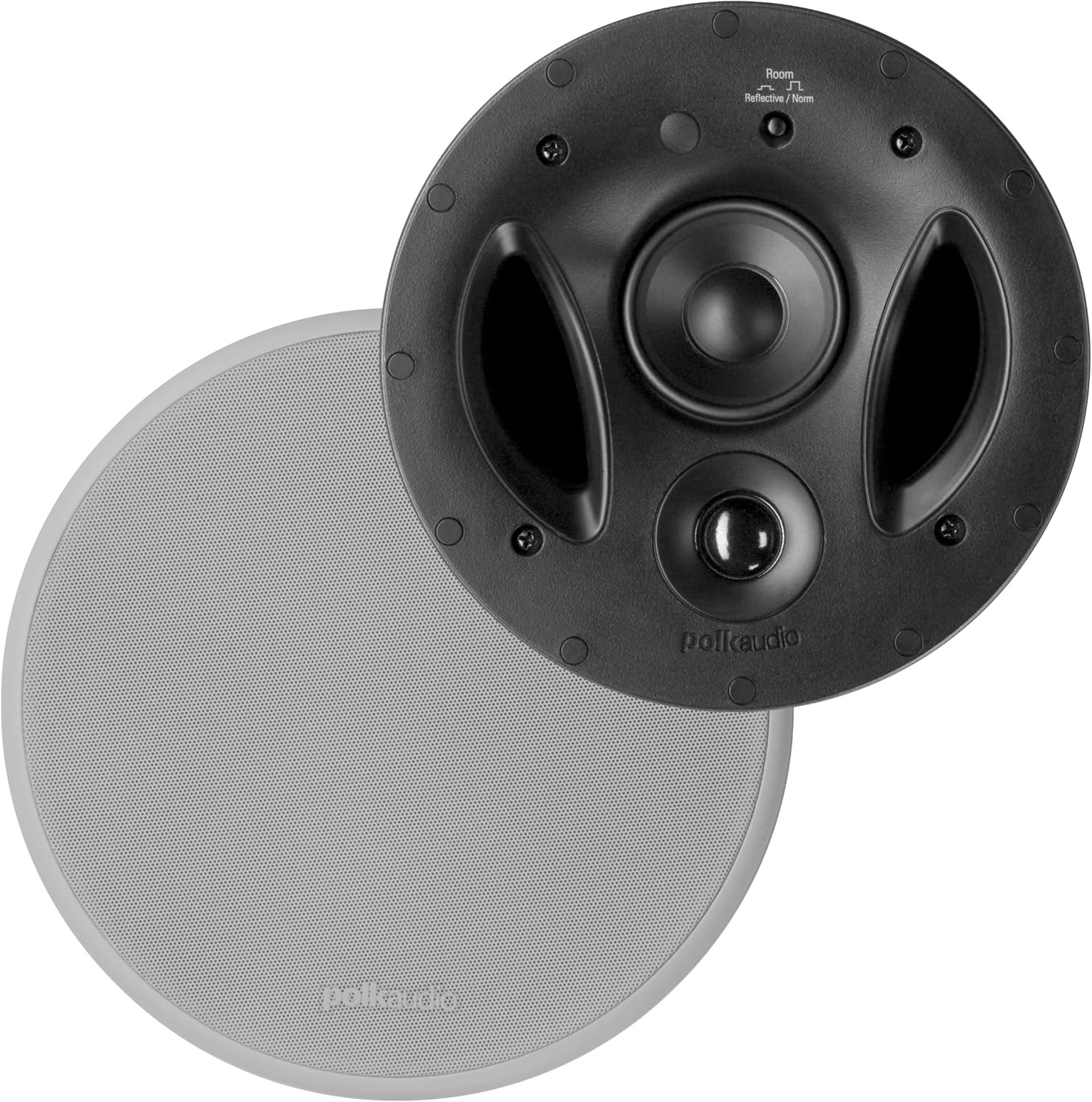
Pros
- Superior midrange clarity compared to typical in-ceiling speakers, thanks to dedicated 2.5" midrange driver
- Flush-mount design disappears into the ceiling, creating a clean, uncluttered aesthetic
- Easy installation with rotating cam system and included perfect-fit templates ensure secure, vibration-free mounting
- Exceptional value for premium 3-way in-ceiling performance at this price point
- Versatile for surround sound, multi-room audio, or as primary speakers in open-concept spaces
Cons
- Requires proper enclosure or cabinet backing for optimal bass response, not truly open-ceiling compatible
- Not waterproof, limiting use to climate-controlled indoor environments only
- Maximum 125-watt output may require external amplification for larger rooms or high-volume listening
The Polk Audio 70-RT is a premium in-ceiling speaker designed for homeowners who refuse to compromise on audio quality for the sake of aesthetics. Unlike budget ceiling speakers that sacrifice midrange clarity for bloated bass, the 70-RT employs a sophisticated 3-way driver configuration that distributes frequencies intelligently across three dedicated drivers. This approach is particularly appealing for surround sound setups, multi-room audio systems, or anyone seeking invisible speakers that actually sound impressive.
What sets the 70-RT apart from competitors is its thoughtful engineering. The 7-inch subwoofer handles low frequencies, a dedicated 2.5-inch midrange driver ensures vocal clarity and instrument separation, and a 0.75-inch dome tweeter delivers extended highs without harshness. Polk's patented Power Port bass venting technology eliminates turbulence in the enclosure, resulting in tight, controlled bass rather than boomy resonance. Real-world reviewers consistently praise the smooth, balanced sound signature, even praising the midrange as a standout strength.
Installation is straightforward thanks to the patented Rotating Cam system and included perfect-fit templates. The wafer-thin, paintable grille is magnetically secured and can be matched to your ceiling color, making the speaker virtually invisible once installed. The enclosure uses fire-resistant materials appropriate for in-ceiling applications, and the lifetime warranty reflects Polk's confidence in build quality and long-term reliability.
One important consideration: these speakers perform best when installed in a proper enclosure or cabinet rather than directly into open ceiling cavities. This is standard practice for high-quality in-ceiling speakers, as it prevents sound from escaping into attic spaces and maintains bass response. Additionally, the 125-watt maximum output is adequate for most rooms but may require external amplification in very large spaces or for bass-heavy content.
The Polk Audio 70-RT represents an excellent choice for discerning listeners who want their surround speakers or in-ceiling speakers to sound as good as they disappear. Whether building a 5.1 surround system or adding whole-home audio to an open floor plan, these speakers deliver the acoustic performance and aesthetic integration that justify their investment.
Driver Configuration: 3-way system with 7" woofer, 2.5" midrange, 0.75" dome tweeter
Frequency Response: 34 Hz to 27,000 Hz
Impedance: 8 ohm
Maximum Output: 125 watts
Mounting Type: In-ceiling, flush-mount
Dimensions: 13" W x 11" D x 9.8" H
Grille: Wafer-thin, paintable, magnetically secured
Connectivity: Wired (8 ohm)
Color: White
Warranty: Lifetime
Installation Features: Patented Rotating Cam system, perfect-fit templates, precision flange
Best For: Homeowners seeking premium in-ceiling speakers for surround sound systems, multi-room audio, or open-concept spaces where traditional speakers are impractical or undesirable.
Room Size: Ideal for medium to large rooms with ceiling heights up to 12 feet. The broad coverage and extended frequency response handle various room acoustics well.
Installation Consideration: Plan for proper enclosure or cabinet backing behind the speaker for optimal bass response. This is essential for maximizing the 70-RT's performance potential.
Amplifier Requirements: Pair with a quality receiver or amplifier rated for 8-ohm speakers. The 125-watt maximum output pairs well with mid-range to high-end home theater receivers.
Aesthetic Integration: The paintable grille allows seamless blending with white or light-colored ceilings. Consider your ceiling color when planning installation for maximum invisibility.
Comparison Note: If budget is primary, entry-level in-ceiling speakers cost less but sacrifice midrange clarity. The 70-RT's 3-way design justifies the premium for listeners who prioritize sound quality alongside aesthetics.
How to Choose an In-Ceiling Subwoofer
Driver Size and Power Handling
The driver, measured in inches, is the heart of the subwoofer. Larger drivers, like 8-inch models, can move more air to produce deeper bass tones. Power handling indicates how much amplifier power the speaker can manage. Match this with your amplifier’s output for optimal performance without risk of damage.
Consider your room size. A larger media room benefits from a more powerful driver with higher power handling. For background music in a smaller space, a robust driver in a full-range speaker may suffice. Understanding your amplifier’s capabilities is crucial here.
Enclosure Type and Bass Response
In-ceiling subwoofers typically use either an infinite baffle (open-back) design or a dedicated back-can enclosure. An infinite baffle uses your ceiling cavity as an enclosure, which requires proper sealing and isolation. A dedicated back-can, like the one included with the JBL model, provides a controlled environment for tighter, more accurate bass.
The bass response, measured in Hertz (Hz), tells you how low the speaker can go. A lower number, such as 34Hz, means deeper bass extension. This is key for feeling the rumble in action scenes. For more on low-frequency specialists, see our main subwoofers category.
Installation and Compatibility
<!–Installation ease varies. Look for features like rotating cam locks, precise cut-out templates, and pre-construction brackets. These make the process smoother for DIY installers. Ensure the speaker’s depth fits within your ceiling’s joist spacing and that the cut-out diameter is manageable.
Compatibility with your existing system is non-negotiable. Check if the subwoofer is passive (requires an external amplifier) and matches your system’s impedance (e.g., 8 ohms). Some models offer multi-tap transformers for commercial 70V/100V systems, providing great flexibility. A well-integrated subwoofer should work seamlessly with your in-wall LCR speakers.
Aesthetic Integration
<!–The primary appeal is invisibility. Look for paintable, thin grilles that can be finished to match your ceiling perfectly. A flush, bezel-less design like that found on some professional models offers the cleanest look. The goal is for the speaker to disappear when not in use.
Consider the grille design in relation to your other speakers for a cohesive appearance. Some homeowners prefer a completely frameless look for a minimalist aesthetic, similar to the principles behind best edgeless In-Wall speakers.
Final Thoughts
Choosing the right in-ceiling subwoofer elevates your audio experience from good to cinematic. For most home theater enthusiasts seeking a balanced blend of deep bass and full-range performance from a discreet package, the Polk Audio 70-RT 3-way In-Ceiling Speaker is an outstanding choice. For dedicated, high-power bass reinforcement in a custom installation or commercial setting, the professional-grade performance of the JBL Professional Control419CS/T Passive 8 inch is unmatched. Whichever you select, you’ll gain powerful, room-filling sound without sacrificing an inch of floor space.
Frequently Asked Questions
Can I use an in-ceiling subwoofer for music and movies? Absolutely. A quality in-ceiling subwoofer enhances both mediums. It provides the low-end foundation for music genres like electronic and classical, and delivers the impactful bass for movie soundtracks and effects, creating a fully immersive experience.
Is it difficult to install an in-ceiling subwoofer myself? Installation complexity depends on your comfort with wiring and cutting into drywall. Many modern models are designed for DIY installation with clear templates and tool-less mounting systems. However, for ensuring optimal acoustic performance and sealing, consulting a professional installer is often recommended, especially for more complex setups.
How does an in-ceiling subwoofer compare to a traditional floor model? The primary trade-off is space and aesthetics versus maximum output. A floor-standing subwoofer often has a larger cabinet capable of producing more extreme bass levels. An in-ceiling model saves floor space and is invisible but may not reach the same extreme low-frequency output. For many integrated home systems in 2026, the performance of a premium in-ceiling sub is more than sufficient. Learn more about placement and types in our in-ceiling speaker category.
Do I need a special amplifier for an in-ceiling subwoofer? You need an amplifier or AV receiver capable of powering a passive subwoofer, typically via speaker-level inputs. Some home theater receivers have dedicated subwoofer pre-outs for active (powered) subwoofers, so ensure your chosen model is compatible. Always check the power handling and impedance specifications of the subwoofer against your amplifier’s output.


Write Your Review
No reviews yet. Be the first to share your experience!