

Your high-quality speakers are ready, but your music library is trapped on your phone or computer. A network audio streamer is the missing link that unlocks a world of high-fidelity sound. It connects your existing stereo system to streaming services, local files, and multiroom audio with ease.
This guide reviews the top network audio streamers available. We have assessed key players from WiiMHome and Eversolo, focusing on performance, features, and value. Whether you are building a budget-friendly setup or a premium audiophile system, you will find the right component here.
Top Network Audio Streamers Compared

Pros
- Exceptional audio performance with audiophile-spec DAC at a mid-range price point
- Unmatched connectivity options covering virtually every digital and analog source and output format
- Intuitive WiiM Home App praised by reviewers for seamless setup and reliable day-to-day control
- Built-in bass management with adjustable crossover and subwoofer output fills a gap many receivers leave open
- Supports a wide range of streaming services and voice assistants including Alexa and Google Assistant
Cons
- No AirPlay support, which may be a dealbreaker for users deeply invested in the Apple ecosystem
- AAA batteries for the included voice remote are not included in the box, requiring an extra purchase out of the gate
The WiiM Ultra is a compact, feature-packed music streamer and preamplifier designed for listeners who want high-resolution audio without building a rack full of separate components. At its core sits an ESS ES9038 Q2M DAC, the same chip found in dedicated DACs costing significantly more, making it a compelling option for both entry-level audiophiles and seasoned enthusiasts looking to simplify their setup.
Streaming performance is where the Ultra genuinely shines. It supports hi-res playback up to 24-bit/192kHz from major platforms including Spotify, TIDAL, Qobuz, and Amazon Music HD, with gapless playback and Roon Ready certification for those already in the Roon ecosystem. Wi-Fi 6 and Bluetooth 5.3 ensure a stable, low-latency wireless connection, while the WiiM Home App receives consistent praise in user reviews for its clean interface and reliable multiroom synchronization with Echo and Google Home devices.
Build quality is a clear step above what the price might suggest. The aluminum chassis feels solid and premium, and the 3.5-inch touchscreen is bright and responsive for quick on-device control. Connectivity is genuinely comprehensive, covering HDMI ARC, USB, Optical, Coaxial, RCA, a Phono input with ground adapter, a dedicated headphone output, and a Subwoofer Out with adjustable crossover, a combination rarely found at this price tier.
There are a couple of considerations worth noting before purchasing. The WiiM Ultra does not support AirPlay in any form, so Apple ecosystem users relying on AirPlay 2 will need to look elsewhere or use an alternative streaming method. Additionally, while the included accessory bundle is generous, the voice remote ships without batteries, which is a minor but slightly frustrating omission.
Overall, the WiiM Ultra represents outstanding value for its category. It delivers audiophile-adjacent performance, exceptional versatility, and a polished user experience at a price that undercuts most comparable separates. For anyone with an existing amplifier or receiver looking to add a capable, modern streaming front-end, this is one of the most well-rounded choices currently available.
DAC: ESS ES9038 Q2M | THD+N: -116dB | SNR: 121dB | Max Resolution: 24-bit/192kHz
Wireless: Wi-Fi 6, Bluetooth 5.3 | Wired: Ethernet | Display: 3.5-inch touchscreen
Outputs: RCA, Headphone, Coaxial, Optical, USB, HDMI ARC, Subwoofer Out | Inputs: RCA, Phono, Optical, USB
Streaming Services: Spotify Connect, Amazon Music, TIDAL Connect, Qobuz Connect, Deezer, iHeartRadio, TuneIn, SoundCloud, Pandora, and more | Voice Control: Amazon Alexa, Google Assistant
Dimensions: 8.3 x 7.87 x 2.83 inches | Weight: 3.1 lbs | Power: 100-240V AC | Warranty: 1 Year | In the Box: WiiM Ultra, WiiM Voice Remote, HDMI cable, RCA cable, Optical cable, AC power cable, Phono ground adapter, Quick start guide
The WiiM Ultra is best suited for listeners who already own a quality amplifier or receiver and want to add a modern, high-resolution streaming front-end without replacing their existing gear. If your current amp lacks network streaming, a phono stage, or bass management for a subwoofer, this device addresses all three in a single compact unit.
If you are comparing the WiiM Ultra to standalone network streamers in the same price range, its built-in DAC and preamp functionality offer clear added value. For those who plan to use an external DAC, the Ultra still serves as an excellent Roon endpoint or digital transport via its Coaxial or Optical outputs, as demonstrated by several reviewers who pair it with dedicated DACs like the Denafrips Ares 2.
Buyers who rely heavily on AirPlay 2 for whole-home audio, particularly in Apple-centric households, should note that the WiiM Ultra does not support AirPlay in any capacity. In that scenario, a WiiM Pro or a competing device with AirPlay 2 support may be a better fit. For everyone else, especially those using Android, Alexa, or Google ecosystems, the Ultra is a compelling and well-priced choice.

Pros
- True hi-res audio playback up to 192kHz/24-bit with no resampling preserves the original recording quality
- Broad streaming service support including Spotify, TIDAL, Amazon Music, Qobuz, and AirPlay 2 in one affordable device
- Dual voice assistant compatibility with both Alexa and Siri is rare at this price point
- Highly rated by a large number of verified buyers, reflecting consistent real-world reliability
- Small, unobtrusive form factor makes it easy to add to any existing audio setup without clutter
Cons
- AirPlay receiver only, meaning it cannot transmit audio to other AirPlay-enabled speakers or devices downstream
- No Google Cast support, which may disappoint Android-first households or those already invested in a Chromecast ecosystem
- Qobuz Connect is not supported natively and must be accessed through the WiiM Home app instead
The WiiM Mini is a palm-sized wireless audio streamer designed to breathe new life into any existing stereo system, amplifier, or powered speakers. At its core, it bridges the gap between legacy audio hardware and modern streaming platforms, making it an excellent choice for audiophiles, home theater enthusiasts, and anyone who wants smart speaker functionality without scrapping their current setup.
The standout feature is its commitment to uncompromised audio quality. Unlike many competing streamers that resample audio to a fixed rate, the WiiM Mini passes audio through unaltered at up to 192kHz and 24-bit resolution via both its analog and digital optical outputs. This means content from Amazon Music Ultra HD, Qobuz, and personal hi-res libraries arrives at your speakers exactly as the artist intended.
Connectivity is genuinely impressive for the price. The device supports AirPlay 2, Spotify Connect, TIDAL Connect, Amazon Music Cast, Alexa, Siri, DLNA, and NAS streaming, covering virtually every major platform and ecosystem. Multiroom grouping with other WiiM devices, Echo speakers, and HomePods works reliably through the WiiM Home app, making whole-home audio straightforward to set up and manage.
On the physical side, the WiiM Mini is compact at just 2.7 inches square and under an inch tall, finished in a clean matte black. It connects via USB-C for power, a 3.5mm analog output, and a TOSLINK digital optical port, covering most amplifier and DAC input configurations. The build feels solid for the size, though it is clearly designed to sit out of sight rather than on display.
The main limitations to keep in mind are the lack of Google Cast support and the AirPlay receive-only restriction, which means it cannot push audio to other AirPlay devices in a chain. For Apple and Amazon ecosystem users these are non-issues, but Android households relying on Chromecast should consider a different WiiM model. Overall, the WiiM Mini delivers exceptional value as a versatile, high-fidelity streaming upgrade for virtually any audio system.
Connectivity: Wi-Fi (2.4GHz/5GHz), Bluetooth. Supported protocols include AirPlay 2, Spotify Connect, TIDAL Connect, Amazon Music Cast (Alexa Cast), DLNA, and NAS home media server streaming.
Audio Outputs: 3.5mm analog stereo output and TOSLINK digital optical (SPDIF) output. Maximum audio resolution is 192kHz at 24-bit via both outputs, with no resampling applied to the signal chain.
Voice Assistants: Amazon Alexa and Apple Siri are both supported. The device integrates with Alexa routines and Apple Home for smart home automation and voice-controlled playback.
Compatible Devices: Works with amplifiers, DACs, powered speakers, HomePod, Apple TV, Echo devices, tablets, and smartphones. Control is handled through the WiiM Home app (iOS and Android) or supported voice assistants.
Physical: Dimensions are 2.7 inches deep by 2.7 inches wide by 0.9 inches tall. Color is matte black. Power is supplied via USB Type-C. Surround configuration is 2-channel stereo.
Who should buy the WiiM Mini? This streamer is ideal for anyone who already owns a quality amplifier, receiver, or powered speakers and wants to add modern wireless streaming without replacing their hardware. It is particularly well-suited to Apple and Amazon ecosystem users who want AirPlay 2 and Alexa in a single compact device.
Apple vs. Android households: The WiiM Mini is optimized for Apple and Amazon users. AirPlay 2, Siri, and Amazon Music Cast are all supported natively. However, Google Cast is not available on this model. If your household relies heavily on Chromecast or Google Home, consider the WiiM Pro or WiiM Pro Plus, which add Google Cast and additional outputs.
Hi-res audio considerations: To take full advantage of the 192kHz/24-bit capability, you will need a subscription to Amazon Music Ultra HD, Qobuz, or access to a personal hi-res library. TIDAL Masters tops out at 96kHz/24-bit, and standard Spotify streams at compressed quality regardless of the hardware. The digital optical output is recommended for the cleanest signal path to an external DAC.
Multiroom setup tips: The WiiM Mini groups natively with other WiiM devices for synchronized playback, and also joins AirPlay 2 groups with HomePods and Apple TV. For Amazon-based multiroom audio, it integrates into Alexa speaker groups alongside Echo devices. For the most flexible whole-home setup, pairing multiple WiiM units through the WiiM Home app offers the tightest synchronization.

Pros
- Exceptional streaming protocol support covers virtually every major platform and voice assistant
- Hi-res 24-bit/192kHz output delivers audiophile-grade sound quality at a budget-friendly price point
- Easy setup with the WiiM app on iOS and Android, including Android devices without Google Play Services
- Versatile connectivity with optical, coaxial, RCA, USB-C, and Ethernet ports for broad compatibility
- Strong multiroom audio capabilities rivaling systems costing several times more
Cons
- AirPlay receiver only, it cannot transmit streams to other AirPlay-enabled speakers or devices
- The built-in DAC is adequate but audiophiles seeking the best analog output may prefer the upgraded WiiM Pro Plus with its premium AKM DAC chip
- Some users report minor software bugs, particularly with YouTube Music via Chromecast, though the app receives regular updates
The WiiM Pro is a network music streamer designed to breathe new life into existing stereo systems without requiring a full equipment overhaul. It sits in a compact, unobtrusive black box and connects to amplifiers, receivers, or DACs via optical, coaxial, or RCA outputs. It is aimed squarely at audiophiles and everyday music lovers who want modern, app-driven streaming tied to gear they already own and love.
Where the WiiM Pro truly shines is in its breadth of streaming support. AirPlay 2, Google Cast, Spotify Connect, TIDAL Connect, Amazon Music, Qobuz, Roon Ready, and DLNA are all on board, making it one of the most protocol-rich streamers at this price point. Hi-res playback up to 24-bit/192kHz is available through the digital outputs, and gapless playback ensures a seamless listening experience across compatible services.
Build quality is solid for the price, with a clean matte finish and a sensibly laid-out rear panel. The included accessory bundle is generous, featuring an optical cable, RCA cable, USB power adapter, and USB-C cable right in the box. Setup via the WiiM app is consistently praised by users as fast and intuitive, with the Android version notably not requiring Google Play Services.
There are a few limitations worth noting. The WiiM Pro is an AirPlay receiver only and cannot send streams to other AirPlay speakers. The onboard DAC performs well for most listeners, but those feeding the analog output directly into high-end amplifiers may notice a ceiling compared to the Pro Plus variant. Occasional minor app bugs, particularly around YouTube Music via Chromecast, have been flagged by some users, though firmware updates address these over time.
Overall, the WiiM Pro delivers remarkable value as a streaming upgrade for legacy stereo systems. It earns its top-two ranking in audio component receivers through a combination of wide compatibility, hi-res audio support, and a genuinely user-friendly experience. For anyone looking to modernize a beloved amplifier or receiver without spending a fortune, this is a hard device to beat.
Audio Output: Digital Optical (TOSLINK), Coaxial SPDIF, Analog RCA stereo. Supports up to 24-bit/192kHz hi-res audio on digital outputs and 24-bit/96kHz via TIDAL MQA core decoding.
Connectivity: Wi-Fi, Ethernet (wired LAN), Bluetooth. Connector types include USB Type-C, RCA, TOSLINK, Coaxial, and Ethernet for comprehensive integration options.
Streaming Protocols: AirPlay 2, Google Cast, Spotify Connect, TIDAL Connect, Amazon Music, Qobuz Connect, Roon Ready, DLNA, NAS, and Home Media Server support.
Voice Assistant Compatibility: Amazon Alexa, Google Assistant, and Siri. Compatible with Echo devices, Google Home, HomePod, and Apple TV.
Physical: Dimensions 5.5 x 5.5 x 1.6 inches, weight 11.6 ounces. Color: Black. In the box: optical cable, RCA cable, USB power adapter, USB-C cable, and user guide. Warranty: 12 months.
If you own a stereo amplifier, AV receiver, or powered speakers without built-in streaming, the WiiM Pro is one of the most cost-effective ways to add that capability. It works best when connected via the digital optical or coaxial output to an external DAC or a receiver with a built-in DAC, preserving the highest possible audio quality.
Consider the WiiM Pro if your priority is broad streaming service support and multiroom audio flexibility. It covers virtually every major platform and voice ecosystem, so you are unlikely to encounter a service it cannot handle. If you primarily stream Spotify, Apple Music, TIDAL, or Amazon Music, all of these are natively supported with their respective high-quality connect protocols.
If you plan to use the analog RCA output as your primary connection and you own a high-end amplifier, it may be worth stepping up to the WiiM Pro Plus, which features a premium AKM DAC chip for improved analog performance. For digital output users or those pairing with a dedicated external DAC, the standard WiiM Pro offers the same streaming engine at a lower price and represents outstanding value.
For home theater or TV audio integration, note that Google Cast allows streaming of TV audio from Cast-enabled apps, and AirPlay 2 supports audio from Apple TV. This makes the WiiM Pro a versatile addition to both dedicated listening rooms and living room setups alike.
Pros
- Superior sound quality with exceptional clarity, detailed midrange, and punchy bass that rivals dedicated DAC-transport combinations
- Exceptionally well-designed software with extensive features including FIR filters, robust EQ controls, and frequent firmware updates
- Multiple control methods via touchscreen, remote control, and mobile app across iOS, Android, and macOS platforms
- Flexible storage options with dual NVMe bays allowing local music library storage for optimal wireless-free playback
- Premium build quality with CNC-machined aluminum chassis and anodized finishing that feels substantial and professional
Cons
- SFP fiber network modules must be purchased separately, adding extra cost for those seeking optical isolation benefits
- Requires a separate DAC to convert digital output to analog audio, increasing total system cost and complexity
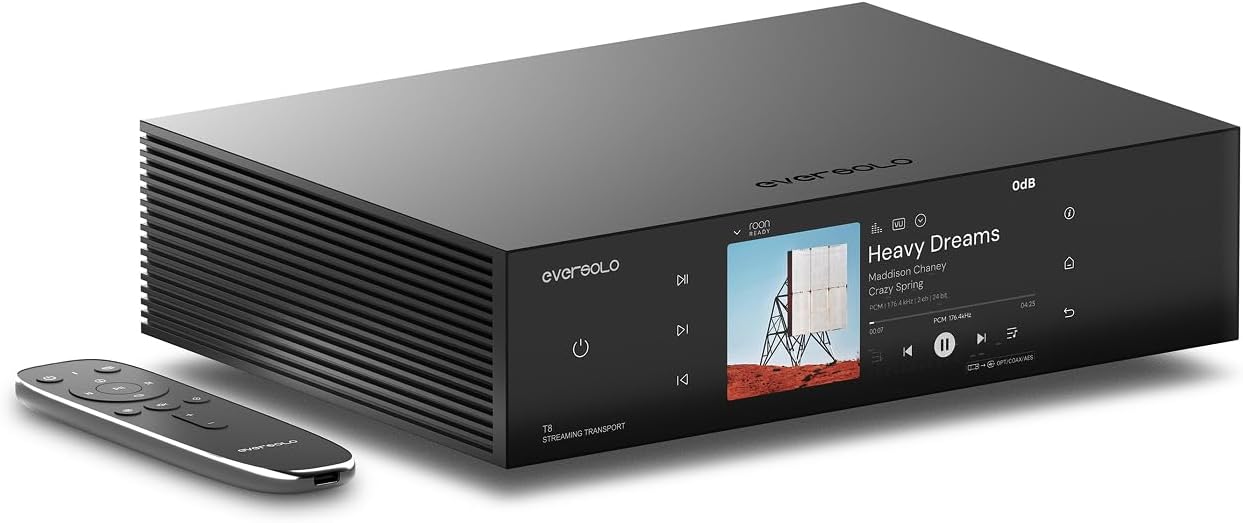
The Eversolo T8 is a professional-grade streaming transport designed for audiophiles and music enthusiasts who demand transparent, high-resolution digital audio. It functions as a dedicated source component that streams music from services like TIDAL and Qobuz, or stores local high-resolution files, then sends pristine digital audio to your DAC via multiple output options. This is the ideal choice for listeners who have invested in quality DAC and amplification but want superior streaming capabilities and jitter reduction.
The standout feature is the dual femtosecond clock architecture with AS318-B series crystal oscillators operating at 49.1520 MHz. This dramatically reduces clock jitter at the source, resulting in noticeably cleaner audio with enhanced detail retrieval, superior vocal tone, and a more three-dimensional soundstage. The fully isolated outputs on all ports eliminate ground loop noise and interference, while support for up to DSD512 and PCM 768kHz ensures compatibility with the most demanding high-resolution audio formats available today.
Build quality is exceptional, featuring a CNC-machined aluminum chassis with anodized finishing that delivers premium aesthetics and mechanical stability. The 6-inch vibrant touchscreen is bright, responsive, and displays real-time VU meters and cover art with excellent attention to detail. Control is intuitive through the touchscreen, included remote, or mobile app on iOS, Android, or macOS devices, making operation smooth from day one.
The proprietary evotune acoustic calibration system is a game-changer for room optimization, automatically compensating for acoustic imperfections while the 10-band parametric EQ lets you fine-tune specific frequencies to your preferences. Integration with Roon, Qobuz Connect, and TIDAL Connect provides seamless access to millions of tracks in lossless quality, while dual NVMe storage bays allow you to build a personal music library for ultimate playback control.
The main considerations are the premium price point and the requirement for a separate DAC to complete your system. However, users consistently report that the T8 justifies its cost through superior sound quality, software sophistication, and build excellence that surpasses competing streaming transports. This is a genuine end-game component for serious music lovers.
Connectivity: Wi-Fi 6, Bluetooth, Ethernet, SFP Fiber Network, Gigabit LAN
Audio Outputs: IIS (8 pinout configurations), Coaxial, AES/EBU (balanced XLR), USB Audio, Optical, USB 3.0 OTG x2
Maximum Resolution: IIS and USB Audio support DSD512 Native and PCM 768kHz 32Bit; Coaxial, AES/EBU, and Optical support PCM 192kHz 24Bit and DoP64
Streaming Services: TIDAL, Qobuz, IDAGIO, Amazon Music, TuneIn Radio, Presto Music, KKBOX, Radio Paradise, Deezer
Display: 6-inch vibrant touchscreen with multiple VU meter visualizers
Clocking: Dual femtosecond clocks with AS318-B series professional audiophile-grade crystal oscillators
Storage: Dual NVMe bays for high-capacity local music library storage
Control Options: Touchscreen, remote control, mobile app (iOS, iPadOS, Android, macOS M-series)
Build: CNC-machined aluminum chassis with anodized finishing
Weight: 4.5 kg
Warranty: 1 year manufacturer
Who Should Buy This: The T8 is ideal for serious audiophiles and music enthusiasts who already own a quality DAC and want a superior streaming transport. It's perfect for those who value high-resolution audio, extensive software features, and premium build quality. If you stream from TIDAL or Qobuz regularly, or maintain a large personal music library, this transport will elevate your listening experience significantly.
Who Should Consider Alternatives: Casual listeners or those on a tight budget should explore more affordable streaming options. If you need a complete all-in-one streaming solution with built-in DAC, integrated amplification, or speakers, you may want to look at different product categories.
Important Considerations: The T8 is a transport only and requires a separate DAC to convert digital audio to analog. Factor this into your total system cost. SFP fiber network modules must be purchased separately if you want optical isolation benefits. Ensure your chosen DAC supports at least one of the T8's output formats (IIS is most common for high-end DACs).
Setup Recommendations: For optimal performance, use the AES/EBU XLR output with a quality digital cable to your DAC, or the IIS connection if your DAC supports it. Take advantage of the dual NVMe storage bays to store your favorite high-resolution files locally, reducing reliance on wireless streaming. Use the evotune acoustic calibration system to automatically optimize sound for your listening room.

Pros
- Exceptional streaming versatility with support for nearly every major platform including Spotify, TIDAL, Qobuz, and Amazon Music
- True high-resolution audio output up to 24-bit/192kHz delivers audiophile-grade sound through existing equipment
- Flexible connectivity options including optical, coaxial, RCA, and Ethernet suit a wide range of stereo systems
- Multiroom audio support across AirPlay 2, Google Cast, and Alexa ecosystems in a single compact device
- Strong 4.3-star rating from a large number of verified buyers reflects reliable real-world performance
Cons
- AirPlay receiver only, meaning it cannot transmit audio to other AirPlay-enabled speakers or devices downstream
- Full 24-bit/192kHz streaming is limited to a handful of services like Amazon Music Ultra HD and Qobuz, so users of other platforms may not hear the full benefit
The WiiM Pro Plus is a network music streamer designed to breathe new life into traditional hi-fi and stereo systems. Rather than replacing your amplifier or speakers, it slots neatly into your existing setup and adds modern wireless streaming capabilities, making it ideal for audiophiles who love their current gear but want the convenience of today's streaming services.
The standout feature is its support for high-resolution audio up to 24-bit/192kHz, delivered via both digital optical or coaxial outputs and analog RCA. Combined with gapless playback and bit-perfect output, the listening experience is genuinely impressive. The built-in MQA core decoder is a welcome bonus for TIDAL subscribers seeking Master-quality tracks, and Roon Ready certification appeals to serious home audio enthusiasts.
Connectivity is a real strength here. The WiiM Pro Plus supports AirPlay 2, Google Cast, Spotify Connect, TIDAL Connect, Qobuz Connect, and Amazon Music, covering virtually every major streaming ecosystem. Multiroom grouping works seamlessly across AirPlay 2, Google Home, and Alexa devices, letting you sync audio throughout your home without investing in a separate smart speaker system. Voice control via Alexa, Google Assistant, and Siri adds everyday convenience.
In terms of design, the unit is compact at 5.5 inches square and just 1.6 inches tall, fitting discreetly into any rack or shelf. Build quality feels solid for the price point, and the variety of physical connectors including USB-C, RCA, optical, coaxial, and Ethernet ensures broad compatibility. One important limitation to note is that the device is an AirPlay receiver only and cannot send audio to other AirPlay speakers downstream.
Overall, the WiiM Pro Plus delivers exceptional value for anyone looking to modernize a stereo system with minimal fuss. Its broad platform support, true hi-res audio output, and multiroom capabilities make it one of the most versatile streamers in its class. If you already own quality speakers or an amplifier and want to add streaming without compromise, this is a highly recommended choice.
Brand: WiiM (WiiMHome) | ASIN: B0CC2HWC7N | Color: Black | Dimensions: 5.5 x 5.5 x 1.6 inches
Connectivity: Wi-Fi, Ethernet (wired), Bluetooth | Audio Resolution: Up to 24-bit/192kHz on digital and analog outputs | Digital Outputs: Optical (TOSLINK) and Coaxial SPDIF | Analog Output: RCA stereo | Other Ports: USB Type-C, Ethernet
Streaming Protocols: AirPlay 2 (receive only), Google Cast, Spotify Connect, TIDAL Connect (with MQA core decoding up to 24-bit/96kHz), Qobuz Connect, Amazon Music, Roon Ready, DLNA, NAS, UPnP | Voice Assistants: Amazon Alexa (built-in), Google Assistant, Siri
Multiroom Support: AirPlay 2, Google Home, Amazon Alexa, WiiM proprietary multiroom | Compatible Devices: Amplifiers, DACs, speakers, HomePod, Apple TV, Echo, Google Home, mobile phones, tablets | Audio Output Mode: Stereo (2-channel)
The WiiM Pro Plus is best suited for users who already own a quality amplifier, integrated stereo system, or DAC and want to add modern streaming without replacing their existing equipment. If you are starting from scratch with no amplifier or speakers, you may want to consider a complete wireless speaker system instead.
When choosing between the WiiM Pro Plus and its sibling the standard WiiM Pro, the key difference is audio quality. The Pro Plus offers a superior built-in DAC and supports the full 24-bit/192kHz resolution, making it the better choice if you value high-fidelity playback. If you primarily stream compressed audio from Spotify at standard quality, the price difference may be less relevant to you.
For multiroom setups, this device works best when you already have other AirPlay 2, Google Home, or Alexa-compatible speakers in your home. Pairing multiple WiiM devices together using the proprietary WiiM multiroom function is also a cost-effective way to expand synchronized audio across rooms without buying into a single brand ecosystem.
Keep in mind that the AirPlay receiver-only limitation means you cannot use the WiiM Pro Plus as a hub to send audio to other AirPlay speakers. If you need that capability, you will need a separate AirPlay transmitter device. For most users who want to receive and play music locally, this restriction will not be an issue in everyday use.

Pros
- Exceptional build quality with a premium look and feel that rivals units costing significantly more
- Audiophile-grade sound performance that reviewers compare favorably to streamers priced two to three times higher
- Comprehensive streaming service support with native app integration for Tidal, Qobuz, Spotify and more
- Flexible connectivity with both XLR and RCA balanced outputs, HDMI ARC, and multiple digital inputs and outputs
- Android 11-based system with broad third-party app support adds long-term versatility beyond the built-in features
Cons
- No remote control included at this price point, requiring a separate purchase for couch-friendly operation
- The mobile app has been reported as occasionally laggy and inconsistent, particularly when controlling UPnP home music servers
- Some users have reported a known power failure issue, and customer service response times have been described as slow
The Eversolo DMP-A6 Gen 2 is a high-end all-in-one music streamer and DAC designed for audiophiles and serious hi-fi enthusiasts who want a single, elegant device at the center of their digital audio system. Priced in the upper mid-range tier, it targets listeners upgrading from entry-level streamers like the WiiM Ultra who are not yet ready to invest in separates costing thousands of dollars.
The headline upgrade over its predecessor is a newly redesigned linear power supply with a noise floor below 40uV, which translates directly into cleaner signal reproduction and a more detailed, spacious soundstage. Reviewers consistently note that the unit sounds noticeably closer to flagship streamers costing two to three times more, with one owner drawing a direct comparison to the Naim Uniti Atom. Format support is exhaustive, covering DSD512, native multi-channel DSD, MQA, and all standard lossless formats, ensuring no recording in your library goes unplayed at its best quality.
Build quality is a genuine standout. The chassis feels solid and premium, the 6-inch LCD touchscreen is crisp and responsive, and the mechanical control knob has a satisfying tactile feel. The rear panel is impressively equipped, offering dual XLR and RCA analog outputs, HDMI ARC, coaxial, optical, USB, and HD Bluetooth, giving you the flexibility to integrate it into almost any existing system. The HDMI ARC and TRIGGER functions are particularly useful for home theater setups, allowing automatic power coordination with other components.
There are a few friction points worth noting. The unit ships without a remote control, which feels like an oversight at this price, and a compatible remote should be budgeted for separately. The companion mobile app, while functional, has been reported as occasionally laggy and grainy in screen-mirroring mode, and some users have experienced inconsistencies when browsing UPnP home servers. A small number of owners have also reported a power failure issue after several months of use, and customer service responsiveness has drawn criticism.
Overall, the Eversolo DMP-A6 Gen 2 is a compelling and feature-dense streamer-DAC that punches well above its weight in both sound quality and connectivity. For anyone seeking a serious upgrade from a budget streamer without committing to a full separates system, this unit offers exceptional value and genuine audiophile performance. Just budget for a remote and be aware of the app limitations before purchasing.
Audio Formats: FLAC, WAV, APE, DSD512 (DSF, DFF, ISO, DST), MQA, and all standard lossless and lossy formats. Supports stereo and native multi-channel DSD playback via the EOS Audio Engine.
Connectivity: Wi-Fi (including Wi-Fi 6), Ethernet, Bluetooth (HD), HDMI ARC, USB Type-A and Type-C, Coaxial In and Out, Optical In and Out. Analog outputs include dual RCA and dual XLR, which can operate simultaneously or independently.
Streaming Services: Tidal (with Tidal Connect), Qobuz, Spotify Connect Lossless, Amazon Music, Apple Music, Deezer, Highresaudio, Presto Music, IDAGIO, Radio Paradise, TuneIn, Internet Radio, and Squeeze Connect. Roon Ready certified.
Control Options: 6-inch full-color LCD touchscreen, mechanical control knob, dedicated Eversolo app for Android and iOS, and optional IR remote (sold separately). Platform based on Android 11 with support for third-party app installation.
Other Details: Memory 4GB, item weight 2kg, video output resolution 1080p (audio-only HDMI output), one-year manufacturer warranty. Box includes power cable, USB cable, trigger cable, screwdriver, and user manual.
Who should buy this? The DMP-A6 Gen 2 is best suited for audiophiles who already own a power amplifier or active speakers and need a high-quality digital front end. It is also ideal for home theater enthusiasts who want to route TV audio through a dedicated hi-fi DAC using HDMI ARC, and for Roon users seeking a certified endpoint with built-in DAC capabilities.
Who should look elsewhere? If you need a headphone output, this unit does not have one and you will need a separate headphone amplifier. If you are a casual listener who primarily uses Bluetooth speakers or a soundbar, the feature set here is more than you need and a more affordable streamer would serve you better. If remote control from the couch is essential to your workflow, factor in the additional cost of a compatible remote before purchasing.
How does it compare? Against the WiiM Ultra, the Eversolo offers superior DAC performance, better build quality, more analog output options including XLR, and native DSD512 support, at a higher price. Against the Naim Uniti Atom, it comes in at a fraction of the cost while delivering a sound quality that multiple reviewers describe as surprisingly close. It is a strong choice for anyone in the gap between entry-level and flagship streaming.
Setup tips: For best performance, use a wired Ethernet connection rather than Wi-Fi. Pair it with a quality power amplifier and use the XLR balanced outputs if your amplifier supports it. Purchase a compatible IR remote at the time of ordering to avoid frustration. Ensure your music files contain complete ID3 metadata tags to take full advantage of the automatic library organization features.
How to Choose a Network Audio Streamer
Connectivity and Compatibility
Your first consideration should be how the streamer connects to your existing gear. Look for the right digital or analog outputs to match your amplifier or powered speakers. Essential connections include optical, coaxial, RCA, and HDMI ARC for TV audio.
Equally important is wireless protocol support. Ensure it works with your preferred ecosystem, whether that is AirPlay 2 for Apple users, Google Cast for Android, or Alexa for voice control. Some models, like certain Wi-Fi music streamers, offer broad compatibility across all platforms.
Audio Quality and DAC Performance
The built-in Digital-to-Analog Converter (DAC) is the heart of a streamer. It determines how accurately your digital music is converted into an analog signal. Higher-end models feature premium DAC chips from brands like ESS Sabre, which deliver exceptional clarity and detail.
For true audiophile sound, verify the supported audio resolutions. Look for streamers that handle high-resolution formats up to 24-bit/192kHz or even DSD512. This ensures you hear every nuance from services like Tidal Masters and Qobuz, as well as your personal music library.
Streaming Services and User Interface
<!–Check that the streamer supports your must-have music services natively. Most work with Spotify, Amazon Music, and Tidal, but integration depth varies. Some offer dedicated ‘Connect’ features for higher quality, app-controlled streaming.
Consider how you will control playback. A companion mobile app is standard, but a built-in touchscreen or included physical remote adds significant convenience. An intuitive interface makes browsing your library and managing multiroom groups a pleasure, not a chore. For simpler setups, explore wireless audio adapters as an alternative.
Multiroom and Smart Home Integration
A powerful streamer can become the hub for whole-home audio. Look for models that sync seamlessly with other compatible speakers from brands like Sonos, Amazon Echo, or Google Nest. This lets you play music in every room in perfect harmony.
Deep smart home integration is a major benefit. The best streamers work with voice assistants, allowing you to select music, adjust volume, or group rooms with simple commands. This transforms your audio system into a truly connected part of your smart home. You can find more ideas for expanding your system in our guide to wireless audio receivers.
Final Thoughts
Upgrading your audio system with a dedicated network streamer is one of the most impactful changes you can make. For most listeners seeking fantastic sound and robust features, the WiiM Ultra Hi-Res Music Streamer with Touchscreen represents a superb all-in-one solution. If your priority is uncompromising audiophile performance and you have a separate high-end DAC, the Eversolo T8 Music Streamer Transport with Remote offers a transport-focused, precision-engineered experience. Whichever path you choose, you are investing in a richer, more connected way to enjoy music.
Frequently Asked Questions
What is the difference between a network streamer and a Bluetooth receiver?
A network streamer connects via your home Wi-Fi or Ethernet network, offering significantly higher audio quality, greater range, and multiroom capabilities. Bluetooth is convenient but typically compresses audio and has a limited range. For whole-home, high-fidelity audio, a network streamer is the superior choice. Learn more about the different options in our wireless and streaming audio category.
Do I need a separate DAC if my streamer has one built-in?
Not necessarily. Many modern streamers, especially mid-range and high-end models, include excellent internal DACs that will satisfy most listeners. If you already own a premium external DAC you love, you might opt for a ‘streamer transport’ model that focuses solely on delivering a perfect digital signal to your external unit.
Can I use a network audio streamer to play music from my computer or NAS drive?
Yes, absolutely. Most streamers support DLNA/UPnP protocols, allowing you to browse and play music files stored on a Network-Attached Storage (NAS) device or a computer shared on your home network. This is a great way to access a large personal music library in high resolution.
How important is multiroom audio capability?
If you enjoy listening to music in more than one room, it is a game-changer. Multiroom audio lets you play synchronized music throughout your home or different music in different zones, all controlled from your phone. It is a core feature for modern whole-home audio systems and a key reason to choose a network streamer over simpler alternatives. For more on building a complete system, visit our home audio guides.


Write Your Review
No reviews yet. Be the first to share your experience!