

You’ve invested in quality headphones or a fine speaker system, yet something feels missing. The digital music flowing from your computer or streamer lacks the depth, clarity, and emotional impact you crave. The bridge between your digital files and the rich analog sound you desire is a high-quality Digital-to-Analog Converter, or DAC. A reference-grade DAC acts as the cornerstone of any serious listening setup, meticulously reconstructing your music with precision and minimal coloration.
This guide is crafted for the discerning listener ready to step beyond basic audio. Whether you’re building a dedicated desktop station or integrating high-fidelity sound into your living room, selecting the right DAC is paramount. We have evaluated nine of the most compelling models available in 2026, spanning from accessible entry points to statement pieces. Our goal is to demystify the technical jargon and highlight the products that truly deliver on the promise of reference-grade audio. For those seeking the absolute pinnacle of performance, our roundup of the best flagship HiFi DACs explores the cutting edge.
Top Contenders at a Glance
Pros
- Outstanding audio performance with industry-leading ES9039Q2M DAC chip and ultra-low distortion specifications
- Versatile connectivity with three input types and UAC mode switching eliminates need for multiple adapters
- Durable aluminum construction provides superior build quality and improved heat management over plastic alternatives
- MQA decoding support maximizes audio quality from compatible streaming platforms and high-resolution music files
- Compact, portable design makes it ideal for desktop setups, gaming consoles, and portable audio systems
Cons
- UAC mode switching requires device restart to take effect, adding minor inconvenience when switching between different source devices
- Limited to stereo RCA output, which may require additional equipment for surround sound or multi-channel audio setups
- Compact size means smaller heat dissipation surface compared to larger DAC units, though aluminum construction mitigates this concern
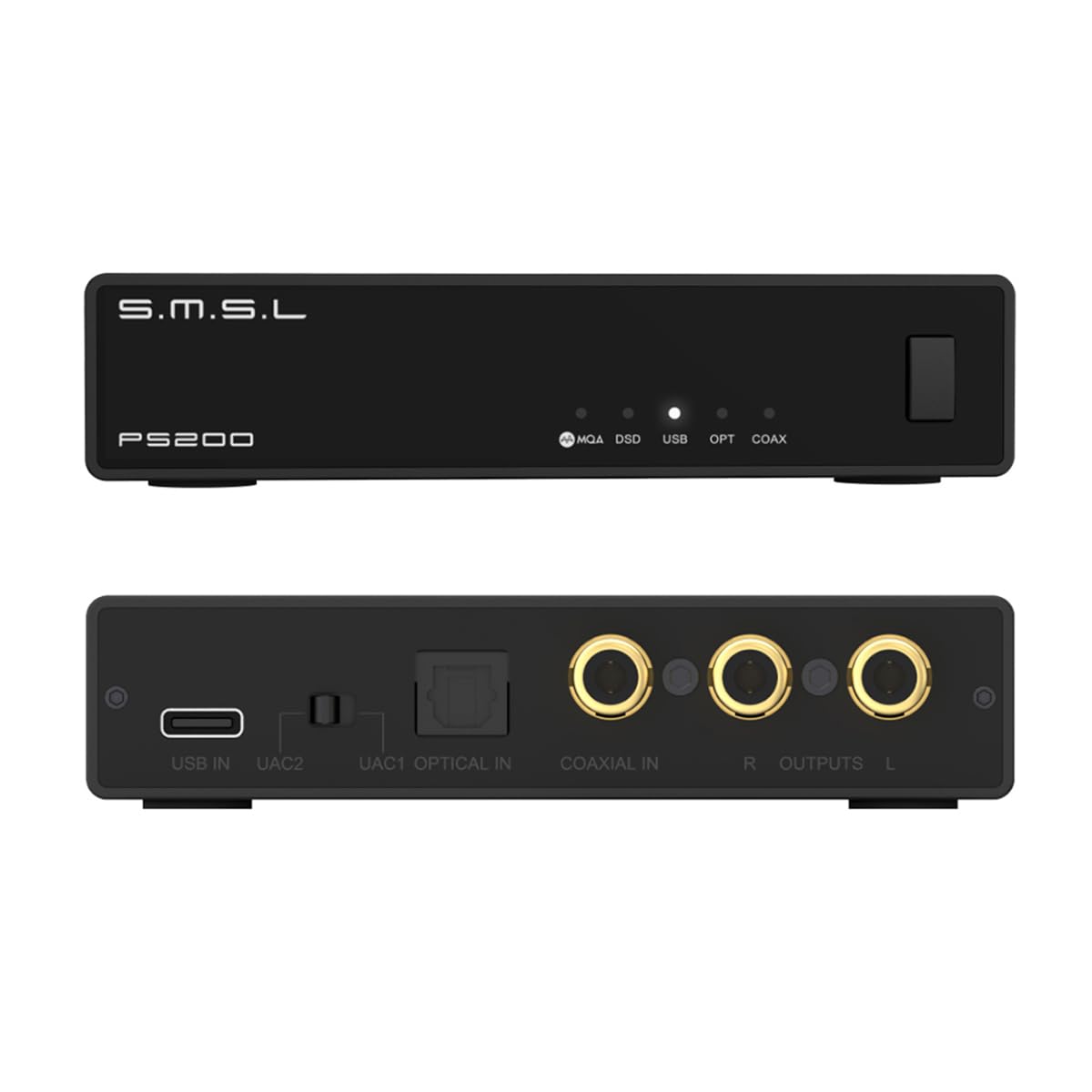
The SMSL PS200PRO is a high-performance digital-to-analog converter designed for audiophiles, gamers, and music enthusiasts who demand studio-quality sound from their digital devices. This compact DAC serves as an essential bridge between modern digital sources like PCs, gaming consoles, and streaming devices, converting digital audio into pristine analog signals that reveal the full detail and nuance of your favorite music.
The standout feature of the PS200PRO is its exceptional technical foundation, built around the ESS ES9039Q2M DAC chip paired with an XMOS XU-316 processor and quad dual op-amp configuration. This combination delivers extraordinary performance metrics: USB input handles PCM up to 32bit/768kHz and DSD512, while maintaining a remarkable 125dB signal-to-noise ratio and virtually imperceptible distortion at 0.00009% THD+N. Real-world performance reflects these specs, delivering audio that is noticeably clearer, more detailed, and more dynamic than typical onboard sound solutions.
The aluminum alloy chassis represents a significant upgrade from the original PS200, offering superior durability and improved thermal management for stable, consistent audio output. The device provides three input options (USB, optical, coaxial) with full MQA and MQA-CD support across all inputs, making it compatible with virtually any digital audio source. The UAC1/2 mode switch ensures optimal compatibility with PS5 and Switch consoles as well as PCs and tablets, though switching modes does require a device restart.
The main limitation is the stereo RCA output configuration, which restricts use in multi-channel or surround sound scenarios. Additionally, the compact form factor, while beneficial for portability, provides less surface area for passive cooling compared to larger desktop DACs, though the aluminum construction effectively mitigates heat concerns.
The SMSL PS200PRO delivers professional-grade audio performance at a compelling price point, making it an excellent choice for anyone serious about improving their digital audio quality without breaking the bank. Whether upgrading a gaming setup, enhancing a PC audio system, or building a portable audiophile rig, this DAC consistently punches above its weight in sound quality and versatility.
Audio Performance: ESS ES9039Q2M DAC chip, XMOS XU-316 processor, 4x dual op-amp configuration, 125dB SNR, 0.00009% THD+N at -120.5dB
Audio Format Support: PCM 32bit/768kHz, DSD512, MQA decoding, MQA-CD, DoP64
Connectivity: USB (UAC1/2 switchable), Optical, Coaxial inputs; Stereo RCA outputs
Physical Specs: 4.13 inches length x 4.13 inches width, aluminum alloy construction, 6-pin configuration
Compatibility: PC, PS5, Nintendo Switch, tablets, CD players, televisions
Who Should Buy This DAC? The PS200PRO is ideal for PC gamers seeking console-quality audio, music enthusiasts using high-resolution streaming services, console gamers upgrading from standard audio outputs, and anyone with a quality audio system looking to maximize digital source performance.
Setup Considerations: Ensure your audio source supports at least one of the three input types (USB, optical, or coaxial). For PS5 and Switch, use UAC1 mode. For PC and tablets, use UAC2 mode and remember to restart after switching. Connect the RCA outputs to your amplifier, active speakers, or audio interface.
Maximizing Performance: Use high-quality shielded RCA cables to minimize interference. Place the DAC away from heat sources and ensure adequate ventilation. For best results, use quality USB cables with PS5 and PC connections. Consider upgrading your cables and power supply for even greater sonic improvements.
Compatibility Check: Verify your devices support at least one input type before purchasing. The DAC works best with quality amplification or active speakers, as it outputs line-level analog signals rather than headphone-level output.
What to Look for in a Reference HiFi DAC
DAC Chip Architecture and Sound Signature
The core DAC chip is the heart of the converter, but its implementation defines the soul. Modern chips from ESS, AKM, and ROHM offer exceptional measured performance. However, the surrounding circuitry, power supply, and clocking create the final sound. Some models, like the AIYIMA D20 Balanced Audio DAC,Dual ES9039Q2M, offer a unique choice between chip-based sound signatures. Others, such as the FiiO K13 R2R Desktop DAC & Headphone Amp, pursue a distinct ‘resistor ladder’ approach for a more analog-like presentation.
Connectivity and System Integration
A reference DAC should be a versatile hub. Beyond standard USB, optical, and coaxial inputs, consider future needs. Balanced XLR outputs provide superior noise rejection for longer cable runs to amplifiers. Features like a 12V trigger, as seen on the TOPPING DX5 II Hi-Res DAC & Headphone Amp Combo, allow for single-button control of your entire audio system. If you plan to connect to a TV or gaming console, confirm UAC mode switching for full compatibility. For building a multi-device setup, our guide on the best desktop dual DACs offers further insights.
Output Options and Amplification
Determine if you need a pure DAC to feed an external amplifier, or a combo unit with a built-in headphone amp. Combo units like the Fosi Audio ZH3 DAC Headphone Amp provide exceptional convenience and value. Check the output power, especially if you own high-impedance headphones. Balanced headphone outputs (4.4mm or XLR) often deliver more power and a cleaner signal. Also, verify if the unit can function as a preamplifier, giving you volume control for active speakers or a power amp.
Feature Set and Customization
Advanced features can tailor the sound to your exact preference. Parametric Equalizers (PEQ), like the 10-band system in the FiiO K13, allow for precise frequency adjustments. Digital filter selections let you fine-trade the trade-off between sharpness and smoothness. Bluetooth connectivity with high-resolution codecs like LDAC is now a common and valuable feature for wireless streaming without major quality loss. Consider what level of control you desire over your final sound.
Final Thoughts
Upgrading to a dedicated reference DAC is one of the most impactful steps you can take toward audiophile-grade sound. The field in 2026 offers remarkable options at every level. For the enthusiast seeking maximum flexibility and a unique dual-DAC experience, the AIYIMA D20 Balanced Audio DAC,Dual ES9039Q2M presents a compelling case. Meanwhile, listeners prioritizing a classic, musical R2R architecture and powerful amplification will find the FiiO K13 R2R Desktop DAC & Headphone Amp an exceptional all-in-one solution. Whichever path you choose, you are investing in the faithful reproduction of your music, revealing details and emotion often lost in translation. For more inspiration on setting up your perfect listening post, explore our recommendations for the best HiFi DACs for desktop audio.
Frequently Asked Questions
Do I need a separate DAC if my computer or phone already has one?
Yes, almost certainly. Built-in DACs in consumer devices are engineered for cost and space savings, not audio fidelity. They are susceptible to electrical noise from other components. A dedicated external DAC uses superior components, isolated circuitry, and clean power to provide a dramatically clearer, more detailed, and dynamic sound.
What’s the difference between a Delta-Sigma DAC and an R2R DAC?
Most modern DACs use Delta-Sigma modulation, a highly efficient method that excels in measured performance like low distortion. R2R (Resistor-to-Resistor) DACs use a ladder of precise resistors and are often praised for a more natural, organic, and musically cohesive sound character, reminiscent of vintage analog gear. The choice is subjective and depends on your sonic preference.
Are balanced connections really better than single-ended?
For headphone listening, a balanced connection can provide more power and a lower noise floor, which is especially noticeable with sensitive in-ear monitors. For connecting to an amplifier, balanced XLR cables reject interference much more effectively over long distances, making them the professional standard. For short desktop runs, a quality single-ended (RCA) connection is often perfectly sufficient.
How important is high-resolution support (e.g., DSD512, 768kHz)?
While the practical benefits of ultra-high-resolution formats beyond 24-bit/192kHz are debated, support for them indicates a modern, capable DAC platform with robust digital processing. It ensures future compatibility as music libraries evolve. More importantly, a DAC that handles these formats typically has excellent engineering throughout, which benefits all your music, even standard CD-quality files. You can explore a wide range of these capable devices in our main HiFi DAC category.




Write Your Review
No reviews yet. Be the first to share your experience!