

You love the thrill of deep, resonant bass, but your living room, bedroom, or home office simply can’t accommodate a massive speaker cabinet. The quest for powerful low-end in a compact footprint is a common challenge. Choosing the wrong subwoofer can lead to muddy sound, annoying room vibrations, or a complete mismatch with your existing audio setup.
This guide is designed for anyone looking to add serious bass to a small or medium-sized room without sacrificing sound quality or space. We have evaluated nine top-rated subwoofers and soundbar systems, focusing on models that deliver performance where size matters. For more general audio upgrades, explore our guide on the best subwoofers for TV.

Pros
- Excellent value for money with impressive bass output relative to price point
- Well-constructed MDF cabinet provides durability and acoustic performance beyond typical budget subwoofers
- Compact footprint makes it ideal for apartments, small rooms, and space-constrained setups
- Works with existing amplifiers, eliminating need for powered subwoofer investment
- Customer reviews highlight satisfying bass impact for gaming and virtual pinball applications
Cons
- Requires external amplifier or receiver, making it unsuitable as a standalone speaker system
- Best performance in 50 Hz range rather than deep sub-bass frequencies below 40 Hz
- Some users report construction quality inconsistencies, particularly with port assembly
The Audio Fantasy SUB65 is a passive 6.5-inch subwoofer designed for home theater enthusiasts, gamers, and audio hobbyists who already own or plan to purchase an external amplifier or receiver. It fills a specific niche in the budget subwoofer market by offering solid bass performance without the cost premium of powered alternatives.
The standout feature is the premium MDF wood cabinet construction, which significantly reduces acoustic resonance compared to cheaper particle board alternatives. Paired with the 6.5-inch downfiring woofer and stable anti-shock base, this subwoofer delivers 100W RMS power with minimal distortion. Real-world performance shines in small to mid-size rooms, with users reporting satisfying bass impact for gaming and entertainment applications. The compact dimensions (8.6" x 8.6" x 13.1") make it exceptionally space-efficient.
Build quality is generally solid, though some users note inconsistencies in assembly, particularly with the port area. The cabinet feels well-made out of the box with proper bracing and finishing. Connectivity is straightforward via standard speaker wire, though you'll need RCA cables from your amplifier, which may require additional purchases depending on your setup.
The main limitation is that this subwoofer performs best in the 50 Hz range rather than delivering deep sub-bass below 40 Hz. This makes it better suited for music, gaming, and general home theater rather than bass-heavy movie soundtracks. Additionally, it cannot function alone and absolutely requires an external amplifier with appropriate subwoofer outputs.
Overall, the SUB65 represents excellent value for budget-conscious buyers with existing amplification. It won't replace a high-end powered subwoofer, but for small rooms and entry-level systems, it delivers impressive results backed by a 2-year warranty.
Driver and Power: 6.5-inch downfiring woofer, 100W RMS (less than 5% THD), 150W peak power, 4 Ohm impedance
Design: Premium MDF wood cabinet with 40mm anti-shock base, downfiring configuration with front-facing port
Dimensions: 8.6" (D) x 8.6" (H) x 13.1" (W)
Connectivity: Wired via standard speaker wire, RCA protocol connection
Frequency Response: 200 Hz, optimal performance around 50 Hz
Maximum Range: 10 meters
Warranty: 2-year manufacturer coverage
Compatibility: Works with desktop, home theater, television, and gaming console systems
Is This Right for You? The SUB65 suits you if you already own an amplifier with subwoofer outputs, want a compact bass solution for small to mid-size rooms, or are building an entry-level home theater system on a budget.
What You'll Need: An external amplifier or receiver with subwoofer output capability is mandatory. Standard speaker wire connections are included, but verify your amplifier has appropriate outputs before purchasing.
Best Use Cases: Music listening with stereo systems, gaming setups, virtual pinball cabinets, small apartment home theaters, and PC speaker enhancement.
When to Look Elsewhere: If you need a standalone powered subwoofer, require deep sub-bass below 40 Hz for action films, or have a large room requiring 150+ watts of continuous power, consider powered alternatives instead.
Setup Expectations: Installation is straightforward with simple wired connections. Expect to spend time dialing in crossover settings on your amplifier for optimal performance. The compact size means minimal space requirements and flexible placement options.

Pros
- Impressive 300W peak power output for a subwoofer in this price range
- Deep 32Hz frequency response brings movie soundtracks and music to life with real impact
- Flexible phase and crossover controls make integration with existing speaker setups straightforward
- Solid wood enclosure construction minimizes unwanted resonance and cabinet coloration
- Backed by Klipsch's reputation for audio quality and a strong limited warranty
Cons
- Wired-only connectivity via RCA means no wireless or Bluetooth streaming options for flexible placement
- At over 16 inches tall, the cabinet footprint may feel bulky in smaller living rooms or tight media setups
The Klipsch R-100SW is a 10-inch floor-standing subwoofer designed for home theater and stereo enthusiasts who want authoritative, room-filling bass without breaking the bank. It fits naturally into any 2.1, 5.1, or 7.1 surround sound system and is equally at home in a dedicated media room or a large living space.
At the heart of this subwoofer is a 10-inch front-firing spun-copper IMG woofer paired with an all-digital amplifier rated at 150 watts continuous and 300 watts peak. This combination delivers a frequency response reaching down to 32Hz, which is deep enough to reproduce the low-end rumble of action films, the punch of kick drums, and the resonance of pipe organs with convincing realism.
The R-100SW is built with a wood enclosure finished in a clean black brushed polymer veneer, giving it a refined appearance that blends into most home decor. The front-firing driver configuration adds placement flexibility, allowing the unit to perform well even when positioned close to a wall. Controls for volume, low-pass crossover frequency, and 0 to 180-degree phase adjustment are accessible on the rear panel, making it easy to dial in the perfect blend with your main speakers.
On the downside, the R-100SW is strictly a wired subwoofer, connecting via RCA inputs only, which limits placement flexibility compared to wireless-enabled alternatives. The cabinet is also fairly substantial in size, so buyers with compact rooms should measure carefully before purchasing.
Overall, the Klipsch R-100SW delivers exceptional bass performance and build quality at its price point. With a class-leading 5-year woofer warranty, broad receiver compatibility, and Klipsch's proven acoustic engineering, it is a compelling choice for anyone looking to add serious low-end impact to their home audio system.
The Klipsch R-100SW features a 10-inch (25.4 cm) spun-copper IMG woofer in a front-firing configuration housed in a wood enclosure. Amplifier power is rated at 150 watts continuous and 300 watts peak, delivered by an all-digital amplifier stage.
Frequency response spans 32Hz to 120Hz at plus or minus 3dB, making it suitable for both cinematic low-frequency effects and musical bass reproduction. Connectivity is handled via line-level LFE RCA inputs, ensuring compatibility with the vast majority of AV receivers and stereo amplifiers.
Rear-panel controls include a volume knob, variable low-pass crossover, and a 0 to 180-degree phase switch. The auto power-on feature activates the subwoofer when a signal is detected and powers it down during periods of silence. Cabinet dimensions are approximately 14.5 inches wide by 12.5 inches deep by 16.4 inches tall. The unit is covered by a 5-year limited warranty on the woofer and a 2-year limited warranty on the amplifier.
If you are building or upgrading a home theater system and want to add deep, impactful bass, the Klipsch R-100SW is worth serious consideration. It pairs especially well with Klipsch Reference series bookshelf or floor-standing speakers, but its flexible crossover controls make it compatible with virtually any brand of main speakers.
For rooms up to around 2,000 square feet, the R-100SW provides more than enough output. If you have a very large open-plan space or you listen at consistently high volumes, you may want to consider a larger 12-inch model for additional headroom. For typical living rooms and dedicated home theaters, this unit is more than capable.
When positioning the subwoofer, try placing it near a front corner of the room for maximum bass reinforcement, then use the phase control to align it with your main speakers. Connect it to your AV receiver using a standard RCA subwoofer cable and set your receiver's crossover to around 80Hz as a starting point, adjusting from there based on your main speakers' bass extension. The auto power-on feature means you can leave it plugged in without worrying about standby power consumption.
Pros
- Powerful 100W dynamic output in a compact, space-saving enclosure ideal for smaller rooms
- Versatile hookup options including RCA and speaker-level connections suit a wide range of receivers and amplifiers
- Adjustable crossover and volume controls make tuning simple and precise for any listening environment
- Durable resonance-free driver materials ensure consistent performance during extended high-volume use
- Comprehensive 5-year limited warranty with dedicated amplifier coverage adds strong long-term value
Cons
- At 11.8 kg the unit is relatively heavy for its size, which may complicate placement or repositioning in tight spaces
- The 40-160 Hz frequency response means it is optimized for bass duties only and will not extend into higher mid-range frequencies
- No wireless connectivity option means cable management is required for clean installation in modern setups
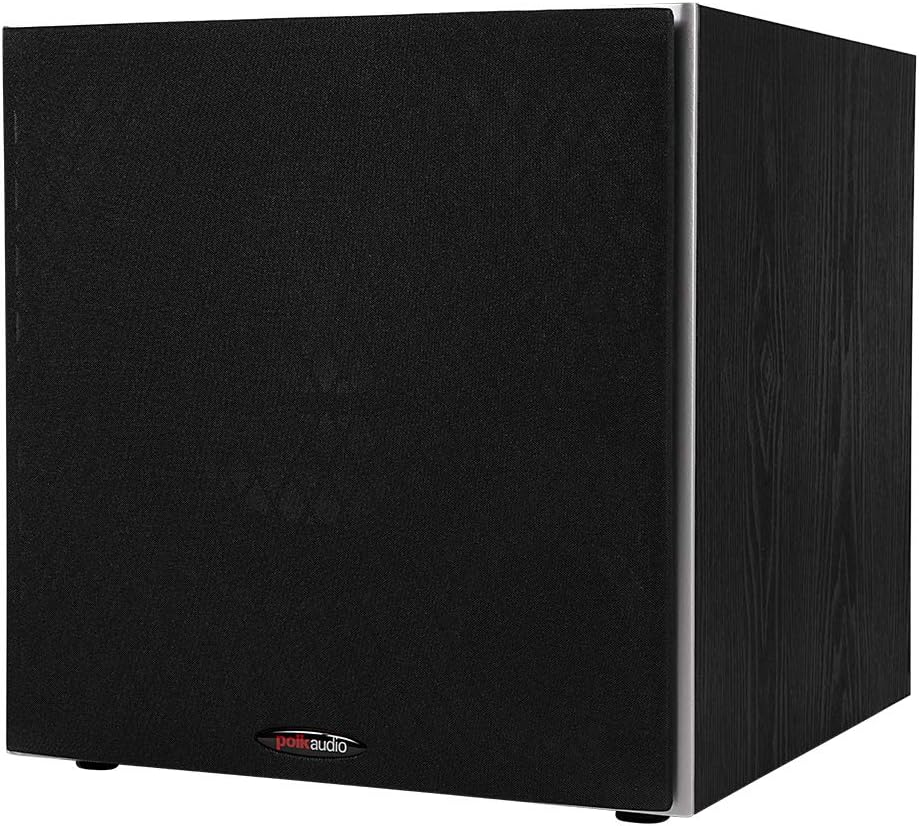
The Polk Audio PSW10 is a 10-inch powered subwoofer designed for home theater and stereo enthusiasts who want impactful bass without dedicating a large footprint to their audio setup. It targets small to mid-sized rooms and works as a straightforward upgrade to any existing speaker system, requiring no separate amplifier thanks to its fully self-contained design.
At the heart of the PSW10 is a Dynamic Balance woofer paired with a high-current 50W RMS amplifier capable of delivering up to 100 watts of dynamic power. The configured directed port enhances bass depth and extension, producing a frequency response of 40-160 Hz that covers the full range of cinematic low-end effects and musical bass lines with impressive accuracy and minimal distortion.
The cabinet is engineered from non-resonant materials, which prevents unwanted vibrations from coloring the sound at high volumes. A detachable front grille, clean black finish, and compact 17 x 14.25 x 14.5 inch dimensions give the PSW10 a tidy, unobtrusive appearance that fits neatly alongside most furniture. Connectivity is straightforward, with RCA line-level and speaker-level inputs and outputs on the rear panel alongside a Phase Toggle Switch for users running dual subwoofer configurations.
One honest drawback is the lack of wireless connectivity, which is increasingly common at this price point and would simplify placement in modern living rooms. The unit is also on the heavier side at nearly 12 kg, so moving it around during setup can be a bit cumbersome. Additionally, the crossover filter tops out at 160 Hz, so users pairing it with small satellite speakers should verify their main speakers can cover the upper bass and midrange adequately.
Overall, the Polk Audio PSW10 is a well-engineered, reliable subwoofer that delivers genuine low-frequency performance in a compact package. Its flexible inputs, adjustable crossover, and robust warranty make it a smart and accessible choice for anyone looking to add serious bass to a home theater or music system without complexity or compromise.
Driver Size: 10 inches | Amplifier Power: 50W RMS, 100W Dynamic | Frequency Response: 40-160 Hz (-3dB) | Impedance: 8 ohm | Channels: 5.1 compatible
Crossover: Continuously variable 80-160 Hz low-pass filter | Connectivity: RCA line-level input/output, Speaker-level input/output | Power Source: AC corded | Mounting: Floor mount
Dimensions: 17 inches D x 14.25 inches W x 14.5 inches H | Weight: 11.8 kg | Color: Black | Model Number: AM1055-C (PSW10)
Warranty: 5-year limited warranty, 3 years on amplifier parts and labor | In the Box: Powered subwoofer, grille, online registration card, owner's manual | Manufacturer: DEI Holdings (Polk Audio)
If you are shopping for your first subwoofer, the PSW10 is an excellent starting point. Its self-contained amplifier means you do not need to budget for a separate sub amp, and its dual input options make it compatible with virtually any AV receiver, stereo amplifier, or even a soundbar with a subwoofer output.
Room size is an important consideration. The PSW10 performs best in rooms up to roughly 2,000 square feet. For larger spaces or dedicated home theater rooms, you may want to consider a larger driver or a higher-wattage model, but for typical living rooms and apartments this unit delivers more than enough output.
When positioning the subwoofer, start by placing it near the front of the room close to your main speakers, then use the rotary volume and crossover controls to dial in a balanced blend. The Phase Toggle Switch is particularly useful if you ever expand to a dual-subwoofer setup, helping eliminate bass cancellation between units.
Buyers who prioritize wireless convenience or who are building a fully cable-free setup should note that the PSW10 uses only wired connections. In that case, pairing it with an aftermarket wireless subwoofer adapter is a straightforward workaround. For everyone else, the PSW10 represents a dependable, high-value choice backed by a strong warranty and Polk Audio's decades of acoustic engineering expertise.

Pros
- Delivers powerful, room-filling bass that punches well above its 8-inch size
- Ideal for apartments and noise-restricted environments with controllable volume output
- Yamaha's YST II technology ensures clear, distortion-free bass without muddiness
- Includes 15-foot cable and remote control for convenient setup and operation
- Highly rated by users comparing it favorably to much more expensive subwoofers
Cons
- 8-inch driver cannot match the depth and impact of larger 12-inch or 15-inch subwoofers in spacious rooms
- Plastic enclosure feels less premium than higher-end models, though it performs well
- Best suited for small to medium rooms rather than large home theater spaces
The Yamaha NS-SW050BL is a powered subwoofer engineered for listeners who demand serious bass performance without the bulk, noise, or expense of larger alternatives. It's perfect for apartment dwellers, small room enthusiasts, and anyone upgrading from passive subwoofers or built-in TV speakers who needs authentic low-end impact.
What sets this sub apart is Yamaha's Advanced YST II servo technology combined with its twisted flare port design. These technologies work together to produce clear, punchy bass that remains tight and controlled even at higher volumes. Users consistently report that despite its modest 8-inch woofer, the subwoofer delivers impressive tactile feedback and room-filling low frequencies, with one professional reviewer noting it rivals subwoofers costing three times as much.
The build quality reflects its value positioning. The plastic enclosure is functional and unobtrusive, fitting naturally into any room decor. The included 15-foot cable and remote control make setup straightforward, while connectivity options including wired and Bluetooth ensure compatibility with modern home theater systems and music players alike.
The primary limitation is size. This is fundamentally a small-room subwoofer. If you have a large open space or crave movie theater-level bass impact, you'll want a larger driver. However, for the intended use case of apartments, offices, and compact living spaces, this subwoofer excels at delivering bass that satisfies without disturbing neighbors.
The Yamaha NS-SW050BL represents exceptional value for anyone seeking quality subwoofer performance within space and budget constraints. Its combination of advanced bass technology, compact form factor, and proven reliability makes it a smart choice for upgrading your audio experience without compromise.
Driver and Performance: 8-inch cone woofer, 100W dynamic power output at 5 ohms, 28 Hz frequency response, 1-inch tweeter
Technology: Advanced YST II (Yamaha Active Servo Technology II) with discrete amplifier circuitry, twisted flare port for reduced port noise
Connectivity: Wired connection with included 15-foot cable, Bluetooth wireless technology, Ethernet connectivity, remote control operation
Design: Floor-standing enclosure with plastic construction, black color, stylish compact form factor optimized for small to medium rooms
Warranty and Accessories: 2-year manufacturer limited warranty, includes subwoofer cable, warranty card, and manual
Who Should Buy This: Apartment dwellers with noise restrictions, music and movie enthusiasts with small to medium-sized rooms, anyone upgrading from passive subwoofers, budget-conscious buyers seeking professional-grade bass quality, and those who prioritize a compact footprint over maximum low-end extension.
Room Size Considerations: This subwoofer performs optimally in rooms up to approximately 250 square feet. In larger spaces, you may want to consider a 10-inch or 12-inch model for deeper bass coverage and impact.
Setup Tips: Place the subwoofer in a corner or against a wall to maximize bass response. Use the included 15-foot cable to position it away from your main listening area if needed. Start with the gain control at moderate levels and adjust to taste based on your room acoustics and content preferences.
Compatibility: Works with any modern home theater receiver that has subwoofer output, stereo amplifiers with preamp outputs, and devices with Bluetooth capability. The included cable and remote make integration straightforward regardless of your existing audio setup.

Pros
- Powerful 70W RMS output with Class-D efficiency delivers deep, clean bass without running hot
- Versatile connectivity with dual hookup modes makes it compatible with a wide range of speakers and amplifiers
- Compact slim design with attractive wood grain finish fits neatly into home and desktop environments
- Auto-standby feature is a practical energy-saving touch for everyday use
- Officially compatible with a broad lineup of Edifier speakers and works with third-party systems via RCA
Cons
- Series connection mode (Signal In to Signal Out) does not support Bluetooth, USB, or optical speaker inputs, which may limit compatibility with some modern wireless desktop speakers
- At just under 23 lbs, the unit is moderately heavy for a compact subwoofer, which could be a consideration for desk or shelf placement
- No wireless connectivity means users with fully wireless setups will need to run physical cables
The Edifier T5s is a compact powered subwoofer aimed at desktop audio fans, bookshelf speaker owners, and home theater enthusiasts who want a meaningful bass upgrade without committing to a large, traditional subwoofer. With a 70W RMS Class-D amplifier driving an 8-inch long-throw woofer, it punches well above its size and price bracket, reaching a low frequency extension of 35Hz that adds genuine depth and body to music, movies, and gaming audio.
One of the T5s's strongest attributes is its tuning flexibility. The adjustable low-pass filter, spanning 30Hz to 160Hz, lets you dial in the crossover point to blend naturally with your existing speakers, while the 0 and 180 degree phase selector ensures the subwoofer stays in acoustic sync with your mains. This level of control is typically found on more expensive units and makes the T5s genuinely versatile across different room setups and speaker pairings.
The cabinet design is a highlight in a product category where aesthetics are often an afterthought. The 18mm MDF enclosure with a wood grain finish and low-profile grille looks refined and understated, sitting comfortably in a living room or on a media shelf. The front-firing driver combined with a right-firing acoustic port is a smart engineering choice that reduces placement sensitivity and keeps bass response tight and controlled rather than boomy.
There are a few practical limitations worth noting. The series-connection mode, which routes audio through the subwoofer to your main speakers, only works with speakers that have a wired line-in port. Bluetooth, USB, and optical inputs are not supported in this configuration, so users with modern wireless desktop speakers may find their options more restricted. Additionally, there is no wireless connectivity of any kind, meaning cables are always part of the equation.
Overall, the Edifier T5s is a well-engineered, attractively designed powered subwoofer that delivers serious low-frequency performance in a compact, easy-to-place package. The plug-and-play setup, included cables, and auto-standby feature make it approachable for casual users, while the precise tuning controls satisfy more demanding listeners. It is a strong recommendation for anyone looking to add clean, impactful bass to a desktop or small home theater system.
Driver: 8-inch long-throw dynamic woofer with front-firing configuration and right-firing acoustic port.
Amplifier: Class-D built-in amplifier delivering 70W RMS continuous output. No external receiver required.
Frequency Response: 35Hz and above. Low-pass filter adjustable from 30Hz to 160Hz. Phase selector: 0 degrees or 180 degrees.
Connectivity: RCA Signal In and RCA Signal Out. Includes 3.5mm-to-RCA cable and RCA cable. No wireless connectivity.
Cabinet: 18mm MDF construction with wood grain finish. Dimensions: 15.71 inches deep, 6.69 inches wide, 16.14 inches tall. Weight: approximately 22.9 lbs (10.38 kg).
Power: Corded electric. Auto-standby activates after 15 minutes of inactivity. Warranty: 2-year manufacturer limited warranty.
If you are shopping for your first subwoofer or upgrading a compact desktop speaker setup, the Edifier T5s is one of the most approachable options in its class. Its plug-and-play design means you do not need a separate AV receiver or amplifier, and the included cables mean you can be up and running within minutes of unboxing.
For buyers pairing this with Edifier bookshelf speakers such as the R1280Ts, R1700BT, or R1850DB, the T5s is officially optimized for those pairings and will integrate with minimal fuss. If you are using third-party speakers, check that your speakers or amplifier have a dedicated subwoofer output (sub out) or standard RCA line outputs, as this is the most reliable connection method.
Consider the series-connection mode carefully if your main speakers rely on Bluetooth, USB, or optical inputs. In that scenario, the T5s cannot pass audio through to those speakers, and you would need a system with a dedicated sub out or a wired RCA line input on your main speakers to take full advantage of the T5s's dual-connection flexibility.
Room placement is relatively forgiving thanks to the front-firing woofer and side-firing port design, but as a general rule, placing the subwoofer near a wall or in a corner will naturally reinforce bass output. Use the phase control to eliminate any cancellation effects between the subwoofer and your main speakers once positioned.

Pros
- Genuine Dolby Atmos 5.1 surround sound without needing rear speakers, making setup simple and clutter-free
- Powerful 300W output with a tuned wooden subwoofer delivers impressive bass depth for its size and price point
- VoiceMX dialogue enhancement keeps vocals intelligible even at low volumes or during intense audio scenes
- Feature-rich companion app with extensive EQ customization gives users precise control over their listening experience
- Rated number one in its category with consistently strong customer praise for ease of setup and noticeable sound improvement over TV speakers
Cons
- Bass levels may feel underwhelming out of the box and require manual adjustment through the app or remote EQ settings
- Best suited for small to medium-sized rooms and secondary TVs rather than large dedicated home theater spaces
- Subwoofer is wired rather than wireless, which may limit placement flexibility in some room layouts
The ULTIMEA Poseidon M60 is a 5.1-channel Dolby Atmos soundbar system designed for home theater enthusiasts who want immersive, cinema-quality audio without the complexity of a full surround speaker setup. At $595, it targets buyers who are upgrading from basic TV speakers and want meaningful audio improvement without committing to a multi-speaker installation. It is equally at home in a bedroom, living room, or dedicated media space of small to medium size.
The standout feature here is the true 5.1-channel Dolby Atmos experience delivered through a single soundbar unit. Two side-firing drivers create a wide soundstage that mimics rear surround channels convincingly, while the dedicated wired wooden subwoofer adds genuine low-end weight. The VoiceMX dialogue enhancement is a real-world differentiator, keeping speech clear and natural even during loud cinematic scenes, a common frustration with standard TV audio. Customers consistently note the night-and-day difference compared to built-in TV speakers.
Build quality is solid for the price range. The soundbar has a slim, low-profile design at just 2.76 inches tall, fitting neatly under most televisions on a console or mounted to a wall. The subwoofer enclosure is constructed from wood, which contributes to its tighter, more accurate bass response compared to plastic alternatives. At 12.6 pounds total system weight, it feels substantial without being difficult to install.
There are a few honest considerations to keep in mind. The bass output at default settings has been noted by some users as requiring adjustment before it reaches its full potential, so expect a brief EQ tuning session after setup. The wired subwoofer connection, while providing a more reliable signal, does restrict placement options compared to wireless models. This system is also better matched to smaller or secondary rooms rather than large open-plan spaces where a more powerful dedicated system would serve better.
Overall, the ULTIMEA Poseidon M60 delivers exceptional value for buyers seeking a straightforward, feature-rich Dolby Atmos upgrade. The combination of app-based EQ control, HDMI eARC connectivity, Bluetooth 5.4, and a genuinely powerful 300W driver configuration makes it one of the most capable soundbar systems in its category. For anyone stepping up from TV speakers or looking for a capable bedroom or secondary room audio solution, this is a highly recommended purchase.
Audio Channels: 5.1-channel with Dolby Atmos
Peak Output Power: 300 watts
Frequency Response: 45 Hz to 18 kHz
Maximum SPL: 99 dB
Driver Configuration: Five full-range drivers plus one 5.25-inch subwoofer driver
Connectivity: HDMI eARC, Optical, Bluetooth 5.4
Subwoofer Connection: Wired
Control Methods: App (iOS and Android), Remote Control
Soundbar Dimensions: 31.5 inches x 3.54 inches x 2.76 inches
System Weight: 12.6 pounds
Mounting Options: Tabletop or Wall Mount (brackets included)
Enclosure Material: Wood (subwoofer)
Warranty: 1-year limited warranty
Compatible Devices: Television, Gaming Console, Desktop, Home Theater
In the Box: Soundbar, Wired Subwoofer, HDMI Cable, Remote Control, Power Adaptor, Wall Brackets, Mounting Hardware
If you are considering the ULTIMEA Poseidon M60, the most important question is what you are upgrading from and what room you plan to use it in. This system is an outstanding choice for anyone moving up from built-in TV speakers, a basic two-channel soundbar, or a budget single-unit system. The jump in audio quality, particularly in dialogue clarity and bass depth, will be immediately noticeable and satisfying.
For room sizing, this system performs best in spaces up to roughly 300 to 400 square feet. Bedrooms, home offices, and mid-sized living rooms are ideal environments. If you have a very large open-plan living area or a dedicated home theater room with high ceilings, you may want to consider a more powerful system or one with physical rear speakers to fill the space adequately.
Connectivity is a key strength here. If your TV supports HDMI eARC, use it. This connection unlocks the full lossless Dolby Atmos signal and provides the best possible audio quality the system can deliver. Optical is available as a fallback, and Bluetooth 5.4 handles wireless streaming from phones and tablets with minimal latency. Gaming console users will also appreciate the low-latency DSP processing, which keeps audio synchronized with fast-paced on-screen action.
Take time to explore the companion app after setup. The default sound profile is a reasonable starting point, but spending ten minutes adjusting the 10-band EQ and experimenting with the 121 presets will help you dial in a sound signature that suits your room acoustics and personal taste. Many users who initially found the bass underwhelming resolved this quickly through the app, so do not judge the system on its out-of-box defaults alone.

Pros
- Exceptional value for Dolby Atmos and DTS Virtual:X support at this price point
- Wireless subwoofer eliminates cable clutter and offers flexible placement options
- AI Sonic calibration ensures balanced, optimized sound without manual tweaking
- Versatile connectivity supports TV, gaming consoles, streaming devices, and projectors
- Solid metal construction feels premium and durable compared to budget soundbars
Cons
- No customer reviews yet to validate real-world performance and long-term reliability
- Limited to 2.1 channels, so it lacks the full surround sound of higher-end systems
- 220W output may feel modest for very large rooms or bass-heavy music preferences
The TCL S55H is a 2.1 soundbar system designed specifically for TV viewers, movie enthusiasts, and casual gamers who want immersive audio without the complexity or expense of full surround setups. It combines a compact soundbar with a wireless subwoofer to deliver room-filling sound in apartments, bedrooms, and small-to-medium living spaces where space and simplicity matter.
The standout feature is its support for Dolby Atmos and DTS Virtual:X, technologies typically found in pricier systems. These codecs create a convincing sense of height and spatial depth, making dialogue crisp and action sequences feel dynamic. The wireless subwoofer handles low-frequency effects with punch, whether it's the rumble of a car engine or the thump of a bass line, while the soundbar focuses on mids and highs for clarity.
Design and build quality impress for the price point. The 31.89-inch soundbar is intentionally low-profile, fitting neatly under most TVs without obstruction. The metal and plastic construction feels solid rather than cheap, and the compact 7.68-inch subwoofer sits discretely in a corner or beside furniture. Setup is genuinely plug-and-play, with HDMI eARC, optical, Bluetooth 5.2, and AUX connectivity covering virtually any TV or device scenario.
The AI Sonic auto room calibration is a thoughtful inclusion that adjusts sound to your unique room layout and listening position via the TCL app, eliminating guesswork. The included remote is straightforward, and everything needed for installation comes in the box, including a wall-mount kit.
The main limitation is the lack of customer reviews at launch, making it impossible to verify long-term durability or real-world performance claims. Additionally, 220W across a 2.1 setup may feel underpowered for very large rooms or bass-heavy music lovers. For TV viewing and casual gaming in standard-sized spaces, however, the TCL S55H delivers excellent value and genuine immersive sound without compromise.
Audio Performance: 220W total power output, 2.1 channel configuration, Dolby Atmos and DTS Virtual:X support, 60 Hz frequency response, dynamic driver type with 5.5-inch drivers.
Connectivity: Bluetooth 5.2 (10-meter range), HDMI eARC/ARC, optical, AUX, and USB. Wireless subwoofer connection via proprietary protocol.
Dimensions: Soundbar: 31.89 inches wide by 2.36 inches tall by 3.86 inches deep. Subwoofer: 7.68 inches wide by 12.60 inches tall by 7.68 inches deep.
Control and Setup: Full-function remote control with included batteries, app-based AI Sonic calibration, simple plug-and-play installation. Includes HDMI cable, power cord, remote with batteries, and wall-mount kit.
Warranty: 1-year manufacturer's limited warranty. Compatible with any smart TV, projector, or device with standard audio outputs.
Who Should Buy: The TCL S55H is perfect for apartment dwellers, bedroom setups, and small-to-medium living rooms where space and simplicity are priorities. TV viewers seeking affordable Dolby Atmos support and casual gamers will appreciate the immersive audio. Those wanting a wireless subwoofer without cable management headaches will find the system ideal.
Who Should Look Elsewhere: Audiophiles demanding reference-quality sound or those with very large rooms may want higher-wattage systems. Buyers needing full 5.1 or 7.1 surround setups should consider larger TCL models or competing brands with expandable speaker configurations.
Key Considerations: Verify your TV supports HDMI eARC for the best connectivity option. The AI Sonic calibration requires the TCL app, so ensure you have smartphone access. The wireless subwoofer needs a clear line of sight and adequate power outlet placement. Room size directly impacts perceived bass impact, so smaller spaces will feel more impactful than larger ones.
Value Assessment: For the price, the TCL S55H offers genuine premium features like Dolby Atmos, wireless subwoofer, and AI calibration typically found in systems costing significantly more. The complete package approach, including cables and wall-mount kit, eliminates hidden costs and setup frustration.

Pros
- Truly wireless subwoofer placement removes clutter and simplifies room setup
- Bluetooth 6.0 provides noticeably more stable and faster connections than older standards
- App-based 10-band EQ with 121 presets gives audiophile-level customization at an entry-level price
- Multiple connectivity options including HDMI ARC, Optical, and Bluetooth cover virtually all TV and device setups
- Mica-reinforced drivers and BassMX technology together deliver audio quality that punches above the price point
Cons
- With no verified reviews yet, real-world long-term durability and reliability remain unconfirmed
- At 5.25 inches, the subwoofer driver is on the smaller side and may not fully satisfy bass enthusiasts in large rooms
The ULTIMEA Poseidon M30 is a 2.1-channel sound bar system designed for home theater use, pairing a slim 23.6-inch soundbar with a dedicated wireless subwoofer. It targets buyers who want a meaningful audio upgrade over built-in TV speakers without spending a premium price or dealing with complicated wiring. The 240W peak output and wide 45 Hz to 18 kHz frequency range make it versatile enough for movies, music, and gaming alike.
The standout technical features here are VoiceMX and BassMX, two proprietary DSP-driven technologies that address the two most common complaints with budget sound bars: muddy dialogue and weak bass. VoiceMX dynamically boosts the 120 Hz to 6 kHz vocal range in real time, keeping speech intelligible even during loud action sequences. BassMX pairs an 18mm high-excursion driver with a tuned 6.5L cabinet to produce bass that feels controlled and deep rather than boomy or distorted.
Build quality reflects the price point, with a clean, minimalist bar design suited to tabletop placement or wall mounting using the included brackets. The mica-reinforced diaphragms are a notable engineering choice at this price, increasing driver rigidity by up to 30% and reducing distortion by up to 20% compared to standard cones. The wireless subwoofer connection works over a dedicated link rather than Bluetooth, which typically means lower latency and more consistent synchronization with the bar.
The main drawbacks to consider are the subwoofer driver size and the lack of real-world user reviews at launch. A 5.25-inch driver in a 6.5L cabinet performs well in medium-sized rooms, but buyers with large open-plan spaces may find the low-frequency output insufficient. Additionally, while the spec sheet is impressive, the absence of long-term owner feedback means durability and software reliability are still unknowns.
Overall, the Poseidon M30 makes a compelling case for anyone seeking a feature-rich 2.1 sound bar under $100. The combination of Bluetooth 6.0, a fully app-controlled 10-band EQ, wireless subwoofer, and HDMI ARC connectivity is genuinely rare at this price. If the build quality holds up in practice, this system represents outstanding value for everyday home theater use.
System Configuration: 2.1-channel sound bar with dedicated wireless subwoofer. Peak output power is 240W with a frequency response of 45 Hz to 18 kHz and a maximum SPL of 95 dB.
Drivers and Cabinet: Mica-reinforced diaphragm drivers in the soundbar for reduced distortion. Subwoofer features a 5.25-inch (18mm high-excursion) driver housed in a tuned 6.5L cabinet with a high-density magnetic circuit.
Connectivity: HDMI ARC, Optical input, and Bluetooth 6.0 for wireless streaming. The subwoofer connects to the soundbar wirelessly without audio cables.
Control and Software: Full control via the Ultimea App, featuring a 10-band parametric equalizer and 121 preset EQ matrices. OTA firmware updates are supported for ongoing improvements.
Physical Dimensions and Package: Soundbar measures 23.62 inches wide x 2.76 inches deep x 3.54 inches tall. Package includes the soundbar, wireless subwoofer, HDMI cable, two power adapters, two wall brackets, mounting screws, and wall mount kit. One-year manufacturer warranty included.
Who should buy this: The Poseidon M30 is ideal for apartment dwellers, dorm rooms, and living rooms up to roughly 300 to 400 square feet. It suits anyone upgrading from flat TV audio who wants genuine bass impact and clear dialogue without running speaker wire across the room.
Connectivity considerations: If your TV supports HDMI ARC, use it for the best audio quality and simplified remote control. Optical input is a solid fallback for older TVs. Bluetooth 6.0 is best reserved for casual music streaming from a phone or tablet rather than as a primary TV audio connection.
Getting the most from the EQ: Download the Ultimea App before your first use. Start with one of the 121 preset matrices matched to your content type, then use the 10-band EQ to fine-tune based on your room acoustics. Placing the subwoofer in a corner can naturally reinforce bass output without needing to push the driver harder.
Room size guidance: For rooms larger than 400 square feet, manage expectations around the subwoofer output. The 5.25-inch driver performs well in moderate spaces, but very large or open rooms may benefit from a larger dedicated subwoofer system. The soundbar itself handles mids and highs with confidence regardless of room size.
Alternatives to consider: If you need Dolby Atmos support or a larger subwoofer driver, look at systems in the $150 to $200 range. However, for pure value per dollar in the sub-$100 category, the Poseidon M30 is difficult to beat given its feature set and power output.

Pros
- Massive bass output at a fraction of the cost of comparable subwoofers
- Adjustable controls allow precise tuning to match your specific room and speaker setup
- Versatile connectivity options work seamlessly with multiple audio configurations
- Solid construction with attractive black finish complements most home theater setups
- Performs exceptionally well at moderate volume levels for balanced, immersive sound
Cons
- Full 600W output may overwhelm smaller rooms or paired speakers, requiring careful volume calibration
- Bass response can sound loose or boomy if crossover settings are not properly adjusted for your system
- Limited warranty coverage at one year compared to premium subwoofer brands
The Rockville Rock Shaker is a powered 10-inch subwoofer designed for home theater enthusiasts, music lovers, and gamers who want impactful bass without premium pricing. This floor-standing unit combines a large woofer with built-in amplification to deliver the low-frequency effects that transform your entertainment experience. It's perfect for anyone upgrading from small speakers or looking to add depth to an existing audio system.
Performance-wise, the Rock Shaker excels at producing that visceral, chest-thumping bass that makes movies and games come alive. The 600W peak output with 300W RMS rating drives the 10-inch dynamic driver effectively, and the Class-D amplifier ensures clean reproduction without distortion across the frequency range. Users consistently praise the value and punch, noting that it performs surprisingly well even at moderate volume settings where clarity shines.
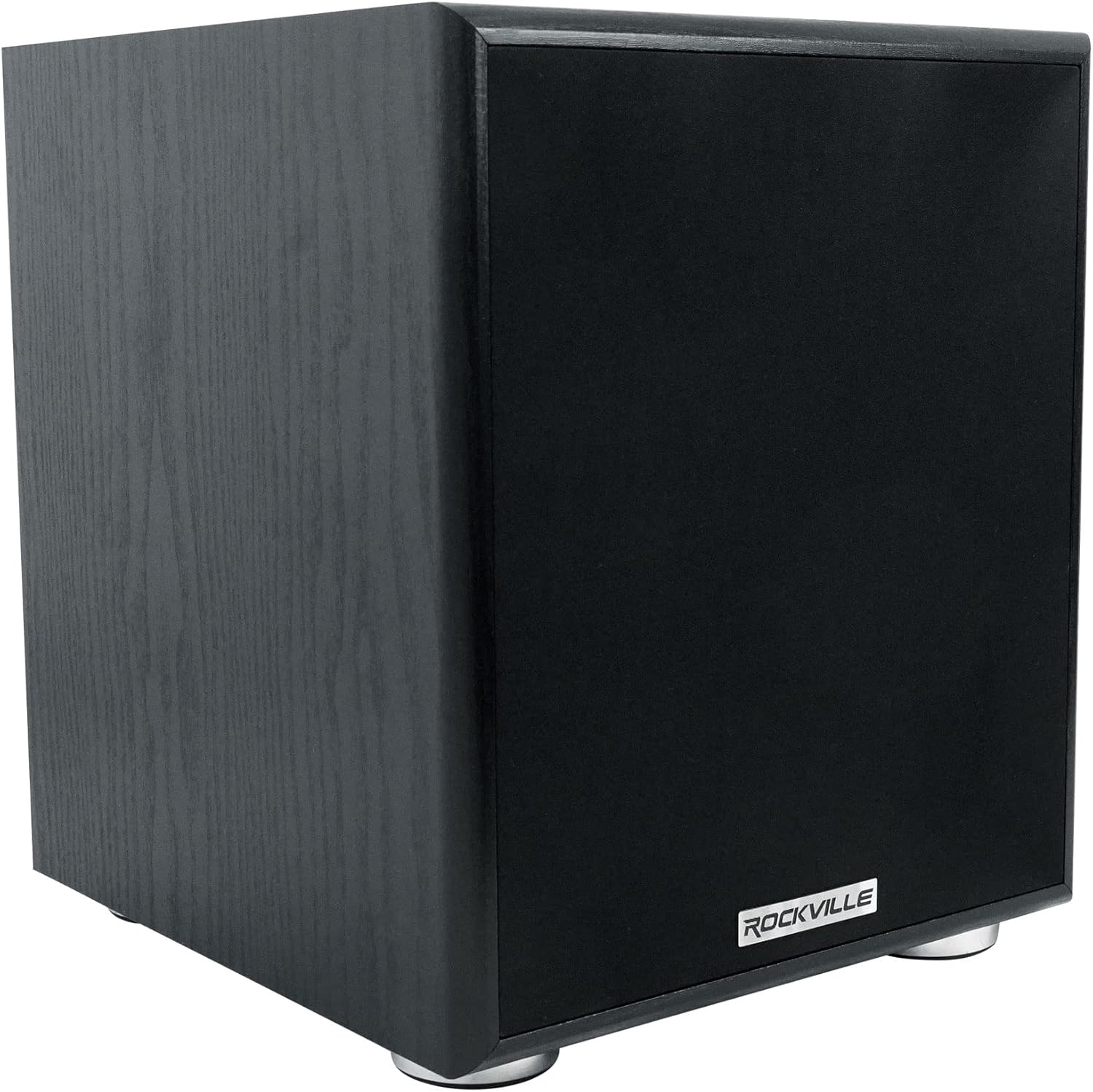
Build quality reflects the budget-friendly positioning, with an MDF enclosure wrapped in high-grade black vinyl and a removable foam grill. The construction is solid and durable, though not quite at the level of premium studio-grade subwoofers. Connectivity is straightforward with RCA line inputs/outputs and high-level speaker inputs, making integration simple whether you're using a receiver or powered speakers.
The main consideration is proper calibration. This subwoofer's power and output require careful adjustment of the crossover frequency, volume, and phase controls to integrate smoothly with your main speakers. Set too high, it can overwhelm the midrange and muddy clarity. Properly dialed in, it transforms your system into something far more capable. The remote control makes these adjustments convenient.
Verdict: The Rock Shaker delivers exceptional value for budget-conscious buyers seeking serious bass impact. It's not a precision studio monitor, but rather an enthusiast-focused subwoofer that prioritizes raw performance and versatility. If you're willing to spend time tuning it to your room and speaker pairing, you'll enjoy a dramatic upgrade to your audio experience at a price that won't strain your wallet.
Driver and Output: 10-inch dynamic driver woofer, 600W peak power output, 300W RMS continuous power, 4 ohm impedance, 85 dB signal-to-noise ratio
Frequency Response: 200 Hz and below, with adjustable crossover frequency control for flexible integration with main speakers
Enclosure: MDF construction with high-grade black vinyl finish, detachable foam grill, floor-standing design
Connectivity: RCA line inputs and outputs, high-level speaker inputs and outputs, wired connection only (no wireless capability)
Controls: Push-button control method with remote control included, adjustable volume, crossover frequency, phase, and bass boost controls
Warranty: 1-year limited manufacturer warranty
Who Should Buy: Budget-conscious home theater enthusiasts, gamers seeking immersive audio, music lovers upgrading from small speakers, and anyone wanting to add bass to a receiver-based system without spending $300 or more.
Integration Tips: Start with the crossover set to 50-80 Hz depending on your main speakers' bass capabilities. Set volume to 25-50% initially and adjust upward gradually. Use the phase control (0 or 180 degrees) to determine which setting produces tighter, more integrated bass with your speakers. The bass boost switch adds extra punch if needed, but use sparingly to avoid muddiness.
Best Paired With: Works well with bookshelf speakers, compact powered speakers, mid-range AV receivers, and gaming console setups. Ideal for medium-sized rooms, living rooms, and dedicated gaming spaces where precise studio monitoring isn't the priority.
Avoid If: You need studio-quality accuracy for critical listening or music production, require wireless connectivity, have a very small room where 600W would be excessive, or prefer minimal setup and calibration requirements.
Buying Guide for Small Room Subwoofers
Powered vs. Passive: Understanding the Difference
The most fundamental choice is between a powered and a passive subwoofer. A powered model, like the Klipsch R-100SW or the Edifier T5s, has a built-in amplifier. This makes it a simple plug-and-play solution that connects directly to your receiver or soundbar.
A passive subwoofer, such as the Audio Fantasy 6.5 Inch model, requires an external amplifier to function. This offers more customization for advanced setups but adds complexity. For most small room applications, a powered subwoofer is the more straightforward and popular choice.
Driver Size and Placement Strategy
Driver size, measured in inches, influences bass response. In a small room, an 8-inch or 10-inch driver is often sufficient. Placement is equally critical. A front-firing subwoofer can be easier to position, while a down-firing unit uses the floor to enhance bass dispersion.
Consider where you can fit the subwoofer. Corners can amplify bass but may cause boominess. Placing it near your listening position, often to the side of furniture, can provide a more balanced sound. Experimentation is key to finding the sweet spot in your specific room.
Essential Controls for Fine-Tuning
Look for subwoofers with adjustable controls to blend seamlessly with your main speakers. A low-pass crossover filter lets you set the frequency point where bass is handed off from your speakers to the sub. This prevents overlap and muddiness.
A phase control switch (0/180 degrees) helps synchronize the subwoofer’s sound waves with your main speakers. Volume control is also vital for balancing bass levels, especially important in confined spaces to avoid overpowering the room. For hands-off convenience, some models feature auto-on technology.
Considering an All-in-One Soundbar System
If space is at an absolute premium, a soundbar with a wireless subwoofer is an excellent alternative. Systems like the TCL S55H or the ULTIMEA models consolidate your audio into two compact components. The soundbar handles mids and highs while the separate wireless subwoofer delivers the bass.
This setup eliminates the need for a separate AV receiver and multiple speaker wires, creating a very clean look. The wireless connection for the sub gives you placement flexibility. You can browse our full range of audio solutions in the subwoofers category and related options like bookshelf speakers.
Final Thoughts
Enhancing your small room with rich, detailed bass is entirely achievable with the right equipment. For a classic, high-performance powered subwoofer that blends powerful output with brand heritage, the Polk Audio PSW10 10″ Subwoofer is a standout choice. If your priority is a streamlined, space-saving solution that delivers immersive cinematic sound without complexity, the TCL S55H 2.1 Sound Bar with Wireless Subwoofer offers incredible value and easy integration. Whichever path you choose, the right bass will transform your listening experience.
Frequently Asked Questions
Will a subwoofer be too loud for my apartment?
Not if you choose appropriately. A subwoofer designed for small rooms, paired with careful volume and crossover settings, allows you to enjoy full-range sound at lower overall volumes. It fills in the low frequencies your TV or small speakers miss, creating a richer experience without needing to crank up the volume and disturb neighbors. Proper placement away from shared walls also helps.
What size subwoofer is best for a bedroom or office?
For most bedrooms or home offices, an 8-inch or 10-inch powered subwoofer is ideal. These sizes provide ample bass impact without the physical bulk or excessive output power that can overwhelm a small space. Models like the Yamaha 8″ 100W or the Edifier T5s are specifically engineered for such environments, delivering tight, accurate bass that enhances music, movies, and games.
Can I use a subwoofer just for music, not home theater?
Absolutely. A quality subwoofer is a fantastic addition to any music listening setup. It reproduces the lower octaves of instruments like bass guitars, kick drums, and pianos that bookshelf or floorstanding speakers may struggle with. This results in a more complete, lifelike, and engaging musical presentation. For ideas on optimizing your setup for film scores and soundtracks, see our list of the best subwoofers for movies.
How do I connect a subwoofer to my existing sound system?
Connection methods vary. Most modern AV receivers have a dedicated subwoofer output (often labeled “Sub Out” or “LFE”) that uses a single RCA cable to connect to a powered sub. If your receiver lacks this, you can often use speaker wire connections. Soundbar systems typically connect via HDMI ARC/eARC, optical cable, or wirelessly. Always consult your equipment’s manual and the subwoofer’s instructions for the best connection method for your specific setup.



Write Your Review
No reviews yet. Be the first to share your experience!