

Your phone’s battery bar dips into the red during a crucial work call. Your tablet runs out of juice just as your flight is delayed. In our hyper-connected world, a dead device isn’t just inconvenient; it can disrupt your entire day. That’s where a reliable portable battery becomes a non-negotiable essential, acting as a personal power grid you can carry anywhere.
This guide cuts through the noise to bring you a curated selection of the best portable batteries for 2026. Whether you need enough power for a multi-day camping trip, blistering speed to charge a laptop, or a compact daily companion, we have a recommendation. For a broader look at reliable power sources, explore our guide to the best power banks available.
How to Choose Your Portable Battery
Capacity: How Much Power Do You Really Need?
Capacity, measured in milliamp-hours (mAh), dictates how many times you can recharge your devices. A 10,000mAh battery can typically charge a smartphone two to three times, making it perfect for daily commutes. For longer trips without access to outlets, consider capacities of 20,000mAh or higher.
Models like the best portable chargers with 50,000mAh or 60,000mAh can power multiple devices for days. Remember, higher capacity usually means a larger, heavier unit. Balance your need for total power with the portability you require.
Charging Speed and Output Power
Output wattage (W) determines how quickly a battery can charge your gear. Standard charging often falls below 18W. Fast charging protocols like Power Delivery (PD) and Quick Charge (QC) at 30W, 45W, or higher can refill a phone in under an hour.
For charging laptops or tablets, you’ll need a power bank with at least 45W output, with 65W or 100W being ideal for full-speed charging. The best USB-C chargers often pair perfectly with these high-output batteries for a complete fast-charging ecosystem.
Ports, Cables, and Convenience Features
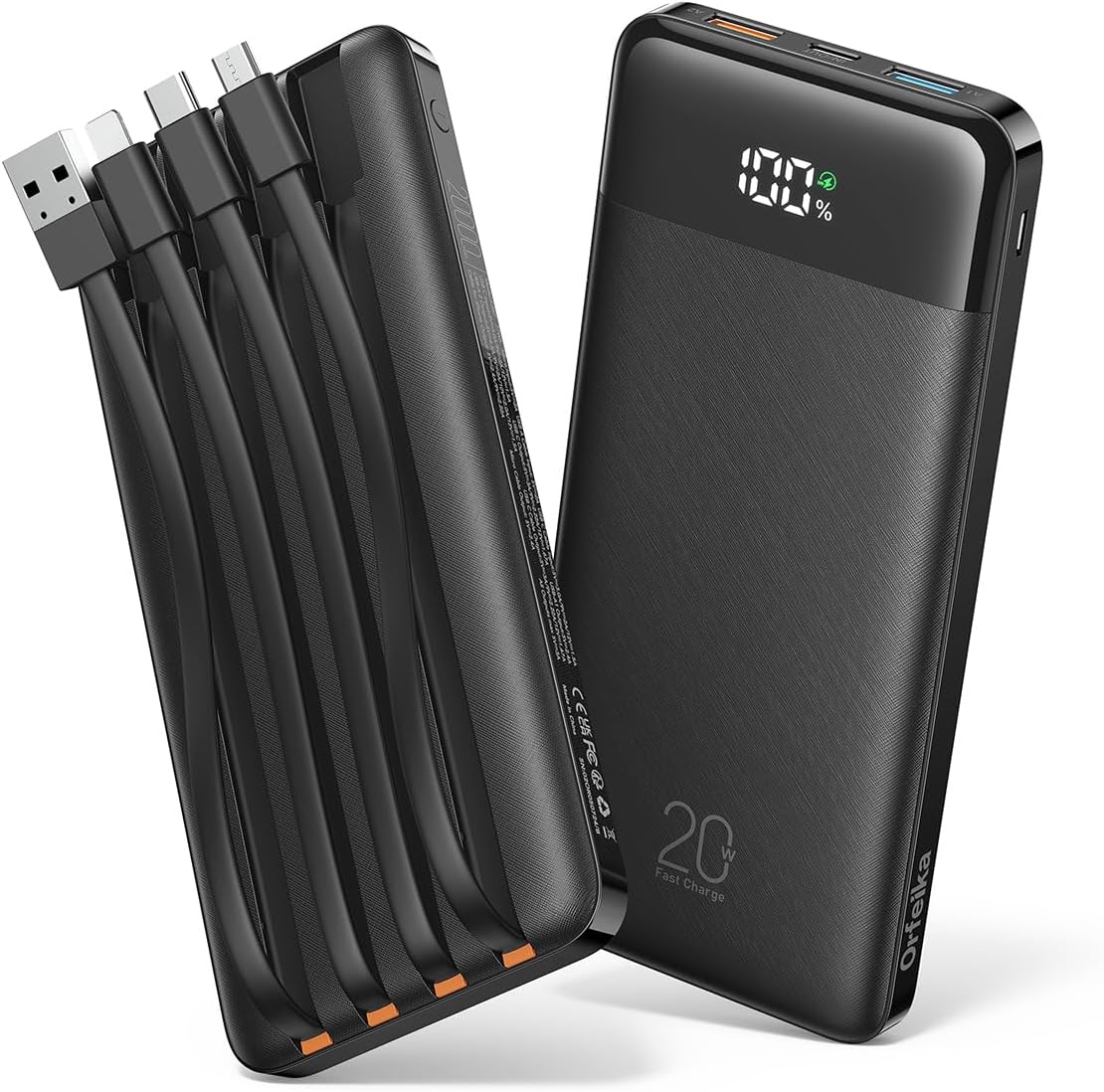
<!–Consider how many devices you charge simultaneously. Multiple USB-A and USB-C ports are common. Built-in cables eliminate the need to carry extras, reducing clutter and ensuring you always have the right connector. Some models include handy extras like digital displays for precise battery percentage or integrated flashlights for emergencies.
If you manage a collection of gadgets, a power bank with diverse built-in cables and multiple ports offers maximum flexibility. For organizing your other charging gear, check out our cables and adapters category for more solutions.
Size, Weight, and Travel Compliance
<!–Your ideal power bank should fit your lifestyle. Ultra-compact models are easy to slip into a pocket, while high-capacity units are better suited for a backpack. If you fly frequently, note that airlines typically restrict power banks with a capacity over 100 watt-hours (Wh), which is roughly 27,000mAh at 3.7V.
Always verify that your chosen model is airline-approved if you travel often. A compact, travel-safe design ensures your power source is always with you, whether you’re navigating an airport or heading to a coffee shop. You can find more essential travel gear in our main chargers and batteries hub.
Final Thoughts
Choosing the right portable battery ultimately depends on balancing your need for capacity, speed, and portability. For most users seeking a perfect blend of compact size and serious power, the INIU 10000mAh 45W Fast Charging Portable Charger is an outstanding value-packed choice. If your adventures demand the absolute maximum runtime and simultaneous device charging, the massive IAPOS 60000mAh 22.5W Fast Charge Portable Charger will keep your entire gear kit running for days on end.
Frequently Asked Questions
Can a portable battery charge a laptop? Yes, but you need to check the specifications carefully. Many modern laptops require 45W or more to charge effectively. Look for power banks that specifically list laptop compatibility and offer high-output USB-C ports with Power Delivery (PD) support.
How do I know what capacity power bank I need? A good rule of thumb is to match the battery’s capacity to your device’s battery. For example, a 10,000mAh power bank contains about 2.5 times the energy of a typical 4,000mAh smartphone battery, allowing for approximately two full charges, accounting for energy conversion loss.
Are portable batteries allowed on airplanes? Yes, but with restrictions. The Federal Aviation Administration (FAA) allows power banks in carry-on luggage only, not checked bags. Batteries must be under 100 watt-hours (Wh). Most power banks list their Wh rating; if they only list mAh, you can calculate it as (mAh * Voltage) / 1000. For air travel in 2026, always confirm your specific model’s rating.
How long does a portable battery last before it needs replacing? The lifespan depends on usage and quality. A well-made power bank can undergo 300 to 500 full charge cycles before its capacity significantly degrades. With typical use, this translates to several years of reliable service. Proper care, like avoiding extreme temperatures, can extend its life.


Write Your Review
No reviews yet. Be the first to share your experience!