

You are about to board a long flight, your phone battery is at 30%, and the airport charging station is occupied. Or perhaps you are on a weekend camping trip, capturing perfect photos, when your camera battery icon turns red. These moments of power anxiety are universal, but the solution is simple: a reliable power bank. The right portable charger can transform your travel, workday, or outdoor adventure, ensuring your essential devices never run out of juice.
Choosing among hundreds of options, however, can be overwhelming. That is why we have compiled this focused review of the best power banks for 2026. We assessed key factors like charging speed, capacity, portability, and safety features to identify top performers for different scenarios. Whether you need a slim charger for daily commutes or a high-capacity powerhouse for week-long trips, our guide points you to the right choice.
Top Power Banks at a Glance
Below is our curated list of the top-rated power banks available right now. This comparison table provides a quick overview to help you start your search.
How to Choose the Right Power Bank
Capacity: Match Your Power Needs
Capacity, measured in milliampere-hours (mAh), determines how many times a power bank can recharge your device. A 10,000mAh model might fully charge a smartphone twice, perfect for a day trip. For multi-day travel or charging larger devices like tablets, a 20,000mAh or even 50,000mAh unit is more suitable. Remember, higher capacity usually means more size and weight. Consider your typical usage: a compact model like the INIU 10000mAh 45W Fast Charging Portable Charger is ideal for daily carry, while massive packs are better for extended off-grid use.
Charging Speed and Ports
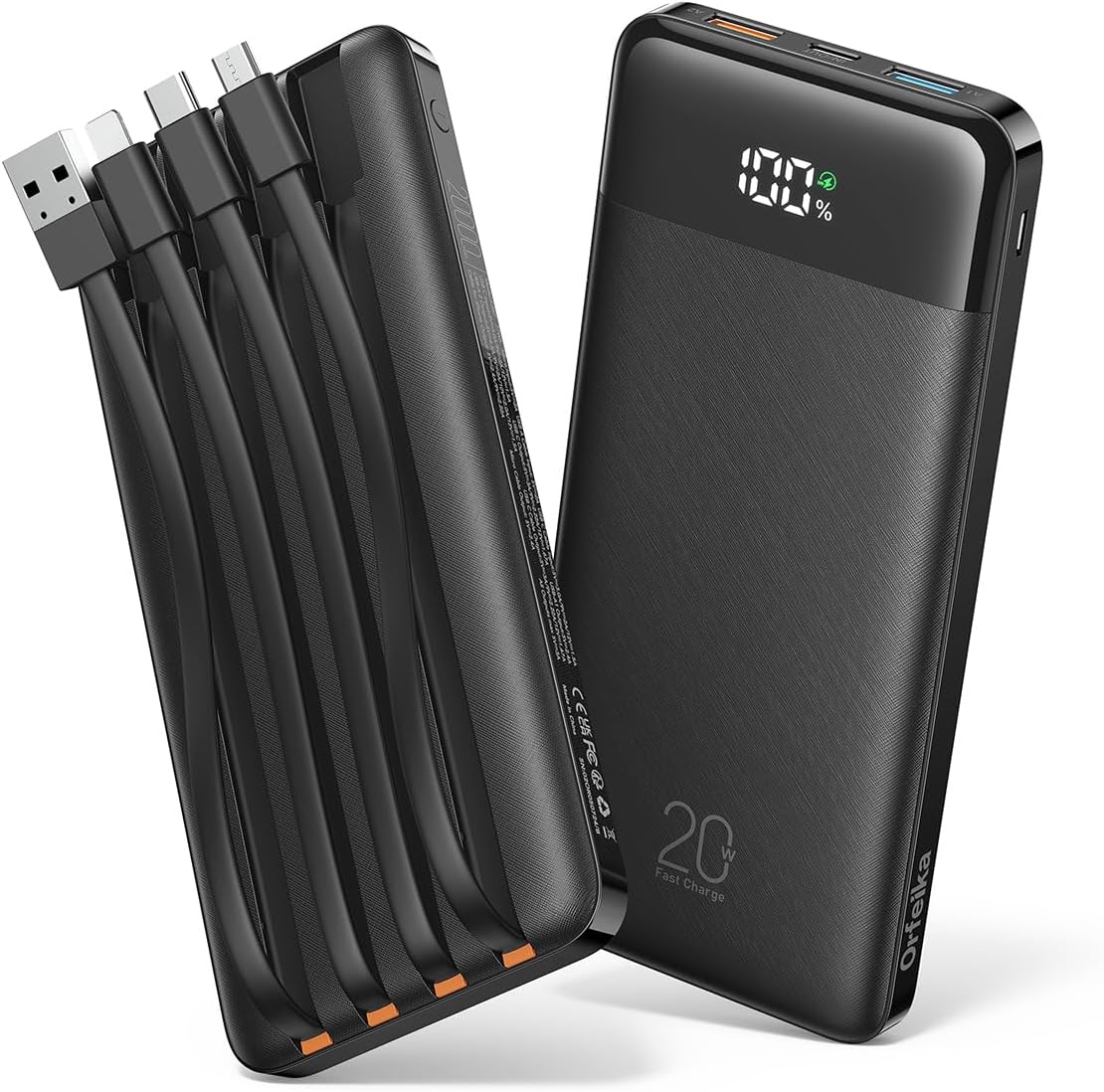
Fast charging technology, measured in watts (W), gets your devices back to full power quickly. Look for support for protocols like Power Delivery (PD) and Quick Charge (QC). The number and type of ports are equally crucial. USB-C ports are becoming standard for fast input and output, while USB-A ports offer broad compatibility. Some models, like the Orfeika 20000mAh Power Bank, include built-in cables to eliminate cord clutter, a fantastic feature for travel. For charging multiple devices at once, ensure the power bank has enough ports and sufficient total output wattage.
Portability and Design Features
A power bank should be a convenient companion, not a burden. Weight and dimensions matter, especially if you will carry it in a pocket or small bag. Many modern designs balance high capacity with a surprisingly slim profile. Useful extras include an integrated digital display for precise battery level monitoring, a built-in flashlight for emergencies, and a rugged, scratch-resistant shell. For frequent flyers, confirming that the power bank’s watt-hour (Wh) rating is under 100Wh is essential for airline carry-on compliance, a topic covered in our broader guide on the best portable chargers.
Safety and Reliability
Never compromise on safety when choosing a power bank. Look for certifications like UL 2056 and built-in protections against overcharging, overheating, short-circuiting, and over-current. Reputable brands invest in advanced chipsets and quality battery cells for consistent, safe performance. A solid warranty and responsive customer service, as offered by many brands in our list, provide long-term peace of mind. For all your charging and battery needs, explore our dedicated Chargers & Batteries category.
Final Thoughts
Ultimately, the best power bank is the one that seamlessly integrates into your lifestyle, providing reliable power without hassle. For the ultimate combination of extreme speed and smart features for tech enthusiasts and professionals, the Anker Prime Power Bank, 26,250mAh 300W stands in a class of its own. If your priority is maximum capacity and convenience for long trips without breaking the bank, the feature-packed 50000mAh Portable Charger Power Bank from JKELAR is an excellent value-focused choice. Whichever model you select, you will gain the freedom to use your devices without constantly hunting for an outlet.
Frequently Asked Questions
Can I take a power bank on an airplane?
Yes, but with restrictions. The Transportation Security Administration (TSA) allows power banks in carry-on luggage only, not in checked bags. The unit’s energy capacity must be less than 100 watt-hours (Wh). Most power banks under 27,000mAh typically meet this requirement, but always check the product specifications or label to confirm before you fly.
How do I know if a power bank is fast charging?
Look for the output wattage and supported charging protocols listed in the product details. A power bank offering 18W, 20W, or higher with support for Power Delivery (PD) or Quick Charge (QC) will provide fast charging for compatible devices. For example, many modern smartphones can utilize 20W PD charging to reach 50% battery in roughly 30 minutes.
What is the difference between mAh and Wh?
mAh (milliampere-hour) measures the battery’s charge capacity, while Wh (watt-hour) measures its energy capacity. Wh is the more accurate metric for comparing different power banks, as it accounts for voltage. For airline travel, the legal limit is based on Wh (under 100Wh). You can often calculate Wh by multiplying the battery’s mAh by its voltage and dividing by 1000.
How long does a power bank last?
A quality power bank can last for several years and hundreds of charge cycles. Its lifespan depends on the battery quality, how often it is used and recharged, and how it is stored. To maximize longevity, avoid exposing it to extreme temperatures, do not let it fully discharge for extended periods, and use the recommended charger for replenishing its own battery.


Write Your Review
No reviews yet. Be the first to share your experience!