

You leave your listening room, but your amplifier stays on, quietly generating heat and consuming power. This scenario is common, but it doesn’t have to be the norm. An amplifier with a dedicated standby mode solves this exact problem, offering a smart way to save energy and extend the life of your components. This guide is for anyone building a conscious, high-fidelity home audio system who values both performance and practicality. We have reviewed the leading models that include this essential feature, from budget-friendly options to premium audiophile units. For those exploring other essential amplifier features, our guide on the best amplifiers for passive speakers offers complementary insights.
Pros
- Excellent sound clarity with balanced highs, mids, and bass across all input sources
- Phono input eliminates the need for a separate turntable preamp, saving money and desk space
- Bluetooth connection is quick to pair and remains stable during extended listening sessions
- Compact low-profile design fits standard AV furniture without any awkward modifications
- Highly rated by a large number of verified buyers, reflecting consistent real-world reliability
Cons
- Maximum volume output may feel limited for larger rooms or listeners who prefer concert-level loudness
- 2-channel stereo only, so it is not suitable for home theater surround sound setups
- No digital optical or coaxial inputs, which may frustrate users wanting to connect modern TVs or DACs directly
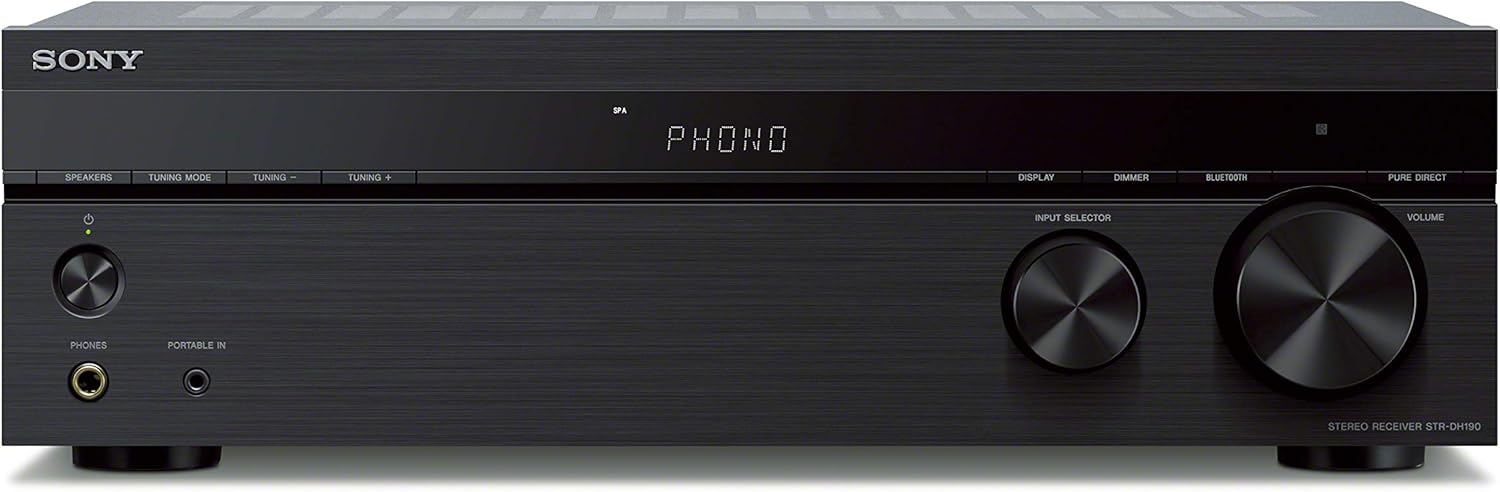
The Sony STRDH190 is a 2-channel home stereo receiver designed for music lovers who want a clean, capable hub for multiple audio sources. Whether you are spinning vinyl, streaming from a phone, or tuning into FM radio, this receiver handles it all in one compact unit. It is particularly well suited to first-time stereo system builders and returning audiophiles who value simplicity over complexity.
Sound performance is the STRDH190's strongest suit. With 100 watts per channel and Sony's large-capacity power transformer, the receiver delivers a composed, detailed soundstage with crisp highs and solid bass. Customer feedback consistently praises its clarity at moderate to high volumes, and High-Resolution Audio support means the unit can resolve fine details that compressed streaming formats often obscure.
The feature set is thoughtfully chosen for its target audience. The built-in phono preamp is a genuine convenience for turntable users, while Bluetooth pairing is described by owners as fast and reliable. The A/B speaker switching is a practical bonus, allowing two pairs of speakers to run simultaneously or independently for multi-room flexibility. A full-size headphone jack and 30-preset FM tuner round out the everyday usability.
On the design side, the STRDH190's low-profile chassis at just over 5 inches tall is a real-world advantage for anyone working with a standard AV cabinet. Build quality feels solid for the price point, and the included remote adds a layer of convenience that budget receivers often skip. The unit weighs 17 pounds, which speaks to the substantial internal components rather than hollow construction.
The main limitations are its 2-channel-only configuration, which rules it out for surround sound duties, and a lack of digital inputs for users wanting to connect a TV or external DAC. Volume headroom in very large rooms can also feel modest. That said, for a stereo-focused listener who values vinyl, Bluetooth, and clean audio in one tidy package, the STRDH190 is a genuinely impressive and well-rounded receiver.
Model: Sony STRDH190 | Color: Black | Channels: 2 (Stereo) | Output Power: 100W x 2 (8 ohms, 1 kHz) | Total Wattage: 200W
Speaker Impedance: 6 to 16 ohms | Inputs: Phono input, 4x stereo RCA, 3.5mm aux | Outputs: Stereo RCA, A/B speaker terminals, 1/4-inch headphone jack
Wireless: Bluetooth (2.4 GHz, max output 5.0 dBm) | FM Tuner: 30 station presets | Audio Format: WMA, High-Resolution Audio
Dimensions: 11"D x 17"W x 5.2"H | Weight: 17.1 lbs | Power: AC 120V, 60 Hz | Warranty: 1 year limited
In the Box: Receiver, remote control (RMT-AA400U), batteries, FM antenna | ASIN: B078WFDR8D | UPC: 027242908383
If you are shopping for your first stereo receiver, the STRDH190 is one of the most complete entry-level options available. It covers all the essential bases: Bluetooth streaming, FM radio, a phono stage for turntables, and enough inputs for a CD player, TV audio output, and more. You will not need to buy a separate phono preamp, which keeps your total system cost down.
Pairing advice: this receiver works best with bookshelf or floor-standing speakers rated between 6 and 16 ohms. Popular matches noted by owners include Yamaha bookshelf speakers and classic Bose 301s. For turntable users, Sony's own PS-LX310BT is a frequently recommended companion that integrates seamlessly with the STRDH190's phono input.
Consider your room size before purchasing. The 100-watt-per-channel rating is more than adequate for small to medium rooms, but listeners in large open-plan spaces who prefer very high volume levels may eventually want to step up to a higher-powered model. For most living rooms and dedicated listening spaces, however, the power on offer is genuinely sufficient.
This receiver is not the right choice if you need surround sound for a home theater setup, or if you want to connect a modern TV via optical or coaxial digital audio. For those use cases, a dedicated AV receiver would be a better fit. But as a pure stereo music receiver with broad source compatibility, the STRDH190 is hard to beat at its price point.
Buying Guide for Amplifiers with Standby Mode
Understanding Standby Function Implementation
Not all standby modes are created equal. The most basic type simply mutes the output and reduces power to the main amplification circuits. More advanced implementations, like an auto-standby feature, will automatically switch the unit to low-power mode after a period of inactivity. This is incredibly convenient, ensuring you never accidentally leave your amp fully powered on for days. When assessing this feature, check the product specifications or manual to understand its behavior and any configurable timers.
Power Output and Speaker Compatibility
The core purpose of an amplifier is to drive your speakers. Your choice must match the power requirements and impedance of your passive speakers. A mismatch can lead to poor sound quality or even damage. Consider both the wattage per channel and the impedance rating, such as 8 ohms or 4 ohms. An amplifier with multi-room capabilities, like some featured in our list of the best multiroom amplifiers, often includes standby functions for individual zones, adding another layer of control.
Connectivity and Source Integration
<!–Modern amplifiers are hubs for multiple audio sources. Beyond standby mode, evaluate the inputs you need. Common connections include RCA analog, optical, coaxial digital, phono for turntables, and Bluetooth. Streaming amplifiers add Wi-Fi and app control. Ensure the unit can handle all your current gear and has room for future additions. A well-connected amp remains the centerpiece of your system for years, making features like standby mode even more valuable for daily use.
Build Quality and Thermal Management
<!–An amplifier’s longevity is tied to its construction and ability to manage heat. Quality internal components, robust power supplies, and effective heat sinks contribute to stable performance. A proper standby mode aids thermal management by reducing heat output when the system is idle. This is particularly important for Class A/B amplifiers, which generate more heat than Class D designs. A well-built amp from a reputable brand within the amplifiers category is a sound investment.
Final Thoughts
Choosing an amplifier with standby mode is a smart decision for energy efficiency and preserving your equipment. For a superb blend of traditional Hi-Fi power and modern features, including a confirmed auto standby function, the YAMAHA A-S501BL Natural Sound Integrated Stereo is an excellent choice. If your priority is a sleek, all-in-one streaming solution with intuitive smart controls that inherently manage power states, the versatile WiiM Amp Pro Streaming Amplifier for TV offers outstanding performance and convenience for the connected home.
Frequently Asked Questions
Does using standby mode frequently harm my amplifier?
No, using standby mode is designed to protect your amplifier. It significantly reduces wear on components like capacitors and transformers by lowering their operational temperature and stress during idle periods. This practice is recommended for extending the overall lifespan of your audio equipment. For more on automated features, see our guide on amplifiers with auto-on.
What is the difference between standby mode and turning the amp completely off?
Standby mode keeps a small portion of the circuit active, allowing for a faster startup, often via a remote control signal. Turning the unit completely off at the power switch cuts all electricity. Standby offers a balance between instant readiness and energy savings, while a full power-off saves the most energy but requires a manual restart.
Can I add a standby function to an older amplifier that doesn’t have one?
It is not practical or safe to modify an amplifier’s internal circuitry to add a standby function. A safer alternative is to use a high-quality, switched AC power strip or a smart plug. This allows you to cut power to the amplifier and other components remotely or on a schedule, though it lacks the nuanced, low-power state of a true integrated standby circuit.
Are there amplifiers with standby mode suitable for outdoor use?
While the primary function of standby mode is similar, amplifiers designed for permanent outdoor installation must have specific weatherproofing. The models in this guide are intended for indoor use. When selecting gear for outdoor spaces, always prioritize products specifically rated and built for environmental exposure. You can explore our broader home audio resources for more information.





Write Your Review
No reviews yet. Be the first to share your experience!