

Your tablet is your window to the world, your mobile office, and your entertainment hub. But its utility vanishes the moment the battery indicator turns red. Whether you’re a student navigating campus, a professional on a cross-country flight, or a family on a road trip, finding yourself without power is a modern inconvenience we all want to avoid. A dedicated power bank for your tablet is the solution, transforming any space into a charging station.
This guide is designed for anyone who relies on a tablet and needs reliable backup power. We have evaluated several of the most popular portable chargers available, focusing on their capacity to handle larger tablet batteries, their charging speed, and their overall design for portability. Our goal is to help you find a power bank that matches your lifestyle, ensuring your device stays charged from your morning commute to your evening unwind. For those who need versatile charging solutions, exploring 2-in-1 power banks can also be a smart move.
Choosing the Right Power Bank for Your Tablet
Capacity and Runtime
The battery capacity, measured in milliamp-hours (mAh), is the most critical factor. Tablet batteries are significantly larger than smartphone batteries, often ranging from 7,000 to 12,000mAh. You need a power bank with enough capacity to provide multiple full charges. A 10,000mAh power bank is a good start for a single top-up, while 20,000mAh or higher models offer enough juice for extended trips without access to an outlet.
Remember, no power bank transfers energy with 100% efficiency. Some power is lost as heat during the conversion process. Therefore, a 20,000mAh power bank will not deliver a full 20,000mAh to your devices. Look for products that clearly state how many times they can charge specific tablets. For the ultimate in long-term off-grid power, a dedicated portable power station is worth considering.
Charging Speed and Port Compatibility
Modern tablets support fast charging protocols like USB Power Delivery (PD). A power bank with a high-wattage USB-C PD port can recharge your tablet much faster than a standard 5V/2A port. For example, an 18W or 20W PD output can provide a substantial boost in a short time. If you use your tablet while it charges, faster input means less downtime.
Check your tablet’s charging specifications and ensure the power bank you choose supports the same protocol. Many newer models also feature GaN technology for more efficient, compact fast charging, a topic we cover in our guide to the best GaN chargers. Also, consider if you need multiple output ports to charge your tablet, phone, and earbuds simultaneously.
Portability and Design
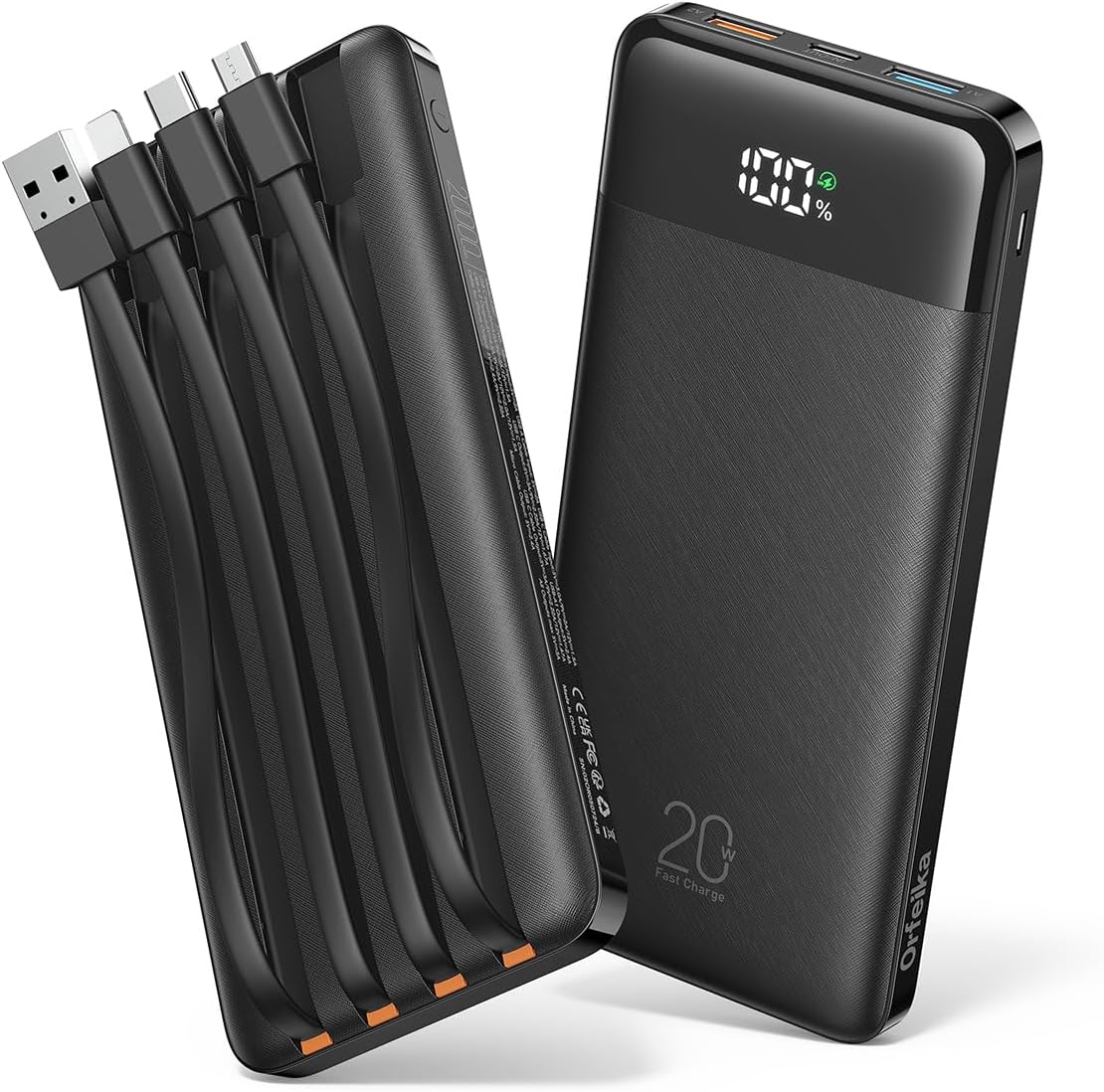
A power bank is only useful if you carry it with you. Size and weight are key, especially with higher-capacity models. Some manufacturers use high-density battery cells to pack more capacity into a smaller, lighter frame. Consider where you’ll store it: in a backpack, a purse, or a pocket? Built-in cables can reduce clutter, while a clear LED display lets you monitor remaining power easily.
If you travel frequently, verify the power bank’s airline compliance. Regulations typically allow power banks under 100 watt-hours (Wh) in carry-on luggage. Most standard capacity models fall under this limit, but always double-check before you fly. Durability is another factor; a robust, scratch-resistant shell will withstand the rigors of daily use. You can find more information on travel-friendly gear in our Chargers & Batteries category.
Safety and Reliability
Never compromise on safety when it comes to lithium-ion batteries. Look for power banks with multiple built-in protection circuits that guard against overcharging, short circuits, and excessive temperatures. Reputable brands often have their products certified to relevant safety standards. A good warranty and responsive customer service provide additional peace of mind, ensuring your investment is protected.
Reading user reviews can validate a product’s real-world reliability. Pay attention to comments about long-term battery health and the durability of ports and cables. A reliable power bank should perform consistently over time, not just when it’s new. For related advice on charging other devices, our review of the best portable chargers for android offers complementary insights.
Final Thoughts
Selecting the best power bank for your tablet ultimately depends on your individual usage patterns and travel needs. For most users seeking a balance of ample capacity, fast charging, and convenient built-in cables, the Orfeika 20000mAh Power Bank is a compelling all-rounder. If your priority is maximum portability and rapid charging for shorter trips, the compact INIU 10000mAh 45W Fast Charging Portable Charger is an excellent choice that easily slips into any bag. With the right power bank by your side, you can confidently use your tablet anywhere without worrying about the next outlet.
Frequently Asked Questions
What size power bank do I need for my tablet?
You need a power bank with a capacity at least double your tablet’s battery size to account for efficiency loss and ensure a full recharge. For example, a tablet with a 8,000mAh battery pairs well with a 20,000mAh power bank, providing roughly two full charges. For extended use away from outlets, consider 25,000mAh or higher.
Can I bring a power bank on a plane?
Yes, you can bring power banks in your carry-on luggage, but there are restrictions. Most airlines follow international regulations that limit batteries to under 100 watt-hours (Wh). Many common power banks, like 20,000mAh models, fall under this limit. Always check your specific power bank’s Wh rating and your airline’s policy before flying in 2026.
How do I know if a power bank supports fast charging for my tablet?
Check the product specifications for output ratings like “USB Power Delivery (PD)” or “Quick Charge (QC)” and the wattage (e.g., 18W, 45W). Then, confirm your tablet supports the same fast-charging standard. Using a compatible cable is also essential; a USB-C to USB-C cable is typically required for PD fast charging.
Is it bad to leave my power bank charging overnight?
Modern power banks with built-in protection circuits are designed to stop charging once full, preventing overcharging. However, as a best practice for long-term battery health, it’s advisable to unplug it once the indicator shows a full charge. Consistently leaving any lithium-ion device plugged in for excessively long periods is not recommended.


Write Your Review
No reviews yet. Be the first to share your experience!