

You’re building a home studio and want gear that not only sounds professional but also looks the part. A vibrant red audio interface sits proudly on your desk, signaling a serious commitment to your craft. The right interface is the heart of your setup, converting your musical ideas into pristine digital audio.
This guide focuses on the best red audio interfaces available, perfect for musicians, podcasters, and content creators. We’ve assessed key models to help you make an informed decision for your recording needs. For a broader selection of gear, explore our guide on audio interfaces.

Pros
- Exceptional sound quality at an affordable price point with professional-grade converters
- Auto Gain and Clip Safe features eliminate guesswork and prevent ruined takes
- Includes industry-leading software and plugin bundle worth hundreds separately
- Minimal latency and simple setup makes it accessible for beginners and professionals alike
- Air Mode adds musical character and presence without complex EQ adjustments
Cons
- Limited to 2 inputs and 2 outputs, so users requiring more channels will need to upgrade
- Air Mode's second preset may not suit all vocal types and requires some experimentation
- USB-C cable included, but USB-A adapters not provided for older computers
The Focusrite Scarlett 2i2 4th Gen is a professional USB-C audio interface designed for musicians, podcasters, content creators, and home studio enthusiasts. Whether you're recording vocals, guitars, drums, or streaming, this compact interface delivers studio-quality sound with intelligent features that make recording intuitive and forgiving. It's the interface of choice for bedroom producers and professional touring musicians alike.
The standout feature is the combination of studio-grade converters with 120dB dynamic range, matched to equipment found in world-class recording studios, paired with intelligent Auto Gain and Clip Safe technology. Auto Gain automatically sets optimal recording levels for your microphone or instrument, while Clip Safe prevents distortion from sudden loud peaks. The two ultra-low-noise mic preamps offer 69dB of analog gain, handling even demanding dynamic microphones without struggling. Air Mode adds musical presence and harmonic richness, lifting vocals and guitars forward in the mix with the character of a large-format console.
Build quality is excellent for the price, with a sleek, durable aluminum chassis and intuitive front-panel controls. The amped headphone output delivers full volume through any headphones with independent control, and USB-C connectivity provides bus power directly from your computer with virtually zero latency. Setup is remarkably simple: connect your mic or guitar, plug in USB, launch your DAW, and start recording. The included software bundle (Pro Tools Intro+, Ableton Live Lite, Cubase LE, and Hitmaker Expansion) provides professional tools right out of the box.
The primary limitation is the 2-input, 2-output configuration, which may feel restrictive if you need to record multiple sources simultaneously or require more complex routing. Additionally, Air Mode's second preset cuts midrange aggressively, which works beautifully on some sources but may require switching back to Air Mode 1 or disabling it entirely for certain vocal types. The included USB-A to USB-C cable works perfectly, though older computers may need adapters.
Verdict: The Scarlett 2i2 4th Gen is an exceptional value for anyone serious about recording quality audio at home. Its combination of professional sound, intelligent features, and comprehensive software bundle makes it the industry standard for entry-level and mid-level home studios. Highly recommended for beginners and professionals alike.
Audio Inputs and Outputs: 2 microphone/line inputs, 2 hi-Z instrument inputs, 2 line outputs, headphone output with independent volume control
Audio Quality: 24-bit/192kHz resolution, 120dB dynamic range, 20Hz-20kHz frequency response
Connectivity: USB-C (includes USB-A to USB-C cable), compatible with Mac OS, Windows OS, and iOS
Microphone Preamps: 2 ultra-low-noise preamps with 69dB analog gain, Auto Gain, and Clip Safe features
Physical Dimensions: 7.09 inches wide x 4.61 inches deep x 1.87 inches tall, weighs 1.7 pounds
Software Included: Pro Tools Intro+, Ableton Live Lite, Cubase LE, Hitmaker Expansion (includes Auto-Tune Access, Softube Marshall Silver Jubilee, Native Instruments MASSIVE)
Warranty: 3-year manufacturer warranty with 24/7/365 support
Perfect For: Home recording enthusiasts, singer-songwriters, bedroom producers, podcasters, guitarists, streamers, and anyone upgrading from built-in computer audio. This interface is also ideal for musicians who gig with laptops and need reliable, portable audio I/O.
May Not Be Ideal For: Studios requiring more than 2 simultaneous inputs, or users needing extensive analog I/O routing. If you frequently record full bands or require MIDI I/O, consider the Scarlett 4i4 instead.
Comparison Note: The Scarlett 2i2 4th Gen represents the sweet spot between affordability and professional quality. It's the industry standard for entry-level home studios and competes favorably with interfaces costing significantly more.

Pros
- Exceptional audio quality with no background noise, even at budget price point
- Truly plug-and-play functionality works immediately on Windows, Mac, and Linux systems
- Dual combo jacks provide maximum flexibility for microphones, guitars, and line-level sources
- Lightweight and compact form factor ideal for desk space and portability
- Zero-latency monitoring enables confident tracking without hearing delay or echo
Cons
- LED illumination on gain knobs does not function as prominently displayed in product images
- Requires careful gain adjustment when connecting instruments with built-in preamps to avoid clipping
- Limited to 2 input channels, which may not suit users needing more simultaneous inputs
The PIYONE Q2 is a 2x2 USB-C audio interface designed for home recordists, podcasters, guitarists, and content creators who want professional-grade sound without complexity. It bridges the gap between budget-friendly and professional-quality recording, making it an ideal first interface for beginners or a secondary interface for established creators.
The standout feature is its genuine plug-and-play operation. Simply connect the USB-C cable to your computer, and the interface is recognized immediately on Windows, Mac, and Linux systems without any driver installation. The 24-bit/192kHz audio resolution captures professional-quality recordings with excellent clarity and minimal noise. The zero-latency direct monitoring feature eliminates tracking delays, allowing you to hear yourself in real-time without the frustrating latency that plagues cheaper interfaces. Dual XLR/TRS combo inputs with 48V phantom power provide flexibility for condenser microphones, dynamic mics, guitars, and line-level sources.
Build quality and design are impressive for the price. The compact form factor fits easily on any desk without consuming valuable space. The illuminated control knobs create a modern, professional aesthetic that looks great in any studio setup. The interface feels solid and well-constructed, with ergonomic knobs and buttons positioned for comfortable operation during long recording sessions.
One notable drawback is that the LED illumination on the gain knobs does not function as prominently as shown in product images, which may disappoint users specifically drawn to this visual feature. Additionally, users must exercise caution when adjusting gain levels with instruments that have built-in preamps, as excessive gain can cause clipping. The 2-channel limitation means this interface cannot handle multiple simultaneous inputs beyond two sources.
Verdict: The PIYONE Q2 delivers exceptional value for beginners and budget-conscious creators seeking professional audio quality without complexity. Its combination of studio-grade sound, zero-latency monitoring, and truly plug-and-play setup makes it an excellent choice for home recording, podcasting, and content creation. Recommended for anyone starting their recording journey or needing a reliable portable interface.
Audio Quality: 24-bit resolution, 192kHz maximum sample rate, high-performance converters, low-noise design
Connectivity: USB-C port (handles both data transfer and bus power), 3.5mm headphone jack
Inputs: 2 XLR/TRS combo jacks, 48V phantom power supply
Channels: 2 input channels, 2 output channels
Features: Zero-latency direct monitoring, monitor mix function, loopback capability, illuminated control knobs, class-compliant design
Compatibility: Mac, Windows PC, Linux, iOS (via USB-C adapter)
Physical: Compact portable design, 0.74 kg weight, Alloy Red finish
Warranty: 2-year limited warranty
Ideal For: Beginner recording artists, podcasters, singer-songwriters, content creators, home studio enthusiasts, and anyone seeking professional audio quality without complex setup requirements.
Perfect Use Cases: Recording vocals with condenser microphones, capturing acoustic guitar performances, podcasting and voice-over work, streaming with professional audio quality, music production on a budget, portable recording for travel or mobile content creation.
Not Ideal For: Users requiring more than 2 simultaneous inputs, professional studios with extensive I/O requirements, or those specifically seeking prominent LED illumination effects on control knobs.
Pros
- Excellent value for professional-grade recording specifications at this price
- Universal compatibility with multiple devices and operating systems
- Low-latency monitoring keeps you in sync without audio delay during recording
- Sturdy metal construction with all essential connectivity ports included
- Works with industry-standard DAW software and audio applications
Cons
- Very limited user reviews available, making real-world reliability difficult to assess
- macOS compatibility may require system reformatting on some configurations
- No built-in audio effects or software bundle included with purchase
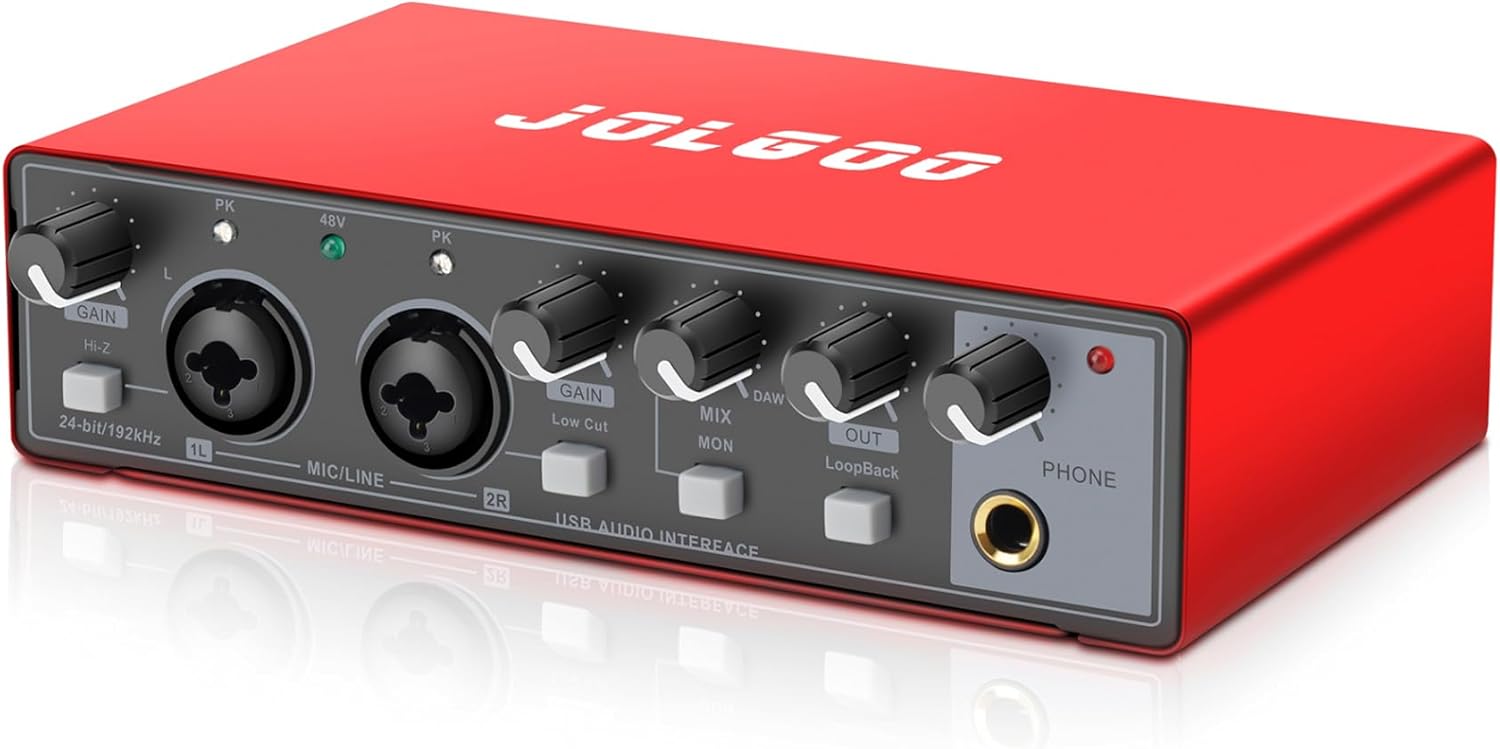
The JOLGOO USB audio interface is a compact recording solution designed for home studios, independent musicians, podcasters, and content creators who need professional audio quality without the complexity. This plug-and-play device eliminates driver installation headaches and works immediately with Windows, macOS, and popular DAW software like Pro Tools, Ableton Live, and GarageBand.
The standout feature is its 24-bit/192kHz recording resolution, which matches professional studio standards and ensures pristine audio capture for vocals, instruments, and voiceovers. Real-time USB monitoring with minimal latency keeps you synchronized during recording sessions, while the dual XLR/line combo inputs with 48V phantom power accommodate both condenser microphones and line-level instruments like keyboards and guitars. LED peak indicators help prevent clipping and distortion.
Build quality appears solid with a red metal shell and all essential connectivity ports included. The package comes with both USB-C and USB-A cables, making it compatible with modern and legacy computers alike. The compact form factor fits easily on any desk without consuming valuable studio real estate.
The main limitation is the absence of user reviews, which makes it difficult to assess long-term reliability and real-world performance consistency. Additionally, some macOS users may encounter system compatibility variations that require reformatting. The interface also lacks built-in effects processing or included software, so you'll rely entirely on your DAW for audio production.
Overall, the JOLGOO offers impressive specifications and genuine plug-and-play convenience at an attractive price. It's a solid choice for beginners and intermediate producers seeking professional recording quality without steep investment, provided you're comfortable with limited community feedback and willing to work within your DAW's capabilities.
Audio Performance: 24-bit resolution, 192 kHz maximum sample rate, 2-channel recording and playback
Connectivity: USB (includes USB-C and USB-A cables), XLR/line combo inputs, stereo line outputs, headphone output
Phantom Power: 48V for condenser microphones with LED peak indicators
Compatibility: Windows, macOS, compatible with guitars, microphones, keyboards, laptops, tablets, and smartphones
Software Support: Driver-free operation with DAW, Pro Tools, Ableton Live, Cubase, GarageBand, Audacity, and Studio Magic Plug-in Suite
Physical: Red metal shell construction, 0.82 kg weight, compact design
Warranty: 12 months manufacturer coverage
Ideal For: Home studio producers, independent musicians, podcasters, voice-over artists, content creators, and anyone seeking studio-quality recording without professional studio costs.
Best Use Cases: Bedroom music production, podcast recording, YouTube content creation, acoustic instrument recording, vocal recording for music projects, and streaming setup.
Not Ideal For: Users requiring extensive built-in effects, those needing more than 2 input channels, or users prioritizing extensive community support and reviews before purchase.
Buying Guide
Sound Quality and Conversion
The core purpose of an audio interface is faithful sound reproduction. Look for high bit depths and sample rates, like 24-bit/192kHz, which provide a wide dynamic range and detailed audio capture. Premium converters ensure your recordings are clean, with minimal noise and distortion.
This is what separates professional results from amateur ones. A superior interface captures the full nuance of your voice or instrument. If you plan to connect studio monitors, you’ll want an interface with excellent output quality, as detailed in our resource on the best audio interfaces for studio monitors.
Connectivity and Input Flexibility
Consider what you need to plug in. Most creators start with at least two inputs: one for a microphone and one for a guitar or keyboard. Combo XLR/TRS jacks offer maximum versatility, accommodating both microphones and line-level instruments directly.
If you use condenser microphones, verify the unit provides 48V phantom power. For guitarists, a dedicated Hi-Z instrument input is crucial for optimal tone. Think about future expansion, too, especially if you record drums or a full band, which our guide on the best audio interfaces for drums covers in depth.
Ease of Use and Driver Stability
<!–Your creative flow should never be interrupted by technical hiccups. Plug-and-play, class-compliant interfaces offer incredible convenience, working instantly with most computers without special drivers. This is ideal for quick setups and mobile recording sessions.
For more advanced features, like ultra-low latency monitoring, dedicated drivers can provide better performance. Regardless, you want reliable software that won’t crash during a critical take. Stability is non-negotiable for a smooth recording experience, whether you’re a solo artist or working with a group, similar to the needs highlighted for band practice.
Final Thoughts
Frequently Asked Questions
What makes a red audio interface a good choice?
A red audio interface is more than just a stylish studio centerpiece. It often represents a lineage of reliable, professional-grade gear, particularly with brands like Focusrite. The color can make your workspace more inspiring and help you quickly identify your core recording device. Ultimately, performance matters most, but the visual appeal of a red interface is a welcome bonus.
Do I need an interface with MIDI connections?
If you use hardware synthesizers, drum machines, or MIDI controllers that require a 5-pin DIN connection, then yes, you need an interface with MIDI I/O. Many compact two-input interfaces omit MIDI ports to save space. For keyboard and synth players, it’s a key feature to look for. We explore this further in our article on the best audio interfaces for synthesizers.
Can I use a red audio interface for podcasting?
Absolutely. A quality two-input red audio interface is excellent for podcasting. It allows you to connect two XLR microphones for you and a co-host, providing individual gain control and clean preamps. Features like direct monitoring and loopback are also highly useful for recording high-quality audio and managing your show’s mix.


Write Your Review
No reviews yet. Be the first to share your experience!