

Whether you’re rediscovering a dusty vinyl collection, building a dedicated home theater, or simply upgrading your living room sound, the receiver sitting at the heart of your system makes all the difference. A great stereo receiver ties together your speakers, streaming sources, and audio components into one cohesive, satisfying experience. If you’ve been overwhelmed by the sheer number of options out there, you’re not alone.
This guide is built for music lovers, movie enthusiasts, and everyone in between. We’ve evaluated each model across real-world performance, connectivity, and long-term value. Whether you’re browsing the broader world of home audio or zeroing in on a specific receiver, you’ll find a clear recommendation here.
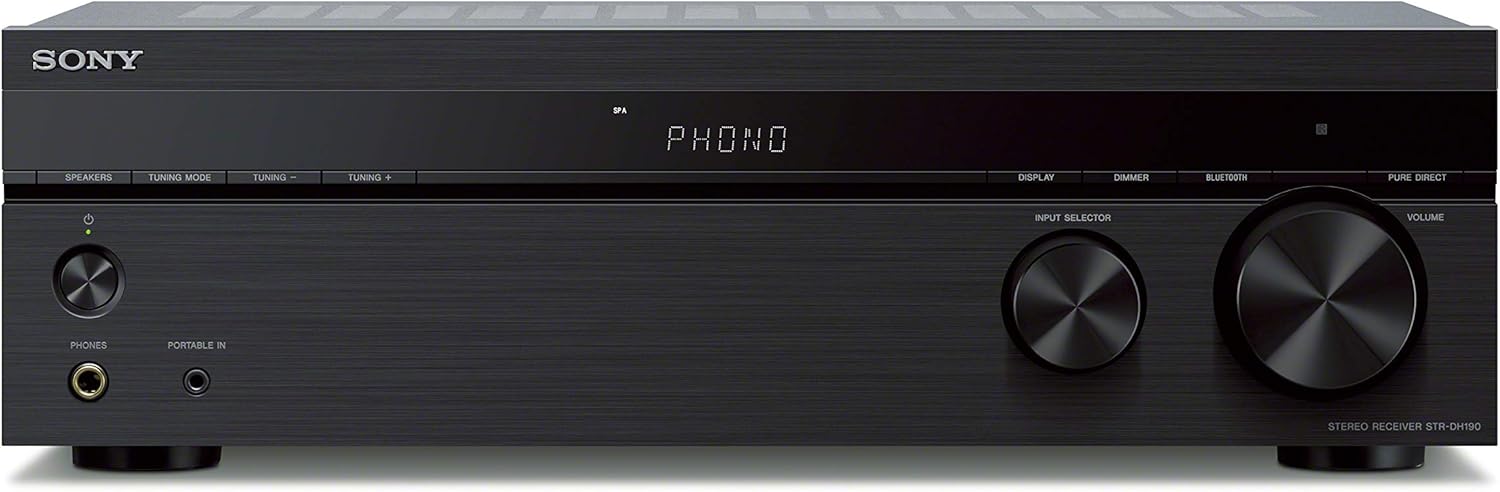
Pros
- Excellent sound clarity with balanced highs, mids, and bass across all input sources
- Phono input eliminates the need for a separate turntable preamp, saving money and desk space
- Bluetooth connection is quick to pair and remains stable during extended listening sessions
- Compact low-profile design fits standard AV furniture without any awkward modifications
- Highly rated by a large number of verified buyers, reflecting consistent real-world reliability
Cons
- Maximum volume output may feel limited for larger rooms or listeners who prefer concert-level loudness
- 2-channel stereo only, so it is not suitable for home theater surround sound setups
- No digital optical or coaxial inputs, which may frustrate users wanting to connect modern TVs or DACs directly
The Sony STRDH190 is a 2-channel home stereo receiver designed for music lovers who want a clean, capable hub for multiple audio sources. Whether you are spinning vinyl, streaming from a phone, or tuning into FM radio, this receiver handles it all in one compact unit. It is particularly well suited to first-time stereo system builders and returning audiophiles who value simplicity over complexity.
Sound performance is the STRDH190's strongest suit. With 100 watts per channel and Sony's large-capacity power transformer, the receiver delivers a composed, detailed soundstage with crisp highs and solid bass. Customer feedback consistently praises its clarity at moderate to high volumes, and High-Resolution Audio support means the unit can resolve fine details that compressed streaming formats often obscure.
The feature set is thoughtfully chosen for its target audience. The built-in phono preamp is a genuine convenience for turntable users, while Bluetooth pairing is described by owners as fast and reliable. The A/B speaker switching is a practical bonus, allowing two pairs of speakers to run simultaneously or independently for multi-room flexibility. A full-size headphone jack and 30-preset FM tuner round out the everyday usability.
On the design side, the STRDH190's low-profile chassis at just over 5 inches tall is a real-world advantage for anyone working with a standard AV cabinet. Build quality feels solid for the price point, and the included remote adds a layer of convenience that budget receivers often skip. The unit weighs 17 pounds, which speaks to the substantial internal components rather than hollow construction.
The main limitations are its 2-channel-only configuration, which rules it out for surround sound duties, and a lack of digital inputs for users wanting to connect a TV or external DAC. Volume headroom in very large rooms can also feel modest. That said, for a stereo-focused listener who values vinyl, Bluetooth, and clean audio in one tidy package, the STRDH190 is a genuinely impressive and well-rounded receiver.
Model: Sony STRDH190 | Color: Black | Channels: 2 (Stereo) | Output Power: 100W x 2 (8 ohms, 1 kHz) | Total Wattage: 200W
Speaker Impedance: 6 to 16 ohms | Inputs: Phono input, 4x stereo RCA, 3.5mm aux | Outputs: Stereo RCA, A/B speaker terminals, 1/4-inch headphone jack
Wireless: Bluetooth (2.4 GHz, max output 5.0 dBm) | FM Tuner: 30 station presets | Audio Format: WMA, High-Resolution Audio
Dimensions: 11"D x 17"W x 5.2"H | Weight: 17.1 lbs | Power: AC 120V, 60 Hz | Warranty: 1 year limited
In the Box: Receiver, remote control (RMT-AA400U), batteries, FM antenna | ASIN: B078WFDR8D | UPC: 027242908383
If you are shopping for your first stereo receiver, the STRDH190 is one of the most complete entry-level options available. It covers all the essential bases: Bluetooth streaming, FM radio, a phono stage for turntables, and enough inputs for a CD player, TV audio output, and more. You will not need to buy a separate phono preamp, which keeps your total system cost down.
Pairing advice: this receiver works best with bookshelf or floor-standing speakers rated between 6 and 16 ohms. Popular matches noted by owners include Yamaha bookshelf speakers and classic Bose 301s. For turntable users, Sony's own PS-LX310BT is a frequently recommended companion that integrates seamlessly with the STRDH190's phono input.
Consider your room size before purchasing. The 100-watt-per-channel rating is more than adequate for small to medium rooms, but listeners in large open-plan spaces who prefer very high volume levels may eventually want to step up to a higher-powered model. For most living rooms and dedicated listening spaces, however, the power on offer is genuinely sufficient.
This receiver is not the right choice if you need surround sound for a home theater setup, or if you want to connect a modern TV via optical or coaxial digital audio. For those use cases, a dedicated AV receiver would be a better fit. But as a pure stereo music receiver with broad source compatibility, the STRDH190 is hard to beat at its price point.
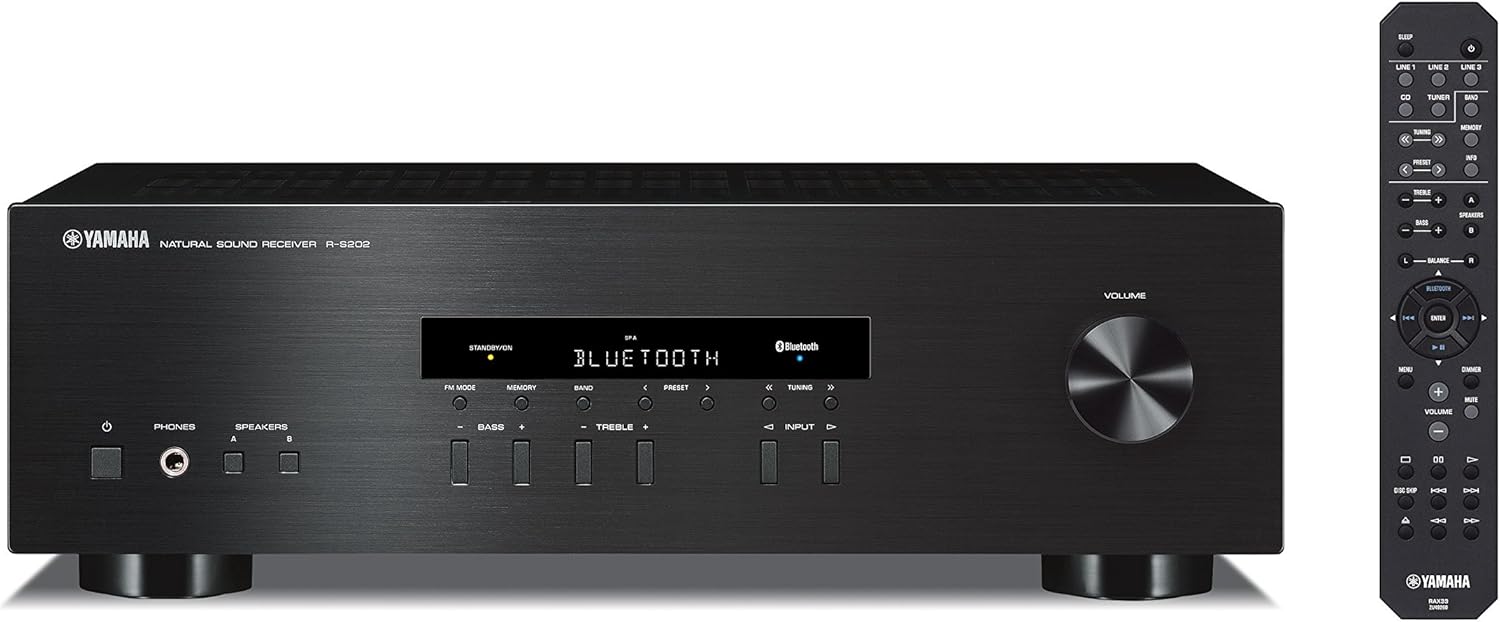
Pros
- Trusted Yamaha build quality with a solid 14.8-pound chassis that feels premium and durable
- Bluetooth 4.1 + EDR provides reliable wireless streaming from smartphones, tablets, and other compatible devices
- Dual speaker selector allows connection of two speaker systems for versatile listening setups
- Wide 10 Hz to 100 kHz frequency response delivers exceptional audio fidelity beyond typical receiver ranges
- Included remote control and intuitive layout make daily operation simple and convenient
Cons
- No HDMI ARC or digital optical inputs, which may limit integration with modern TVs and home theater setups
- At 2 channels only, it is not suitable for users looking to build a surround sound or multi-channel home theater system
The Yamaha R-S202BL is a 2-channel stereo receiver designed for music lovers who want straightforward, high-quality audio performance without the complexity of a full home theater system. Rated at 100 watts of output power and built around Yamaha's Natural Sound philosophy, it targets both entry-level audiophiles and everyday listeners who value reliability and clean sound reproduction.
The standout feature is its Bluetooth 4.1 + EDR connectivity, which allows seamless wireless streaming from smartphones, tablets, and other devices. Paired with a wide frequency response of 10 Hz to 100 kHz, the R-S202BL reproduces audio with impressive detail and accuracy. The built-in 40-station FM/AM preset tuner adds traditional broadcast radio support, making this receiver a genuinely versatile audio hub for the living room or dedicated listening space.
In terms of design, the R-S202BL sports a brushed aluminum finish with a clean, minimalist front panel that looks premium and timeless. At 14.8 pounds, the chassis feels substantial and well-built, consistent with Yamaha's reputation for durable construction. The compact 15 x 20 x 8-inch footprint means it fits neatly into most AV furniture without dominating the space.
On the downside, the receiver lacks digital inputs such as optical or coaxial, and there is no HDMI connectivity for direct TV integration despite the spec sheet listing HDMI as a connector type. Users building a modern home theater setup may find the input options limiting. Additionally, being a 2-channel unit, it is strictly a stereo receiver and does not support surround sound configurations.
Overall, the Yamaha R-S202BL is a compelling choice for anyone who wants a reliable, great-sounding stereo receiver with the convenience of Bluetooth streaming and traditional tuner functionality. It earns its strong reputation through solid build quality, wide frequency performance, and the trusted Yamaha name, making it a smart buy for music-focused listeners on a reasonable budget.
Model: Yamaha R-S202BL | Color: Black | Output Power: 100 Watts | Channels: 2.0 Stereo
Frequency Response: 10 Hz to 100 kHz (0 +/- 0.5 dB / 0 +/- 3.0 dB) | Input Sensitivity (CD): 500 mV / 47k Ohms | Audio Encoding: Stereo, WMA
Wireless: Bluetooth 4.1 + EDR | Compatible Devices: Smartphone, Tablet, Speaker, Television, Game Console | Tuner: FM/AM with 40 preset stations
Speaker Systems: Dual speaker selector with A/B output terminals | Headphone Terminal: Yes | Remote Control: Included
Dimensions: 20 inches D x 15 inches W x 8 inches H | Weight: 14.8 pounds | Warranty: 1-year manufacturer warranty | UPC: 027108954103
If you are shopping for your first stereo receiver or upgrading from a basic all-in-one system, the Yamaha R-S202BL offers an excellent balance of performance, features, and value. It is best suited for dedicated stereo music listening rather than home theater use, so consider your primary use case before purchasing.
For speaker pairing, the R-S202BL works well with bookshelf or floor-standing speakers rated between 6 and 16 ohms. With 100 watts of output power, it can drive moderately sensitive speakers in small to medium-sized rooms with ease. Avoid pairing it with very inefficient or power-hungry speakers that require more than 100 watts to perform well.
The Bluetooth feature makes this receiver especially appealing for users who stream music from services like Spotify, Apple Music, or Amazon Music. Since it supports Bluetooth 4.1 + EDR, you can expect a stable wireless connection with minimal dropout from most modern smartphones and tablets within a typical room distance.
Keep in mind that the R-S202BL does not include digital audio inputs, so if you plan to connect a TV, gaming console, or media player via optical or coaxial cable, you will need to use analog RCA connections instead. For users who only need stereo music playback from analog and Bluetooth sources, this limitation is unlikely to matter. It is a focused, well-executed stereo receiver that does exactly what it promises.

Pros
- Intuitive setup process with color-coded connections and an on-screen wizard that guides you step by step
- Exceptional audio performance with support for Dolby Atmos, DTS:X, and virtual height channels for cinema-grade immersion
- Versatile connectivity including phono input, eARC, 6 HDMI ports, Bluetooth, Wi-Fi, and AirPlay 2
- HEOS multi-room streaming and broad voice assistant support add serious smart home value
- Solid build quality and a compact form factor compared to older generation receivers
Cons
- The HEOS app and on-screen interface feel dated and can be clunky to navigate, especially for streaming configuration
- Older 4K TVs may experience compatibility issues with the advanced HDMI feature set, potentially requiring a TV upgrade
- Auto-calibration results may disappoint critical listeners, with some users preferring to manually tune speaker settings
The Denon AVR-X1700H is a 7.2 channel AV receiver aimed at home theater enthusiasts who want a powerful, future-ready centerpiece without spending on a flagship model. With 80 watts per channel, 8K HDMI support, and a rich suite of audio formats, it sits comfortably in the sweet spot between entry-level and premium receivers.
On the audio side, this receiver truly shines. Support for Dolby Atmos, DTS:X, DTS Virtual:X, and Dolby Atmos Height Virtualization means you can enjoy three-dimensional surround sound even in a room without dedicated overhead speakers. Real-world users consistently praise the theater-like experience it creates, particularly in 7.1.2 configurations with height channels.
Setup is one of the AVR-X1700H's strongest selling points. The color-coded rear panel, labeled speaker wire connections, and award-winning on-screen setup wizard make the installation process far less daunting than many competing receivers. Connectivity is equally impressive, offering six HDMI inputs, a phono input for turntables, AirPlay 2, Bluetooth, Wi-Fi, and dual subwoofer pre-outs, covering virtually every source a modern home theater might need.
The main drawback worth noting is the HEOS app and receiver interface, which several users describe as outdated and difficult to navigate. While the hardware performance is excellent, the software experience lags behind the overall quality of the unit. Additionally, users with older 4K televisions may encounter HDMI compatibility hurdles due to the advanced 8K HDMI specification.
Overall, the Denon AVR-X1700H delivers outstanding value for its class. It is a well-built, feature-rich receiver that performs reliably in real home theater environments. If you are upgrading from an older receiver or building a serious surround sound system for the first time, this Denon model is a highly recommended choice backed by strong user satisfaction.
Channels: 7.2 Channel | Power Output: 80W per channel | HDMI Ports: 6 In / 1 Out | Video Support: 8K/60Hz, 4K/120Hz, HDR10, HDR10+, Dolby Vision, HLG, H.264, H.265/HEVC
Audio Formats: Dolby Atmos, Dolby Atmos Height Virtualization, DTS:X, DTS Virtual:X | Wireless: Wi-Fi, Bluetooth, AirPlay 2 | Streaming: HEOS Built-in, Spotify, Amazon Music HD, TIDAL, Pandora, Deezer
Voice Control: Amazon Alexa, Google Assistant, Apple Siri, Josh.ai | Inputs: 2 Digital Optical, 2 Analog, 1 Coaxial, 1 Phono (MM/MC) | Pre-Outs: 2 Subwoofer Pre-Outs | eARC: Yes
Dimensions: 13.3"D x 17.1"W x 6"H | Weight: 19 lbs | Color: Black | Warranty: 3-Year Limited | Model: AVR-X1700H | UPC: 747192134600
If you are considering the Denon AVR-X1700H, it is best suited for buyers building or upgrading a dedicated home theater room with 5.1, 7.1, or 7.1.2 speaker configurations. It delivers the most value when paired with a modern 4K or 8K television that supports HDMI 2.1 features like VRR and ALLM, especially for gaming setups.
This receiver is an excellent fit for users who want multi-room audio capability without purchasing a separate streaming device. The HEOS ecosystem allows you to expand audio to other HEOS-compatible speakers throughout your home, making it a smart long-term investment for whole-home audio enthusiasts.
Vinyl listeners will appreciate the built-in phono stage, which supports both moving magnet and moving coil cartridges, though note that only one type can be used at a time. If you own a turntable and want to integrate it into a modern AV setup, this feature alone sets the AVR-X1700H apart from many competitors at this price point.
Buyers with older 4K televisions should verify HDMI compatibility before purchasing, as the advanced HDMI 2.1 feature set can occasionally cause handshake issues with legacy displays. If you are comfortable with manual speaker calibration, you may also want to plan to fine-tune the auto-calibration results for the best possible audio performance.

Pros
- Comprehensive Dolby Atmos and DTS Virtual:X support delivers genuinely immersive surround sound at this price range
- Next-gen HDMI features including 4K/120, 8K/60, ALLM, and VRR make it an ideal companion for modern gaming consoles
- Bluetooth Multipoint is a rare and highly convenient feature that simplifies switching between a phone and a tablet or laptop
- Automatic Room Correction with an included microphone takes the guesswork out of speaker calibration
- Intuitive Quick Guide and on-screen setup menu make installation approachable even for first-time AV receiver owners
Cons
- With only one HDMI output, users with multiple display devices such as a TV and projector will need additional switching equipment
- At 70 watts per channel, the power output may fall short for larger rooms or for driving demanding, low-sensitivity speakers to high volumes
- No built-in Wi-Fi or streaming app support means music playback is limited to Bluetooth only, lacking the flexibility of network streaming
The Yamaha RX300A is a 5.2-channel AV receiver aimed squarely at home theater enthusiasts who want modern features without paying flagship prices. Priced accessibly and backed by Yamaha's long-standing reputation in audio, this receiver is ideal for living room setups pairing a 4K TV or projector with a surround sound speaker system, and it is equally suited to gamers who demand low-latency video performance.
The headline features are genuinely impressive for this tier. Dolby Atmos and DTS Virtual:X support enables three-dimensional audio that adds height and depth to movie soundtracks, while the 4K/120 and 8K/60 HDMI passthrough with ALLM and VRR support makes this receiver a strong match for PlayStation 5 and Xbox Series X owners. The inclusion of Dolby Vision and HDR10+ ensures that the picture quality from your source devices is passed through without compromise.
Bluetooth Multipoint is a standout convenience feature that allows two devices to remain paired at once, so switching from a smartphone playlist to a laptop stream requires no re-pairing. The automatic room correction system, which uses the included setup microphone, does a commendable job optimizing speaker levels and distances for the specific acoustics of your room. Scene buttons add further everyday usability by letting you save preferred input and sound mode combinations for instant recall.
There are a few limitations worth noting. The single HDMI output restricts users who want to feed both a TV and a projector simultaneously. The 70-watt-per-channel power rating is adequate for most medium-sized rooms but may leave larger spaces or power-hungry speakers sounding underpowered at high volumes. The absence of Wi-Fi and network streaming also means users who rely on services like Spotify Connect or AirPlay will need to use Bluetooth as their only wireless audio path.
Overall, the Yamaha RX300A delivers a well-rounded package that punches above its weight in features and audio quality. For anyone building or upgrading a home theater system on a sensible budget, it offers a compelling combination of immersive audio, next-gen video, and everyday convenience that is hard to match at this price point.
Channels: 5.2-channel configuration with support for 3.1.2-channel Dolby Atmos layouts using up-firing or in-ceiling height speakers.
Power Output: 70 watts per channel, suitable for small to medium-sized home theater rooms with standard sensitivity speakers.
HDMI: 4 HDMI inputs and 1 HDMI output, supporting 4K/120Hz and 8K/60Hz passthrough, ALLM, VRR, eARC/ARC, Dolby Vision, and HDR10+.
Audio Formats: Dolby Atmos, DTS Virtual:X, Dolby TrueHD, and a range of selectable sound modes for music, movies, and games.
Connectivity: Bluetooth (Multipoint), HDMI, optical, coaxial, and analog inputs. No built-in Wi-Fi or Ethernet.
Dimensions and Weight: 12.5 inches deep, 17.13 inches wide, 6.13 inches tall, weighing 16.8 pounds. Includes remote control, setup microphone, FM antenna, and AAA batteries.
Warranty: 2-year limited manufacturer warranty from Yamaha.
Who should buy the Yamaha RX300A? This receiver is a strong fit for first-time home theater builders and upgraders who want a modern, feature-rich AV receiver without overspending. If your setup includes a 4K TV, a gaming console, and a 5.1 or 5.2 speaker system, this unit covers all the bases confidently.
Gamers: The support for 4K/120Hz, ALLM (Auto Low Latency Mode), and VRR (Variable Refresh Rate) makes the RX300A a genuinely game-ready receiver. Connecting a PlayStation 5 or Xbox Series X will unlock these features automatically, reducing input lag and enabling smooth frame rates.
Atmos enthusiasts on a budget: If you want to experience Dolby Atmos without investing in a high-end receiver, the RX300A supports up-firing Atmos speakers or in-ceiling height channels in a 3.1.2 configuration. This is a practical entry point into three-dimensional audio at a reasonable cost.
What to consider before buying: If you need Wi-Fi streaming, multi-zone audio, or more than one HDMI output, you may want to look at higher-tier Yamaha models or competing brands. Similarly, if your room is large or your speakers have low sensitivity ratings, you may want a receiver with higher wattage to ensure sufficient headroom at louder listening levels.
Accessories to consider: A set of Dolby Atmos-enabled up-firing speaker modules or in-ceiling height speakers will unlock the full potential of this receiver's immersive audio capabilities. Pairing it with a quality subwoofer will also significantly enhance the low-frequency performance for movies and music.

Pros
- Exceptional input variety including optical and coaxial for smart TV compatibility
- Bluetooth 5.3 connects quickly and maintains a reliable connection during playback
- Dual mic jacks with echo and Talk Over make it genuinely useful for karaoke and events
- Compact form factor is easy to place in garages, living rooms, or small home theaters
- Remote control works across all input modes for convenient full-room adjustment
Cons
- Actual RMS power is 25W per channel, so it may struggle to drive large or demanding tower speakers at high volumes
- No HDMI input limits direct integration with modern AV setups and gaming consoles
- Battery for the remote is not included, and the unit must be powered off via the front panel to avoid humming noise
The Donner MAMP5 is a 4-channel stereo receiver designed for home audio, karaoke, and garage or workshop listening. Priced accessibly and packed with connectivity options, it targets casual listeners, entertainers, and anyone building a flexible multi-source audio system on a budget.
The standout strength of this unit is its sheer variety of inputs. Bluetooth 5.3, USB, dual RCA pairs, AUX, FM radio, optical, and coaxial are all present, making it compatible with smart TVs, CD players, streaming devices, and smartphones alike. Reviewers consistently praise how quickly Bluetooth connects and how reliably it stays paired during extended listening sessions.
The dual 1/4-inch microphone inputs with echo and Talk Over functionality are a genuine differentiator at this price. The Talk Over feature automatically lowers background music when a mic is active, which is practical for karaoke nights, speeches, or hosting events. The full-function remote adds convenience by allowing treble, midrange, bass, and echo adjustments from any input mode without touching the unit.
There are some honest limitations to keep in mind. The advertised 1000W figure refers to peak power, with actual RMS output sitting at 25W per channel. For a garage, small room, or moderate speaker setup this is sufficient, but users running large floor-standing or high-demand reference speakers may find the amp falls short at higher volumes. There is also no HDMI input, which is worth noting for home theater builds relying on modern AV switching.
Overall, the Donner MAMP5 delivers solid value for its price bracket. It is a practical choice for anyone who wants a versatile, karaoke-ready, multi-source receiver for everyday home or workshop use, as long as expectations are aligned with its real-world power output rather than the peak wattage headline.
Output Power: 1000W Peak (25W x 4 RMS) | Channels: 4 | Speaker Impedance: 4 to 8 ohms
Inputs: Bluetooth 5.3, USB (up to 64GB), 2x RCA pairs, AUX, 2x 1/4-inch Mic, FM Radio, Optical, Coaxial | No HDMI input
Audio Formats: WAV, WMA | Streaming Services: Spotify, Deezer, TIDAL | Control: Front panel touch controls and remote (battery not included)
Dimensions: 13.7 inches D x 9.8 inches W x 3.9 inches H | Weight: 4.12 kg | Color: Black | Warranty: 1 Year
If you are shopping for a budget home audio receiver, the Donner MAMP5 is worth considering when your priority is connectivity flexibility and karaoke capability rather than raw amplifier power. It works well for small to medium rooms, garages, workshops, and casual home theater setups with standard bookshelf or moderate floor-standing speakers.
Buyers with high-efficiency or mid-range speakers rated between 4 and 8 ohms will get the most satisfying results. If you plan to drive large, power-hungry tower speakers or a dedicated subwoofer at concert-level volumes, a higher-wattage RMS amplifier would serve you better. The 25W RMS per channel is the real working figure to evaluate, not the 1000W peak rating.
For smart TV integration, check that your television supports an external audio output mode before purchasing, as HDMI ARC is not supported. The optical and coaxial inputs cover most modern TV audio output options. If you want a receiver that doubles as a karaoke machine, party amplifier, and everyday music hub without spending several hundred dollars, this Donner unit offers a compelling combination of features for the price.
Stereo Receiver Buying Guide
Channel Configuration and Power Output
The number of channels a receiver supports determines how many speakers you can drive and how immersive your audio experience will be. A two-channel receiver like the Sony STRDH190 2-ch Home Stereo Receiver with Phono is ideal for straightforward stereo listening, while a 7.2-channel unit like the Denon AVR-X1700H 7.2 Channel AV Receiver delivers full surround sound for dedicated home theater rooms.
Power output, measured in watts per channel, also matters. Higher wattage gives you headroom for dynamic peaks without distortion, especially when paired with demanding floorstanding speakers or a dedicated subwoofer.
Connectivity and Source Inputs
Modern receivers need to handle a wide variety of sources. Look for Bluetooth for wireless streaming, phono inputs if you own a turntable, and HDMI ports if you’re connecting a television or gaming console. The YAMAHA R-S202BL Stereo Receiver covers Bluetooth and FM/AM tuning in a clean, no-fuss package, while the Yamaha RX300A 5.2-Channel Home Theater AV Receiver adds HDMI eARC and next-gen gaming features like ALLM and VRR.
For versatile home setups, explore options in the wireless and streaming audio category to complement your receiver with compatible streaming devices and smart speakers.
Audio Format Support
If immersive movie sound is a priority, you’ll want a receiver that supports Dolby Atmos and DTS:X. The Denon AVR-X1700H 7.2 Channel AV Receiver and the Yamaha RX300A 5.2-Channel Home Theater AV Receiver both deliver full three-dimensional audio processing, including height virtualization for rooms without overhead speakers.
For pure music listening, high-resolution audio support is worth seeking out. The Sony STRDH190 2-ch Home Stereo Receiver with Phono is specifically designed to reproduce studio-quality sound with higher-than-CD fidelity, making it a strong choice for audiophiles on a focused stereo setup.
Speaker Compatibility and Room Matching
Always match your receiver’s impedance rating to your speakers. Most home receivers handle 6 to 16 ohms, but confirm compatibility before committing. If you’re still selecting speakers, our roundup of the best bookshelf speakers pairs well with compact two-channel receivers, while larger setups benefit from a look at our full home audio speakers guide.
Room correction technology is another feature that separates mid-range and premium receivers from entry-level options. The Yamaha RX300A 5.2-Channel Home Theater AV Receiver includes an automatic setup microphone that measures your room’s acoustics and optimizes speaker output accordingly.
Final Thoughts
There’s a strong option here for every type of listener. If you want a clean, reliable two-channel setup with phono support and Bluetooth, the Sony STRDH190 2-ch Home Stereo Receiver with Phono delivers outstanding value for music-first households. For those building a full home theater with immersive surround sound and multi-room streaming, the Denon AVR-X1700H 7.2 Channel AV Receiver is a feature-rich powerhouse that earns its place at the top of any serious setup.
Frequently Asked Questions
What is the difference between a stereo receiver and an AV receiver?
A stereo receiver handles two audio channels and is designed primarily for music playback. An AV receiver supports multiple channels (often five, seven, or more) and includes video switching via HDMI, making it the better choice for home theater setups. In 2026, most AV receivers also handle music streaming beautifully, so the lines have blurred considerably.
Do I need a receiver with Dolby Atmos?
If you watch a lot of movies or play modern video games, Dolby Atmos support adds a noticeable layer of immersion through height and spatial audio effects. It’s not essential for music-only setups, but for home theater use it’s one of the most meaningful upgrades available. Receivers like the Yamaha RX300A 5.2-Channel Home Theater AV Receiver support Dolby Atmos even without dedicated overhead speakers through height virtualization technology.
Can I use a stereo receiver with a turntable?
Yes, but your receiver needs a dedicated phono input with a built-in phono preamp to handle the low-level signal from a turntable cartridge. The Sony STRDH190 2-ch Home Stereo Receiver with Phono includes this feature, making it one of the most convenient choices for vinyl enthusiasts who don’t want a separate preamp. Always confirm whether your turntable has a built-in preamp before purchasing, as that affects which input you’ll use.
How many speakers can a typical stereo receiver support?
Most two-channel stereo receivers support two to four speakers, often with A/B speaker switching to run different zones independently. Multi-channel AV receivers can support five, seven, or more speakers depending on the configuration. If you’re building a multi-room audio system, look into wireless and streaming audio solutions that can extend your receiver’s reach throughout the home without running additional speaker wire.




Write Your Review
No reviews yet. Be the first to share your experience!