

Are you a podcaster needing to host guests, a musician wanting to record a full band demo, or a content creator juggling multiple audio sources? If your current two-input interface feels limiting, stepping up to a 4-channel model unlocks a new level of production flexibility. These units serve as the central nervous system of a capable home studio, letting you capture vocals, guitars, synths, and more all at once.
This guide cuts through the noise to present the most reliable and high-performing 4-channel audio interfaces available in 2026. We have assessed models for their sound quality, driver stability, feature sets, and overall value. Whether you’re building your first serious setup or expanding your I/O capabilities, you’ll find a perfect match here. For those with simpler needs, our review of the best 2-Channel audio interfaces is also a great resource.
Pros
- Exceptional audio quality with studio-grade converters and 192kHz sample rate capability
- Intelligent recording features like Auto Gain and Clip Safe eliminate guesswork and failed takes
- Air mode adds musical presence and harmonic richness to vocals and guitars
- Included software suite provides professional recording, production, and mastering tools immediately
- Reliable performance with zero driver issues reported in customer reviews
Cons
- Requires high-impedance headphones for optimal headphone output performance, limiting some accessory choices
- Some gaming and specialized software can cause driver crashes requiring system restart
- Learning curve involved in configuring MIDI and audio routing within DAW software
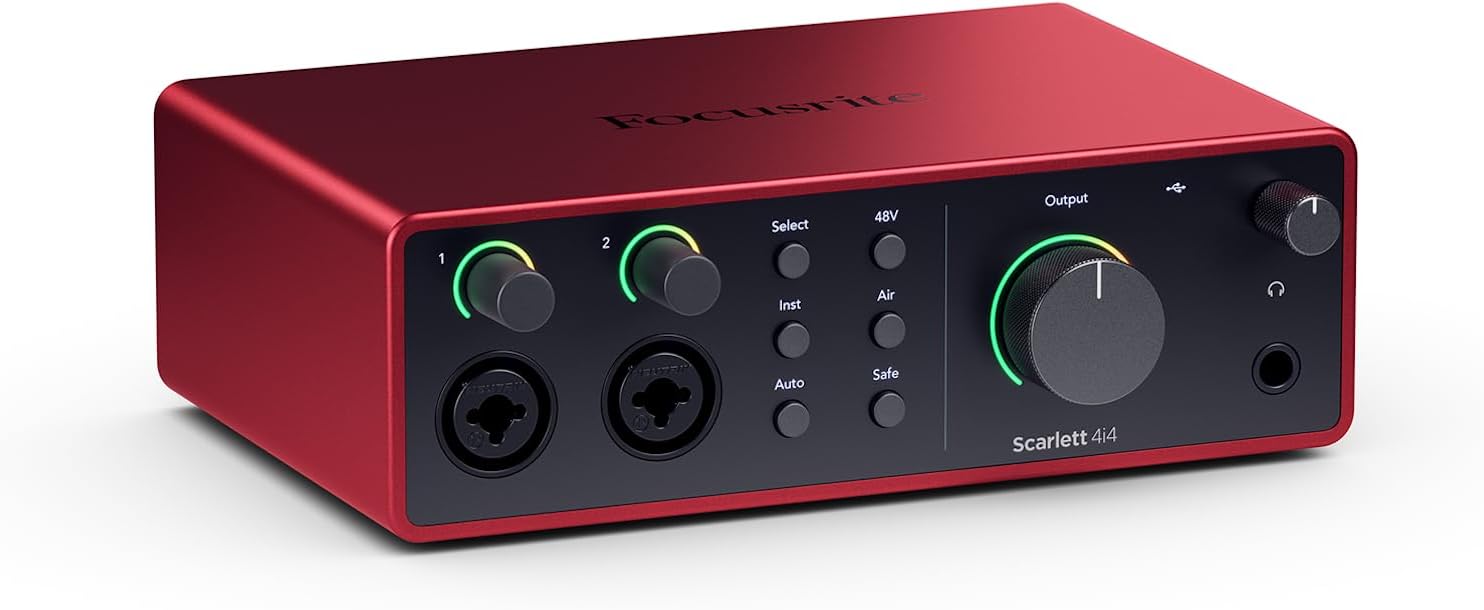
The Focusrite Scarlett 4i4 4th Gen is a professional audio interface designed for musicians, producers, podcasters, and content creators who need reliable, studio-quality sound capture. This USB-C interface combines professional-grade audio converters with intelligent recording features that make it accessible to beginners while satisfying experienced engineers.
The standout feature is the dual ultra-low-noise Scarlett 4th Gen mic preamps paired with studio-grade converters boasting a massive 120dB dynamic range, matching equipment found in the world's biggest recording studios. The innovative Air mode adds musical presence and harmonic richness to vocals and guitars, while Auto Gain and Clip Safe features automatically set perfect recording levels and prevent clipping, meaning you capture keeper takes without obsessing over gain staging.
Build quality is solid and compact, measuring just 7.09 inches wide and weighing 2.2 pounds, making it portable for mobile recording setups. The interface offers versatile I/O with 2 Hi-Z instrument inputs for guitars and synths, 4 line inputs, 4 line outputs, and MIDI I/O to accommodate any recording scenario. USB-C connectivity delivers low-latency performance critical for streaming and real-time monitoring.
The included software bundle is exceptional value, featuring Pro Tools Intro+, Ableton Live Lite, Cubase LE, and the Hitmaker Expansion with professional plugins from XLN Audio, Softube, and Native Instruments. Some users report occasional driver crashes with certain gaming software, though this appears rare and resolved with system restart.
The Scarlett 4i4 4th Gen delivers professional audio quality and intelligent features at a mid-range price point, backed by a 3-year warranty and round-the-clock support. Whether you're recording music, podcasts, or content, this interface provides the tools and sound quality to produce broadcast-ready results.
Audio Performance: 120dB dynamic range, 24-bit/192kHz maximum sample rate, 20kHz frequency response. Dual ultra-low-noise Scarlett 4th Gen mic preamps with Air mode.
I/O Configuration: 2 Scarlett 4th Gen mic preamps, 2 Hi-Z instrument inputs, 4 line inputs, 4 line outputs, MIDI In/Out, headphone output with high-impedance support.
Connectivity: USB-C with included USB-C to USB-A adaptor and 5V 3A power supply. Compatible with Mac OS, Windows OS, and iOS.
Physical Specs: 7.09 inches wide x 5.08 inches deep x 2.32 inches tall, 2.2 pounds. Includes USB-C cable and power supply.
Software Included: Pro Tools Intro+, Ableton Live Lite, Cubase LE, Hitmaker Expansion with premium plugins and virtual instruments.
Best For: Musicians recording guitars, vocals, and keyboards; music producers and beat makers; podcasters and content creators; streamers needing low-latency monitoring; anyone upgrading from budget interfaces who wants professional sound quality.
Consider If You: Need versatile I/O for multiple instruments and MIDI devices simultaneously; want included professional software to start producing immediately; require reliable, crash-free performance for critical recording sessions; value portability and compact design; prefer established brands with excellent customer support.
May Not Be Ideal If: You need more than 2 mic inputs simultaneously; you work exclusively with gaming software that has driver compatibility issues; you require XLR outputs instead of line-level outputs; budget is below $250.

Pros
- MIDAS preamps deliver clean, low-noise signal path comparable to much more expensive interfaces
- Intuitive plug-and-play setup with minimal driver hassle on both Mac and Windows systems
- Robust build quality and metal construction designed to withstand years of studio use
- Four simultaneous inputs and outputs provide flexibility for multi-track recording and live streaming
- Outstanding value proposition offering professional-grade specs at entry-level pricing
Cons
- Some users report occasional driver compatibility issues on certain Windows OS versions
- MIDI functionality may require additional configuration compared to audio I/O setup
- Limited customer support documentation compared to higher-end competitors
The Behringer U-PHORIA UMC404HD is a compact 4x4 USB audio interface engineered for home studio owners, podcasters, content creators, and mobile recording professionals. It delivers professional-grade audio quality at a price point that makes it accessible to anyone serious about recording but budget-conscious. The interface has earned respect from experienced audio engineers and casual users alike for punching well above its price class.
The standout feature is the inclusion of four MIDAS-designed mic preamps with +48V phantom power, which typically appear only on interfaces costing two to three times as much. Users consistently praise the clean, low-noise signal path and the ability to capture vocals and instruments with clarity and detail. The 24-bit/192 kHz resolution ensures future-proof audio quality, while ultra-low latency streaming supports real-time monitoring during recording sessions. Compatibility with Pro Tools, Ableton Live, Cubase, and other major DAWs means you can integrate it into virtually any existing workflow.
Build quality reflects Behringer's partnership with MIDAS and acquisition of Music Tribe assets. The metal chassis feels solid and impact-resistant, designed to handle the rigors of studio use and travel. The interface is compact at just 11.5 inches wide, making it ideal for portable recording setups or tight desk spaces. Balanced XLR and 1/4-inch outputs ensure professional connectivity to studio monitors and mixing equipment.
The main drawbacks involve driver setup on certain Windows systems and MIDI configuration, which some users find less intuitive than audio I/O setup. A small percentage of users report compatibility issues, though this appears to be system-specific rather than a widespread product defect. Driver support for Mac OS is notably streamlined, with native OS integration requiring minimal configuration.
The Behringer UMC404HD represents genuine value in the audio interface market. It combines professional-grade components, solid engineering, and proven reliability at a price that makes it the obvious choice for anyone building a home studio or upgrading from entry-level equipment. Experienced audio professionals and beginners alike will find it a capable, dependable tool that won't compromise recording quality.
Audio Specifications: 24-bit/192 kHz resolution, 10 Hz to 43 kHz frequency response (0/+0.3 dB). Maximum input levels: Microphone -4 dBu, Line +20 dBu, Instrument -3 dBu. Four MIDAS-designed mic preamps with +48V phantom power.
Connectivity: USB 2.0 interface with 4 inputs/4 outputs plus 1x MIDI I/O. Balanced XLR and 1/4-inch TRS connectors for main outputs. Supports both Mac OS X and Windows XP or higher.
Compatibility: Works with Avid Pro Tools, Ableton Live, Steinberg Cubase, Reaper, Audacity, and other major DAWs. Native driver support for Mac OS, simple driver installation for Windows.
Physical Dimensions: 11.5 inches D x 5.12 inches W x 1.81 inches H. Weight: 2.7 pounds. Rugged metal chassis with impact-resistant construction.
Ideal For: Home studio owners, podcasters, content creators, musicians recording at home, audio engineers on a budget, and anyone upgrading from entry-level USB interfaces. Perfect for mobile recording setups and professional use in tight spaces.
Experience Level: Suitable for beginners through advanced users. The plug-and-play setup welcomes newcomers, while the professional-grade preamps and specifications satisfy experienced engineers.
Use Cases: Music production and multi-track recording, podcast and voiceover recording, live streaming with high-quality audio, instrument recording, vocal tracking, and field recording with a portable setup.

Pros
- Excellent value with included production software and 6GB+ of content
- Hardware monitoring with LCD display eliminates latency issues during recording sessions
- USB-C connection provides reliable, fast performance and works across Mac, PC, and iOS platforms
- Compact and portable design makes it ideal for bedroom studios, home offices, and mobile recording
- Two quality microphone preamps handle both vocals and instruments without additional gear
Cons
- Limited to 4 simultaneous inputs, which may feel restrictive for larger band recordings or complex setups
- USB-C only means you'll need adapters if using older USB-A devices or hubs
- Learning curve on some features like loopback routing for users new to audio interfaces
The MOTU M4 is a 4-in/4-out USB-C audio interface built for modern producers, podcasters, musicians, and content creators who need professional-grade sound quality without the bulk or price tag of larger mixing consoles. It's the perfect middle ground between entry-level USB interfaces and expensive studio-grade equipment, delivering serious features in a compact footprint.
What makes the M4 truly stand out is its combination of hardware monitoring with an LCD screen, which eliminates the frustrating latency that plagues many budget interfaces. The two dedicated microphone preamps deliver clean, professional recordings for vocals and instruments, while the loopback feature opens up possibilities for streaming, podcasting, and music production without needing external hardware. The included 6GB+ of free software and content transforms this from a simple interface into a complete production toolkit.
Build quality is solid and straightforward. The aluminum chassis feels durable despite its lightweight, portable design, making it suitable for both stationary studios and traveling musicians. The USB-C connection is modern and reliable, though it does require adapters for older devices. Navigation through the LCD screen is intuitive, and setup across Mac, Windows, and iOS platforms is refreshingly painless.
The main limitation is the 4-input cap, which restricts simultaneous recording to four sources. For solo artists and small projects this is fine, but larger band recordings or complex setups may feel constrained. Additionally, some users new to audio interfaces may find the loopback routing requires a learning curve to master.
The MOTU M4 earns its 4.6-star rating by delivering genuine professional features at an accessible price point. It's an excellent choice for anyone serious about recording who wants reliability, portability, and included software to get started immediately.
Connectivity: USB-C, compatible with Mac, Windows, and iOS devices
I/O Configuration: 4 inputs and 4 outputs with 2 dedicated microphone preamps
Total Channels: 8 channels
Features: Hardware monitoring with LCD screen, loopback functionality, zero-latency input monitoring
Included Software: 6GB+ of free content including Performer Lite and Live Lite production software
Design: Compact, portable aluminum chassis suitable for studio or mobile use
Who Should Buy: The MOTU M4 is ideal for home studio musicians, podcasters, content creators, and producers who need reliable multi-channel recording in a portable package. It's perfect for upgrading from basic USB audio solutions while staying budget-conscious.
Who Might Want to Look Elsewhere: If you need more than 4 simultaneous inputs for large ensemble recording, or if you prefer a purely software-based solution without hardware monitoring, consider larger interfaces or alternative options.
Setup Considerations: Ensure your computer has an available USB-C port or budget for a USB-C hub adapter. The included software requires internet connection for initial download and activation. Allow 30 minutes for complete setup and driver installation.
Value Assessment: At its price point, the M4 offers exceptional value when factoring in the included 6GB+ of production software. The hardware monitoring alone justifies the investment for serious recording work, as it eliminates the latency issues that frustrate users on cheaper interfaces.

Pros
- Exceptional reliability and durability compared to higher-priced competitors, with users reporting years of trouble-free operation
- Incredibly low latency performance (as low as 5ms) makes real-time monitoring and overdubbing smooth and responsive
- Transparent Crystal Preamp delivers clean, professional-quality sound from condenser microphones and all input sources
- Truly portable and lightweight at just 10.6 ounces with USB-only power, ideal for traveling musicians and remote podcasters
- Outstanding value for the price with included software and compatibility across Mac, Windows, and iOS platforms
Cons
- Line input accepts mono signals only, limiting stereo recording from certain consumer electronics without additional splitters
- Gain levels run slightly low on some inputs, requiring careful gain staging or boosting in post-production for quieter sources
- Uses USB Type-B connector instead of modern USB-C, requiring an adapter for newer laptops and devices
The M-Audio M-Track Solo is a compact USB audio interface designed for recording, podcasting, live streaming, and music production on Mac and Windows computers. It's perfect for beginners stepping up from built-in audio, budget-conscious musicians, podcasters working remotely, and anyone who needs reliable recording quality without complexity or expense.
The standout feature is its zero-latency direct monitoring capability, which lets you hear your input signal in real-time while recording. Users consistently report achieving 5-10ms latency, making overdubbing and live monitoring feel natural and responsive. The Crystal Preamp delivers transparent, clean audio from condenser microphones, and the switchable XLR/Line/Instrument inputs provide flexibility for guitars, keyboards, and line-level devices. The dual-channel design lets you record stereo instruments or capture two sources simultaneously.
Build quality is solid and reliable. The compact 6.4 x 4.5-inch footprint weighs just 10.6 ounces, making it genuinely portable for traveling musicians and remote workers. USB-only power eliminates the need for an external power supply, and the class-compliant design means Mac users get plug-and-play operation without driver installation. The included MPC Beats software and ProTools First provide immediate production tools out of the box.
The main limitation is that the line input only accepts mono signals, which complicates stereo recording from consumer electronics without additional splitters. Gain levels also run somewhat low on certain inputs, requiring careful gain staging to avoid recording quiet sources. The USB Type-B connection feels dated compared to USB-C on modern laptops.
For the price, the M-Audio M-Track Solo delivers exceptional value and reliability. It's a genuinely professional-quality interface that handles podcasting, music recording, and streaming without the complexity or cost of premium alternatives. Highly recommended for anyone starting out or upgrading from basic computer audio.
Audio Specifications
Sample Rate: 48 kHz maximum
Frequency Response: 20 Hz - 20 kHz
Channels: 2-channel recording and playback
Impedance: 1 megaohm
Inputs and Outputs
Microphone Input: Balanced XLR with phantom power
Line Input: Balanced 1/4 inch TRS (mono)
Instrument Input: Unbalanced 1/4 inch TS
Headphone Output: 1/8 inch stereo
Main Outputs: Stereo RCA connectors
Connectivity and Compatibility
Connection: USB Type-B
Operating Systems: Windows 7-10, macOS High Sierra through Big Sur, iOS (with Lightning to USB3 adapter)
DAW Compatibility: Logic Pro, ProTools, GarageBand, Studio One, Cubase, Ableton Live, and virtually all major DAWs
Physical Specifications
Dimensions: 6.43 inches W x 4.46 inches D x 2.14 inches H
Weight: 10.6 ounces
Power: USB-powered only, no external power supply required
Ideal For
Podcasters and content creators recording interviews, solo episodes, or voiceovers from home or on location. Musicians recording acoustic instruments, vocals, guitar, or keyboards without complex mixing needs. Streamers adding professional audio quality to live broadcasts. Beginners learning music production and recording fundamentals. Traveling musicians needing portable, reliable recording capability.
May Not Be Ideal For
Professional studios requiring multi-track simultaneous recording from multiple instruments. Users needing stereo line input for consumer electronics without workarounds. Those requiring higher sample rates above 48 kHz. Anyone exclusively using modern USB-C equipped devices without adapters.

Pros
- Professional 24-bit/192kHz audio resolution rivals interfaces costing significantly more
- Plug-and-play setup with USB-C connectivity requires no complex configuration or drivers
- Included software bundle provides immediate production tools worth hundreds of dollars separately
- Compact footprint makes it perfect for portable recording and travel-friendly setups
- Versatile connectivity supports both XLR microphone inputs and 1/4 inch instrument inputs
Cons
- Limited to 2 inputs and 2 outputs, which may feel restrictive for multi-track recording sessions
- No physical monitoring level knobs on the interface itself, requiring software adjustments
- Requires external powered USB hub for some Android devices and older computers
The M-Track Duo HD is a USB-C audio interface designed for aspiring producers, podcasters, and bedroom musicians who need professional recording quality without unnecessary complexity. This compact unit strips away extraneous features and focuses on delivering the essentials: clean audio capture, reliable connectivity, and straightforward operation that works across Mac, PC, iOS, and Android platforms.
Where this interface truly shines is in its audio specifications. The 24-bit/192kHz resolution captures every nuance of your performance, while the Crystal preamps deliver a solid 55dB of gain with minimal noise. Zero-latency monitoring means you hear yourself instantly without the distracting delays that plague budget interfaces, making it suitable for both overdubbing vocals and recording live instruments. The switchable 48V phantom power supports condenser microphones, expanding your microphone options significantly.
Build quality is solid and practical. The rugged aluminum enclosure feels durable enough for studio and portable use, and the compact 7.5 by 4.4 inch footprint fits comfortably into any recording setup or gig bag. The included USB-C cable provides direct connectivity to modern computers and devices, though you can also use an externally powered USB hub for flexibility. The two combo inputs accommodate microphones, guitars, bass, and line-level sources, covering most common recording scenarios.
The main limitation is the 2-in/2-out configuration, which restricts simultaneous recording to two tracks. Additionally, monitoring level control happens entirely through software rather than dedicated hardware knobs. Some Android users may need an external powered USB hub for stable operation, adding a small additional expense.
The M-Track Duo HD represents exceptional value for the price, especially when factoring in the included Ableton Live Lite, MPC Beats, and Splice subscription. It's an excellent entry point into music production and podcast recording that delivers professional results without overwhelming beginners with unnecessary features.
Connectivity: USB Type-C, Headphone Output 1/4 inch TRS, Instrument Input Unbalanced 1/4 inch TS, Line Input Balanced 1/4 inch TRS, Main Outputs L and R Impedance Balanced 1/4 inch TRS, Mic Input Balanced XLR
Audio Performance: 24-bit/192kHz maximum sample rate, 20Hz frequency response, 1 megaohm impedance, Crystal preamps with 55dB gain, switchable 48V phantom power
Channels: 2 inputs and 2 outputs
Physical: 7.5 inch W x 4.4 inch D x 2.1 inch H, 0.47 kg weight, compact rugged enclosure
Compatibility: Windows, macOS, iOS, and Android operating systems
Included Software: Ableton Live Lite, Akai Professional MPC Beats, 2-month Splice subscription
Warranty: 1 year manufacturer warranty
Best For: The M-Track Duo HD is ideal for bedroom producers starting their music production journey, podcasters looking to upgrade from built-in microphones, session musicians recording demos, and content creators needing reliable audio capture for live streams or videos.
Consider If: You need more than 2 simultaneous inputs, require extensive hardware controls without software interaction, or plan to record complex multi-track arrangements with many overdubs. For these scenarios, a larger interface like the M-Track Quad might better suit your needs.
Setup Tips: Use the included USB-C cable for direct connection to modern computers. If using older devices or experiencing stability issues, connect through an externally powered USB hub. Enable phantom power only when using condenser microphones to avoid unnecessary power drain and potential noise.
Software Integration: The included Ableton Live Lite integrates seamlessly with the M-Track Duo HD for immediate production capability. The 2-month Splice subscription provides access to professional samples and loops used by top producers, helping accelerate your learning and creative process.

Pros
- Outstanding value for the price with more I/O options than comparable competitors
- Crystal clear sound quality perfect for recording music, podcasts, and vocals
- Solid metal construction built to withstand frequent use and transport
- Easy setup with no drivers required, compatible with Windows and Mac systems
- Versatile mixer-interface hybrid design works for recording, live performance, and streaming
Cons
- Output volume levels reported as slightly weak by some users, may require external amplification
- Windows-focused software support, limited compatibility with Linux operating systems
- Steep learning curve for beginners unfamiliar with audio interface controls and effect selection
The Pyle PMUX9 is a professional USB audio interface designed for musicians, podcasters, and content creators who need reliable recording capabilities without breaking the bank. This hybrid mixer-interface device bridges the gap between entry-level interfaces and professional mixing consoles, making it ideal for home studios, small venues, and portable recording setups.
What sets the PMUX9 apart is its impressive feature set: 24 onboard digital effects, 48V phantom power, and extensive connectivity options including XLR combo jacks, 6.35mm guitar inputs, 3.5mm auxiliary, and RCA stereo inputs. The 24-bit, 48kHz recording resolution delivers crystal-clear audio quality, while independent control knobs for each input and output channel provide precise mixing capabilities directly on the unit without relying on computer software.
The build quality is exceptional for the price point. The rugged metal housing feels solid and durable, while the compact dimensions (1.5 x 6.8 x 4.7 inches) make it perfect for small spaces and easy transport between locations. Setup is straightforward with no complex driver installations required, and the unit works seamlessly with both Windows and Mac systems.
The main drawback is that output volume levels run slightly lower than some users prefer, potentially requiring external amplification for certain applications. Additionally, Linux users may encounter compatibility issues. Despite these minor limitations, the PMUX9 delivers exceptional value with more I/O connectivity and built-in effects than competing interfaces at similar price points.
The Pyle PMUX9 is a smart investment for anyone serious about home recording, live streaming, or music production on a budget. Its combination of solid build quality, versatile connectivity, onboard effects, and professional audio quality makes it a compelling choice for beginners and intermediate users alike.
Audio Performance: 24-bit, 48kHz resolution with ultra-low noise design and less than 0.5% THD at +4dBu. Frequency response of plus or minus 1dB at +4dBu and 1kHz.
Connectivity: USB 2.0 Type-B connection. Input: 2 combo XLR and 6.35mm jacks, 1 additional 6.35mm jack, 1 AUX 3.5mm jack, 1 RCA stereo pair. Output: 6.35mm headphone jack, 3.5mm stereo headphone jack, 3.5mm stereo output, 1 RCA monitor pair.
Power and Effects: DC 5V power supply with 7W power consumption and 1A output current. Includes 48V phantom power with LED indicator. Features 24 preset digital effects including reverb, delay, echo, phaser, flanger, chorus, tremolo, wah-wah, and pitch change.
Physical Specifications: Compact dimensions of 1.5 x 6.8 x 4.7 inches. Weight: 0.89 kg. Rugged metal housing. 2 independent channels.
Home Recording: Perfect for recording guitars, vocals, and instruments directly to your computer with professional sound quality and onboard effects.
Podcasting: Multiple microphone inputs and phantom power support make this ideal for podcast production with clean, clear audio capture.
Live Streaming: The mixer-interface hybrid design with independent controls and effects works great for YouTube, Twitch, and social media streaming applications.
Music Production: Beginner and intermediate music producers benefit from the 24 onboard effects and multiple input options without needing additional hardware.
Portable Recording: The compact size and rugged metal construction make this excellent for musicians who record in different locations or perform live with backing tracks.

Pros
- Exceptional value for money compared to premium competitors like Focusrite
- Reliable cross-platform performance on both Windows PC and Mac systems
- Straightforward setup and driver installation for beginners learning music production
- Adequate 4-channel I/O for small to medium home studio recording sessions
- Professional phantom power support enables use of high-quality condenser microphones
Cons
- User interface and control layout may feel unintuitive for first-time users
- Limited customer reviews and feedback compared to established audio interface brands
- No mention of bundled software, relying on third-party DAWs for recording
The Depusheng 4-Channel USB Audio Interface is a budget-conscious solution designed for home studio enthusiasts, aspiring musicians, and beginners entering music production. This interface bridges the gap between entry-level and professional-grade equipment, offering genuine studio-quality specs without the premium price tag. It's particularly well-suited for those building their first recording setup or expanding a modest home studio on a tight budget.
The standout feature is undoubtedly the professional 24-bit/192kHz recording capability paired with ASIO driver support for minimal latency. The four combo inputs accommodate multiple microphones, instruments, and line sources simultaneously, while the built-in +48V phantom power enables use of professional condenser microphones for superior vocal and acoustic recordings. Real-world performance proves solid, with users reporting reliable operation across Windows and Mac platforms and smooth integration with major DAWs like Pro Tools and Ableton Live.
Build quality appears adequate for the price range, with a compact footprint suitable for space-constrained studios. The interface includes necessary features like Hi-Z switches for instrument recording, mono/stereo switching, direct monitoring, and dedicated headphone output. The included power adapter and USB cable provide everything needed for immediate setup, though some users report the overall design could be more intuitive for newcomers to audio interfaces.
The primary drawback is the learning curve, with some users noting the interface isn't particularly user-friendly during initial setup and operation. Additionally, the relatively small user base means less community support and troubleshooting resources compared to established competitors. However, those willing to invest time in learning the controls will find capable hardware underneath.
Verdict: The Depusheng 4-Channel Audio Interface delivers impressive specifications and genuine recording quality at an unbeatable price point. It's an excellent choice for budget-conscious beginners and intermediate producers who prioritize value and multi-channel capability over brand prestige or premium features. Recommended for home studio owners, podcasters, and musicians seeking professional recording tools without breaking the bank.
Audio Quality: 24-bit depth, up to 192kHz sample rate, USB audio streaming
Connectivity: 4 combo XLR/1/4-inch inputs, 4 TS main outputs, USB connection, headphone output
Features: ASIO drivers, +48V phantom power, Hi-Z switches, mono/stereo switching, direct/DAW monitoring, low-latency processing
Compatibility: Windows PC and Mac operating systems, Pro Tools, Ableton Live, and major DAW software
Physical: Compact desktop design, 1kg weight, includes USB cable and power adapter
Warranty: 1-year manufacturer warranty
Ideal For: This interface is perfect for bedroom producers, bedroom musicians, podcast creators, and music students beginning their production journey. It's also suitable for experienced producers seeking an affordable secondary interface for mobile recording or backup purposes.
Not Ideal For: Professional studios requiring extensive I/O, users prioritizing premium build quality and brand reputation, or those needing extensive customer support and community resources.
Best Use Cases: Home vocal recording, multi-instrument tracking, podcast recording, drum recording and practice, guitar and bass recording, online music lessons, and small band rehearsal documentation.
How to Choose Your 4-Channel Audio Interface
Sound Quality and Converter Performance
The primary job of an interface is to convert analog sound into pristine digital audio. Look for specs like high dynamic range (measured in dB) and support for 24-bit/192 kHz resolution. These numbers indicate clean, detailed recordings with plenty of headroom. Premium preamps, like the Midas-designed ones in the Behringer UMC404HD, provide warmth and clarity from the moment your microphone is plugged in.
Advanced features such as Focusrite’s Air mode or MOTU’s premium converters add a professional sheen. They can impart a studio-ready character to vocals and instruments directly upon recording. This saves significant time during the mixing phase.
Connectivity and Input Types
Verify that the input configuration matches your gear. Most 4-channel interfaces offer combo jacks (XLR/TRS) that accept microphones, line-level signals, and instruments. Some, like the Focusrite Scarlett 4i4, include dedicated Hi-Z inputs for guitars and basses. Ensure there is sufficient phantom power (+48V) if you use condenser microphones.
Also, consider output needs. Four line outputs are standard for connecting studio monitors and outboard gear. A dedicated, powerful headphone output with its own level control is essential for comfortable monitoring. For a deeper dive into specific features, explore our guide to the best audio interfaces with auto gain.
Software, Drivers, and Latency
Stable, low-latency drivers are non-negotiable for a frustration-free recording experience. ASIO, Core Audio, and WDM drivers should offer reliable performance with your DAW. Look for interfaces known for robust driver support across Mac and Windows systems. Latency becomes critical when using software monitoring for effects.
Many bundles include valuable software. The Focusrite Scarlett 4i4 and M-AUDIO interfaces come with popular DAWs like Ableton Live Lite and plugin suites. These can jumpstart your production toolkit, offering great value beyond the hardware itself.
Build Quality and Workflow Features
Build Quality and Workflow Features
A metal chassis, like on the Behringer UMC404HD, ensures durability for home use and portable gigs. The physical layout of knobs, buttons, and metering also matters. Clear visual feedback, such as the level meters on the Motu M4, helps prevent clipping and confirms signal flow instantly.
Workflow enhancers include a direct monitor blend knob for zero-latency listening, a loopback function for streaming, and MIDI I/O for connecting keyboards or controllers. Features like Clip Safe and Air mode, detailed in our article on the best audio interfaces with air mode, automate complex tasks for smoother sessions.
Final Thoughts
Selecting the right 4-channel audio interface is a pivotal step toward professional-sounding productions. For creators seeking an all-in-one studio hub with exceptional sound and intelligent features, the Focusrite Scarlett 4i4 4th Gen USB-C Audio is a standout choice that balances power with ease of use. Alternatively, for those prioritizing proven reliability and superb value in a robust package, the Behringer U-PHORIA UMC404HD Audiophile 4×4 remains a perennial favorite for recording musicians. Whichever model you choose from our curated list, you’ll be well-equipped to capture your next great idea. You can explore all our interface recommendations on the main Audio Interfaces category page, and if you’re also in the market for a simple vocal mic, check out our USB Microphones guide.
Frequently Asked Questions
What is the main advantage of a 4-channel over a 2-channel interface?
The primary advantage is simultaneous multi-track recording. You can record a stereo keyboard, a vocalist, and a guitarist all at once, or host a podcast with multiple guests. This capability is essential for capturing live group performances or complex overdub sessions without constantly re-patching cables.
Can I use a 4-channel interface for live streaming?
Absolutely. A 4-channel interface is excellent for streaming. You can connect a high-quality XLR microphone, a dedicated gaming or commentary mic, an instrument, and even a line-in from a mixer or phone. Features like loopback allow you to blend your computer’s audio with your live mic input seamlessly for professional broadcasts.
Do I need an interface with MIDI connections?
If you plan to use hardware synthesizers, drum machines, or MIDI controllers, then yes. MIDI I/O (found on models like the Focusrite Scarlett 4i4 and Behringer UMC404HD) lets you record performance data from these devices into your DAW and control them from your computer. It future-proofs your setup for expanding your gear collection.
How important is the included software bundle?
The software bundle can provide tremendous value, especially for beginners. Bundles often include a entry-level version of a major DAW (Digital Audio Workstation) like Ableton Live or Pro Tools, along with virtual instruments and effects. These can save you hundreds of dollars on software as you start your production journey in 2026.


Write Your Review
No reviews yet. Be the first to share your experience!