

Picture this: your phone hits 1% right as you need to scan a boarding pass, or your laptop dies during a crucial remote work session. A reliable portable power bank is the modern solution to these all-too-common frustrations. Whether you’re a frequent traveler, a busy professional, or someone who simply values staying connected, the right battery pack is a non-negotiable essential.
This guide cuts through the clutter to present the best portable power banks available in 2026. We have assessed nine standout models, from ultra-compact daily carries to massive capacity beasts, to help you find the perfect match for your lifestyle and power needs.
Top Portable Power Banks at a Glance
How to Choose Your Perfect Power Bank
Capacity: How Much Power Do You Really Need?
Capacity, measured in milliampere-hours (mAh), dictates how many times you can recharge your devices. For a simple smartphone top-up, a 10,000mAh pack like the INIU 10000mAh 45W Fast Charging Portable Charger is perfect. For multi-day trips or charging tablets, aim for 20,000mAh to 26,250mAh. True power users and outdoor adventurers should consider the massive 50,000mAh or 60,000mAh options for extended use away from outlets.
Charging Speed and Output Power
Output wattage (W) determines how fast your devices charge. Standard charging often suffices for phones, but fast charging (18W to 45W) saves valuable time. If you need to power a laptop, look for high-output models like the Anker Prime Power Bank, 26,250mAh 300W with 100W+ USB-C ports. For the fastest recharge of the power bank itself, seek models with high-wattage input capabilities.
Portability and Design Features
Consider size and weight relative to capacity. Newer technologies allow for remarkably compact designs, such as the INIU models using high-density batteries. Built-in cables eliminate the need to carry extra cords, a huge convenience for travel. A clear battery percentage display, durable casing, and airline-friendly capacity (under 100Wh) are also key practical features. For related gear, explore our guide to the best portable chargers for your outdoor adventures.
Ports and Simultaneous Charging
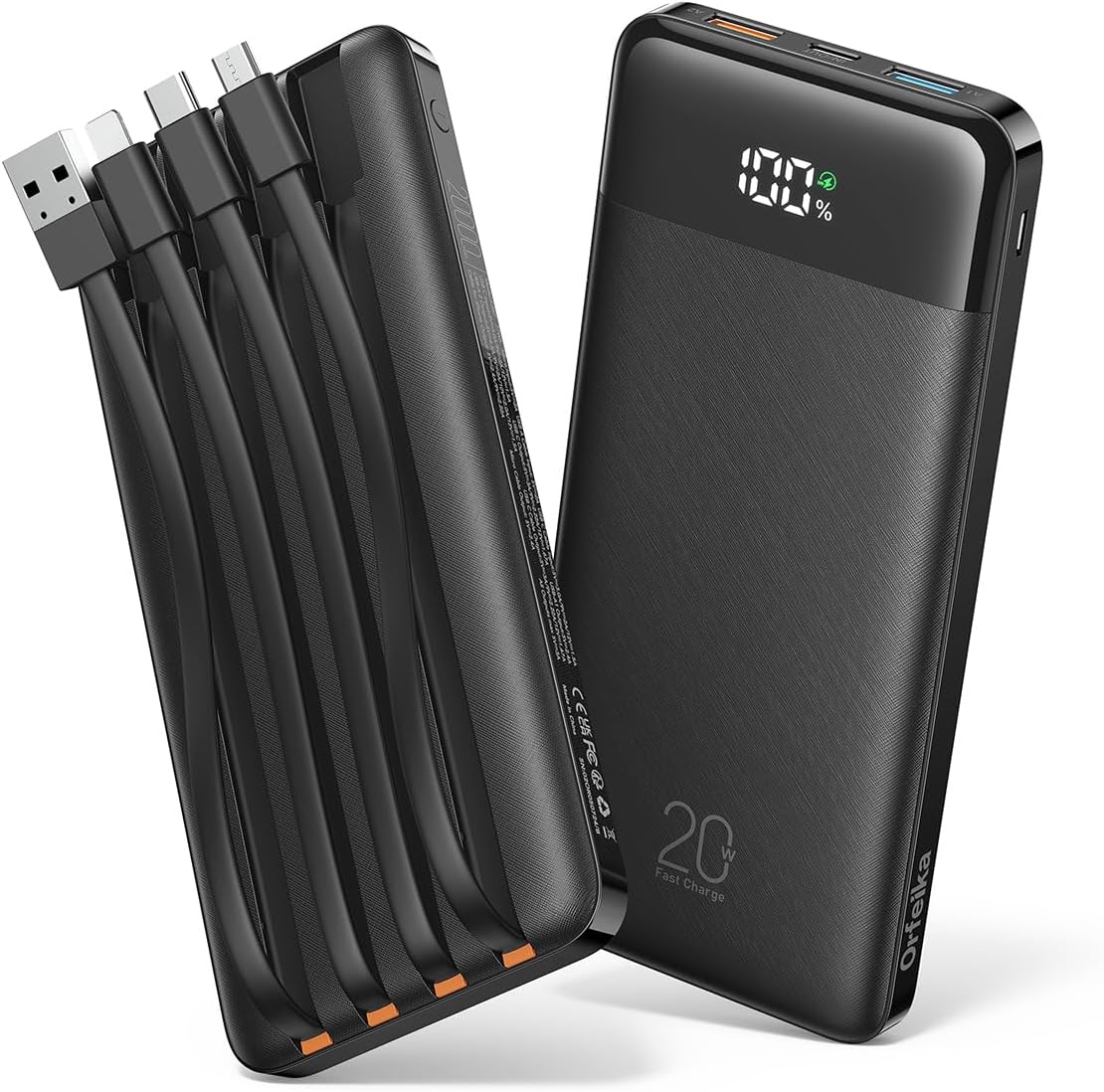
How many devices do you charge at once? A single USB-C port may work for solo use, but families or users with multiple gadgets need more. Look for power banks with multiple USB-C and USB-A ports. Some models, like the Orfeika 20000mAh Power Bank, feature several built-in cables, allowing you to charge up to six devices simultaneously without any extra wires. This makes them excellent companions to a best multi-port USB charger for a complete power setup.
Final Thoughts
Choosing the best portable power bank ultimately depends on balancing capacity, speed, and portability for your specific routine. For the ultimate in travel-friendly, high-speed charging for phones and tablets, the compact INIU Portable Charger, Smaller 45W Fast Charging is a superb choice. Meanwhile, users who need to keep a laptop and multiple other devices running all day will find the high-output Anker Laptop Power Bank, 25,000mAh Travel to be an indispensable powerhouse. Whichever you choose, you’ll gain the invaluable peace of mind that comes with reliable, portable power.
Frequently Asked Questions
Can I bring a portable power bank on a plane?
Yes, you can carry power banks in your carry-on luggage, but there are restrictions. Most airlines follow international regulations limiting lithium-ion batteries in carry-ons to a rating of 100 watt-hours (Wh) or less. All the models in our 2026 roundup that are 27,000mAh or below typically fall under this limit, but always check the specific Wh rating and your airline’s policy before you fly.
How do I know if a power bank is fast charging compatible with my phone?
Your phone and the power bank must support the same fast-charging protocol, such as Power Delivery (PD) for USB-C devices or Quick Charge (QC). Most modern power banks list supported protocols (PD, QC, AFC, etc.) in their specifications. For the fastest results, use a cable rated for the power bank’s maximum output. You can learn more about compatible power sources in our review of the best USB-C wall chargers.
What’s the difference between mAh and Wh?
mAh (milliampere-hour) measures electrical charge capacity, while Wh (watt-hour) measures energy capacity. Wh is a more accurate measure of total stored energy because it accounts for voltage. For airline rules, Wh is the standard measurement. You can often calculate it if not listed: (mAh / 1000) * Voltage = Wh. For example, a 20,000mAh bank at 3.7V has about 74Wh.
Are solar power banks a good alternative?
Solar power banks are excellent for extended off-grid adventures where you have days to recharge via sunlight. However, their panels are generally inefficient for quick top-ups; they primarily serve to slowly recharge the internal battery over many hours. For most users, a traditional high-capacity power bank is more reliable. If you’re interested in solar options, we have a dedicated guide to the best solar power banks.


Write Your Review
No reviews yet. Be the first to share your experience!