

Your laptop battery hits 10% during a critical video call. Your phone dies just as you need directions. A portable power bank transforms these frustrating moments into seamless continuity. With so many options promising high speed and massive capacity, choosing the right one requires careful evaluation.
This guide is for travelers, remote workers, students, and outdoor enthusiasts who need reliable power away from an outlet. We have assessed six top-rated models that balance performance, portability, and smart features, all available at an accessible price point. For those interested in off-grid charging, our review of the best portable batteries with solar charging offers further insights.
How to Choose Your Ideal Power Bank
Capacity and Real-World Usage
Capacity, measured in milliampere-hours (mAh) or watt-hours (Wh), dictates how many charges you get. A 25,000mAh bank can recharge a smartphone four to five times, while a 10,000mAh unit is perfect for two top-ups. Consider your daily device drain and trip duration.
Remember, airlines typically limit carry-on power banks to 100Wh. Most high-capacity models, like those reviewed, stay under this limit for worry-free travel. For a visual check on remaining power, models with a digital display, similar to those in our guide on the best portable chargers with digital display, are incredibly useful.
Output Power and Charging Speed
Output wattage determines how fast your devices charge. Laptops often require 65W to 100W for effective fast charging. Smartphones can use 20W to 30W. Look for Power Delivery (PD) technology, which negotiates the optimal speed with your device.
Total output matters if you charge multiple gadgets simultaneously. A bank with 140W+ total output can power a laptop and a phone at full speed without slowdown. This is essential for professionals on the go. For more on rapid charging, see our related post on the best portable chargers with fast charging.
Port Selection and Convenience Features
<!–The right mix of ports future-proofs your purchase. USB-C is now the standard for laptops and phones. USB-A ports support older cables. Some advanced stations even include AC outlets for devices like small fans or CPAP machines.
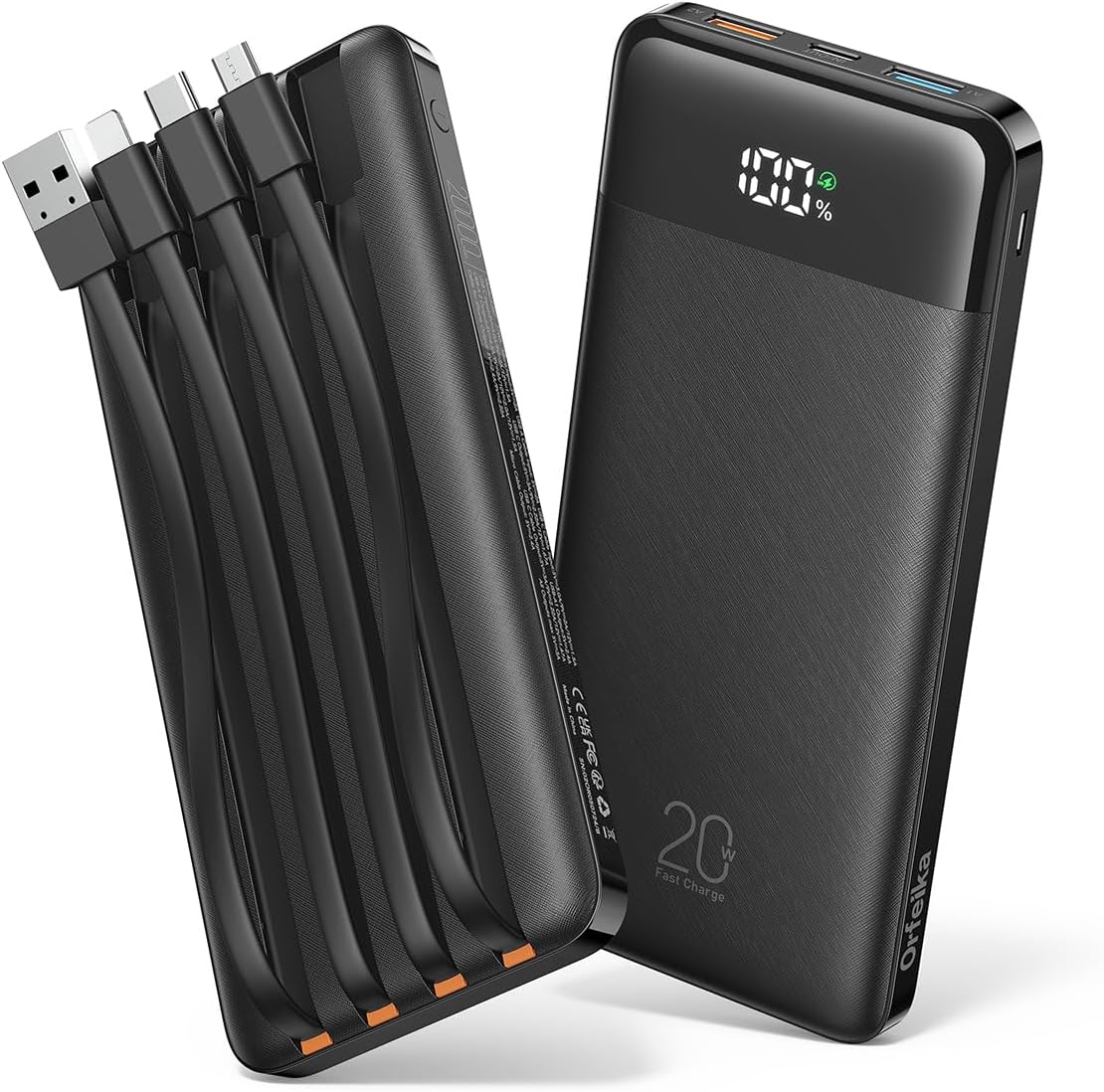
Convenience features reduce cable clutter. Built-in cables, magnetic attachment for phones, and detachable straps that double as charging cables make life easier. These integrated solutions, highlighted in our roundup of the best power banks with Built-In cables, are perfect for minimalist packers.
Build Quality and Battery Health
A power bank is a long-term investment. Look for durable materials that can withstand being tossed in a bag. More importantly, consider the battery chemistry. LiFePO4 batteries, found in some stations, offer thousands of charge cycles, far outlasting standard lithium-ion.
Safety certifications from organizations like UL or CE are non-negotiable. They confirm the product has passed rigorous evaluations for overcharge, short-circuit, and temperature protection. A robust build ensures your devices and your safety are never compromised.
Final Thoughts
After evaluating the field, your choice ultimately depends on your primary use case. For users who need to keep a professional workflow alive, the JUOVI 187W Portable Charger for Laptop Power Bank delivers exceptional speed and simultaneous charging in a travel-friendly package. Conversely, if your adventures take you off-grid or you need to power small appliances, the versatile Daran Portable Power Station 89.6Wh LiFePO4 with its AC outlets and robust battery life is an outstanding companion. Whichever model you select, you are investing in freedom from battery anxiety.
Frequently Asked Questions
Can I take a 25000mAh power bank on a plane?
Yes, in most cases. Airlines regulate power banks by their watt-hour (Wh) rating, not just mAh. A 25000mAh power bank at a standard 3.7V has about 92.5Wh, which is under the common 100Wh carry-on limit. Always check the product specifications and your airline’s policy before travel.
What is the difference between a power bank and a portable power station?
Power banks are typically smaller, designed for phones, tablets, and sometimes laptops via USB ports. Portable power stations are larger, have higher capacity, and often include AC outlets to run household electronics, making them suitable for camping, tailgating, or emergency home backup.
How do I know if a power bank is fast charging my device?
The power bank and your device must support the same fast-charging protocol, like USB Power Delivery (PD) or Qualcomm Quick Charge (QC). Using a compatible cable is also crucial. Many modern power banks have displays that show the current output wattage, confirming a fast-charge session is active.
How long do power banks typically last?
Battery lifespan is measured in charge cycles. A quality power bank can retain over 80% of its original capacity after 500 to 1000 full cycles. Using LiFePO4 battery chemistry, as seen in some models for 2026, can extend this to 3000+ cycles, offering significantly longer service life.


Write Your Review
No reviews yet. Be the first to share your experience!