

Picture this: you’re rushing to catch a flight, and your phone battery is dipping into the red. You scramble through your bag, only to realize you left your charging cable on the kitchen counter. This common frustration is precisely why power banks with built-in cables have become a game-changer. They combine the convenience of a portable battery with the essential cords you need, all in one sleek package.
This guide is for anyone who values simplicity and reliability in their tech accessories. Whether you’re a frequent traveler, a busy professional, or someone who just wants to declutter their bag, we have reviewed several top models to help you make an informed choice. For those who prioritize pure speed, you might also explore our roundup of the best portable chargers with fast charging.
Buying Guide: How to Choose Your Ideal Built-in Cable Power Bank
Capacity and Portability Balance
The capacity, measured in milliampere-hours (mAh), determines how many times you can recharge your devices. A 10,000mAh bank is great for a day out, while a 20,000mAh unit is ideal for weekend trips. Remember, higher capacity often means more weight. Consider how much bulk you’re willing to carry in exchange for more power.
For example, some models manage to pack substantial capacity into a remarkably slim profile. If you need a high-capacity option that remains travel-friendly, our list of the best power banks under $100 includes several excellent high-mAh choices.
Cable Types and Device Compatibility
Check which cables are permanently attached. The most versatile power banks include both USB-C and Lightning cables, covering most modern smartphones and tablets. Some even add a Micro-USB cable for older gadgets or accessories like Bluetooth headphones. Ensure the built-in options match your primary devices.
This built-in approach eliminates the single point of failure of a separate, losable cable. It’s a seamless solution that guarantees you always have the right connector on hand, a key advantage over standard power banks with USB-C that still require you to bring your own wire.
Charging Speed and Output Power
Look for fast-charging protocols like Power Delivery (PD) or Quick Charge. The output wattage (e.g., 20W, 65W) indicates how quickly the bank can charge your devices. Higher wattage is crucial for quickly topping up a smartphone or even charging a laptop. The built-in cable should support these fast-charging speeds.
A power bank that slowly trickle-charges defeats the purpose of portability. You want a unit that can deliver a meaningful power boost during a short layover or coffee break. This makes the charging speed a critical factor in your overall satisfaction with the product.
Additional Ports and Simultaneous Charging
Even with built-in cables, extra USB ports are incredibly valuable. They allow you to charge additional devices or let friends plug in their own cables. Some models can charge three or four devices at once, making them perfect for family trips or group outings. This flexibility turns one power bank into a central charging hub.
This feature is especially useful if you carry multiple gadgets, such as a phone, smartwatch, and wireless earbuds. You can find compact yet powerful options suitable for this multi-device lifestyle in our selection of best portable chargers under $50.
Final Thoughts
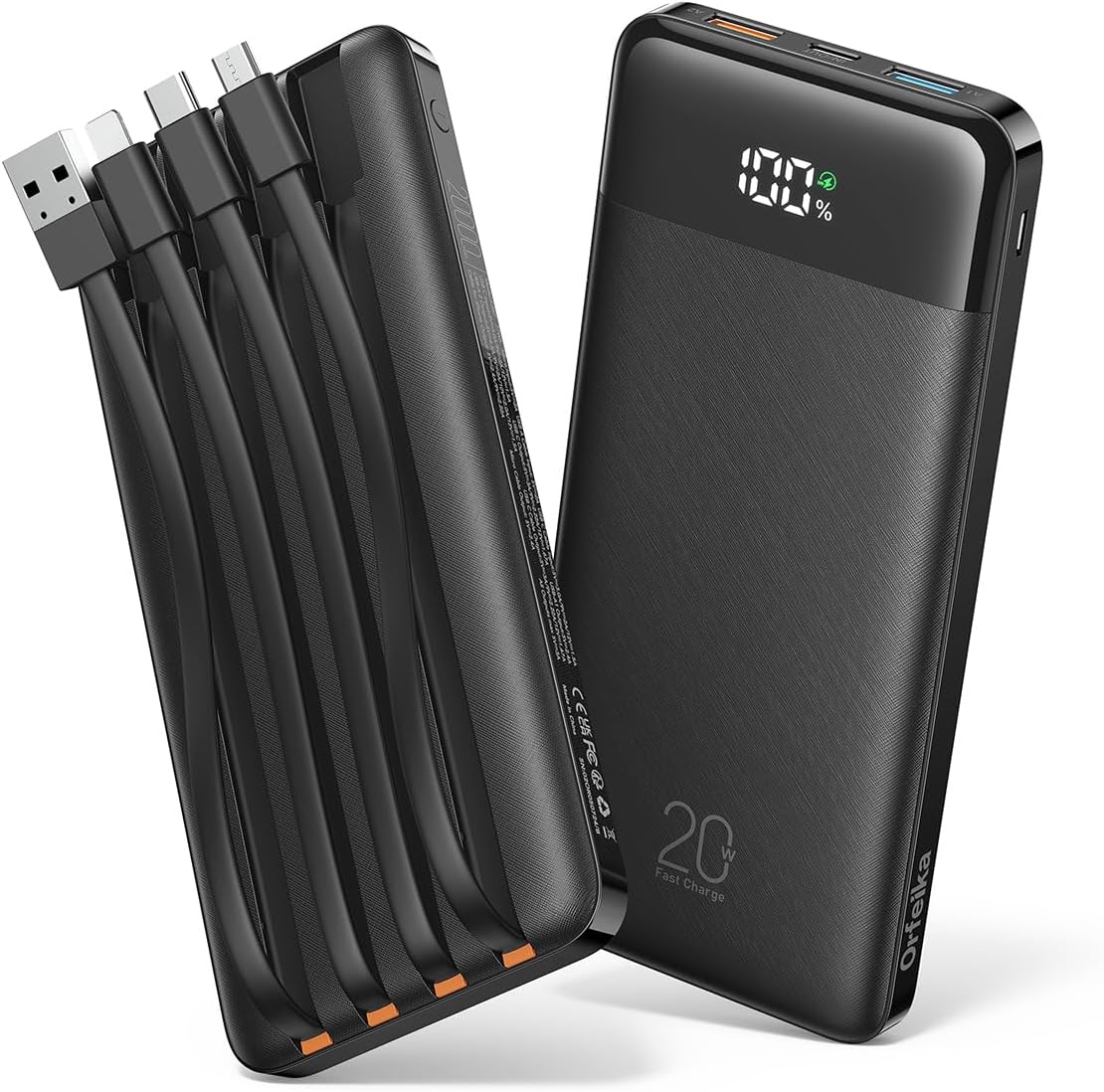
Choosing a power bank with integrated cables is a smart move toward a more organized and reliable mobile power solution. For users who need maximum versatility and high-speed charging for multiple devices, the Orfeika 20000mAh Power Bank stands out as a robust choice. If your priority is a premium, high-power option capable of charging laptops, the Anker Power Bank, 20,000mAh Travel Essential is a top-tier investment. You can explore more options in this category on our main Chargers & Batteries page.
Frequently Asked Questions
Are power banks with built-in cables allowed on airplanes?
Yes, most power banks are permitted in carry-on luggage. The key regulation concerns the battery’s watt-hour (Wh) rating. Units under 100Wh, which includes most models under 27,000mAh, are generally approved by airlines. Always check your specific airline’s policy before you travel.
What happens if the built-in cable breaks?
This is a common concern. Fortunately, these integrated cables are designed for durability, often rated for thousands of bends. If a cable does fail, many models also include standard USB output ports, so you can still use the power bank with a separate cable. The product’s warranty would also cover manufacturing defects.
Can I charge the power bank and my phone at the same time?
Absolutely. This feature is called pass-through charging. It allows you to plug the power bank into a wall outlet to recharge its internal battery while simultaneously using its outputs to charge your devices. Not all power banks support this, so it’s a valuable feature to look for if you want to use it as a desktop charging station.
How do I know which capacity is right for me?
A good rule of thumb is to match the power bank’s capacity to your device’s battery. A 10,000mAh bank can fully charge a modern smartphone about two to three times. For longer trips or if you need to charge tablets or multiple devices, a 20,000mAh capacity is a more future-proof choice that will serve you well through 2026 and beyond.


Write Your Review
No reviews yet. Be the first to share your experience!