
You have a condenser microphone ready and a guitar tuned. Your podcast concept is solid, or your song idea is begging to be recorded. Yet, the sound reaching your computer feels thin, lacking the depth and clarity you envisioned. The barrier often isn’t your talent or gear, but the gateway itself: your audio interface.
This guide is for creators seeking professional fidelity without studio complexity. We have assessed the leading 24-bit/192kHz audio interfaces, examining their preamps, connectivity, and real-world performance. Whether you are a musician, podcaster, or streamer, find the perfect hub to transform your raw audio into studio-quality recordings.

Pros
- Exceptional sound quality and low noise floor that rivals interfaces costing significantly more
- Intuitive controls and layout make it accessible for beginners while offering professional features for experienced users
- Solid build quality with secure connections that won't loosen during transport or use
- Versatile I/O configuration supports multiple recording scenarios without needing additional equipment
- Seamless compatibility with popular recording software, DAWs, and streaming platforms
Cons
- Slightly bulkier and heavier than some competing portable interfaces, which may impact true mobile convenience
- GarageBand users may experience stereo recording limitations and need to work around single-channel or mono recording
The BlueAVS AR013 is a professional 2-in/4-out USB audio interface designed for musicians, podcasters, streamers, and content creators who demand studio-quality sound without unnecessary complexity. It bridges the gap between budget-friendly and high-end interfaces, offering genuine professional features at an affordable price point that makes it accessible to home studios and mobile recording setups.
The standout feature is its combination of 24-bit/192kHz recording capability with an impressive 103dB dynamic range and ultra-low distortion (THD+N below 0.003%). Real-world testing confirms this translates to clean, detailed recordings suitable for music production and podcasting. The zero-latency monitoring system with four modes allows performers to hear themselves in real time without distracting delay, while dual XLR/TRS combo inputs and 48V phantom power support both condenser microphones and dynamic instruments. PAD switches protect against clipping from powerful vocal performances and high-output gear.
Build quality impresses for the price, with solid connections, an angled compact design that fits naturally on desks, and balanced TRS outputs that ensure clean monitoring through studio speakers or headphones. Setup is genuinely plug-and-play for most users, with instant compatibility across Mac, Windows, and major DAWs including Logic Pro, Cubase, Reaper, and Ableton Live. The included USB-A to USB-C cable and comprehensive manual make getting started straightforward.
Minor drawbacks include a slightly larger footprint compared to some ultra-portable competitors, and GarageBand users may encounter stereo recording limitations requiring workarounds like mono recording. These are minor considerations that don't significantly impact the overall value proposition for most use cases.
The BlueAVS AR013 represents exceptional value for anyone building a home studio, upgrading from USB microphones, or seeking a reliable portable interface for streaming and content creation. Its professional sound quality, intuitive operation, and versatile I/O make it a smart investment that performs well beyond its price category.
I/O Configuration: 2 XLR/TRS combo inputs, 4 balanced TRS outputs, 2 headphone outputs
Audio Quality: 24-bit/192kHz maximum sample rate, 103dB dynamic range, THD+N less than 0.003%, 20Hz-20kHz frequency response
Connectivity: USB-C (USB 2.0), includes USB-A to USB-C adapter cable
Features: 48V phantom power, PAD switches, zero-latency monitoring with 4 modes, instrument/line toggle buttons, independent volume controls
Compatibility: Windows, macOS, iOS, Android, Linux. Works with Logic Pro, Cubase, Ableton Live, Reaper, Studio One, GarageBand, OBS Studio, Streamlabs, Zoom, and Audacity
Physical: 8.5 inches deep x 3.9 inches wide x 2.4 inches high, 1.3 pounds
Warranty: 1-year manufacturer's warranty covering original defects
Ideal For: Home studio builders, podcasters upgrading from USB mics, musicians recording guitars and vocals, streamers seeking professional audio quality, content creators using OBS or Streamlabs, and anyone wanting studio-quality sound without a steep learning curve.
Experience Level: Beginners will appreciate the straightforward layout and plug-and-play setup, while experienced producers will value the professional-grade specs and monitoring flexibility. No special technical knowledge required to get started recording immediately.
Use Cases: Music production, podcast recording, guitar and instrument tracking, vocal recording, live streaming, YouTube content creation, and mobile recording sessions. The dual inputs make it perfect for recording acoustic instruments and vocals simultaneously.
Not Ideal For: Users requiring more than 2 simultaneous inputs or those needing ADAT expansion for large mixing studios. Also may be overkill if you only need a single USB microphone input.
Pros
- Exceptional audio quality with studio-grade converters and 192kHz sample rate capability
- Intelligent recording features like Auto Gain and Clip Safe eliminate guesswork and failed takes
- Air mode adds musical presence and harmonic richness to vocals and guitars
- Included software suite provides professional recording, production, and mastering tools immediately
- Reliable performance with zero driver issues reported in customer reviews
Cons
- Requires high-impedance headphones for optimal headphone output performance, limiting some accessory choices
- Some gaming and specialized software can cause driver crashes requiring system restart
- Learning curve involved in configuring MIDI and audio routing within DAW software
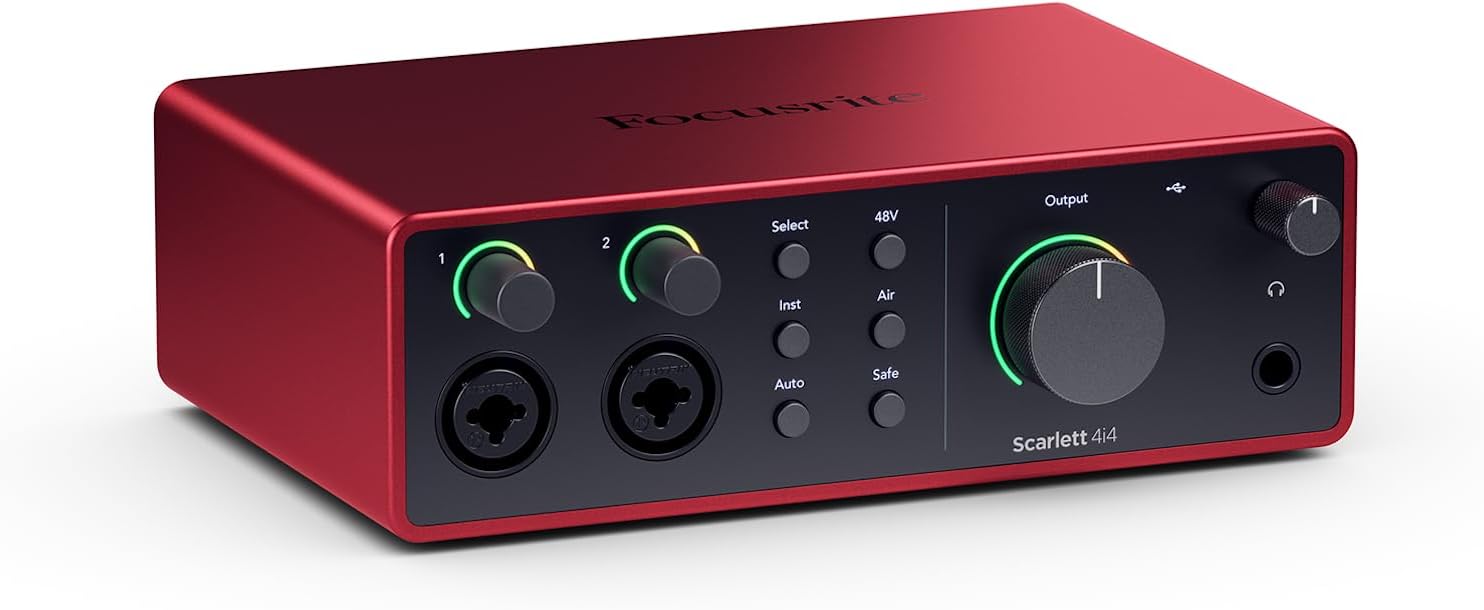
The Focusrite Scarlett 4i4 4th Gen is a professional audio interface designed for musicians, producers, podcasters, and content creators who need reliable, studio-quality sound capture. This USB-C interface combines professional-grade audio converters with intelligent recording features that make it accessible to beginners while satisfying experienced engineers.
The standout feature is the dual ultra-low-noise Scarlett 4th Gen mic preamps paired with studio-grade converters boasting a massive 120dB dynamic range, matching equipment found in the world's biggest recording studios. The innovative Air mode adds musical presence and harmonic richness to vocals and guitars, while Auto Gain and Clip Safe features automatically set perfect recording levels and prevent clipping, meaning you capture keeper takes without obsessing over gain staging.
Build quality is solid and compact, measuring just 7.09 inches wide and weighing 2.2 pounds, making it portable for mobile recording setups. The interface offers versatile I/O with 2 Hi-Z instrument inputs for guitars and synths, 4 line inputs, 4 line outputs, and MIDI I/O to accommodate any recording scenario. USB-C connectivity delivers low-latency performance critical for streaming and real-time monitoring.
The included software bundle is exceptional value, featuring Pro Tools Intro+, Ableton Live Lite, Cubase LE, and the Hitmaker Expansion with professional plugins from XLN Audio, Softube, and Native Instruments. Some users report occasional driver crashes with certain gaming software, though this appears rare and resolved with system restart.
The Scarlett 4i4 4th Gen delivers professional audio quality and intelligent features at a mid-range price point, backed by a 3-year warranty and round-the-clock support. Whether you're recording music, podcasts, or content, this interface provides the tools and sound quality to produce broadcast-ready results.
Audio Performance: 120dB dynamic range, 24-bit/192kHz maximum sample rate, 20kHz frequency response. Dual ultra-low-noise Scarlett 4th Gen mic preamps with Air mode.
I/O Configuration: 2 Scarlett 4th Gen mic preamps, 2 Hi-Z instrument inputs, 4 line inputs, 4 line outputs, MIDI In/Out, headphone output with high-impedance support.
Connectivity: USB-C with included USB-C to USB-A adaptor and 5V 3A power supply. Compatible with Mac OS, Windows OS, and iOS.
Physical Specs: 7.09 inches wide x 5.08 inches deep x 2.32 inches tall, 2.2 pounds. Includes USB-C cable and power supply.
Software Included: Pro Tools Intro+, Ableton Live Lite, Cubase LE, Hitmaker Expansion with premium plugins and virtual instruments.
Best For: Musicians recording guitars, vocals, and keyboards; music producers and beat makers; podcasters and content creators; streamers needing low-latency monitoring; anyone upgrading from budget interfaces who wants professional sound quality.
Consider If You: Need versatile I/O for multiple instruments and MIDI devices simultaneously; want included professional software to start producing immediately; require reliable, crash-free performance for critical recording sessions; value portability and compact design; prefer established brands with excellent customer support.
May Not Be Ideal If: You need more than 2 mic inputs simultaneously; you work exclusively with gaming software that has driver compatibility issues; you require XLR outputs instead of line-level outputs; budget is below $250.

Pros
- MIDAS preamps deliver clean, low-noise signal path comparable to much more expensive interfaces
- Intuitive plug-and-play setup with minimal driver hassle on both Mac and Windows systems
- Robust build quality and metal construction designed to withstand years of studio use
- Four simultaneous inputs and outputs provide flexibility for multi-track recording and live streaming
- Outstanding value proposition offering professional-grade specs at entry-level pricing
Cons
- Some users report occasional driver compatibility issues on certain Windows OS versions
- MIDI functionality may require additional configuration compared to audio I/O setup
- Limited customer support documentation compared to higher-end competitors
The Behringer U-PHORIA UMC404HD is a compact 4x4 USB audio interface engineered for home studio owners, podcasters, content creators, and mobile recording professionals. It delivers professional-grade audio quality at a price point that makes it accessible to anyone serious about recording but budget-conscious. The interface has earned respect from experienced audio engineers and casual users alike for punching well above its price class.
The standout feature is the inclusion of four MIDAS-designed mic preamps with +48V phantom power, which typically appear only on interfaces costing two to three times as much. Users consistently praise the clean, low-noise signal path and the ability to capture vocals and instruments with clarity and detail. The 24-bit/192 kHz resolution ensures future-proof audio quality, while ultra-low latency streaming supports real-time monitoring during recording sessions. Compatibility with Pro Tools, Ableton Live, Cubase, and other major DAWs means you can integrate it into virtually any existing workflow.
Build quality reflects Behringer's partnership with MIDAS and acquisition of Music Tribe assets. The metal chassis feels solid and impact-resistant, designed to handle the rigors of studio use and travel. The interface is compact at just 11.5 inches wide, making it ideal for portable recording setups or tight desk spaces. Balanced XLR and 1/4-inch outputs ensure professional connectivity to studio monitors and mixing equipment.
The main drawbacks involve driver setup on certain Windows systems and MIDI configuration, which some users find less intuitive than audio I/O setup. A small percentage of users report compatibility issues, though this appears to be system-specific rather than a widespread product defect. Driver support for Mac OS is notably streamlined, with native OS integration requiring minimal configuration.
The Behringer UMC404HD represents genuine value in the audio interface market. It combines professional-grade components, solid engineering, and proven reliability at a price that makes it the obvious choice for anyone building a home studio or upgrading from entry-level equipment. Experienced audio professionals and beginners alike will find it a capable, dependable tool that won't compromise recording quality.
Audio Specifications: 24-bit/192 kHz resolution, 10 Hz to 43 kHz frequency response (0/+0.3 dB). Maximum input levels: Microphone -4 dBu, Line +20 dBu, Instrument -3 dBu. Four MIDAS-designed mic preamps with +48V phantom power.
Connectivity: USB 2.0 interface with 4 inputs/4 outputs plus 1x MIDI I/O. Balanced XLR and 1/4-inch TRS connectors for main outputs. Supports both Mac OS X and Windows XP or higher.
Compatibility: Works with Avid Pro Tools, Ableton Live, Steinberg Cubase, Reaper, Audacity, and other major DAWs. Native driver support for Mac OS, simple driver installation for Windows.
Physical Dimensions: 11.5 inches D x 5.12 inches W x 1.81 inches H. Weight: 2.7 pounds. Rugged metal chassis with impact-resistant construction.
Ideal For: Home studio owners, podcasters, content creators, musicians recording at home, audio engineers on a budget, and anyone upgrading from entry-level USB interfaces. Perfect for mobile recording setups and professional use in tight spaces.
Experience Level: Suitable for beginners through advanced users. The plug-and-play setup welcomes newcomers, while the professional-grade preamps and specifications satisfy experienced engineers.
Use Cases: Music production and multi-track recording, podcast and voiceover recording, live streaming with high-quality audio, instrument recording, vocal tracking, and field recording with a portable setup.

Pros
- Professional 24-bit/192kHz audio resolution rivals interfaces costing significantly more
- Plug-and-play setup with USB-C connectivity requires no complex configuration or drivers
- Included software bundle provides immediate production tools worth hundreds of dollars separately
- Compact footprint makes it perfect for portable recording and travel-friendly setups
- Versatile connectivity supports both XLR microphone inputs and 1/4 inch instrument inputs
Cons
- Limited to 2 inputs and 2 outputs, which may feel restrictive for multi-track recording sessions
- No physical monitoring level knobs on the interface itself, requiring software adjustments
- Requires external powered USB hub for some Android devices and older computers
The M-Track Duo HD is a USB-C audio interface designed for aspiring producers, podcasters, and bedroom musicians who need professional recording quality without unnecessary complexity. This compact unit strips away extraneous features and focuses on delivering the essentials: clean audio capture, reliable connectivity, and straightforward operation that works across Mac, PC, iOS, and Android platforms.
Where this interface truly shines is in its audio specifications. The 24-bit/192kHz resolution captures every nuance of your performance, while the Crystal preamps deliver a solid 55dB of gain with minimal noise. Zero-latency monitoring means you hear yourself instantly without the distracting delays that plague budget interfaces, making it suitable for both overdubbing vocals and recording live instruments. The switchable 48V phantom power supports condenser microphones, expanding your microphone options significantly.
Build quality is solid and practical. The rugged aluminum enclosure feels durable enough for studio and portable use, and the compact 7.5 by 4.4 inch footprint fits comfortably into any recording setup or gig bag. The included USB-C cable provides direct connectivity to modern computers and devices, though you can also use an externally powered USB hub for flexibility. The two combo inputs accommodate microphones, guitars, bass, and line-level sources, covering most common recording scenarios.
The main limitation is the 2-in/2-out configuration, which restricts simultaneous recording to two tracks. Additionally, monitoring level control happens entirely through software rather than dedicated hardware knobs. Some Android users may need an external powered USB hub for stable operation, adding a small additional expense.
The M-Track Duo HD represents exceptional value for the price, especially when factoring in the included Ableton Live Lite, MPC Beats, and Splice subscription. It's an excellent entry point into music production and podcast recording that delivers professional results without overwhelming beginners with unnecessary features.
Connectivity: USB Type-C, Headphone Output 1/4 inch TRS, Instrument Input Unbalanced 1/4 inch TS, Line Input Balanced 1/4 inch TRS, Main Outputs L and R Impedance Balanced 1/4 inch TRS, Mic Input Balanced XLR
Audio Performance: 24-bit/192kHz maximum sample rate, 20Hz frequency response, 1 megaohm impedance, Crystal preamps with 55dB gain, switchable 48V phantom power
Channels: 2 inputs and 2 outputs
Physical: 7.5 inch W x 4.4 inch D x 2.1 inch H, 0.47 kg weight, compact rugged enclosure
Compatibility: Windows, macOS, iOS, and Android operating systems
Included Software: Ableton Live Lite, Akai Professional MPC Beats, 2-month Splice subscription
Warranty: 1 year manufacturer warranty
Best For: The M-Track Duo HD is ideal for bedroom producers starting their music production journey, podcasters looking to upgrade from built-in microphones, session musicians recording demos, and content creators needing reliable audio capture for live streams or videos.
Consider If: You need more than 2 simultaneous inputs, require extensive hardware controls without software interaction, or plan to record complex multi-track arrangements with many overdubs. For these scenarios, a larger interface like the M-Track Quad might better suit your needs.
Setup Tips: Use the included USB-C cable for direct connection to modern computers. If using older devices or experiencing stability issues, connect through an externally powered USB hub. Enable phantom power only when using condenser microphones to avoid unnecessary power drain and potential noise.
Software Integration: The included Ableton Live Lite integrates seamlessly with the M-Track Duo HD for immediate production capability. The 2-month Splice subscription provides access to professional samples and loops used by top producers, helping accelerate your learning and creative process.

Pros
- Professional audio quality at an affordable price point, delivering 24-bit/192kHz resolution comparable to interfaces costing twice as much
- Versatile connectivity with both XLR and instrument inputs plus headphone monitoring allows handling multiple audio sources and use cases
- Included ProStudio software and ASIO driver support unlock advanced routing and low-latency capabilities for serious streamers and producers
- Genuinely portable and compact design with intuitive controls makes it practical for home studios, mobile setups, and travel
- Strong cross-platform compatibility and DAW support ensure this interface works with virtually any modern recording or streaming software
Cons
- Limited to 2 channels, restricting simultaneous recording of multiple instruments or complex multi-track setups without additional gear
- Phantom power and preamp features depend on proper driver installation and software configuration, which may challenge complete beginners
- No built-in effects or processing, requiring external plugins or software for audio enhancement beyond basic routing and monitoring
The MAONO PS22 Lite is a compact USB audio interface designed for recording enthusiasts, podcasters, guitarists, and content creators who demand professional sound quality without the complexity or expense of larger systems. This device punches well above its weight, offering studio-grade specifications in a palm-sized form factor that fits any creative workspace.
The standout feature is undoubtedly the 24-bit/192kHz recording capability paired with a 106dB dynamic range, ensuring every nuance of your performance is captured with clarity and depth. The dual-input design handles both XLR microphones (with 56dB preamp gain and 48V phantom power) and guitar or line-level instruments, making it genuinely versatile for mixed creative work. The included ProStudio Routing Software with ASIO driver support opens possibilities for live streamers, enabling virtual channels and loopbacks for complex broadcast scenarios without latency issues.
Build quality reflects the premium positioning, with an ergonomic design featuring a dynamic light ring that indicates input status and a side-mounted headphone jack reducing cable clutter. The intuitive preset modes for recording, live broadcast, and instruments mean switching between creative tasks takes seconds, while the plug-and-play functionality works across Mac, Windows, and iPad platforms. Direct monitoring provides real-time audio feedback essential for getting performances right on the first take.
The primary limitation is the 2-channel configuration, which restricts simultaneous multi-track recording unless you're layering overdubs. Additionally, while the interface excels at capture and routing, it lacks onboard effects or processing, meaning you'll rely on software plugins for audio enhancement. Setup requires proper driver installation and software configuration, which may initially challenge absolute beginners despite the intuitive interface design.
The MAONO PS22 Lite delivers exceptional value for podcasters, guitarists, vocalists, and streamers seeking professional audio quality in a portable, user-friendly package. Its combination of high-resolution recording, versatile inputs, advanced routing software, and cross-platform compatibility makes it a smart investment for anyone serious about audio production without the premium price tag.
Audio Quality: 24-bit/192kHz recording resolution with 106dB dynamic range for professional-grade sound capture.
Inputs: 1 XLR input for microphones with 56dB preamp gain and 48V phantom power, 1 dedicated instrument input with impedance adjustment for guitars and line-level sources.
Connectivity: USB connection with included USB-A/USB-C to USB-C cable. Plug-and-play compatibility with Mac, Windows, and iPad.
Channels: 2-channel interface for stereo recording and monitoring.
Software Support: ASIO drivers, ProStudio Routing Software included. Compatible with Avid Pro Tools, Ableton Live, Logic Pro, Cubase, GarageBand, FL Studio, Studio One, plus streaming platforms like OBS, Twitch, YouTube, TikTok, and Discord.
Design: Compact palm-sized form factor with dynamic light ring indicator, ergonomic construction, and side-mounted headphone monitoring jack.
Best For: Podcasters and voice actors seeking warm, clear vocals with minimal noise. Guitarists and musicians recording demos or full productions. Content creators streaming to Twitch, YouTube, or TikTok. Home studio builders wanting professional results on a budget. Anyone transitioning from built-in computer audio to proper recording equipment.
Consider This If: You need simultaneous recording of multiple instruments, look elsewhere for 4+ channel interfaces. You want onboard effects and processing, you'll need to budget for software plugins. You're a complete beginner, allow time to learn driver installation and basic DAW setup.
Why Choose PS22 Lite Over Alternatives: The combination of 24-bit/192kHz recording, dual-input versatility, included ProStudio software, and compact design offers exceptional value. Many competitors at this price lack phantom power or advanced routing capabilities. The cross-platform compatibility and extensive DAW support ensure future-proof investment.

Pros
- Exceptional value for money, delivering professional audio specs at under $30
- Intuitive controls and zero-latency monitoring make it accessible for beginners and professionals alike
- Versatile connectivity supports everything from condenser mics to guitars with independent gain adjustment
- Compact and portable design ideal for home studios, mobile recording, and on-location work
- No driver installation required, works immediately across multiple operating systems and devices
Cons
- Quality control issues reported by some users, including missing buttons on certain units
- May require additional power solutions for certain Android devices lacking full OTG compliance
- Limited to 2x2 channel configuration, not suitable for multi-track recording setups
The Jolgoo 2x2 USB audio interface is a compact recording solution designed for musicians, podcasters, content creators, and home studio enthusiasts who demand professional audio quality without breaking the bank. This budget-friendly interface packs studio-grade specifications into a portable form factor, making it an accessible entry point for anyone serious about audio recording.
The standout feature is undoubtedly the zero-latency direct monitoring capability, which allows performers to hear themselves in real-time without distracting delay. Combined with 24-bit/192kHz audio conversion, users consistently report capturing crystal-clear vocals, acoustic instruments, and podcast audio with impressive clarity. The 48V phantom power support means you can connect professional condenser microphones, elevating your recording quality significantly. Independent gain controls and LED peak indicators help prevent clipping, giving you precise control over input levels.
Build quality is solid with a sturdy metal housing designed to shield against interference. The interface includes dedicated headphone monitoring, stereo line outputs for studio monitors, and both USB-C and USB-A cable options. Its compact size makes it equally at home on a desktop or packed into a mobile recording rig. Setup is genuinely plug-and-play across Windows, macOS, iOS, and Android devices, with full compatibility for major DAWs like Pro Tools, Ableton, and GarageBand.
Some users have reported quality control concerns, including missing buttons on certain units, which is disappointing at any price point. Additionally, some Android devices may require a power bank due to OTG compliance variations. The 2x2 channel configuration also limits it to stereo recording, which is fine for most solo recording scenarios but won't support multi-track setups.
The Jolgoo 2x2 delivers impressive value for budget-conscious recordists. It successfully bridges the gap between toy interfaces and expensive professional gear, making professional-quality recording accessible to everyone. Recommended for beginners exploring audio production, podcasters seeking portable solutions, and musicians wanting reliable recording without premium pricing.
Audio Specifications: 24-bit resolution, 192kHz maximum sample rate, 2x2 channel configuration, XLR/line combo inputs with independent gain control, 48V phantom power support, zero-latency direct monitoring.
Connectivity: USB connection, includes both USB-C and USB-A cables, compatible with Windows, macOS, iOS, and Android devices. Headphone monitoring output and stereo line outputs for studio monitors.
Compatibility: Works with Avid Pro Tools, Ableton Live, Steinberg Cubase, GarageBand, Audacity, and other mainstream DAWs. Driver-free operation for immediate plug-and-play setup.
Physical: Rugged metal construction for durability and interference shielding, weighs 0.81 kg, compact design suitable for desktop and mobile recording. Includes 12-month manufacturer warranty.
Best For: Home studio recording, podcasting, voiceover work, singer-songwriter demos, and anyone transitioning from smartphone recording to dedicated audio equipment. Excellent for beginners learning audio production fundamentals.
Consider This If: You need professional audio quality on a tight budget, require portable recording capabilities, or want to upgrade from built-in computer audio. The phantom power support makes it particularly valuable if you plan to invest in quality microphones.
Not Ideal For: Professional multi-track recording sessions requiring more than 2 channels, or users requiring extensive technical support. Quality control issues suggest checking your unit carefully upon arrival.
Power Considerations: USB-powered design eliminates need for external power supplies. Note that some Android devices may not provide sufficient power via OTG, in which case a powered USB hub or power bank solves the issue.
Pros
- Excellent value for professional-grade recording specifications at this price
- Universal compatibility with multiple devices and operating systems
- Low-latency monitoring keeps you in sync without audio delay during recording
- Sturdy metal construction with all essential connectivity ports included
- Works with industry-standard DAW software and audio applications
Cons
- Very limited user reviews available, making real-world reliability difficult to assess
- macOS compatibility may require system reformatting on some configurations
- No built-in audio effects or software bundle included with purchase
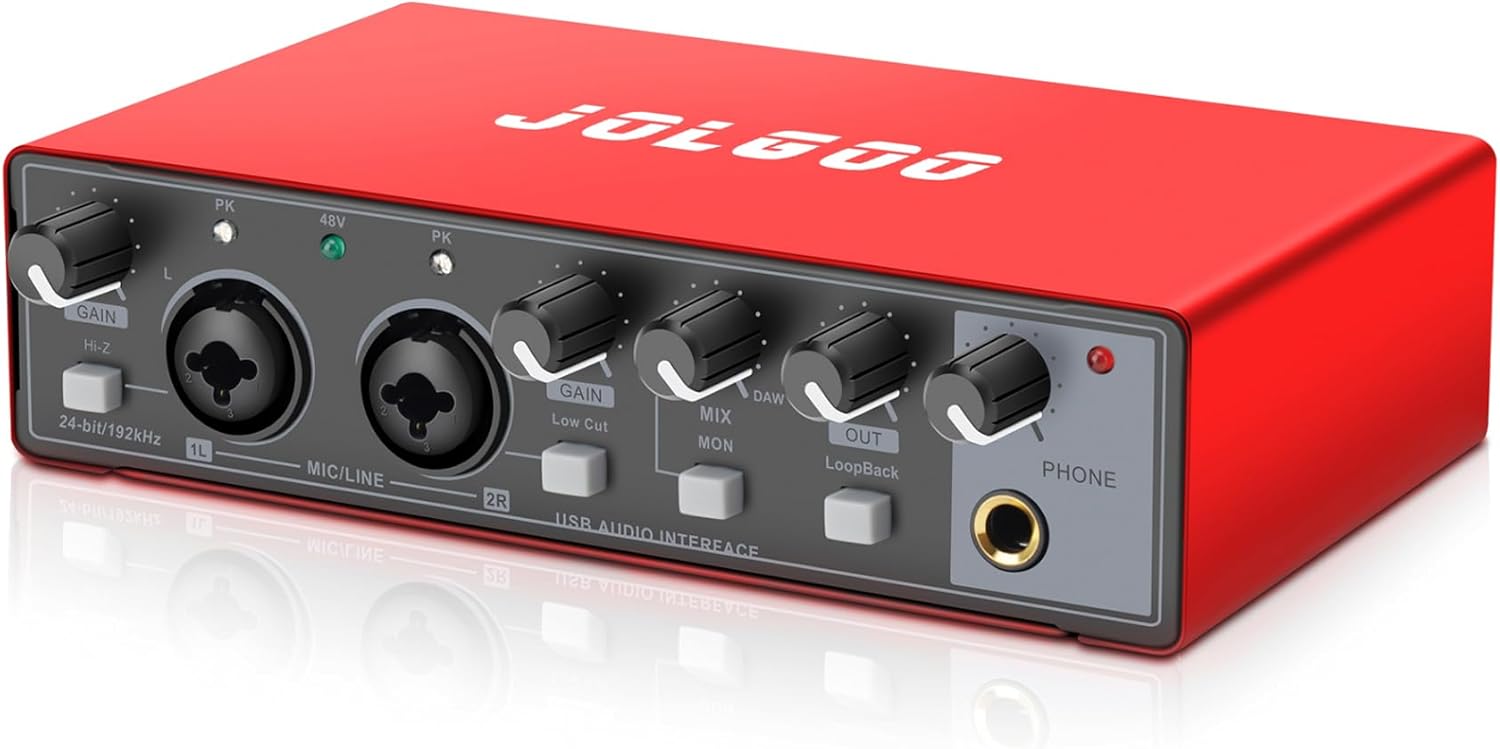
The JOLGOO USB audio interface is a compact recording solution designed for home studios, independent musicians, podcasters, and content creators who need professional audio quality without the complexity. This plug-and-play device eliminates driver installation headaches and works immediately with Windows, macOS, and popular DAW software like Pro Tools, Ableton Live, and GarageBand.
The standout feature is its 24-bit/192kHz recording resolution, which matches professional studio standards and ensures pristine audio capture for vocals, instruments, and voiceovers. Real-time USB monitoring with minimal latency keeps you synchronized during recording sessions, while the dual XLR/line combo inputs with 48V phantom power accommodate both condenser microphones and line-level instruments like keyboards and guitars. LED peak indicators help prevent clipping and distortion.
Build quality appears solid with a red metal shell and all essential connectivity ports included. The package comes with both USB-C and USB-A cables, making it compatible with modern and legacy computers alike. The compact form factor fits easily on any desk without consuming valuable studio real estate.
The main limitation is the absence of user reviews, which makes it difficult to assess long-term reliability and real-world performance consistency. Additionally, some macOS users may encounter system compatibility variations that require reformatting. The interface also lacks built-in effects processing or included software, so you'll rely entirely on your DAW for audio production.
Overall, the JOLGOO offers impressive specifications and genuine plug-and-play convenience at an attractive price. It's a solid choice for beginners and intermediate producers seeking professional recording quality without steep investment, provided you're comfortable with limited community feedback and willing to work within your DAW's capabilities.
Audio Performance: 24-bit resolution, 192 kHz maximum sample rate, 2-channel recording and playback
Connectivity: USB (includes USB-C and USB-A cables), XLR/line combo inputs, stereo line outputs, headphone output
Phantom Power: 48V for condenser microphones with LED peak indicators
Compatibility: Windows, macOS, compatible with guitars, microphones, keyboards, laptops, tablets, and smartphones
Software Support: Driver-free operation with DAW, Pro Tools, Ableton Live, Cubase, GarageBand, Audacity, and Studio Magic Plug-in Suite
Physical: Red metal shell construction, 0.82 kg weight, compact design
Warranty: 12 months manufacturer coverage
Ideal For: Home studio producers, independent musicians, podcasters, voice-over artists, content creators, and anyone seeking studio-quality recording without professional studio costs.
Best Use Cases: Bedroom music production, podcast recording, YouTube content creation, acoustic instrument recording, vocal recording for music projects, and streaming setup.
Not Ideal For: Users requiring extensive built-in effects, those needing more than 2 input channels, or users prioritizing extensive community support and reviews before purchase.
Choosing Your 24-Bit/192kHz Audio Interface
Input/Output Configuration
Your required channels dictate your choice. Solo vocalists or guitarists can thrive with a simple 2-channel audio interface. It provides one XLR mic input and one instrument input.
Recording a duo, a podcast with two hosts, or using multiple synths demands more. A 4-input model, like those in our 4-channel interface guide, offers necessary flexibility. Always plan for future expansion to avoid quick obsolescence.
Preamplifier and Converter Quality
The preamp is your sound’s first touchpoint. It amplifies your microphone’s weak signal cleanly. Look for features like high gain range (over 50dB) and ultra-low noise specifications.
The analog-to-digital converter (ADC) defines resolution. A true 24-bit/192kHz converter captures immense dynamic range and frequency detail. This ensures your recordings have professional depth and clarity right from the source.
Connectivity and Monitoring
<!–Modern connectivity is crucial. USB-C offers robust power and fast data transfer, compatible with most computers and tablets. Ensure your interface includes dedicated headphone and monitor outputs for separate volume control.
Zero-latency monitoring is non-negotiable. This feature lets you hear yourself in real time without distracting delay. Some interfaces offer direct hardware monitoring, while others use efficient driver technology. For more control, explore options with built-in EQ on audio interfaces.
Software and Driver Support
<!–A robust software bundle accelerates your workflow. Many interfaces include licenses for popular Digital Audio Workstations (DAWs) and plugin suites. These tools are invaluable for editing, mixing, and adding effects.
Driver stability ensures a smooth recording session. Verified compatibility with your operating system (Windows, macOS, iOS) prevents crashes and audio glitches. Reliable manufacturers provide regular driver updates for long-term support. For ultra-portable needs, also consider the top mini audio interfaces available.
Final Thoughts
Selecting the right high-resolution audio interface hinges on matching its capabilities to your creative goals. For those seeking an exceptional balance of pristine sound, versatile connectivity, and intelligent features, the Focusrite Scarlett 4i4 4th Gen USB-C Audio stands out as a top-tier hub for serious creators. Alternatively, if your priority is maximum value and proven reliability in a compact format, the MAONO PS22 Lite USB Audio Interface for PC offers a compelling entry point into professional-grade recording. Explore all options on our dedicated audio interfaces page to find your perfect match.
Frequently Asked Questions
Why is 24-bit/192kHz considered high-resolution for audio interfaces?
This specification refers to the bit depth and sample rate of the analog-to-digital conversion. A 24-bit depth provides a massive dynamic range, capturing both very soft and very loud sounds without distortion. A 192kHz sample rate allows the interface to accurately capture frequencies far beyond human hearing, resulting in smoother, more detailed recordings, especially for complex sources like vocals and acoustic instruments.
Do I need an audio interface if I already have a USB microphone?
A USB microphone is an all-in-one solution, but an interface provides superior flexibility and quality. An interface allows you to use any professional XLR microphone, offers higher-quality preamps and converters, and lets you record multiple sources simultaneously, like a mic and a guitar. It is the clear choice for growing your setup and achieving the best possible sound.
What does +48V phantom power do on an audio interface?
Phantom power is a +48-volt DC current sent through the XLR cable. It is required to operate condenser microphones, which are highly sensitive and favored for studio vocals, acoustic instruments, and detailed podcasting. Dynamic microphones, like the classic Shure SM58, do not require phantom power. Always engage it only when using a condenser mic.
How do I reduce latency when recording with an audio interface?
First, utilize the interface’s direct monitoring feature if available. This routes the input signal directly to your headphones, bypassing computer processing. Second, ensure you are using the manufacturer’s dedicated ASIO or Core Audio driver within your recording software. Finally, in your DAW settings, try increasing the buffer size slightly when mixing, and lowering it when recording to find the optimal balance between performance and stability.


Write Your Review
No reviews yet. Be the first to share your experience!